Direct Answer: A slow drain is often a surface clog you can clear yourself. A drain that needs repair has a deeper problem — damaged pipe, root intrusion, or a failing line — that clearing alone won’t fix.
A slow drain is one of those problems that’s easy to ignore — until it isn’t. Water backs up a little, drains eventually, and life goes on. But that pattern can quietly become something much worse if the cause is something a bottle of drain cleaner was never going to fix.
Homes throughout Monterey County deal with this constantly. Older construction in Watsonville and the surrounding communities means aging pipes, heavy root activity from mature trees, and years of mineral buildup from the region’s notoriously hard water. The slow drain you’re looking at today may be a simple fix. Or it may be a warning sign.
This article explains the actual difference between a clog you can manage and a drain problem that calls for a licensed plumber — and what signals tell you which one you’re dealing with.
What a Normal Slow Drain Actually Looks Like
Most slow drains start with buildup close to the surface — hair packed around a stopper, soap scum narrowing the drain opening, or grease that’s cooled and stuck to the inside of a kitchen drain pipe. These are frustrating but shallow problems.
If the slowdown is isolated to a single fixture and started recently, that’s a good sign the issue is near the top. A slow shower drain that began after you noticed more hair shedding, or a kitchen sink that got sluggish around the holidays when cooking ramps up — those fit the pattern of a basic clog.
Signs a slow drain is likely manageable on its own:
- Only one fixture is affected
- The drain still clears eventually, even if slowly
- No odor coming from the drain
- No water backing up into a separate fixture
- The problem started gradually and recently
A standard drain cleaning — either DIY with a drain snake or professional clearing with proper tools — usually resolves this. But the moment more than one of those conditions breaks down, the picture changes.
When a Slow Drain Is Actually a Sign of Pipe Damage
The tricky part is that a drain with a serious underlying problem can look exactly like a simple clog for weeks or months. You clear it, it slows again, you clear it again. That cycle is the first warning sign most homeowners miss.
If you’re clearing the same drain two or more times in a few months, the issue is likely further down the line — or the pipe itself has a structural problem that allows debris and buildup to keep catching.
Watch for these specific patterns:
- Multiple slow drains at once — bathroom sink, tub, and toilet all draining slowly suggests a mainline issue, not individual clogs
- Gurgling sounds from one drain when you use a different fixture, which means air is being pushed through a partially blocked or damaged line
- Water backing up into the tub when you flush the toilet — a strong indicator that something is blocking or damaged in the main sewer line
- Recurring clogs in the same spot even after professional cleaning — often a sign of pipe misalignment, root intrusion, or a collapsed section
- Sewage odor inside the home, which means gas is escaping through a gap or break rather than venting properly
Any one of these warrants a sewer camera inspection to see what’s actually happening inside the pipe. Clearing the drain again without looking at the pipe is like treating a symptom without checking for the cause.
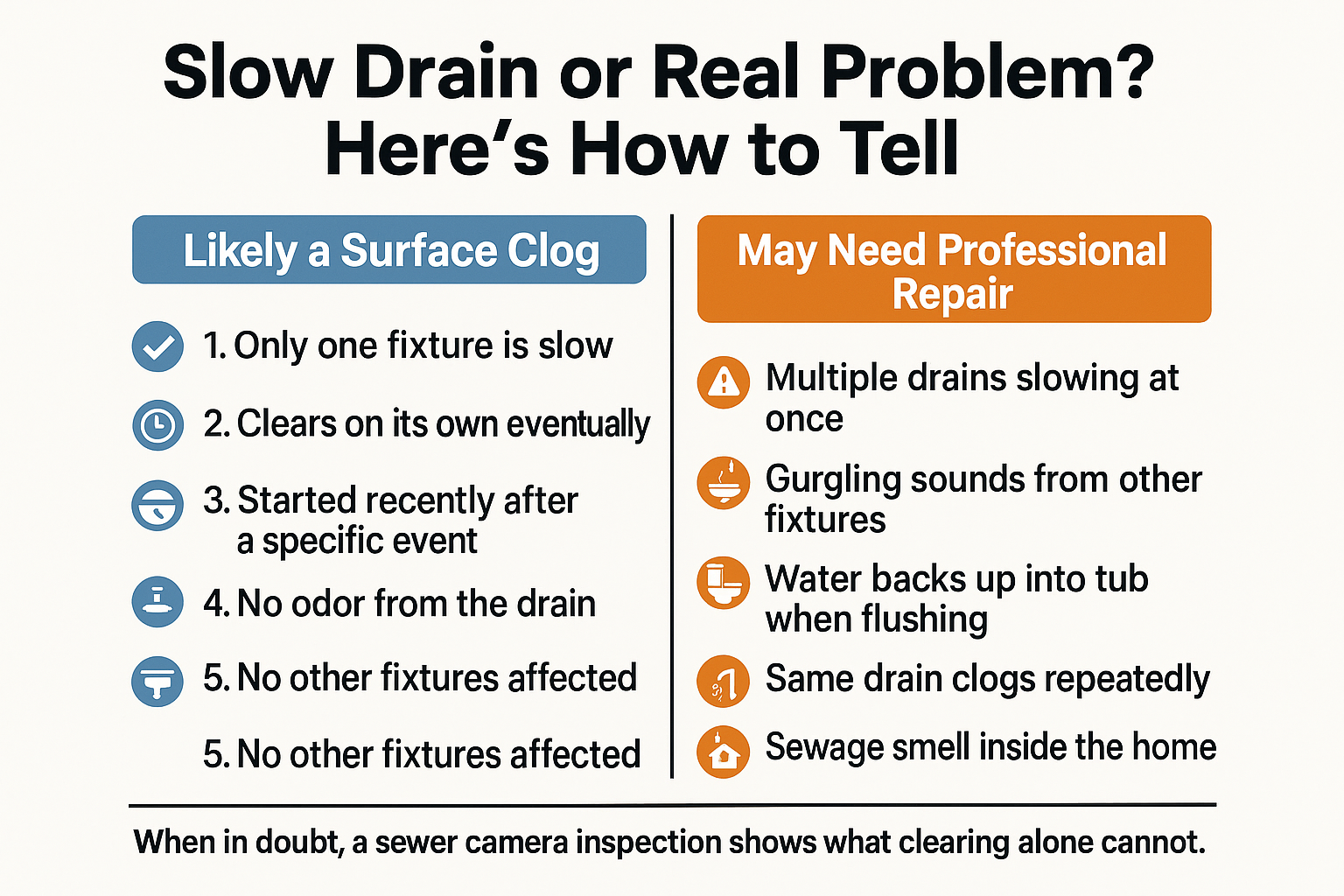
How to Read Your Drain Problem
This breakdown shows the key differences between a surface clog and a drain issue that needs professional repair.
Root Intrusion Is a Bigger Problem on the Central Coast Than Most People Expect
In older Watsonville neighborhoods and throughout much of Santa Cruz County, mature trees are everywhere — and their roots follow water. Clay sewer pipes that were standard in construction from the 1940s through the 1980s develop small cracks over time, and tree roots find those cracks.
Once roots are inside a pipe, they don’t stop. They grow, catch debris, and eventually block flow entirely. A slow drain caused by root intrusion will keep coming back no matter how many times it gets cleared — because the entry point is still there.
Root intrusion repair typically involves one or a combination of approaches:
- Hydro jetting to clear existing roots and buildup from inside the pipe
- Camera inspection to locate where and how badly roots have entered
- Sewer line repair or replacement if the pipe is cracked or collapsed enough that roots will simply return
The only way to know which situation you’re dealing with is to put a camera in the line. A visual inspection tells you whether you’re clearing a clog or addressing structural damage — and that distinction determines what kind of repair is actually needed.
Hard water throughout the Monterey Bay region also accelerates mineral scaling inside pipes over time, which compounds any blockage problem by narrowing the pipe’s interior diameter even before clogs form.
Slow Drain vs. Drain That Needs Repair: Quick Reference
Use this to compare what you’re seeing at home against patterns that typically indicate each type of problem.
| What You’re Seeing | Likely Surface Clog | May Need Repair |
|---|---|---|
| Only one fixture affected | Yes | Not typical |
| Multiple fixtures slow at once | Unlikely | Yes — mainline concern |
| Drain clears after waiting | Common | Sometimes, but returns quickly |
| Recurring clog in same drain | Possible | Strong indicator |
| Gurgling in other fixtures | No | Yes |
| Sewage odor inside home | No | Yes — immediate attention |
| Water backs up into tub at flush | No | Yes — mainline blockage likely |
| Problem started after storm or rain | Possible | Yes — root or ground shift concern |
What a Sewer Camera Inspection Actually Shows You
A lot of homeowners have never had a camera put in their sewer line — and most don’t think about it until something backs up. But a sewer camera inspection is one of the most straightforward diagnostic tools in plumbing, and it eliminates the guesswork entirely.
A licensed plumber feeds a small waterproof camera through the cleanout access point and into the main sewer line. The camera transmits live video so the technician can see exactly what’s inside — buildup, cracks, root intrusion, offset joints, or collapsed sections.
What it can identify:
- Root infiltration — where roots entered and how extensively they’ve spread
- Pipe offset or separation — joints that have shifted due to ground movement, which is relevant in seismically active areas like Santa Cruz County
- Grease or scale buildup concentrated in a specific section
- Pipe material condition — whether the pipe itself is failing or just dirty
- Collapse or bellying — low spots where waste pools instead of draining
If a camera inspection shows a clean line, you know the issue is upstream — at the fixture or in the branch drain. If it shows damage, you have a documented picture of exactly what needs to be addressed and where. Either way, you’re making decisions based on what’s real, not guesswork.
Frequently Asked Questions About Slow Drains and Drain Repair
Can I just use a store-bought drain cleaner to fix a slow drain?
For a hair clog near the surface of a shower drain, a basic drain cleaner or a small hand snake might clear it. But chemical drain cleaners do nothing for root intrusion, pipe damage, or blockages deep in the line — and repeated use of harsh chemicals can degrade older pipes over time. If the drain comes back slow within a few weeks, stop using chemicals and get someone to look at the pipe.
My toilet gurgles when I run the washing machine. Is that a slow drain problem or something bigger?
That’s almost always a mainline issue, not a simple clog. When one fixture displaces air through a completely separate fixture, it means something is restricting flow in the shared line. This warrants a professional inspection, not a store-bought fix.
How do I know if I have root intrusion in my sewer line?
The most common signs are recurring clogs in the same drain, slow drains that come back shortly after being cleared, and gurgling sounds in toilets or other fixtures. The only way to confirm root intrusion is a sewer camera inspection — roots aren’t visible from the outside and can’t be detected by clearing alone.
My home in Watsonville was built in the 1960s. Should I be worried about my sewer line?
Older homes in Watsonville and throughout Santa Cruz County were commonly built with clay or cast iron sewer pipes, both of which have a limited service life and are susceptible to cracking, root intrusion, and joint separation. That doesn’t mean the pipes are failing — but it does mean a proactive camera inspection makes sense before a problem develops, especially if you’ve never had one done.
Is hydro jetting the same as regular drain cleaning?
No. Standard drain cleaning uses a mechanical snake or auger to physically break through a blockage. Hydro jetting uses pressurized water — typically 3,000 to 4,000 PSI — to scour the interior walls of the pipe, clearing buildup that a snake can’t reach. It’s more thorough and is often the right choice when a pipe has significant scale, grease accumulation, or recurring root growth. It also requires a professional assessment first to confirm the pipe is structurally sound enough to handle the pressure.
Do I need a permit to repair a sewer line?
In most cases, yes — particularly for sewer line replacement or any work that involves opening the ground or connecting to the municipal sewer system. A licensed plumbing contractor familiar with Watsonville and Santa Cruz County requirements will handle permit coordination as part of the job. Always confirm your contractor holds an active CSLB license before any sewer work begins.
Not Sure What You’re Dealing With?
If your drain keeps coming back slow, or you’re seeing signs that point beyond a basic clog, the most useful thing you can do is get a camera in the line before the problem gets ahead of you. Maverick Plumbing Technicians, Inc. serves homeowners and property managers throughout Monterey County and Santa Cruz County — including Watsonville and the surrounding communities. We’re licensed (CSLB #1102966), insured, and available for both scheduled inspections and same-day emergency calls. Reach us directly at (831) 515-9903 or request service at maverickplumbingtechnicians.com.
