

Direct Answer: Warm spots on your floor, a water meter that won’t stop spinning, or unexplained wet flooring are the most reliable signs of a leak under your foundation.
Most slab leaks don’t announce themselves. There’s no gushing water, no burst pipe you can see. What you get instead is a warm patch on your kitchen floor, a water bill that went up for no reason, or the faint sound of water running when everything in the house is off. By the time the damage is obvious, the leak has usually been going on for weeks.
This is a real problem for homeowners in Monterey County. The soil conditions along the Central Coast — combined with older copper pipe systems in homes built in the 1960s through the 1990s — make slab leaks more common here than in many parts of California. Hard water is also widespread throughout Santa Cruz County and into Monterey County, and it accelerates the corrosion of pipes running beneath your foundation.
This article covers the signs that matter, what’s actually happening inside your slab when a leak starts, and what the professional detection process looks like. If you’re already seeing some of these warning signs, the right move is to stop guessing and get a proper inspection before the damage spreads.
The Warning Signs Homeowners Most Often Miss
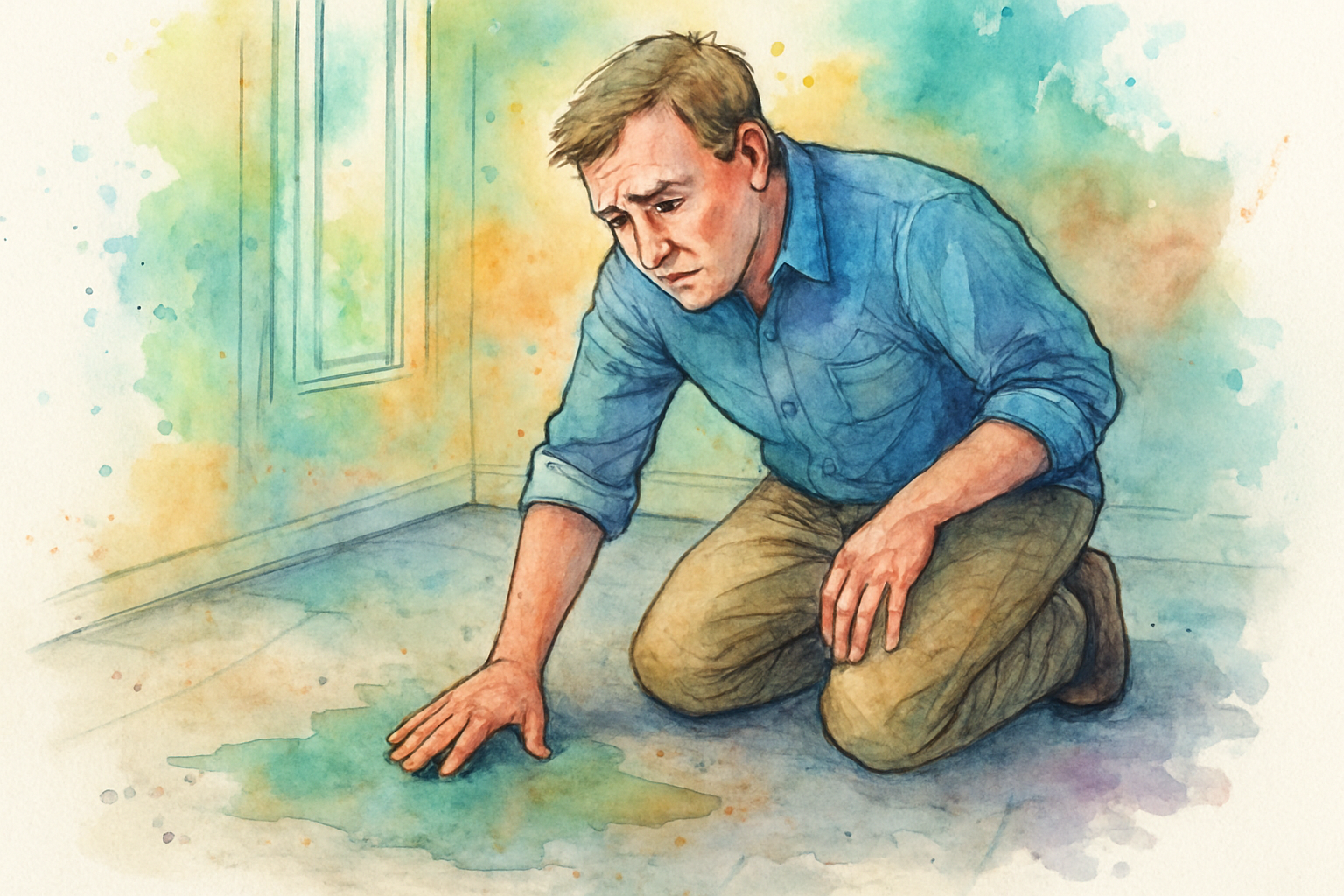
A slab leak happens when a water line running beneath your concrete foundation develops a crack, pinhole, or joint failure. The pipe keeps delivering pressure, and water slowly saturates the ground under your slab — or works its way up through the concrete itself.
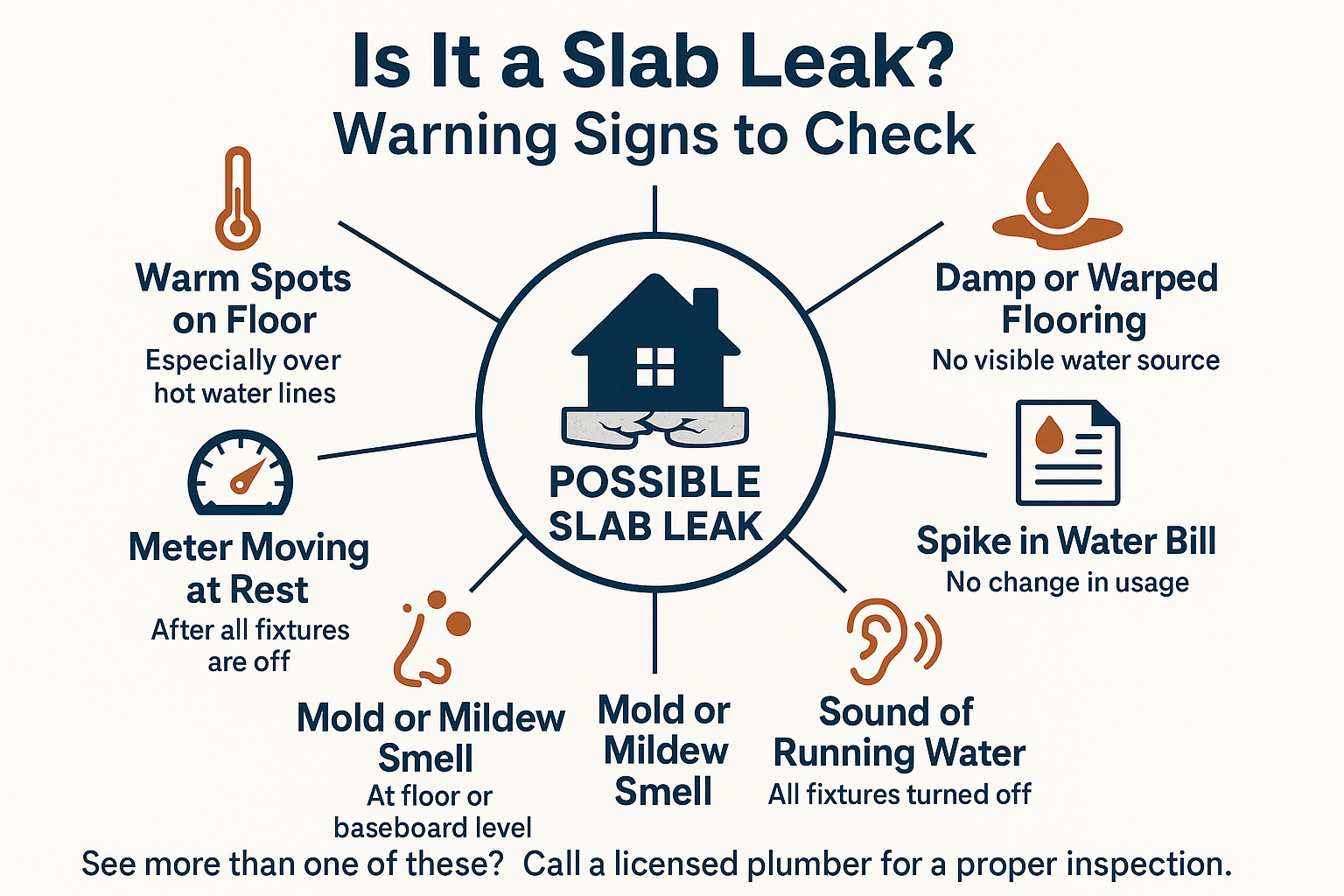
The signs that show up first are easy to brush off as something else:
- Warm or hot spots on the floor — usually over a hot water line that’s leaking
- Damp carpet or warped wood flooring with no visible source
- Water meter that continues to move even when every fixture is turned off
- A sudden, unexplained increase in your water bill
- Mold or mildew smell at floor level, especially near exterior walls or bathrooms
- The sound of running water inside a wall or under the floor with no fixtures on
The warm floor sign is particularly telling. If you’re walking barefoot and notice a section of tile or hardwood that’s noticeably warmer than the surrounding floor, that’s heat transferring up from a leaking hot water line below. It’s one of the clearest physical indicators short of visible water.
Many Watsonville and Salinas homeowners discover their slab leak only after they get a water bill that’s two or three times the normal amount. If that happens to you, the meter test below is a good first step before calling for service.
How to Do a Basic Water Meter Check at Home
You don’t need any tools to run this test. It takes about 30 minutes and gives you a real data point before you call anyone.
Here’s how it works:
1. Turn off every fixture, appliance, and water-using device in the house — including ice makers and irrigation.
2. Find your water meter, usually near the street or curb in front of the property.
3. Look at the meter dial or digital display and write down the exact reading.
4. Don’t use any water for 30 minutes.
5. Come back and check the reading again.
If the numbers moved — or if there’s a small red or blue leak indicator dial that’s spinning — water is leaving your system somewhere. That doesn’t automatically mean a slab leak. You could have a running toilet, a dripping hose bib, or a faulty irrigation valve. But combined with any of the floor or odor signs above, a moving meter at rest is a strong signal that something underground is involved.
If the meter is moving and you cannot identify any obvious source above ground, that’s the point to call a licensed plumber. The next step is professional leak detection — not more guesswork.
What Professional Leak Detection Actually Involves
There’s a common misconception that finding a slab leak means tearing up your floor to look for it. That’s not how professional detection works today.
A licensed plumber uses electronic listening equipment and pressure testing to locate the leak without opening the slab. The process typically involves:
- Acoustic detection — a ground microphone picks up the sound of water escaping under pressure beneath the concrete
- Pressure isolation testing — shutting down sections of the plumbing system to narrow down which line is losing pressure
- Thermal imaging — in some cases, a thermal camera identifies temperature variation in the slab caused by leaking hot water lines
The goal is to pinpoint the leak location as precisely as possible before any concrete is touched. A well-located leak might require opening only a small section of slab — sometimes less than a square foot. A poorly diagnosed one can mean unnecessary demolition and a much longer repair.
Maverick Plumbing uses slab leak detection as part of a broader approach to leak identification, including cases where the leak source isn’t immediately obvious. If you’re dealing with unexplained moisture or a suspicious water bill in Salinas, Watsonville, or elsewhere in Monterey County, a professional inspection is the only way to know for certain what’s happening under your floor.
Slab Leak Warning Signs at a Glance
This infographic summarizes the most common slab leak indicators so you can quickly assess what you’re seeing at home.
Why Slab Leaks Are Especially Common on the Central Coast
Homes built in Monterey County between 1960 and 1995 were commonly plumbed with copper pipe. Copper holds up well in many conditions, but the hard water common throughout this region is corrosive to copper over time. The dissolved minerals — primarily calcium and magnesium — gradually eat away at the pipe walls from the inside.
Below the slab, this process accelerates. Pipes in direct contact with alkaline soil face external corrosion on top of the internal mineral buildup. Movement in the soil — from seasonal moisture changes, tree roots, or minor seismic activity common to this part of California — adds physical stress to already-weakened joints and pipe walls.
The result is that a lot of 40- to 60-year-old homes in Watsonville, Santa Cruz, and surrounding communities are sitting on copper supply lines that are well past their useful lifespan. A single slab leak is often an early indicator that the rest of the system is in similar shape. That’s not always the case, but it’s worth discussing with a licensed plumber after any slab leak repair — because a second leak in a different location a year later is not unusual in older homes with corroded pipe.
If your home has already had slow or recurring drain problems, that’s another sign the overall plumbing system may be showing its age and worth a professional assessment.
Slab Leak Signs: What They Suggest and What to Do Next
Different warning signs point to different levels of urgency. Use this as a quick reference for what you’re seeing and what action makes sense.
| What You’re Seeing | What It May Indicate | Recommended Next Step |
|---|---|---|
| Warm patch on floor, no other signs | Hot water line leak, early stage | Run meter test; call plumber if meter moves |
| Moving water meter with all fixtures off | Active leak somewhere in the system | Identify above-ground sources first; if none found, call for leak detection |
| Damp carpet or warped floors near slab | Water wicking up through concrete | Call a licensed plumber — damage is already occurring |
| Mold smell at floor level, no visible moisture | Moisture accumulating below surface | Professional inspection needed — mold indicates ongoing saturation |
| Water bill spike + one physical sign | High probability of active slab leak | Schedule professional leak detection promptly |
| Multiple signs present simultaneously | Significant slab leak in progress | Call immediately — further delay increases structural and mold risk |
What Happens If You Wait
A slab leak left alone doesn’t stabilize — it gets worse. The water that’s escaping under your foundation keeps saturating the soil, which can cause settlement or shifting in the slab itself. In severe cases, that movement cracks interior walls and door frames.
Inside the home, the moisture that wicks up through concrete creates ideal conditions for mold growth under flooring, inside wall cavities, and along baseboards. Mold remediation in a Monterey County home is a separate and significant undertaking on top of the actual plumbing repair.
The other risk is structural damage to the concrete slab itself. A small, contained leak repair is a manageable job. A leak that’s been running for six months — with saturated soil, shifted concrete, and mold throughout the subfloor — is a much longer and more involved repair for everyone involved. Catching these early is almost always the better outcome.
Frequently Asked Questions About Slab Leaks
Can I have a slab leak if my floors look completely dry?
Yes. A lot of slab leaks run for weeks before any moisture reaches the surface. The water may be saturating the soil beneath the slab or draining laterally without ever wicking upward. A moving water meter is often the only indicator in the early stages, which is why the meter test is worth doing even if your floors look fine.
How does a plumber find the leak without tearing up my floor?
Using acoustic listening equipment, a plumber can hear the sound of pressurized water escaping beneath the concrete. Combined with pressure isolation testing — which narrows down which section of pipe is losing pressure — the leak can usually be located to within a foot or two. Thermal imaging is sometimes used for hot water line leaks. The concrete doesn’t get opened until the location is already confirmed.
Is a slab leak the same as a foundation leak?
Not exactly. A slab leak refers specifically to a water or drain line that’s leaking beneath a concrete slab foundation. A foundation leak more broadly refers to water intrusion through foundation walls or floors, which can have other causes. If a plumber confirms there’s no active pipe leak, water intrusion through the foundation itself may involve a different type of contractor.
My house is in Salinas and was built in 1978. Am I at higher risk?
Homes from that era commonly used copper supply lines, which are now 45+ years old. Combined with the mineral-rich water throughout Monterey County, corrosion on pipes that age is normal — not a sign that the house was built poorly. It just means the original plumbing has had a long life and may be approaching the end of it. A professional inspection after any leak event is a reasonable precaution.
Should I turn off my water if I think I have a slab leak?
If the water meter is moving with everything off and you’ve confirmed no above-ground source, shutting off the main supply stops additional water from entering the leak. That’s a reasonable precaution while you wait for a plumber. Your main shut-off is typically located near the meter at the street or at the point where the supply line enters the house.
What if the leak turns out to be in the sewer line under the slab, not the water supply?
Sewer line leaks under slabs are less obvious because there’s no pressurized water running continuously. Signs include soft or settling ground near the slab edge, sewage odors inside the home, or recurring drainage backups that don’t have a clear cause. A sewer camera inspection can identify a broken or offset drain line beneath the slab without any excavation. It’s a different problem than a water supply leak, but the detection process has the same goal — find it precisely before opening anything up.
Think You Might Have a Slab Leak in Monterey County?
If you’re seeing warm spots on the floor, a water bill that doesn’t add up, or a meter that won’t stop moving, the right call is a professional inspection — not more waiting. Maverick Plumbing Technicians, Inc. is a licensed and insured plumbing contractor (CSLB #1102966) serving Watsonville, Santa Cruz, Salinas, and surrounding areas throughout Monterey and Santa Cruz counties. Call us at (831) 515-9903 or visit maverickplumbingtechnicians.com to request service.
