
Direct Answer: A backflow preventer stops irrigation water from being pulled back into your drinking supply. It can fail with no warning, which is why most water authorities require a certified annual test.
There is a brass fitting sticking out of the ground near your irrigation valves. Most homeowners in Watsonville walk past it every week and have never once thought about it.
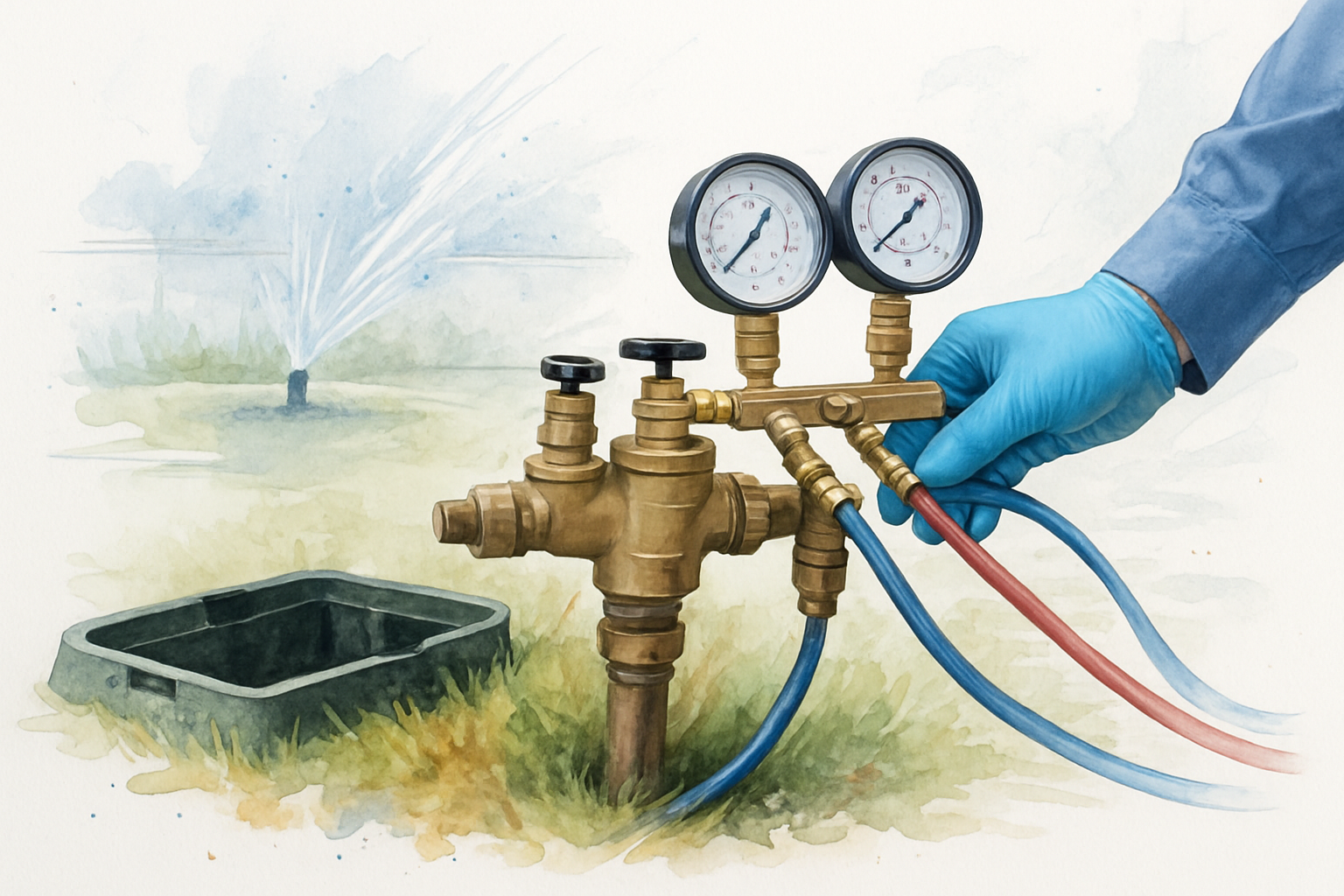
That device is a backflow preventer, and its whole job is to keep sprinkler water, fertilizer, and whatever else is sitting in your irrigation lines from getting pulled backward into the water you drink. When it works, you never notice it. When it stops working, you also never notice it, and that is the problem.
I get calls about this most often after someone opens mail from their water authority asking for a test report. Below I will explain what the device actually does, why one that looks fine can still fail a test, and what a certified test involves from start to finish.
What a backflow preventer actually stops
Your home’s water lines are pressurized. That pressure is the only thing keeping water moving in one direction, out of the meter and into your house and yard.
When that pressure drops or reverses, water can travel the wrong way. A pressure reversal happens more often than people think, usually from something ordinary:
- A water main break down the street
- Fire hydrant use during a structure fire or hydrant flushing
- A large pump or well kicking on nearby
- Utility work on the distribution line
For a few seconds or a few minutes, the system pulls instead of pushes. Anything sitting in your irrigation lines can get drawn back toward the clean supply.
That is not hypothetical water. Irrigation lines hold standing water that has been sitting in a hot valve box, water that has run past soil, animal waste, and in many Watsonville properties, water near land where fertilizer and crop treatments are applied. The agricultural footprint around much of Watsonville’s residential edge is exactly why California treats irrigation connections as a cross-connection risk. The State Water Resources Control Board’s cross-connection control program sets the framework local water suppliers follow.
Why a device that looks fine can still fail
This is the part that surprises homeowners. A backflow preventer is not a solid block of brass that either exists or does not. Inside there are check valves, springs, rubber seats, and a relief valve, and those parts wear.
Hard water is common throughout Santa Cruz County and into Monterey County, and mineral scale builds up on the sealing surfaces over time. Grit from the line, sun exposure, and years of thermal cycling do the rest.
What fails, and why you cannot see it:
- Rubber seats harden or get scored, so the check valve no longer seals tight
- Springs weaken, so the valve does not close fast enough during a reversal
- Debris lodges under a seat, holding it open a fraction of an inch
- The relief valve sticks, so it will not dump water when it should
Every one of those failures happens inside a sealed brass body. The outside still looks clean. Nothing leaks, no light comes on, and your sprinklers run exactly the same as they did last year.
A device that is installed but no longer sealing gives you zero protection. The only way to know is to put a gauge on it and measure.
Looking at it versus testing it
People sometimes tell me their landscaper checked the backflow. Here is the difference between a look and a certified test.
| What gets checked | Visual look-over | Certified annual test |
|---|---|---|
| Device is present and installed in the right orientation | Yes | Yes |
| Visible corrosion, cracks, or a dripping relief valve | Yes | Yes |
| Whether each check valve holds under measured pressure | No | Yes |
| Whether the relief valve opens at the correct differential | No | Yes |
| Condition of internal seats and springs | No | Identified through test results |
| Signed report filed with the water authority | No | Yes |
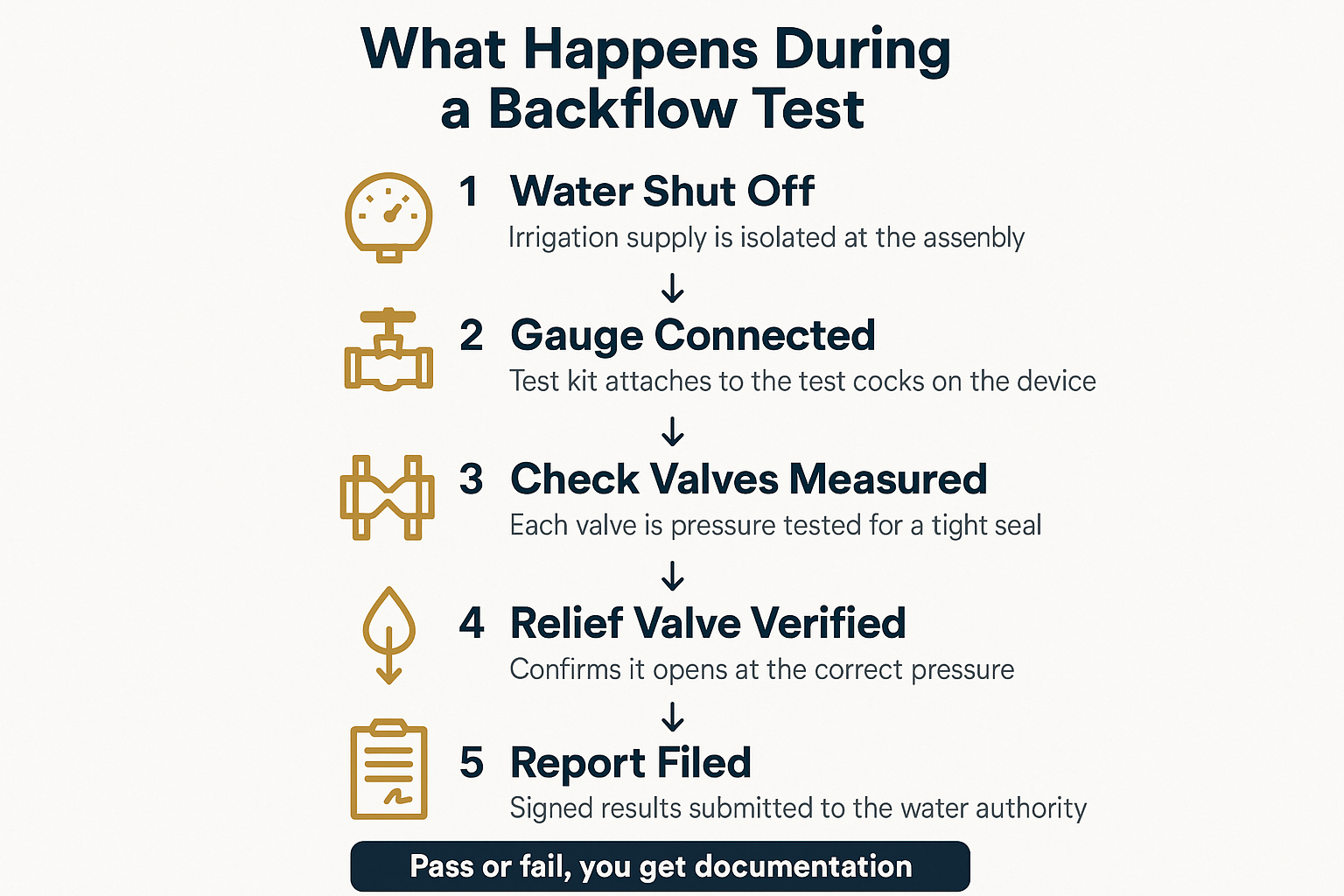
What a backflow test actually involves
The test itself is short. Most residential assemblies take well under an hour from setup to paperwork.
You got a testing notice. What that letter means
A notice from your water supplier is not a sales letter and it is not optional. It means your address is on file as having a cross-connection, usually an irrigation system, a well, a fire line, or a commercial process line.
The notice typically gives you a deadline and asks for a test performed by a certified tester, with results submitted directly to the water authority. Many jurisdictions require this annually.
Here is what to expect from a compliant test:
- Your irrigation water is off briefly during the test
- The tester records readings for each check valve and the relief valve
- If the assembly passes, a signed report goes to the water authority and you keep a copy
- If it fails, you get the specific reason, whether a rebuild or a replacement is the right call, and a retest after the repair
Keep your copy. Property managers especially should file these, because when a unit changes hands or a water authority audits records, that report is the proof the device was verified on a given date.
California’s cross-connection rules were clarified in recent code updates, with more attention on multi-unit and mixed-use buildings. If you manage an apartment property, a restaurant, or a retail space with irrigation or chemical lines, it is worth confirming which assemblies on your property are on the water authority’s list.
Who can legally do the test
A general handyman or a landscaper cannot file a test report. The work has to be done by someone certified to test backflow assemblies, and in California the plumbing repair side of it belongs to a licensed plumbing contractor.
When you are checking who to call, two things matter:
- An active CSLB license you can verify yourself online
- Certification to test the specific assembly type on your property
Maverick Plumbing holds CSLB license #1102966 and handles backflow preventer installation, replacement, and testing along with the compliance paperwork that follows. The point is not who you call. The point is that a visual once-over and a filed test report are two entirely different things, and only one of them satisfies the notice sitting on your counter.
Frequently Asked Questions About Backflow Preventer Testing
How do I know if I even have a backflow preventer?
Look near where your irrigation line branches off the main supply, often close to the meter, a hose bib, or the valve boxes. You are looking for a brass or bronze body with two shut-off valves and several small test ports sticking out of it. If your home has an in-ground sprinkler system installed under modern code, there is almost certainly one.
How often does it need to be tested?
Many California water suppliers require annual testing, and some require it more often on higher-risk commercial connections. Your notice will state the schedule your specific water authority uses.
Can I test it myself?
No. The test requires a calibrated differential pressure gauge kit and a certified tester’s signature for the report to be accepted. Opening the test cocks without knowing what you are doing can also flood the box or damage the internals.
What happens if I just ignore the notice?
Water suppliers have the authority to escalate, and the usual path is a follow-up notice, then a possible penalty or service interruption on the connection. Ignoring it also leaves your drinking water unprotected during the exact pressure event the device exists for.
If it fails, do I need a whole new device?
Not always. Many failures come down to worn rubber seats, a weak spring, or debris under a check valve, and a rebuild kit for that make and model handles it. Replacement makes more sense when the body is corroded, the assembly is obsolete, or it was installed in a spot that does not meet current code.
Does anything else in my house need a backflow preventer?
Possibly. Boilers, fire sprinkler lines, water treatment equipment, and commercial kitchen connections can all be cross-connection points. On residential properties, irrigation is by far the most common one, but a water authority letter will name the specific connection they have on file.
Not sure when your backflow assembly was last tested?
If you have an irrigation system in Watsonville, Santa Cruz, or anywhere in our Monterey County service area and you cannot remember the last test date, it is worth finding out before the water authority asks. We are a licensed and insured plumbing contractor with 24/7 emergency service available, and testing questions are a normal part of what we field. Call (831) 515-9903 or request service at maverickplumbingtechnicians.com when you want a straight answer.
