
Direct Answer: SB 342 takes effect January 1, 2027. On commercial, institutional, public works, common interest, and four-or-more-unit multifamily projects, a contractor who lapses mid job repays only the compensation earned while unlicensed.
If you own a commercial building in Monterey County, run a restaurant space, or manage an apartment complex with four or more units, there is a change to California contractor law you should know about before your next project starts.
Right now, if a contractor’s license lapses at any point during a job, California law has let the project owner claw back every dollar paid, even for the work done while the license was active. That changes on January 1, 2027.
My position on this is simple. Most owners treat the license check as a one-time box at signing, and starting January 1 that is not enough on covered projects. You should verify at signing and again during a long job, because the safety net you used to have is getting a lot smaller.
What SB 342 changes about a contractor license lapse in California in 2027
Governor Newsom signed SB 342 (Umberg) on September 30, 2026, Chapter 967, Statutes of 2026. It amends Business and Professions Code section 7031, the statute that has made temporary license lapses so painful for contractors and so useful for owners in a dispute.
The old rule is all or nothing. A gap in licensure at any point, even a short administrative one, could wipe out a contractor’s right to be paid for the entire project.
The new rule ties the penalty to the gap itself. On covered projects, a contractor who was licensed at contract execution may recover for work performed while licensed, and must disgorge only the compensation for work performed while unlicensed.
The law takes effect January 1, 2027. Firms that follow California construction law, including Jones Day, Finch, Thornton & Baird, and Glassberg Pollak, have all flagged the same practical takeaway: anyone whose strategy relied on full disgorgement needs to rethink it.
And for building owners along the Monterey Bay, that is the part worth sitting with. The leverage shifts.

Who this covers, and who it leaves alone
This is where owners and property managers get tripped up, because the new rule does not apply across the board. The amendments apply to:
- Public works projects
- Commercial and institutional construction
- Construction of common interest developments
- Construction of multifamily residential projects consisting of four or more units
Single-family homes, duplexes, triplexes, and other residential projects under four units stay under the existing all-or-nothing disgorgement rule.
So a homeowner off Carmel Valley Road replacing a galvanized supply line keeps the stronger remedy. The HOA board for a common interest development in Marina, or the owner of a strip retail building in Salinas, does not.
That split matters more than it sounds. Most of the plumbing work that runs long enough for a license to lapse mid job is exactly the commercial and multifamily work the new law covers: tenant improvement build-outs, whole-building repipes, sewer main line replacements, and phased work across a property management portfolio.
Project type and which rule applies
Here is the short version of who sits on which side of the line starting January 1, 2027.
| Project type | Before January 1, 2027 | Starting January 1, 2027 |
|---|---|---|
| Single-family home, 1 to 3 units | All-or-nothing disgorgement | No change, all-or-nothing disgorgement |
| Commercial and institutional construction | All-or-nothing disgorgement | Disgorge only compensation for unlicensed-period work |
| Multifamily residential, 4 or more units | All-or-nothing disgorgement | Disgorge only compensation for unlicensed-period work |
| Common interest developments | All-or-nothing disgorgement | Disgorge only compensation for unlicensed-period work |
| Public works | All-or-nothing disgorgement | Disgorge only compensation for unlicensed-period work |
How to check a contractor’s license before you sign
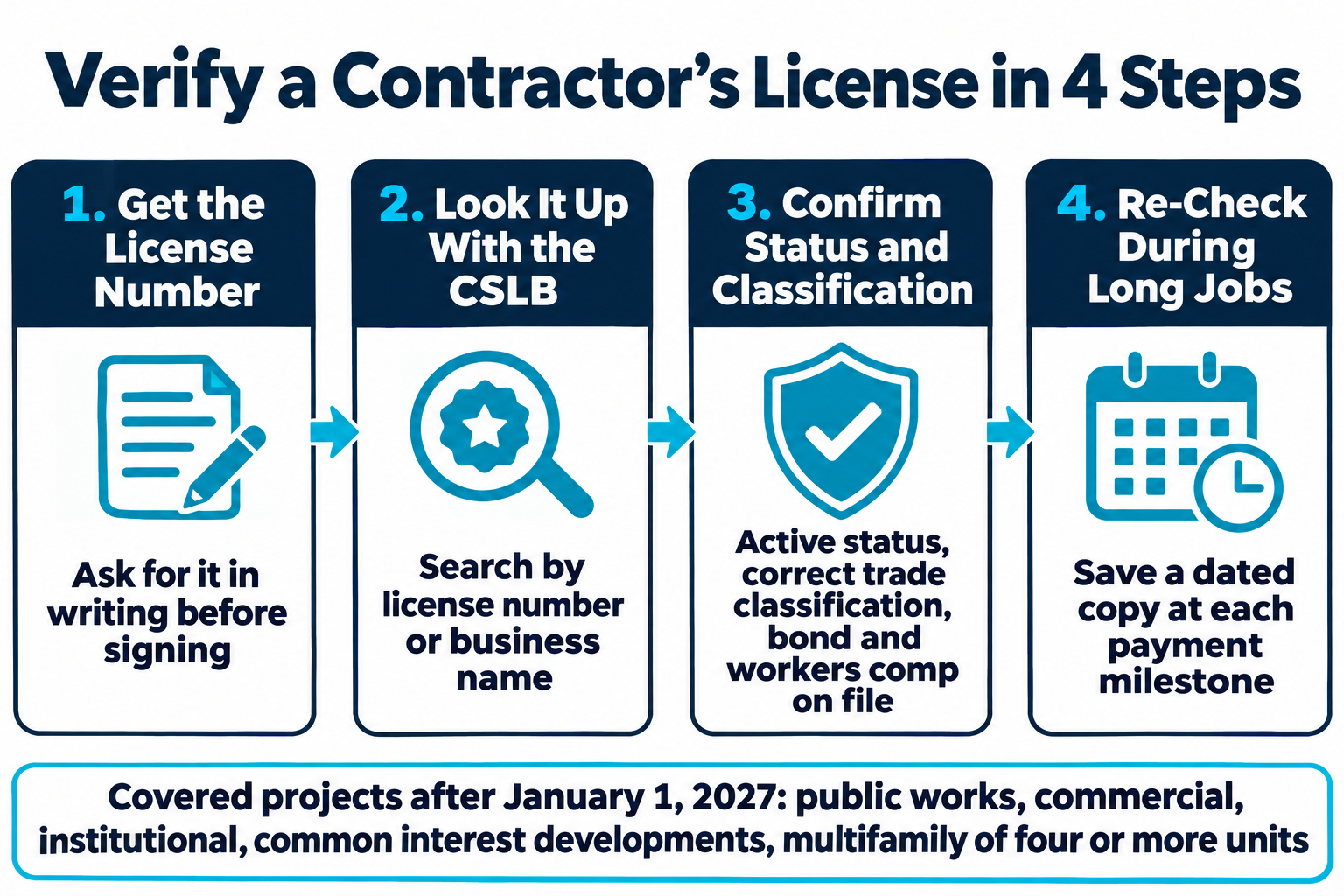
This takes about two minutes, and on a covered project it is now the step doing most of the protective work.
What I would actually do if I managed a commercial property here
License lapses are rarely dramatic. They happen because a bond renewal got missed, a workers comp policy hit a gap, or a qualifying individual left the company and nobody filed the paperwork in time. The contractor often does not know until a notice shows up.
So build the check into your process instead of your memory:
- Get the license number in writing before the contract is signed, not after the first invoice
- Verify active status at signing through the Contractors State License Board, and save a dated screenshot with the contract file
- Re-verify at each payment milestone on any job running more than a few weeks
- Confirm the classification matches the work, since plumbing work falls under C-36
- Ask about the bond and workers comp status directly, because those are the usual causes of a lapse
We run a Class C-36 plumbing license, CSLB #1102966, and I have never once had an owner lose anything by asking to see it. If a contractor gets prickly about that question, that is information too.
If you want the step-by-step, I wrote one up already: checking a Santa Cruz plumber’s license takes two minutes.
Why this hits plumbing work harder than you would expect
Think about which jobs stretch out long enough for a license to lapse in the middle. On the commercial side around Monterey Bay, it is almost always plumbing or underground work.
A restaurant tenant improvement in Watsonville or Seaside can run weeks between slab trenching, grease interceptor work, and final fixture set. A whole-building repipe at a motel or a multifamily property is phased by unit. Sewer main line replacement depends on permits, inspections, and sometimes a county encroachment approval.
Those are the contracts where a short administrative gap is most likely to land somewhere in the middle. They are also, in my experience, the jobs where owners are least likely to re-check anything after the first signature.
Permits are a related piece of the same paper trail. If you are not sure which jobs on your property require one, which plumbing jobs in Santa Cruz County need a permit covers the common ones.
And there is a reason commercial failures carry more weight than a home repair does. I get into that in plumbing problems in a business hit differently than at home.
Frequently Asked Questions About SB 342 and Contractor License Lapses
Does SB 342 mean an unlicensed contractor can now get paid in California?
No. The relief applies to a contractor who was licensed at contract execution and later had a gap. On covered projects, that contractor can recover for work performed while licensed and must disgorge compensation for work performed while unlicensed. Someone who was never licensed is in a different position entirely.
I own a fourplex in Monterey County. Which rule applies to me?
Multifamily residential projects consisting of four or more units are covered by the amendments, so a fourplex falls on the new side of the line. A duplex or triplex stays under the existing all-or-nothing disgorgement rule.
What should I keep in my file to protect myself?
A dated copy of the license lookup at signing, the signed contract, and another dated lookup at each major payment milestone. On a multi-week job, that record is what tells you exactly when a gap started and which work falls inside it.
Does this change anything about permits or inspections?
No. SB 342 deals with payment and disgorgement under Business and Professions Code section 7031. Permit requirements, code compliance, and inspections through your city or county building department are unchanged.
Is January 1, 2027 the date I need to worry about, or September 30, 2026?
September 30, 2026 is when the bill was signed. January 1, 2027 is when it takes effect, and that is the date to plan around for contracts you are signing now.
Planning commercial or multifamily plumbing work before January 1?
If you are lining up a tenant improvement, a repipe, or sewer main line work on a commercial or multifamily property in Santa Cruz or Monterey County, it is a good time to get the license, scope, and schedule sorted before the contract is signed. We are a licensed and insured plumbing contractor, CSLB #1102966, with service available 24 hours a day. You can reach us at (831) 515-9903 or through maverickplumbingtechnicians.com if you want to talk through a project.
