

Direct Answer: An undetected slab leak quietly erodes your foundation, warps flooring, promotes mold growth, and drives up your water bill — often for months before most homeowners notice anything obvious.
A slab leak is a water line break that happens beneath the concrete foundation your home sits on. Because the pipe is buried under several inches of concrete, water has nowhere obvious to go — so it spreads outward and upward, silently, for weeks or months before most homeowners see any sign of it.
In Monterey County, the combination of older housing stock, coastal soil movement, and mineral-heavy water speeds up pipe corrosion faster than many homeowners expect. A small pinhole in a copper line under a Watsonville home can go unnoticed long enough to cause damage that dwarfs the cost of fixing the pipe itself.
This article focuses on the damage that actually happens when a slab leak is left alone — not the leak itself, but what comes after. If you’re trying to figure out whether you have one in the first place, How Do You Know If the Leak Is Under Your Foundation? covers the warning signs in detail.
The First Thing That Fails: Your Flooring
Water under a slab doesn’t stay there. It migrates upward through the concrete and attacks whatever flooring sits on top of it.
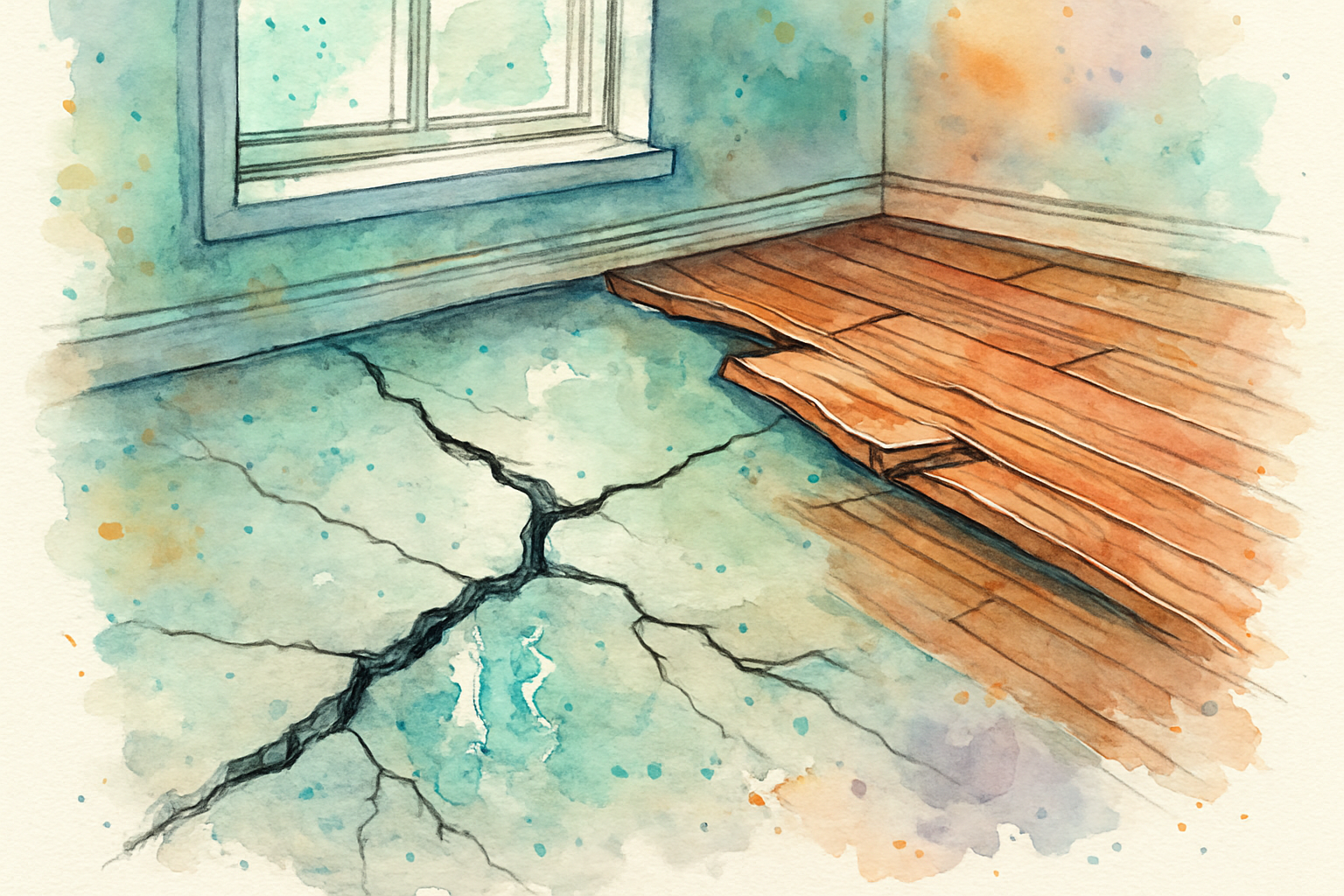
Hardwood and engineered wood floors are usually the first visible casualty. They buckle, cup, and warp — sometimes within just a few weeks of a moderate leak. Once wood absorbs that much moisture, it rarely goes back to its original shape. Replacement is almost always necessary.
Tile floors hide the problem longer, but they aren’t immune. The grout cracks first, then the adhesive bond beneath the tile breaks down. You’ll notice tiles that feel loose or hollow when you walk on them. By the time multiple tiles are shifting, the moisture has usually spread well beyond the visible damage area.
Carpet acts like a sponge. It holds moisture against the subfloor, accelerating rot and creating the damp, musty smell that homeowners often chalk up to general humidity — especially in a coastal area like Santa Cruz County where that smell doesn’t always raise alarm bells immediately.
The longer a slab leak runs, the larger the moisture footprint under the floor becomes. What starts as a wet spot under a single room can spread to an adjacent hallway, bathroom, or living area before anyone notices.
Mold Gets in Faster Than You’d Think
Mold doesn’t need much. It needs moisture, a surface to grow on, and 48 to 72 hours — and it has all three when a slab leak is running under your home.
The moisture wicks into the subfloor, then into wall framing at the base of interior walls, then into drywall. Mold colonies establish in the dark, enclosed spaces between your floor and the concrete before they ever show up on a surface you can see. By the time you spot black or gray discoloration on a baseboard or wall, the problem behind that wall is almost always larger.
This is particularly relevant for homes in older Watsonville neighborhoods where wall framing and subfloor materials are decades old and more porous than modern alternatives. Older wood absorbs moisture faster and provides a more hospitable environment for mold than engineered lumber.
The practical consequence is that remediating a mold problem — not just fixing the pipe, but treating the affected structure — adds significant scope to the repair. A leak that might have been a straightforward plumbing fix at week two becomes a construction-level project at month three.
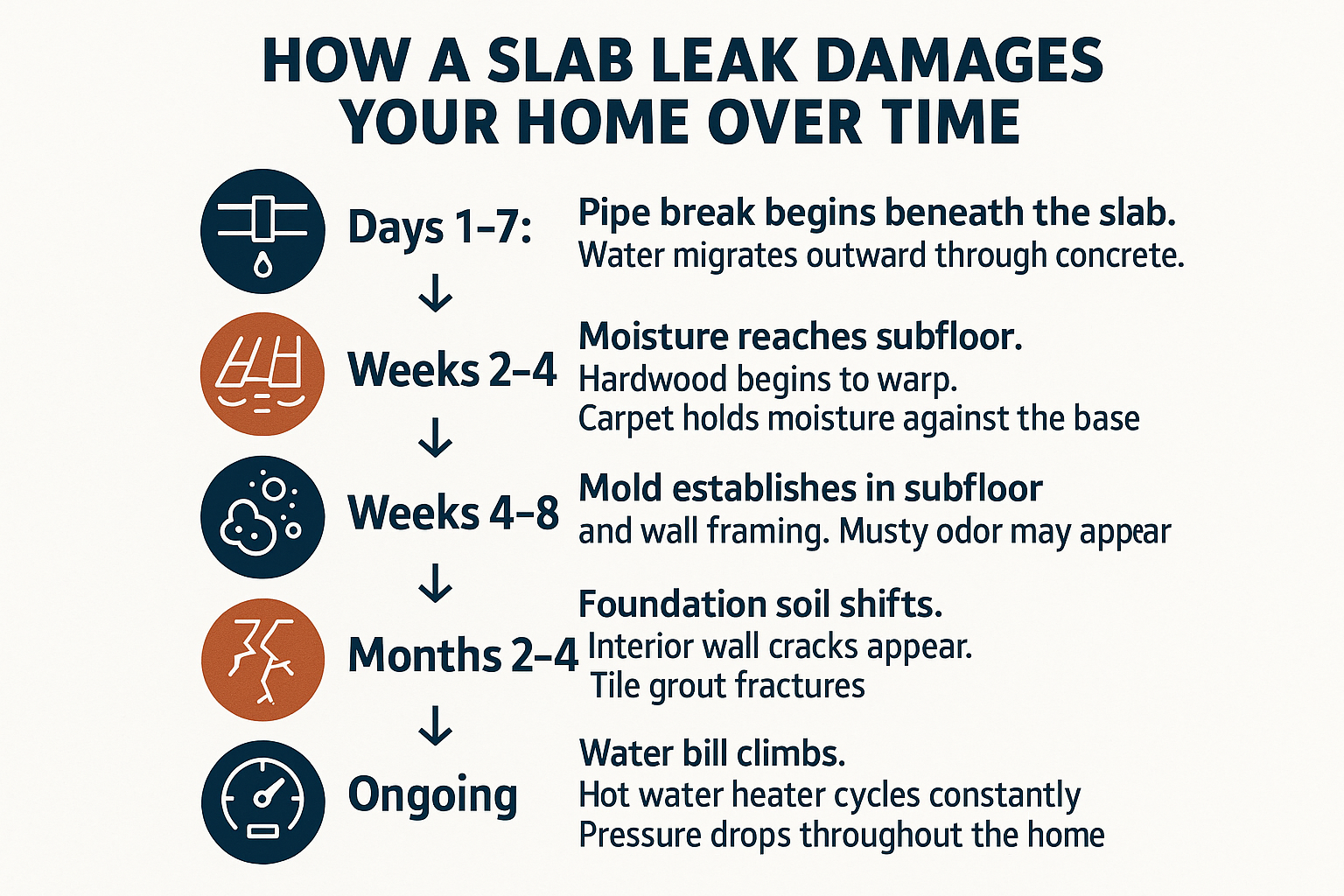
How a Slab Leak Damages a Home Over Time
This timeline shows how undetected slab leak damage compounds the longer it goes without repair.
What It Does to the Foundation Itself
Concrete feels permanent, but the soil beneath it isn’t. When water saturates the ground under a slab, it changes the density and stability of that soil — and the foundation moves with it.
In Monterey County, many residential properties sit on expansive clay-heavy soils that swell when wet and shrink when dry. A slow, continuous leak keeps that soil in a constant state of saturation, which creates uneven pressure on the slab from below. The result shows up as:
- Cracks in interior drywall, especially at door and window corners
- Doors or windows that stick or no longer close properly
- Visible cracks in the concrete floor itself, sometimes with slight vertical displacement
- Separation between walls and ceiling or floor trim
None of these signs appear overnight. But when they do appear, they often get attributed to general settling — which is why slab leaks go undiagnosed for as long as they do. The home looks like it’s just aging. It’s actually being slowly undermined by water pressure from below.
Slab repairs and foundation stabilization work, if it gets to that stage, are far more involved than plumbing repairs alone. Getting a licensed plumber involved early — before the structural symptoms show up — is almost always the better outcome for the homeowner.
Slab Leak Damage: What Gets Affected and When
The scope of a slab leak repair depends heavily on how long it’s been running. This table shows the typical progression from early to late discovery.
| Timeframe | What’s Typically Affected | Repair Scope |
|---|---|---|
| Days to 2 weeks | Subfloor moisture, early flooring saturation | Pipe repair, drying, possible flooring section replacement |
| 2–6 weeks | Flooring warping, early mold in subfloor cavity | Pipe repair, flooring replacement, mold treatment |
| 6 weeks – 3 months | Mold in wall framing, tile adhesive failure, rising humidity throughout home | Pipe repair, structural drying, mold remediation, drywall and flooring work |
| 3+ months | Foundation soil shift, wall cracking, potential structural movement | Plumbing repair plus possible foundation stabilization and full interior restoration |
Your Water Bill and Water Heater Are Telling You Something
Long before walls crack or floors buckle, two things in your home will signal that something is wrong: your monthly water bill and your water heater.
A slab leak on a hot water line — which is common, because hot water accelerates copper pipe corrosion — means your water heater is working constantly to keep up with the lost water. You’ll notice the water heater cycling more often. In some cases, you’ll run out of hot water during normal use when you never had that problem before.
On the billing side, water loss from a slab leak doesn’t taper off. It’s continuous. A homeowner who suddenly sees their water usage jump with no obvious explanation — no new appliances, no irrigation changes, no known leaks — should treat that as a real signal, not a billing error.
For properties in Watsonville and the broader Santa Cruz County service area, the local water utilities track usage month-over-month. A sudden spike without a clear reason is worth investigating before assuming it will resolve on its own.
Frequently Asked Questions About Slab Leaks
Can a slab leak fix itself if I just wait?
No. Water line breaks don’t seal on their own. The pipe will continue releasing water until it’s repaired. Every day it runs, the damage footprint underneath your floor gets larger.
How do plumbers actually fix a slab leak without breaking up the whole floor?
There are a few methods depending on where the break is and how the pipe is routed. One option is direct access — cutting through the concrete above the break, making the repair, and patching the slab. Another option, used when the pipe is too difficult to access directly, is rerouting — running a new line through the wall or ceiling instead of under the slab entirely. A licensed plumber will assess which method makes sense based on your home’s layout and pipe condition. If corrosion is widespread, a full repiping evaluation may be more practical than repeated spot repairs.
My floor feels warm in one spot. Is that a slab leak?
A warm or hot spot on the floor is one of the more reliable early signs of a slab leak on a hot water line. It doesn’t confirm it definitively, but it warrants a professional inspection. Don’t ignore it.
Can I use my home’s water while waiting for a plumber?
If the leak is active and you’ve identified it, the safest move is to shut off the main water supply to stop further damage until repairs can be made. If you’re not sure whether the leak is active, a plumber can run a pressure test to confirm. You can learn more about the signs that point to a foundation leak here.
My drain has been slow in the same area. Could that be connected?
Slow drains are a separate issue from slab leaks — one involves your supply lines, the other your drain lines. But if you’re noticing multiple plumbing symptoms in the same area of the house, it’s worth getting both evaluated at the same time. The Difference Between a Slow Drain and a Drain That Actually Needs Repair explains how to tell what kind of drain problem you’re actually dealing with.
How does hard water make slab leaks more likely?
Hard water — which is prevalent throughout Santa Cruz County and much of the Central Coast — accelerates mineral buildup inside copper pipes. Over years, that scale creates weak points in the pipe wall that eventually fail. Homes with older copper plumbing and no water softening in place are at higher risk for this type of failure.
Suspect a Slab Leak in Your Monterey County Home?
If you’re seeing warm spots on the floor, unexplained water bill increases, or early signs of moisture damage — don’t wait to find out how far it’s spread. Maverick Plumbing Technicians, Inc. serves Watsonville, Santa Cruz, and the surrounding Monterey County area with licensed leak detection and slab leak repair. Call us at (831) 515-9903 or request service at maverickplumbingtechnicians.com.
