Direct Answer: Watsonville’s hard water leaves mineral scale inside pipes, which narrows the passage for grease and debris. That buildup is why drains here slow down and clog faster than homeowners expect.
Most homeowners in Watsonville assume a slow drain is just a slow drain — a minor annoyance that’ll work itself out or maybe need a bottle of drain cleaner. But there’s a local reason that drains here fail faster than they would in other parts of the state, and it has nothing to do with how careful you are with what goes down them.
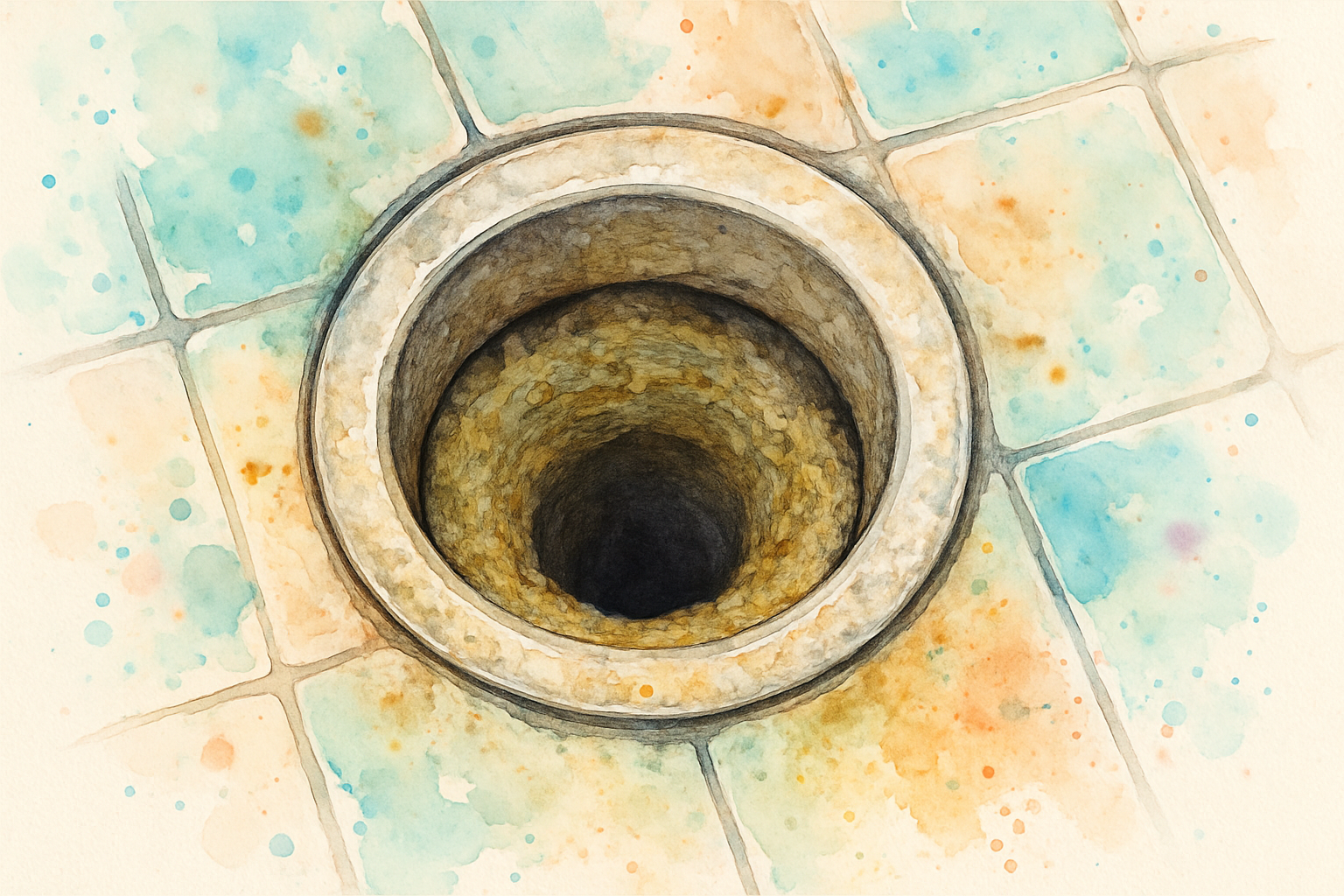
Santa Cruz County has hard water. That’s not a scare tactic — it’s a measurable water quality fact. Hard water carries dissolved minerals, primarily calcium and magnesium, that gradually coat the inside of pipes. Over time, that mineral scale narrows the pipe’s interior diameter, which leaves less room for grease, soap residue, and debris to pass before a partial clog forms.
That’s the setup. And once a pipe is scaled down, it doesn’t take much to push a slow drain into a full backup. This article walks through why that happens, what progressive drain failure actually looks like before the flood, and what the difference is between a drain that needs cleaning and one that needs something more.
The Real Reason Watsonville Drains Slow Down
Mineral scale is the part most homeowners never see. It builds slowly — a thin film after a few years, a meaningful restriction after a decade or more. By the time a drain is running noticeably slow, the pipe interior has often been narrowing for years.
That narrowing changes how everything else behaves. Grease that might have washed through a full-diameter pipe now sticks to the mineral layer. Soap residue accumulates on top of that. Hair and food particles catch on the buildup instead of flowing through. The result is a clog that forms much faster than it would in a clean pipe — and one that keeps coming back after a basic cleaning because the underlying scale is still there.
Older homes in Watsonville see this more often because many were built with galvanized steel or cast iron drain lines, both of which are more prone to interior corrosion and scale accumulation than modern PVC. If your home was built before the 1980s and you’re dealing with recurring drain problems, the pipe material itself may be part of the equation.
This is also why the same drain keeps backing up after repeated cleaning — punching through a clog doesn’t address what the pipe walls look like underneath.
How a Drain Fails — Stage by Stage
Drains rarely fail all at once. What actually happens is a slow progression that most homeowners tolerate for months or years before a single event forces the issue.
A caller from Aptos described a situation that plays out frequently in this area: the washing machine had been draining slowly for a while, and it seemed manageable. Then one full wash cycle sent enough water volume through the line that the partial clog couldn’t keep up — and standing water came up through the laundry drain onto the floor. The clog hadn’t suddenly gotten worse. The load had just finally exceeded what the restricted pipe could handle.
That pattern is worth knowing, because it tells you what to watch for before you get to the flood stage:
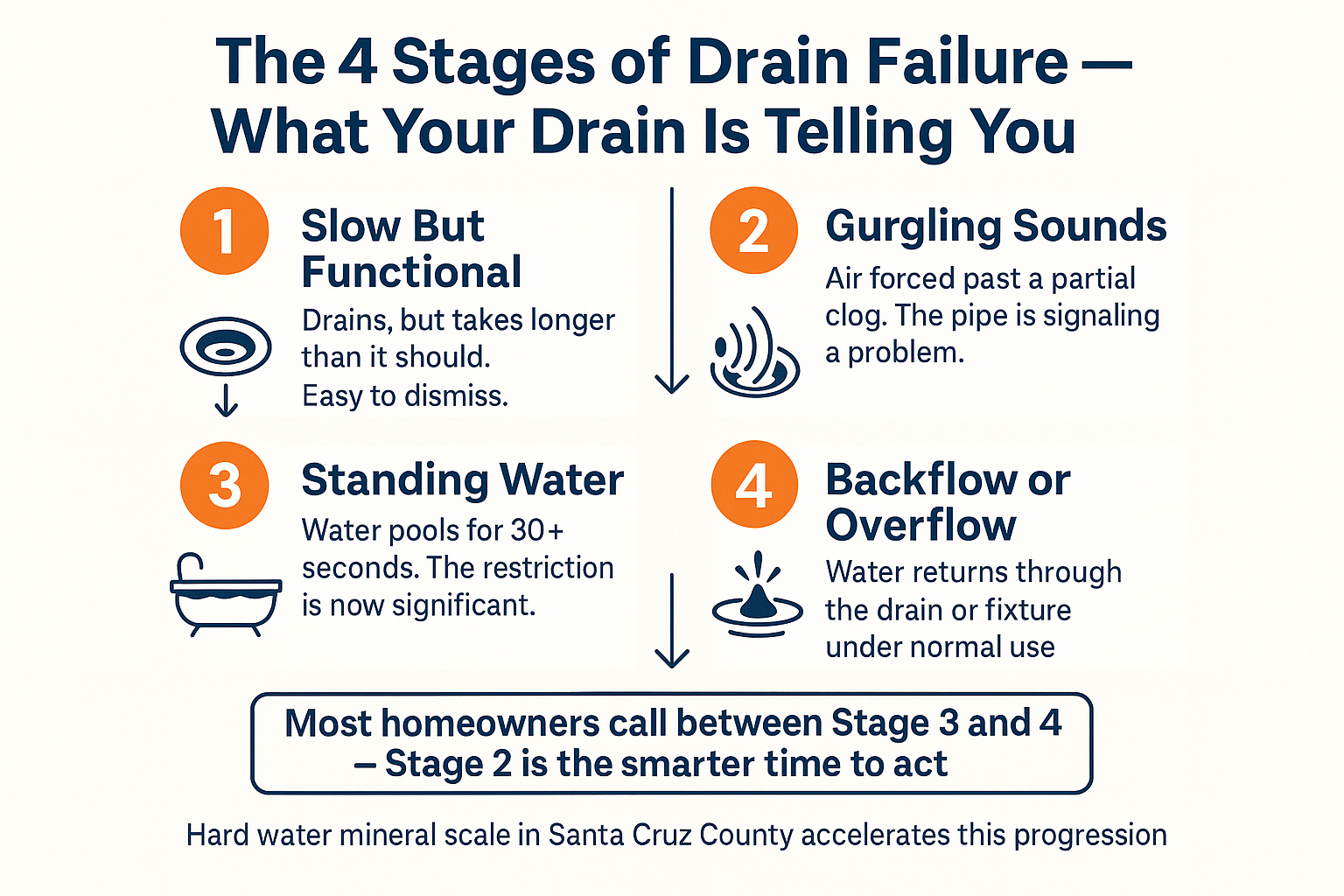
- Stage 1 — Slow but functional. Water drains, just not fast. Easy to dismiss as normal.
- Stage 2 — Gurgling sounds. Air is being displaced as water forces past a partial restriction. This is the pipe telling you something.
- Stage 3 — Standing water after use. The sink or tub holds water for 30 seconds or longer before draining. The restriction is now significant.
- Stage 4 — Backflow or overflow. Water comes back up through a drain, or a fixture overflows under normal use. The blockage is effectively complete.
Most homeowners call a plumber somewhere between Stage 3 and Stage 4. Calling at Stage 2 is better — and cheaper, because the pipe hasn’t been sitting under sustained back-pressure.
If you’re unsure whether your situation is a slow drain or something more serious, the difference between a slow drain and one that actually needs repair is worth reading before you decide.
The 4 Stages of Drain Failure
Most drain problems follow a predictable pattern. Knowing which stage you’re in changes what the right response looks like.
Snaking vs. Hydro Jetting — Why the Difference Matters Here
This is one of the most common questions that comes up in drain conversations, and it’s worth explaining plainly because the right answer depends on what’s actually happening inside the pipe.
Snaking — also called drain augering — uses a flexible metal cable to punch through a blockage. It’s effective for clearing a clog caused by hair, a soft grease buildup, or a foreign object. But it doesn’t clean the pipe walls. After a snake job, the inside of the pipe still has whatever scale, grease film, or corrosion was there before — which means the next clog can form faster.
Hydro jetting uses high-pressure water — often 3,000 to 4,000 PSI — delivered through a specialized nozzle to scour the pipe wall-to-wall. It removes grease film, mineral scale, soap residue, and even some root intrusion. The pipe comes out cleaner, not just open. The interval before the next backup is typically much longer.
But hydro jetting isn’t always the right call. For older galvanized or cast iron lines — common in Watsonville homes built before the 1980s — high-pressure water applied to a pipe that’s already corroded or weakened can cause more damage than it fixes. That’s why a sewer camera inspection before any drain cleaning method is recommended for older lines. The camera shows what the pipe condition actually is, which determines whether snaking or jetting is appropriate.
A contractor who skips the diagnostic step and immediately runs a snake or a jetter is guessing. And if that guess is wrong on a damaged line, what looks like a clog can turn into a broken pipe.
When the Kitchen Drain Is the Problem — and When It Isn’t
Garbage disposals deserve a specific mention here because they’re behind more kitchen drain calls than most homeowners expect.
A disposal pushes food waste into drain lines that are already dealing with grease and mineral scale. The issue isn’t the disposal itself — it’s that most homeowners don’t run enough water volume to flush solid waste all the way through to the main line. Particles settle in the trap or in the pipe just past the disposal, where grease and scale are waiting to grab them.
So a slow kitchen drain is frequently two problems working together: scale narrowing the pipe and food waste accumulating in the restriction. Cleaning one without addressing the other usually means the problem comes back.
The question that changes what fix makes sense is whether the problem is isolated to the kitchen or affecting multiple drains:
- Only the kitchen drain is slow — the issue is likely in the branch line or the trap near the disposal. A targeted cleaning or inspection of that line is the starting point.
- Multiple drains are slow — bathroom, laundry, and kitchen all backing up — the restriction is probably deeper in the system, closer to or at the main sewer line. That’s a different conversation than a disposal problem.
- One drain backing up while another overflows — this can indicate a mainline blockage or a venting issue, neither of which a simple snake will resolve.
If you’re seeing a pattern across multiple fixtures rather than one isolated clog, the diagnosis step matters more than the cleaning method.
Snaking vs. Hydro Jetting — When Each Makes Sense
The right drain cleaning method depends on what type of blockage you have and what condition the pipe is in. Here’s a plain-language comparison.
| Factor | Drain Snaking | Hydro Jetting |
|---|---|---|
| What it does | Punches through the blockage | Scours the full pipe wall |
| Best for | Hair clogs, soft grease, foreign objects | Scale buildup, grease film, root debris |
| Pipe condition requirement | Works on most pipe materials | Not recommended for weakened or corroded pipe |
| Leaves pipe walls clean? | No — residue remains | Yes — removes buildup from walls |
| Camera inspection needed first? | For older or repeatedly clogged lines, yes | Yes — required to check pipe condition before jetting |
| Older Watsonville homes (pre-1980s) | Often the safer starting point | Only after camera confirms pipe integrity |
Why Licensing Matters More Than You’d Think for Drain Work
Drain cleaning looks like a simple service from the outside, and that’s part of why unlicensed operators — including some marketed through app-based platforms and online directories — have established a foothold in the Santa Cruz County market.
The problem is that drain work without a proper diagnosis isn’t just ineffective — it can cause real damage. A contractor who runs a cable through a line without inspecting it first doesn’t know whether that line has a crack, a root intrusion that’s compromised the pipe wall, or a section that’s already partially collapsed. Forcing a snake through a damaged section can turn a drainage problem into a broken sewer line.
A licensed plumbing contractor holding an active CSLB license — the California Contractors State License Board credential required for plumbing work in this state — is operating under a professional and legal obligation to evaluate the work before recommending a method. That’s not just a compliance point. It’s the practical difference between a contractor who diagnoses and one who just clears and bills.
Maverick Plumbing Technicians, Inc. holds an active CSLB license (#1102966) and operates as a licensed and insured plumbing contractor throughout Watsonville and Santa Cruz County. When you’re dealing with a drain that keeps coming back — or one that’s finally failed completely — the licensing question is worth asking before anyone touches the line.
Frequently Asked Questions About Drain Cleaning in Watsonville
How do I know if my drain problem is in the branch line or the main sewer line?
The clearest indicator is how many fixtures are affected. If it’s just one drain — one sink, one tub — the clog is almost always in the branch line serving that fixture. If multiple drains in different parts of the house are slow or backing up at the same time, the restriction is more likely in the main line. A sewer camera inspection is the only way to confirm where the problem actually is.
Can I use chemical drain cleaners to fix a slow drain?
Chemical drain openers may temporarily clear a soft clog, but they do nothing for mineral scale — which is the underlying issue in most Watsonville homes with hard water. They can also damage older pipe materials, including galvanized steel and certain plastic fittings. For a drain that keeps coming back, chemical treatments mask the symptom without addressing the cause.
How often should drains be cleaned preventively in a hard water area?
There’s no single answer, because it depends on how old your pipes are, what fixtures feed into them, and whether you’ve had recurring issues. As a general point of reference, homes with older galvanized lines and active garbage disposal use tend to see buildup faster than newer homes on PVC. If you’ve had a drain cleaned and it slowed again within a year or two, a camera inspection before the next cleaning is a smarter starting point than another blind clearing.
My washing machine drain backed up and flooded the laundry room — is that a plumbing emergency?
It depends on the volume of water and whether it’s still coming. If water is actively overflowing and you can’t stop it, that warrants an urgent call. If the machine has stopped and you have standing water to clean up but no active flow, it’s serious but not necessarily a middle-of-the-night situation. Either way, it shouldn’t wait — a washing machine drain that failed under a single load has likely been building to that point for a while. See what counts as a middle-of-the-night plumbing call for more guidance.
Does hydro jetting damage old pipes?
It can, which is exactly why a camera inspection should happen before jetting is attempted on any older line. Galvanized and cast iron pipes that have corroded significantly may not hold up to high-pressure water. A camera inspection shows the pipe’s actual condition — cracks, corrosion, partial collapses — before any method is chosen. A licensed contractor won’t recommend jetting without knowing what they’re working with.
What should I ask a plumber before they start drain cleaning work?
Three things worth asking: whether they’re going to inspect the line before choosing a method, what their CSLB license number is, and what happens if they find damage during the cleaning. A contractor who answers all three clearly — and can show you the camera footage — is operating the way a licensed professional should.
Dealing With a Slow or Backed-Up Drain in Watsonville or Santa Cruz?
If your drain has been slow for a while — or just gave out completely — Maverick Plumbing Technicians, Inc. serves homeowners throughout Watsonville, Santa Cruz, and the surrounding Santa Cruz County area with licensed drain cleaning, sewer camera inspection, and hydro jetting. We’re available 24/7 for emergencies. Call (831) 515-9903 to talk through what you’re seeing, or reach out through maverickplumbingtechnicians.com to request service.
