Direct Answer: One slow drain is usually a localized clog. But when multiple drains back up, or the same drain clogs repeatedly, you’re likely dealing with a main line problem that needs professional attention.
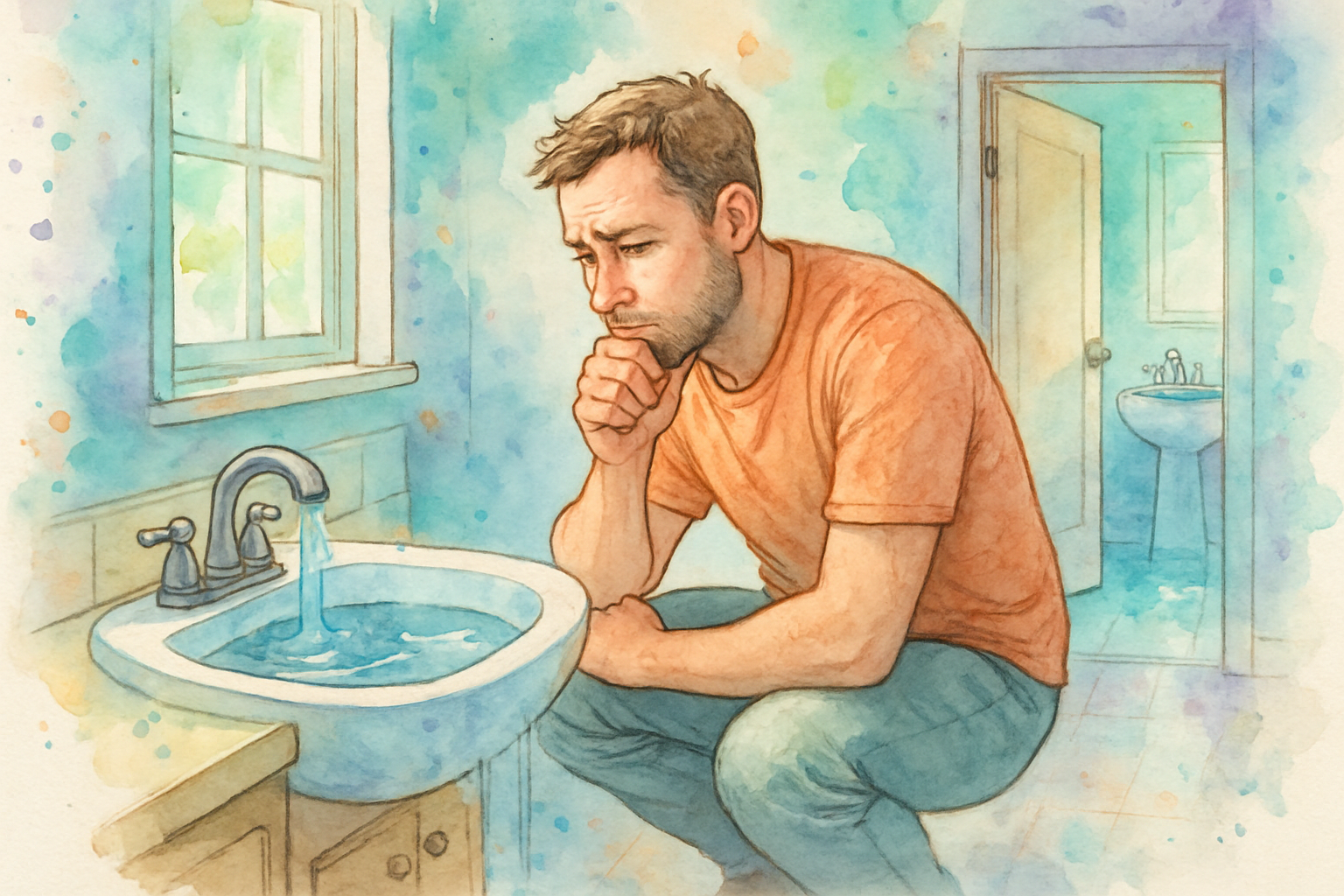
One clogged drain is annoying. Two drains backing up at the same time — or the same drain clogging every few weeks — is something else entirely. A lot of homeowners in Watsonville and across Monterey County treat repeated drain problems as bad luck, when what they’re actually dealing with is a signal the whole system is trying to send.
The difference between a single clog and a pattern matters because the fix is completely different. A localized clog might be cleared with basic drain cleaning. A pattern usually points back to the main sewer line — and if that’s the issue, a plunger won’t help.
This article focuses on two things: how to read what your drains are actually telling you, and when the pattern you’re seeing means it’s time to stop guessing and get a camera in the line.
What a Single Clog Actually Looks Like
A true isolated clog is confined to one fixture — one sink, one shower, one toilet. The other drains in the house are working normally. There’s no gurgling from other fixtures, no backup happening somewhere else when you flush, and no sewage smell creeping in from a floor drain.
These clogs usually have a pretty clear cause:
- Hair and soap buildup in a bathroom sink or shower drain
- Food grease accumulating in a kitchen drain over time
- A foreign object — a toy, a wipe labeled “flushable,” a cotton pad — caught in the trap
- Mineral buildup from the hard water that’s common throughout Santa Cruz County and the Monterey Bay region
An isolated clog is the least complicated version of this problem. But even here, the difference between a slow drain and a drain that actually needs repair is worth understanding before you start pulling things apart. What looks like a simple clog is sometimes a symptom of a pipe that’s partially collapsed or scaled beyond what a snake can clear.
When the Pattern Means It’s the Main Line
Your home’s individual drain lines — kitchen, bathrooms, laundry — all feed into one main sewer line that runs out to either the city sewer or a septic system. When that main line is partially or fully blocked, waste has nowhere to go. It backs up through whichever fixture happens to be lowest in the house.
The signs that point to the main line rather than a branch line are pretty distinct:
- Multiple drains slow down or back up at the same time
- Flushing one toilet causes water to rise in another toilet or in a tub
- Gurgling sounds coming from drains you’re not using
- A floor drain in the garage, laundry room, or bathroom is backing up with dark water
- The same drain clogs repeatedly — cleared one month, clogged again two months later
The gurgling is especially telling. When a toilet gurgles after you run the washing machine, that’s air being pushed backward through a shared line. The system is already under pressure.
For properties in older parts of Watsonville and Santa Cruz, another factor comes into play: root intrusion. Tree roots — from eucalyptus, pine, and other deep-rooted species common in the region — actively seek moisture. They find sewer line joints, work their way in, and grow until the line is partially or completely blocked. This is one of the most common reasons a main line clogs repeatedly after being cleaned, and it won’t resolve without either cutting the roots out mechanically or repairing the line itself.
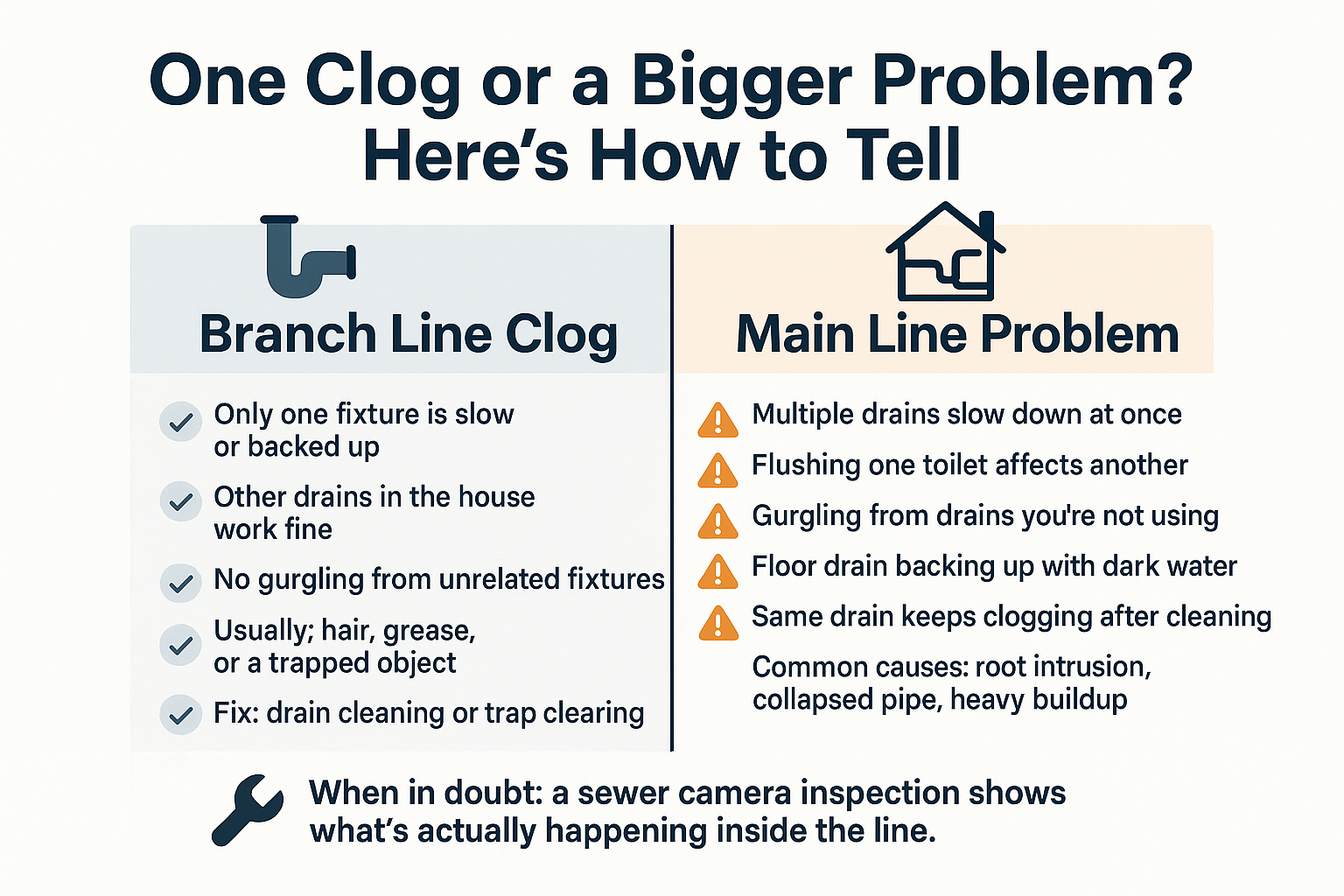
How to Read Your Drain Problem: Branch Line vs. Main Line
This infographic breaks down the key differences between a localized clog and a main sewer line problem — and what each one typically requires.
What a Sewer Camera Inspection Actually Does
A lot of homeowners in Monterey County have heard of sewer camera inspections but aren’t sure what they actually involve or when they make sense. The short version: a licensed plumber feeds a small waterproof camera through the drain line to see what’s inside the pipe in real time.
This matters because drain problems that can’t be diagnosed visually often get misdiagnosed. A plumber who snakes a line and finds it’s clear might miss a partial collapse 10 feet further down the line. A camera shows the actual condition of the pipe — buildup, root intrusion, cracks, bellied sections where the pipe has sagged and water pools instead of flowing.
The situations where a camera inspection is the right call:
- You’ve had the same drain cleaned more than once in 12 months and it keeps coming back
- Multiple drains are slow at the same time
- You’re buying or selling a home and want to know the condition of the sewer line before closing
- You’ve had a sewage backup reach the floor
- You’re dealing with unexplained wet spots in the yard above where the sewer line runs
For properties on sloped terrain — which covers a lot of residential land in the hills above Watsonville and through the Santa Cruz Mountains — pipe bellying is more common than people expect. Soil movement over time causes sections of the line to drop, creating low spots where solids settle instead of flushing through. A camera is the only way to see that without digging.
If a camera does find something serious — roots, a cracked line, a major blockage — that information tells you exactly what kind of repair is needed rather than guessing from symptoms. That’s a very different starting point than calling a plumber back for the fourth time because the same drain is slow again.
Drain Symptoms and What They Usually Point To
This table maps common drain symptoms to their most likely causes — and whether the fix is likely to be a simple cleaning or something more involved.
| Symptom | Most Likely Cause | What’s Usually Needed |
|---|---|---|
| One sink drains slowly | Hair, soap, or grease buildup in that drain’s trap or branch line | Drain cleaning or trap clearing |
| Same drain clogs repeatedly | Partial root intrusion, pipe scaling, or a damaged section | Camera inspection to identify the cause |
| Two or more drains slow at once | Main line blockage or heavy buildup in a shared line | Mainline cleaning or hydro jetting |
| Toilet gurgles when washer drains | Air being pushed back through shared drain lines — main line pressure | Camera inspection + mainline evaluation |
| Floor drain backs up with dark water | Sewage backpressure from main line obstruction | Immediate professional service — do not ignore |
| Wet or sunken area in yard above sewer line | Possible sewer line crack or leak underground | Camera inspection + possible sewer line repair |
The Risk of Waiting When It’s Already a Pattern
A slow drain that gets ignored doesn’t stay slow — it eventually stops. And when a partially blocked main line finally seals up, the backup comes through the lowest fixture in the house. That’s usually a floor drain, a toilet, or a shower on the ground level. At that point, you’re no longer dealing with a slow drain. You’re dealing with raw sewage inside the house.
That’s an emergency. And it’s a messier, more expensive situation than the one that existed a month earlier when the pattern was first showing up.
This is one of those cases where understanding the difference between urgent and “wait until morning” plumbing problems actually changes what you should do. A slow drain might genuinely wait a few days. But multiple slow drains, repeated clogs in the same fixture, or any sign of sewage backing up — those belong in the urgent column.
For context on when a drain problem has fully crossed into emergency territory, when does a plumbing problem become an emergency covers exactly that territory in more detail.
Frequently Asked Questions About Drain Patterns and Sewer Problems
Can I use a store-bought drain cleaner to fix a recurring clog?
For a simple, localized hair or grease clog, a drain cleaner might help temporarily. But if the same drain keeps clogging, the chemical isn’t reaching the actual cause — and repeated use can damage older pipes. For a recurring problem, a professional drain cleaning with a mechanical snake or hydro jetting is more effective and safer for your plumbing.
How do I know if my sewer line connects to the city sewer or a septic tank?
If your property is in an older residential area of Watsonville or Santa Cruz proper, you’re most likely on the city sewer system. Rural and semi-rural properties — especially in the hills or unincorporated parts of Monterey County — are more often on septic. Your county property records or a call to Santa Cruz County Public Works can confirm it. A licensed plumber can also tell you during a service call.
My toilet gurgles when I run the washing machine. Is that serious?
Yes, that’s worth having checked. Gurgling between fixtures means air is being displaced through shared drain lines — which points to a main line that’s under pressure from a partial blockage. It’s not an emergency in most cases, but it usually gets worse before it gets better if left alone.
How long does a sewer camera inspection take?
For a typical single-family home, a camera inspection usually takes 30 to 60 minutes, depending on the length of the line and what the camera finds. The plumber can review the footage with you on site and explain what they’re seeing in real time.
What’s hydro jetting, and is it different from snaking a drain?
A snake (or drain auger) physically breaks through or pulls out a clog. Hydro jetting uses high-pressure water to scour the inside of the pipe — removing grease buildup, mineral scale, and soft root intrusions that a snake would just punch through. Hydro jetting is more thorough, but a camera inspection first is usually recommended to make sure the pipe is in good enough condition to handle the pressure.
Should I be worried about tree roots if I live in Watsonville or Santa Cruz?
It’s a real concern in both cities, especially in neighborhoods with mature landscaping. Eucalyptus, Monterey pine, and fig trees — all common in Santa Cruz County — have aggressive root systems that seek moisture. If your sewer line runs through or near a mature tree’s root zone, a camera inspection every few years is reasonable preventive maintenance, not an overreaction.
Seeing a Pattern With Your Drains in Monterey County?
If you’re dealing with drains that keep coming back, multiple fixtures slowing down at once, or anything that looks like sewage backing up, Maverick Plumbing Technicians, Inc. serves Watsonville, Santa Cruz, and the surrounding communities throughout Monterey County with licensed sewer camera inspection, drain cleaning, hydro jetting, and main line repair — available 24/7 for situations that can’t wait. Give us a call at (831) 515-9903 or schedule service at maverickplumbingtechnicians.com.
