Direct Answer: Hard water leaves calcium and magnesium scale inside faucets, showerheads, and water heaters. That buildup restricts flow and wears out parts early. A water softener treats the whole house at the point of entry.
You wipe the white crust off the faucet. A week later it is back. Most homeowners in Watsonville and Santa Cruz treat that as a cleaning problem, not a plumbing problem.
But that white film on the outside is the visible edge of what is happening inside your pipes, your fixtures, and your water heater. Hard water is common throughout Santa Cruz County and much of the Central Coast, and the damage builds slowly enough that people stop noticing it.
I want to walk through what I actually see in the field: which fixtures fail first, why an eight year old water heater starts acting like it is fifteen, and the difference between a water softener and a reverse osmosis system. Those last two get confused constantly.
What Hard Water Is Doing Inside Your Plumbing
Hard water simply means the water carries a high level of dissolved minerals, mostly calcium and magnesium. It is not a health hazard. The U.S. Geological Survey explains water hardness as a natural result of water moving through mineral-rich rock and soil, which is exactly what happens across the Pajaro Valley and the wells and groundwater sources feeding this region.
The problem is what those minerals do when water sits still or gets heated. They come out of solution and stick to whatever surface is nearby.
Over time that means:
- Scale inside supply lines, narrowing the path water travels
- Deposits on valve seats and cartridges inside faucets and shower valves
- Clogged aerator screens at the tip of every faucet
- Sediment layers at the bottom of a tank water heater
- Mineral crust around fitting threads and shut-off valve stems
Here is the part that catches people. The decline is gradual, so you adapt to it. A homeowner in Santa Cruz told me their shower pressure was fine, then admitted it had been “kind of weak for a couple years.” That is scale, not the city’s water pressure.
Your Water Heater Takes the Worst of It
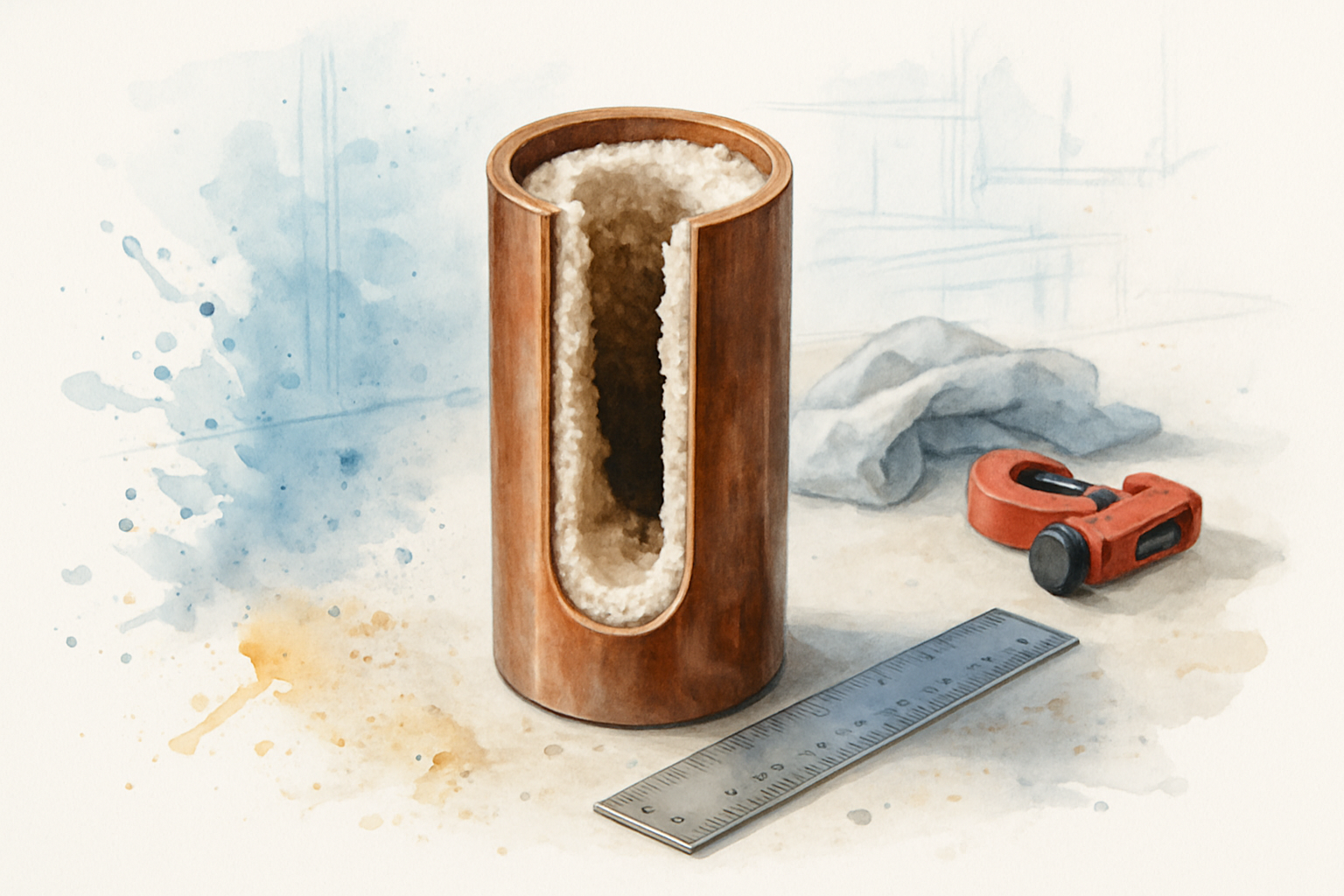
Heat accelerates mineral deposits. That makes the water heater the single hardest hit appliance in a hard water home.
In a tank unit, sediment settles on the bottom of the tank. On a gas heater, the burner now has to push heat through a layer of mineral rock before it reaches the water. On an electric unit, that sediment packs around the heating elements directly.
What that looks like day to day:
- Less hot water than you used to get from the same size tank, because sediment is taking up volume
- Longer recovery time between showers
- Popping or rumbling sounds as water boils under the sediment layer
- Early element or tank failure, sometimes years ahead of schedule
I get calls where someone says the hot water only lasts five minutes and the unit is barely more than a year old. That is not always a failed heater. Sometimes it is scale plus a setting or sizing issue, which is why I want eyes on the unit before anyone talks about replacing it.
In Watsonville and across Santa Cruz County, mineral buildup is one of the most common reasons a heater that is only eight or ten years old starts behaving like it is finished. If you want the fuller picture, we covered how long a water heater should actually last and how to figure out why you have no hot water in separate posts.
Fixture by Fixture: When Scale Goes From Cosmetic to Functional
This is the chart I run through mentally when I walk a house. The left column is what you can see. The right column is when it stops being an appearance issue.
| Fixture | Early Sign (Cosmetic) | When It Becomes Functional Damage |
|---|---|---|
| Showerhead | White crust around the spray nozzles | Spray pattern splits or sprays sideways, pressure drops noticeably |
| Faucet aerator | Chalky film on the screen, spitting stream | Flow slows to a trickle even after cleaning the screen |
| Faucet cartridge | Handle feels slightly gritty to turn | Constant drip, handle sticks, or hot and cold mix unevenly |
| Toilet fill valve | Mineral speckling in the tank | Valve runs continuously or refills on its own |
| Shut-off valves under sinks | Crust around the stem | Valve will not close fully when you actually need it |
| Water heater | Rumbling or popping during heating | Shorter hot water supply, element failure, tank leak |
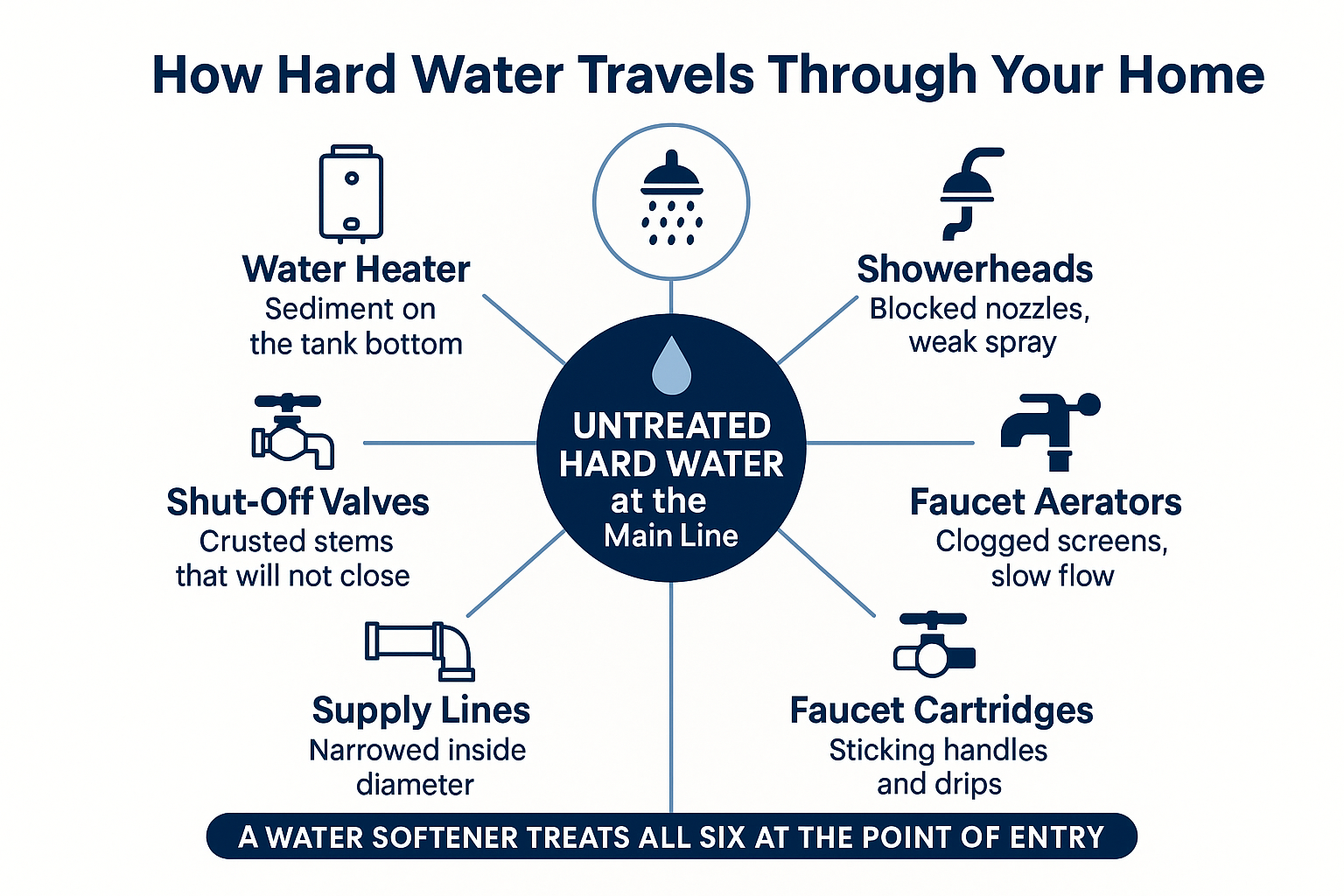
How One Water Supply Damages Six Different Things
This shows the path untreated hard water takes through a typical Central Coast home and what it costs you at each stop.
Water Softener vs. Reverse Osmosis: Two Systems, Two Different Jobs
This is the question I answer most often, and homeowners frequently assume one replaces the other. They do not.
A water softener is a whole-home system. It installs at the point of entry, where the main supply comes into the house, and treats the hardness minerals before the water reaches anything else. Every downstream fixture, pipe, and appliance benefits, including your water heater and your dishwasher.
A reverse osmosis system is point of use. It usually goes under the kitchen sink and treats water at that one tap. It targets drinking water quality: dissolved solids, sediment, taste and odor compounds.
So the short version:
- Want to stop scale from wrecking fixtures and the water heater? That is a softener.
- Want better tasting drinking water at the kitchen tap? That is reverse osmosis.
- Plenty of homes here have both, because they are solving unrelated problems.
One more thing worth knowing. A softener is not a buy it and forget it appliance, and neither is an RO system. Filters and media need service on a schedule.
One Santa Cruz County homeowner wrote in a review that we order her filters and come replace them without her ever having to call and remind us. That ongoing relationship is a normal part of professional installation, and it is a fair question to ask any licensed contractor before you commit to a system.
When It Is Worth Getting a Professional Look
You do not need to replace fixtures the moment you see white crust. But there are points where waiting costs more than acting.
I would want a licensed plumber to take a look if you notice:
- Flow that has dropped across multiple fixtures, not just one
- Hot water that runs out faster than it used to
- Popping or rumbling from the water heater tank
- Faucet handles that stick or drip after being rebuilt once already
- A shut-off valve that will not fully close
That last one matters more than people realize. If a supply line fails and the angle stop under the sink is scaled shut, a small leak turns into a much bigger repair fast. We wrote about using your water meter to check for a hidden leak if you suspect something is running when it should not be.
Whole-home water treatment is licensed plumbing work in California. Sizing the unit, tying it into the main supply, and routing the drain correctly all matter, and the installation has to meet code.
Frequently Asked Questions About Hard Water and Fixtures
Will a water softener undo damage that already happened?
No. A softener stops new scale from forming, but it does not dissolve deposits already packed into an old water heater or a scaled-up cartridge. Existing fixtures may still need service or replacement. The value is in protecting everything from that point forward.
Can I just clean my showerhead and aerators instead?
Soaking them helps, and it is worth doing. But it only treats the parts you can reach. It does nothing for the sediment in your water heater, the deposits on internal valve seats, or the scale inside your supply lines.
Do I need a reverse osmosis system if I already have a softener?
They solve different problems. A softener handles hardness minerals for the whole house. Reverse osmosis handles drinking water quality at one tap, usually the kitchen sink. If your goal is better tasting water to drink and cook with, a softener alone will not get you there.
How often does a water softener need service?
It depends on the system and how hard your water is. Most setups need periodic media or filter attention, and some homeowners have that scheduled ahead of time so they are not tracking it themselves. Ask about the service interval before you pick a unit, not after.
Is hard water a problem in Monterey County too, or just Santa Cruz County?
It shows up throughout the region. Hardness levels vary by water source and neighborhood, so two homes a few miles apart can be noticeably different. The practical test is what you see on your own fixtures and how your water heater is behaving.
Wondering How Much Scale Is Already in Your System?
If your fixtures are scaling up or your water heater is not keeping up the way it used to, an in-person look tells you a lot more than a guess. Maverick Plumbing is a licensed and insured plumbing contractor (CSLB #1102966) serving Watsonville, Santa Cruz County, and parts of Monterey County, with 24/7 emergency service available. You can reach us at (831) 515-9903 or request service at maverickplumbingtechnicians.com when you are ready to talk it through.
