Direct Answer: Most tank water heaters last 8 to 12 years. Tankless units can last 15 to 20 years. Hard water, skipped maintenance, and undersized units all shorten those windows.
Most homeowners don’t think about their water heater until the morning they step into a cold shower. By that point, the unit has usually been failing quietly for months — and the question shifts from “how long will this last” to “how fast can someone get here.”
If you’re in Watsonville, Santa Cruz, or anywhere else in Santa Cruz County or Monterey County, that timeline gets complicated by one factor most people don’t account for: hard water. The water throughout this region is mineral-heavy, and that buildup inside a tank doesn’t just reduce efficiency — it physically shortens how long the unit survives.
This article covers what actually determines a water heater’s lifespan, how to read the warning signs before failure, and how to decide between repairing what you have and replacing it.
The Real Lifespan Numbers — And Why Local Water Changes Them
The general range you’ll see from manufacturers is 8 to 12 years for a tank water heater and 15 to 20 years for a tankless unit. Those numbers assume average water quality, proper installation, and at least occasional maintenance. In Santa Cruz County and Monterey County, average water quality doesn’t apply.
The Central Coast draws from groundwater sources with elevated mineral content — calcium and magnesium primarily. Inside a tank water heater, those minerals drop out of solution when water heats up and settle at the bottom as sediment. Over time, that layer acts as insulation between the burner and the water, forcing the unit to work harder and run longer to reach temperature.
The result is a unit that burns through its components faster than the manufacturer anticipated. A tank water heater that might last 12 years with softer water may start showing serious problems at 8 or 9 years here. That’s not a malfunction — it’s just the local reality.
Factors that affect lifespan in this region:
- Water hardness — the higher the mineral content, the faster sediment accumulates
- Tank size — an undersized unit that runs constantly wears out faster
- Anode rod condition — this sacrificial rod inside the tank is supposed to corrode so the tank doesn’t; if it’s never replaced, the tank starts corroding instead
- Annual flushing — most homeowners skip it; sediment builds unchecked
- Installation quality — improper venting or undersized gas lines stress the unit from day one
How to Tell Your Water Heater Is Running Out of Time
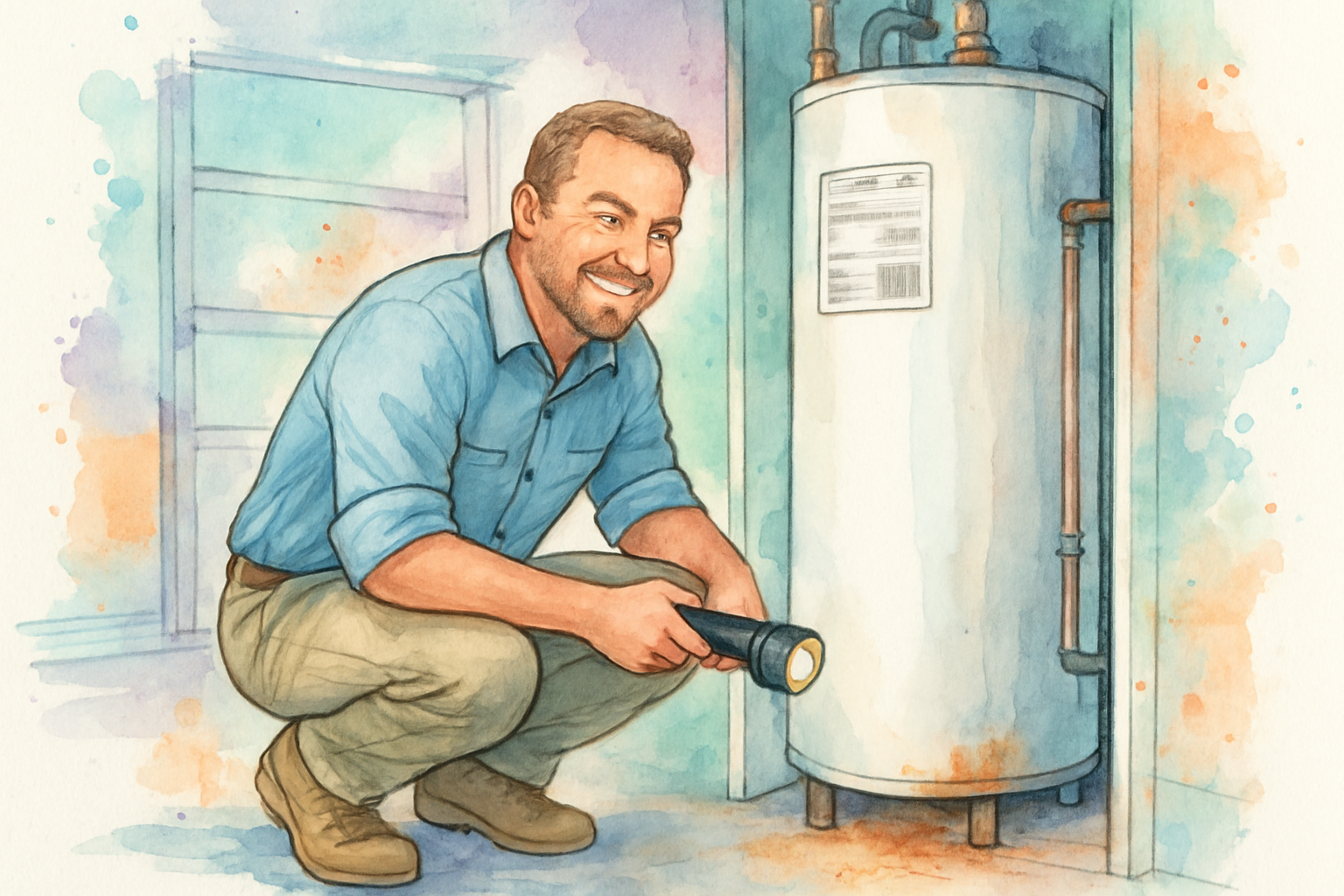
The unit doesn’t usually fail without warning. Most water heaters send clear signals in the months before they give out — but they’re easy to ignore if you don’t know what you’re looking at.
Signs worth taking seriously:
- Rumbling or popping sounds when the unit is heating — that’s sediment being agitated by the burner, and it means the buildup is already significant
- Rusty or discolored water at the hot tap — not always sediment; could be a corroding anode rod or the tank itself
- Inconsistent hot water — the unit runs but can’t maintain temperature, often because sediment has compromised heat transfer
- Water pooling near the base — small drips can mean a loose fitting, but moisture from the tank itself usually means the lining has cracked
- The age factor — if the unit is 10 years or older, it’s worth having it evaluated even if nothing obvious has gone wrong yet
The serial number on the tank tells you how old it is, though manufacturers encode the date differently. If you’re not sure how to read it, a licensed plumber can pull that information during an inspection.
One situation that moves this from “keep an eye on it” to “deal with it now” is water collecting underneath the tank. That’s not a maintenance issue — that’s a plumbing problem that can escalate quickly, especially if the leak is slow and unnoticed for days.
Tank vs. Tankless: Lifespan and Key Differences
These two types of water heaters age very differently. Here’s a straightforward comparison of what homeowners in the Watsonville and Santa Cruz area should understand before deciding which direction to go.
| Factor | Tank Water Heater | Tankless Water Heater |
|---|---|---|
| Typical Lifespan | 8–12 years | 15–20 years |
| Hard Water Impact | Sediment builds in tank; shortens lifespan | Scale builds on heat exchanger; requires descaling |
| Maintenance Needed | Annual flush, anode rod check | Annual descaling, filter cleaning |
| Hot Water Supply | Limited by tank size | Continuous, on demand |
| Installation Complexity | Straightforward replacement | May require gas line or electrical upgrades |
| Failure Style | Gradual decline, then rupture risk | Gradual efficiency loss, error codes |
| Best For | Homes with predictable, moderate usage | Homes wanting long-term efficiency and longevity |
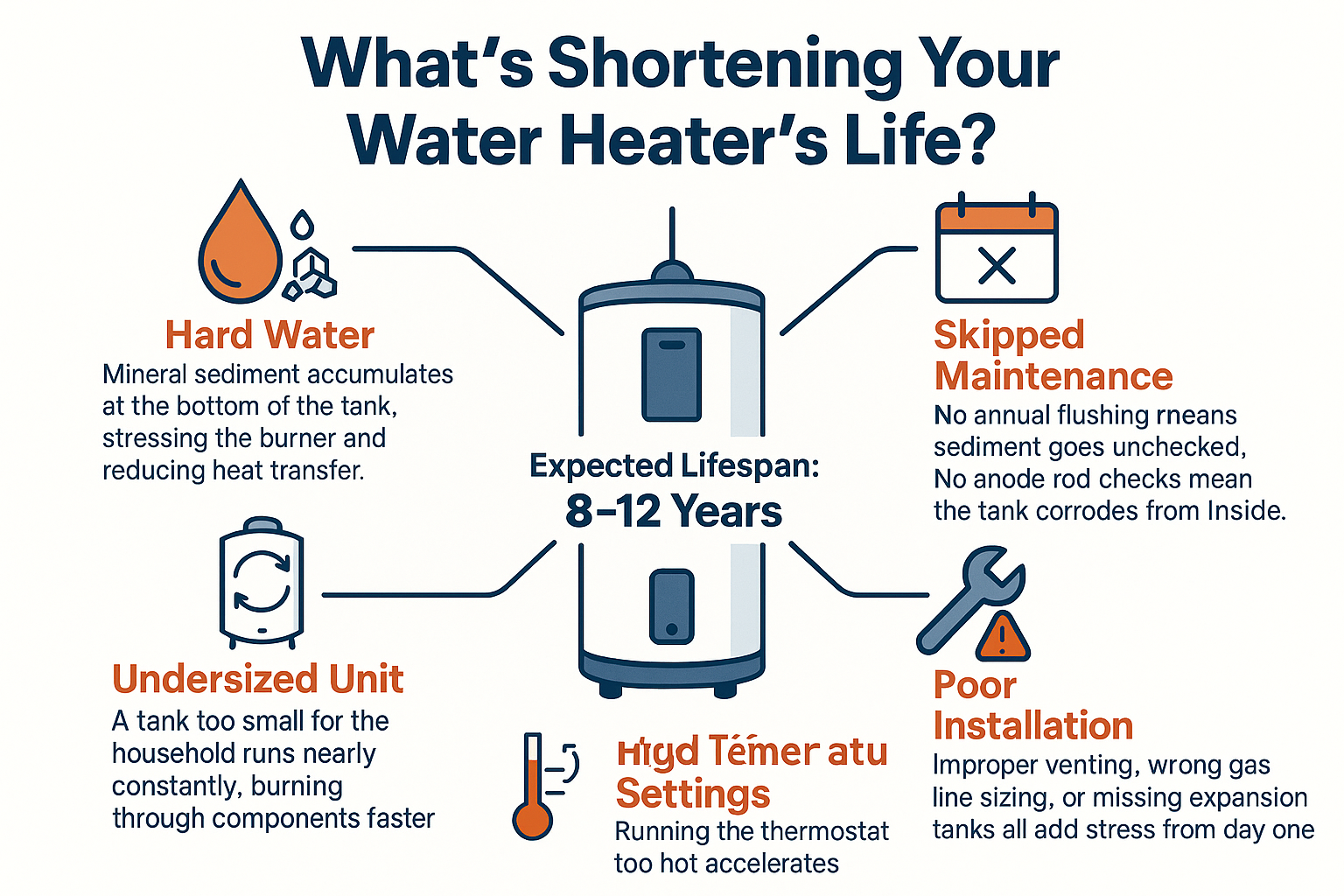
Water Heater Lifespan: What’s Shortening Yours
This infographic breaks down the main factors that cut into a water heater’s expected lifespan — especially relevant for homes on Central Coast California water.
Repair or Replace: How to Think Through the Decision
This is where most homeowners get stuck. The unit isn’t dead yet, but something’s wrong — a failed heating element, a leaking pressure relief valve, a burner that won’t stay lit. Is it worth fixing?
The short answer is: it depends almost entirely on age and what failed.
If the unit is under 7 years old and the component that failed is a standard replaceable part — heating element, thermostat, anode rod — repair usually makes sense. The tank itself is still structurally sound, and the repair extends useful life.
If the unit is 10 years or older, the calculation flips. Paying to repair a component on a unit that’s already past its expected service window means you’re spending money on borrowed time. A second failure often follows within a year or two.
The one situation where age doesn’t matter is tank corrosion or a cracked liner. If water is seeping from the tank body itself — not from a fitting, not from a valve — the unit cannot be repaired. Replacement is the only option, and waiting makes the water damage problem worse.
For tankless units, the decision is similar but the window shifts. A 10-year-old tankless that’s been properly maintained still has years of life left. If it’s throwing error codes or producing inconsistent output, a technician can often diagnose whether it’s a parts issue or end-of-life failure before you commit to anything.
If you’re dealing with a situation that can’t wait — no hot water at all, active leaking, or a unit that’s tripping breakers — that’s worth treating as an urgent call rather than a scheduled appointment. You can read more about how to decide when a plumbing problem needs immediate attention if you’re trying to gauge the situation after hours.
What Maintenance Actually Buys You
Annual maintenance on a water heater isn’t about checking a box — it directly extends how long the unit runs before needing replacement.
For tank water heaters, the two things that matter most are flushing the sediment and inspecting the anode rod. Flushing removes the mineral buildup that accumulates at the bottom of the tank. In Santa Cruz County and Monterey County, where water hardness is a real factor, this isn’t optional — it’s the difference between a unit that hits 10 years and one that fails at 7.
The anode rod is a magnesium or aluminum rod suspended inside the tank. It’s designed to corrode slowly so the tank walls don’t. When the rod is depleted and never replaced, the tank starts corroding instead. By the time you see rust in the water, the damage is usually already significant.
For tankless water heaters, annual descaling flushes mineral scale off the heat exchanger. Skip it long enough and the scale restricts water flow, drops output temperature, and forces the unit to work harder. Most manufacturers require documented annual service to keep the warranty valid — something worth knowing if your unit is still under coverage.
Maintenance also gives a licensed plumber a chance to catch problems early — a loose connection, a failing valve, a venting issue — before they turn into the kind of failure that requires an after-hours call.
Frequently Asked Questions About Water Heater Lifespan
How do I find out how old my water heater is?
The manufacture date is encoded in the serial number on the label attached to the tank. The format varies by brand — some use the first four digits as year and week, others use letter codes for the month. If you can read us the serial number over the phone, we can usually decode it quickly. Or look up your brand’s serial number format online — most manufacturers publish the key.
My water heater is 9 years old and working fine. Should I replace it anyway?
Not necessarily — but it’s worth having it inspected. At 9 years, especially in an area with hard water like Santa Cruz County or Monterey County, sediment buildup and anode rod condition can tell you a lot about how much life is left. If the unit is in decent shape internally, you may get two or three more years out of it. If the anode rod is shot and sediment is heavy, replacement sooner rather than later avoids an emergency situation.
Is a tankless water heater worth it for a Watsonville home?
For most homeowners here, yes — if they go in with realistic expectations. Tankless units last significantly longer than tank models, and they eliminate the risk of a tank rupture. But they do require annual descaling given local water conditions, and the upfront installation can be more involved depending on your current gas line and venting setup. A licensed plumber can assess whether your home’s existing infrastructure supports a tankless unit without major modifications.
My water heater is leaking from the bottom. Is that always a replacement situation?
Not always. If the leak is coming from the drain valve or a fitting at the base, that’s often repairable. If the water is seeping from the tank body itself — meaning the steel shell — that’s a sign the lining has failed and the tank cannot be patched or repaired. In that case, replacement is the only safe path forward. Don’t wait on a tank body leak — water damage compounds quickly.
How often should I flush my water heater?
Once a year is the standard recommendation. In areas with harder water — which describes most of Santa Cruz County — some plumbers recommend flushing every 6 to 9 months if the unit is older or if you’ve noticed sediment issues before. It’s a straightforward service call that pays for itself in extended unit life.
Can I get more years out of my water heater by replacing the anode rod?
Yes, and it’s one of the most underused maintenance steps in residential plumbing. Replacing a depleted anode rod before the tank starts corroding can add years to the unit’s life. If your water heater is between 4 and 8 years old and has never had an anode rod inspection, that’s a worthwhile service call.
Not Sure What Your Water Heater Has Left?
If your unit is aging, acting up, or you just don’t know when it was installed, an inspection by a licensed plumber gives you a real answer — not a guess. Maverick Plumbing Technicians, Inc. serves homeowners throughout Watsonville, Santa Cruz, and the surrounding areas of Santa Cruz County and Monterey County. Call us at (831) 515-9903 or visit maverickplumbingtechnicians.com to request service. We’re available 24/7 for situations that can’t wait.
