Direct Answer: Most plumbing problems — leaky fixtures, slow drains, failing water heaters under ten years old — can be repaired without full replacement. Age, repeated failure, and water damage extent are what shift the math toward replacing.
When something breaks in your home, the first question is almost never about the fix itself — it’s about whether you’re about to spend money on a repair that won’t last. That hesitation makes sense. But for most plumbing problems in Monterey County homes, the answer isn’t as complicated as it feels in the moment.
Watsonville and Santa Cruz homeowners deal with hard water, aging pipe systems in older residential stock, and clay soil conditions that put real stress on underground sewer lines. Those factors affect how long things last — but they don’t mean every problem calls for full replacement.
This article covers two of the most common judgment calls: water heater repair vs. replacement and drain and sewer repair vs. full line work. If you’re staring at a problem right now and trying to decide which direction to go, here’s how to think through it.
Water Heater: When Repair Still Makes Sense
A water heater that stops producing hot water doesn’t automatically need to go. The question is what failed and how old the unit is when it failed.
For tank water heaters, the most repairable problems are:
- A burned-out heating element (electric units) — this is a straightforward part swap
- A failed thermostat — usually inexpensive and accessible
- A faulty pilot light or igniter (gas units) — often a burner assembly or thermocouple issue
- A worn anode rod — this is a maintenance item that, if caught early, extends tank life significantly
If the tank itself is leaking from the body — not from a fitting or the pressure relief valve, but from the tank wall — that’s not repairable. A cracked or corroded tank is a replacement situation.
Age matters a lot here. A 7-year-old unit with a failed thermostat is worth repairing. A 14-year-old unit with the same problem probably isn’t, because other components are close behind. How long a water heater actually lasts depends on your water quality, maintenance history, and unit type — and in Santa Cruz County, hard water accelerates wear on both the tank and its internal parts.
For tankless water heaters, repairs are often more involved but the units are built to last 15 to 20 years with proper maintenance. Scale buildup from hard water is the most common culprit for performance issues in this area — and that’s a service and descaling problem, not a replacement problem.
Drain and Sewer Lines: What Repair Can Fix
Drain problems get misread more often than almost any other plumbing issue. A slow drain isn’t always a sign of pipe failure — but a slow drain that keeps coming back after cleaning usually is.
If you’ve had the same drain cleaned more than once in a 12-month period and the problem returns within a few weeks, that’s not a clog. Something structural is happening. The most common causes in Watsonville and the surrounding area:
- Root intrusion — tree roots from coastal oaks, eucalyptus, and older ornamental plantings are aggressive in this region’s soil conditions
- Pipe belly — a low spot caused by soil settlement where waste pools instead of flowing through
- Partial collapse — older clay tile sewer lines common in pre-1980 homes can crack or shift over time
- Scale and grease buildup so advanced that the pipe diameter is significantly reduced
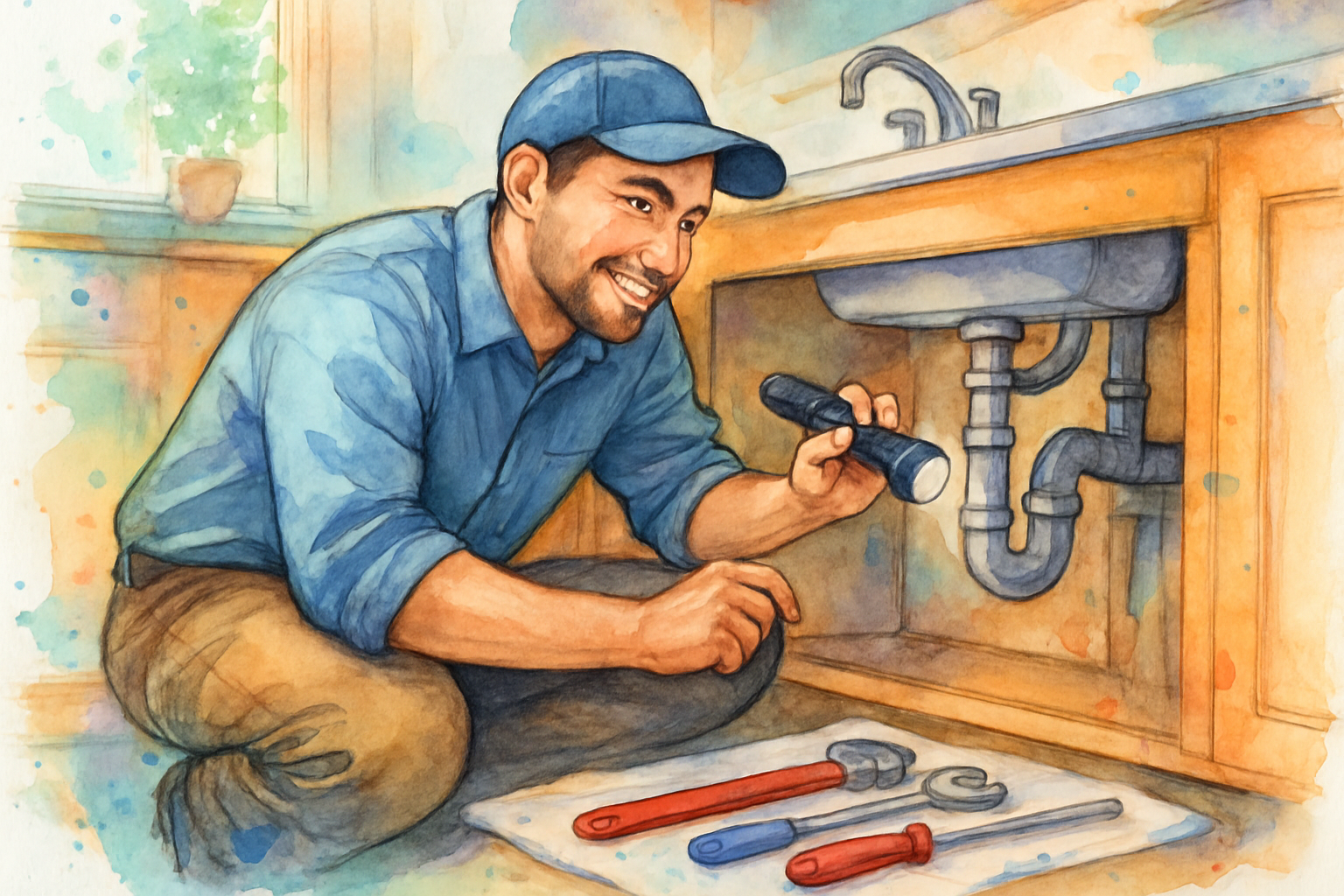
The only way to know which one you’re dealing with is a sewer camera inspection. A plumber runs a camera through the line and sees exactly what’s there. That single step determines whether you’re looking at a targeted repair, a hydro jet cleaning, or a section replacement.
Why the same drain keeps backing up often comes down to one of these structural issues that drain cleaning alone can’t fix. And the difference between a slow drain and a drain that actually needs repair is worth understanding before you call anyone.
Repair vs. Replace: Quick Reference by Problem Type
These are general indicators, not guarantees — a licensed plumber’s evaluation is the only way to confirm which path makes sense for your specific situation.
| Problem | Likely Repair | Likely Replace |
|---|---|---|
| Water heater not heating (electric) | Heating element or thermostat | Tank over 12 years old, or tank body leaking |
| Water heater not heating (gas) | Thermocouple, igniter, or burner assembly | Tank over 12 years old, tank body rusted or leaking |
| Leaking pipe fitting or joint | Fitting replacement or re-seal | Galvanized pipe with widespread corrosion throughout |
| Single slow or clogged drain | Drain cleaning or hydro jetting | Repeated failure after cleaning — inspect for structural damage |
| Root intrusion in sewer line | Root clearing + repair of entry point | Collapsed pipe section or extensive root damage throughout |
| Dripping faucet | Cartridge, washer, or valve seat repair | Corroded fixture body or obsolete parts no longer available |
| Running toilet | Flapper, fill valve, or flush valve repair | Cracked tank or bowl, or fixture past useful life |
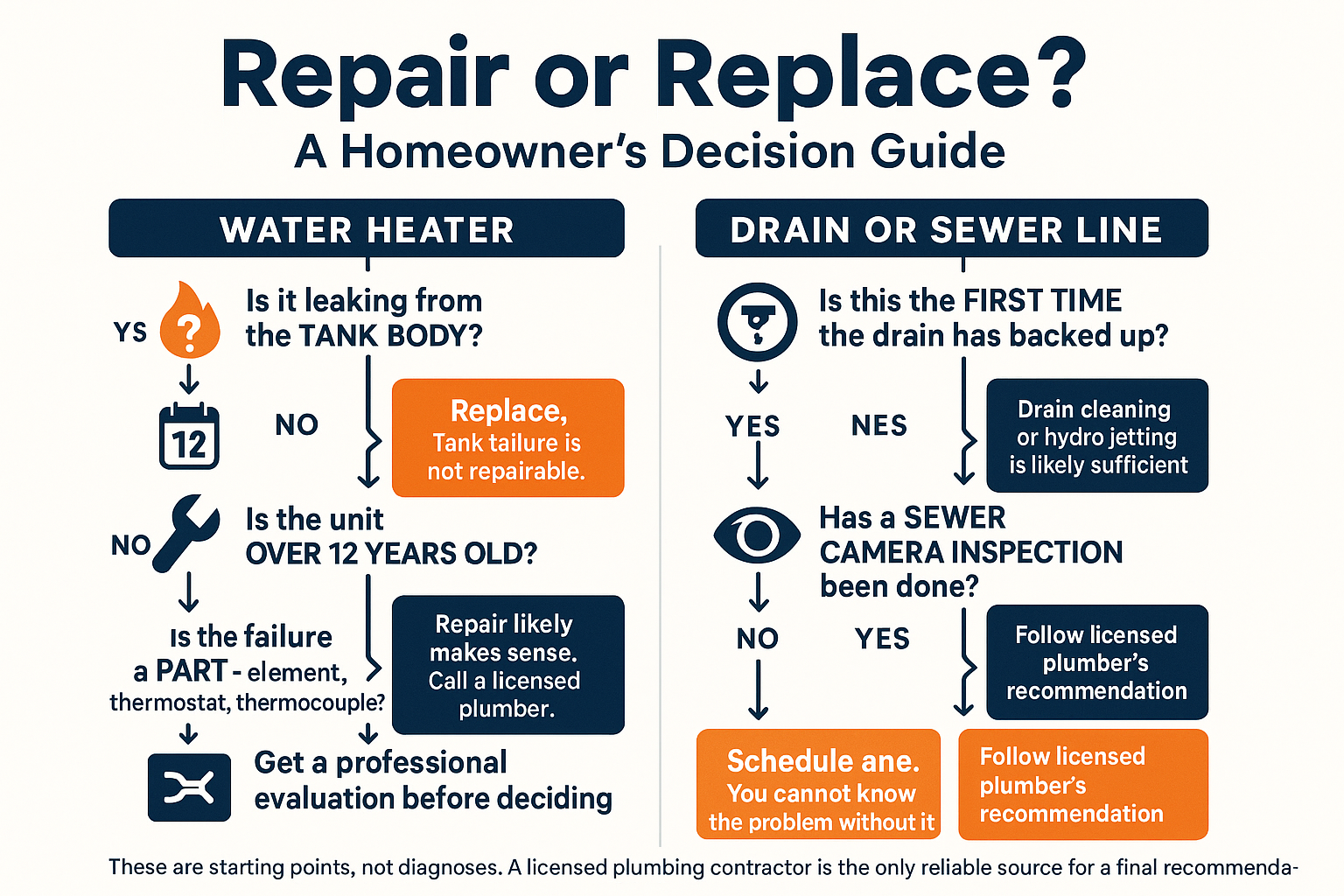
How to Think Through Repair vs. Replace
This decision flow covers the two most common judgment calls homeowners face: water heaters and drain or sewer lines.
Leaks: The Ones That Can Wait vs. the Ones That Cannot
Not every leak is an emergency, but every leak deserves a real answer — because the ones that go unaddressed have a way of becoming much larger problems.
A dripping faucet or a slow weep from a supply line fitting is usually a repair. The fix might be a new cartridge, a washer, or a compression fitting — parts a licensed plumber can swap in a single visit. The damage potential is low if you act within a reasonable window.
A leak you can’t see is a different situation entirely. If your water bill went up without explanation, you can hear water running when everything is off, or you notice warm spots on a concrete floor — those are signs of a possible slab leak. What happens to a home when a slab leak goes undetected is exactly as bad as it sounds. And how to know if a leak is under your foundation is a question worth reading through before you assume everything is fine.
Slab leak repair — whether through direct access, rerouting, or epoxy lining — is decided by the location and severity of the leak. A full repipe isn’t always what’s needed. But a full evaluation is always where it starts.
Frequently Asked Questions About Repair vs. Replace Decisions
My water heater is 8 years old and just stopped heating. Is it worth repairing?
At 8 years, most tank water heaters still have meaningful life left — especially if they’ve been maintained. The question is what failed. If it’s a heating element, thermostat, or thermocouple, a repair makes sense. If the tank itself is corroding or leaking from the body, you’re better off replacing it now rather than putting money into a unit that’s on its way out. Have a licensed plumber diagnose the actual failure before making the call.
My drain got cleaned six months ago and it’s slow again. Do I need the line replaced?
Not necessarily — but you do need a sewer camera inspection before anyone can give you an honest answer. Repeated backup after cleaning usually means something structural: root intrusion, a pipe belly, or significant scale buildup that cleaning can only partially address. The camera shows exactly what’s happening so the recommendation isn’t a guess.
A plumber told me I need to repipe my whole house. How do I know if that’s actually necessary?
Whole-home repiping is the right answer in specific situations — galvanized steel pipe that’s corroded through, polybutylene pipe that’s failing, or a home with widespread pinhole leaks throughout. But it’s not the answer for every old pipe. If you have concerns about the recommendation, a second opinion from another licensed contractor is completely reasonable. Ask the plumber to walk you through exactly which pipes are failing and why.
Is there any plumbing problem where I should stop and call 24/7, not wait until morning?
Yes. Active water flooding, gas odors, a sewer backup affecting multiple fixtures, and any situation where you’ve had to shut off your main water supply are all after-hours calls. If you smell gas specifically: leave the building immediately, don’t touch any electrical switches or open flames, and call from outside. Gas leak response is available 24 hours a day, 7 days a week. For other situations, when a plumbing problem becomes an emergency is a useful reference.
A fitting under my sink is dripping. Can I just tighten it myself?
Sometimes. A compression fitting that’s come slightly loose can often be hand-tightened without any damage. But if the fitting is corroded, if the leak is at a threaded joint, or if tightening doesn’t stop it — stop and call a plumber. Over-tightening old fittings can crack them and turn a small drip into a cabinet full of water.
Not Sure Which Way to Go?
If you’re sitting on a plumbing problem in Watsonville, Santa Cruz, or anywhere in Monterey County and you can’t tell whether it’s a repair or a replacement situation, the right move is a professional evaluation — not a guess. Maverick Plumbing Technicians, Inc. is a licensed and insured plumbing contractor (CSLB #1102966) with 24/7 emergency availability. Call (831) 515-9903 to talk through what you’re seeing, or request service through maverickplumbingtechnicians.com.
