

Direct Answer: It means the utility owns the main and the meter, and everything past the meter is yours. The notice tells you who owns the pipe, not where the water is escaping.
The call usually starts the same way. The water utility flagged continuous flow on the account, left a notice on the door or called, and told the homeowner the water is being lost past the meter.
One caller put it almost word for word: the city detected the leak and told him it was on his side of the meter. What he thought he had been handed was a diagnosis. What he actually had was a property line.
That is the single biggest misunderstanding I run into on these calls. So let me explain what that sentence really means for a Watsonville or Santa Cruz County property owner, how you can narrow the search yourself before anyone comes out, and what the locating work actually looks like once we do.
What “on your side of the meter” actually means
The utility owns the main in the street and the meter itself. Everything downstream of that meter belongs to you.
In practical terms, that is a lot of plumbing. On a typical Watsonville or Pajaro Valley lot, your side of the meter includes:
- The buried service line running from the meter box across the yard, planter beds, or driveway to the house
- The irrigation system, valves, and drip lines, which usually tee off before the house
- Hose bibs and any outdoor spigots
- Every supply line, shut-off valve, and fixture inside the house, including toilets and the water heater
- Any supply piping routed under a concrete slab
So a utility notice does not point at a spot. It rules out the street and hands you a search area that can run from the sidewalk to the back bathroom.
The useful next question is not “where is the leak” but “which of these four or five zones is losing the water.” That is a question you can start answering today, and it is a different job than confirming a leak exists. The utility already did that part.
How to narrow it down yourself before anyone comes out
Start with the cheap checks. The City of Santa Cruz Water Department points to toilets and irrigation systems as the most common sources of household water loss, and that matches what I see across Santa Cruz County and northern Monterey County. Those two account for a large share of the notices homeowners get.
Here is the order I would work in:
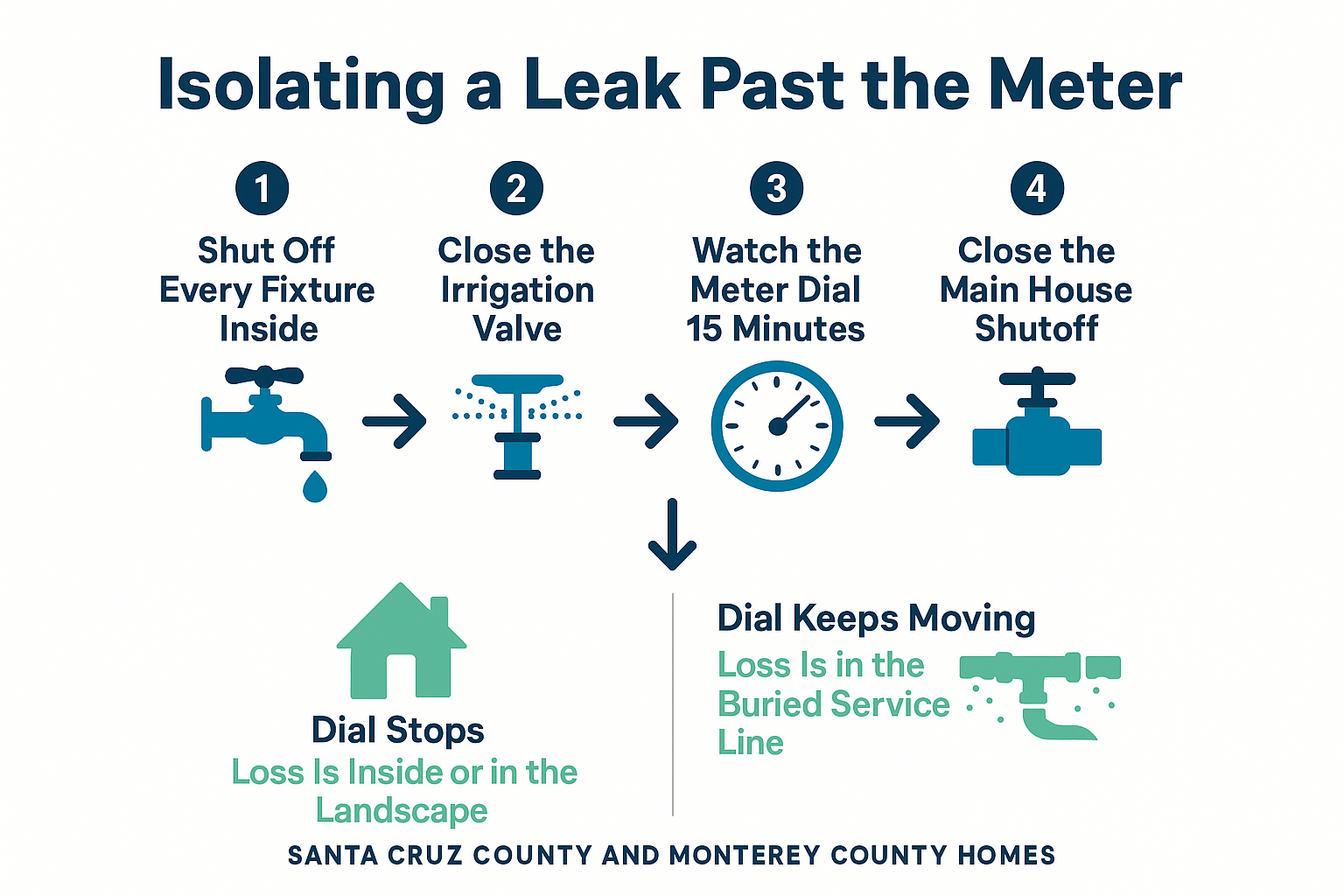
1. Turn off every fixture in the house. No laundry, no dishwasher, no ice maker filling, nobody in the shower.
2. Shut the irrigation system down at its valve. Then watch the low-flow dial on the meter for 15 minutes. If it stops creeping, the loss is on the landscape side.
3. Dye test your toilets. Put food coloring in the tank, wait 15 minutes without flushing, and check the bowl. Color in the bowl means the flapper is passing water around the clock.
4. Close the main house shutoff. If the dial is still moving with that valve closed, the water is being lost between the meter and the shutoff, which points at the buried service line.
That last result is the one that changes the conversation. A moving dial with the house isolated means the problem is underground, and that is where guessing gets expensive. Our walkthrough on reading your water meter for signs of a leak covers the dial-watching part in more detail if you want the step-by-step.
Which Zone Is Losing the Water
This is the mental map I use on the phone when a homeowner calls after a utility notice. Each zone past the meter has its own tell.
| Zone past the meter | How to check it | What the result points to |
|---|---|---|
| Toilets | Food coloring in the tank, no flushing for 15 minutes | Color in the bowl means a failing flapper or fill valve |
| Irrigation and drip lines | Shut the system down at its valve, then watch the meter dial | Dial stops moving, so the loss is in the landscape piping |
| Hose bibs and outdoor spigots | Visual and hand check at each bib and connection | Steady drip or wet soil at the wall |
| Buried service line | Close the main house shutoff and watch the dial | Dial still moving means the loss is between meter and house |
| Under-slab supply lines | Warm spots on the floor, running sound with fixtures off | Needs electronic locating before any concrete is cut |
The Isolation Sequence in Four Steps
If you only do one thing before calling anyone, do this. It takes about half an hour and it tells a plumber where to start.
Why Pajaro Valley ground hides a service line leak so well
Homeowners often tell me they walked the yard and found nothing, so the utility must be wrong. In the lower parts of Watsonville and across the Pajaro Valley, finding nothing is the normal result.
During the rainy season the soil is already saturated. There is no soft spot, no bright green patch, and no puddle, because the water leaving the pipe just follows the trench or disappears into ground that is wet from January to April anyway.
The pipe material matters too. Older service lines and galvanized supply piping fail from the inside out, so the outside of the pipe can look fine right up until a section lets go.
One homeowner in the Watsonville area reached out after a galvanized steel line under a poured slab burst. By the time they called, the water to the whole house was shut off and the conversation had moved from leak repair to repiping. That is the escalation a utility notice is warning you about. A slow loss on the bill and a house with no water are often the same pipe at two different stages, and the warning signs of a slab leak tend to show up well before the burst.
What a licensed plumber actually does after a utility notice
The question I get asked most at this stage is whether walls or the driveway are getting opened up. The answer is not until we know where the failure is.
Locating comes first, in this order:
- Pressure isolation. We close off sections one at a time and watch how pressure behaves to separate the house from the yard from the irrigation.
- Irrigation zones checked separately. Valves and drip lines get their own test rather than being lumped in with the service line.
- Acoustic and electronic locating equipment. Pressurized water escaping a pipe makes a sound signature we can follow and mark.
- Slab lines checked on their own. Under-concrete runs get isolated and traced before anyone touches the floor.
- Pinpointing before any digging or cutting. We mark the spot, then open the smallest access that gets us to it.
Once the failure point is confirmed, there are generally three paths: a targeted repair at the break, rerouting a section of line around the problem area, or replacing a run that is deteriorating along its whole length. Which one I recommend depends on what the line’s condition shows once it is exposed, not on a decision made in the driveway.
Cost questions I handle on the phone, because scope on a buried line is not something anyone should quote blind. Call and ask directly.
Keep the paperwork from the repair visit
This part gets skipped and it costs people money. Many California water utilities have a process for reviewing a bill after a leak is repaired, and those processes generally ask for proof that the work was done by a licensed contractor.
So hold on to everything from the visit:
- The written scope of work describing what failed and what was repaired
- Photos of the exposed pipe and the finished repair
- Any permit records tied to the job
- The invoice showing the contractor’s license number
Every utility sets its own rules, and Watsonville, Santa Cruz, and the districts serving Monterey County do not all handle it the same way. Ask your own water provider what their process requires rather than assuming yours works like a neighbor’s. And if your water bill has been climbing faster than your usage, that documentation becomes more valuable, not less.
Frequently Asked Questions About Leaks Past the Water Meter
Does the city pay for a leak on my side of the meter?
No. The utility maintains the main and the meter, and everything downstream of that meter is the property owner’s responsibility to repair. What some utilities do offer is a bill review or adjustment process after the repair is documented, which is a separate thing from paying for the work.
My yard is completely dry. Can I still have a buried leak?
Yes, and this is common in Watsonville and the Pajaro Valley. In winter the ground is already saturated, so escaping water follows the pipe trench instead of surfacing. A dry yard rules out nothing.
How fast do I need to deal with this?
If the meter is showing continuous flow, you are paying for water every hour and the pipe is not getting better. Galvanized lines in particular fail progressively, so the gap between a slow loss and a line that strands the house without water can be short. We keep 24/7 service available for the situations that tip over.
Can I just shut off the water until I decide what to do?
You can, and sometimes that is the right call overnight. Just know that closing the main shutoff stops the loss but also stops the house, and it does nothing for a leak that sits between the meter and that valve.
Is it worth repairing an old galvanized service line or should it be replaced?
It depends on what the pipe looks like once it is exposed. If the wall thickness is gone along the whole run, a spot repair usually just moves the next failure a few feet down the line, and replacing or rerouting that run is the more durable answer. That judgment gets made at the pipe, not over the phone.
Want the line located instead of guessed at?
One customer wrote that “he sent pictures of the plumbing repairs and installation to me even when I didn’t specifically request them,” and that is how we prefer to work on buried line jobs, since the photos and written scope are exactly what a utility bill review tends to ask for later. We are a licensed and insured plumbing contractor, CSLB #1102966, working throughout Santa Cruz County and Monterey County with service available 24 hours a day. If you have a notice in hand and a meter dial that will not stop moving, you can reach us at (831) 515-9903 or request service at maverickplumbingtechnicians.com.
