

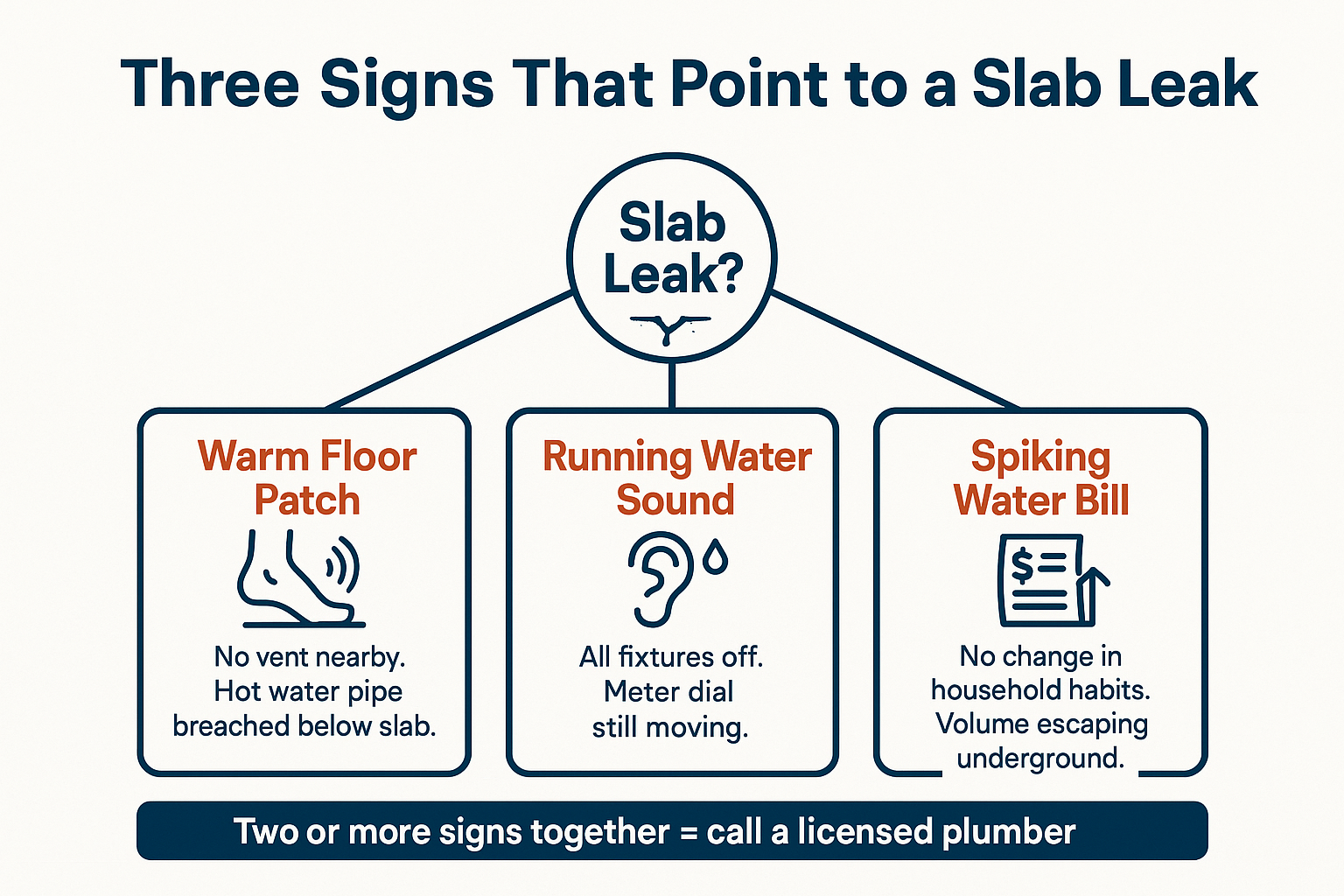
Direct Answer: A warm floor patch, the sound of running water when everything is off, and a spiking water bill are the three earliest signs of a slab leak beneath your foundation. When two or more appear together, call a licensed plumber for detection.
Most slab leaks don’t announce themselves with a burst pipe or a visible flood. They start quietly, beneath the concrete your home is built on, and they give you clues before they become a real crisis. The problem is that those clues are easy to dismiss one at a time.
I’ve seen this pattern repeatedly with homeowners in Watsonville and across Santa Cruz County. A warm spot on the floor gets blamed on the sun. A faint running-water sound gets chalked up to a neighbor. Then the water bill arrives and suddenly everything comes into focus. By then, the leak has usually been active for weeks.
This article walks through five warning signs of a slab leak, explains what’s actually happening beneath your foundation, and gives you a simple self-check to run before picking up the phone. The sooner you catch this, the smaller the repair scope, and right now, with Watsonville’s utility rates increasing each July through 2031, the financial case for acting early has never been more concrete.
1. A Warm or Hot Patch on the Floor with No Vent Nearby
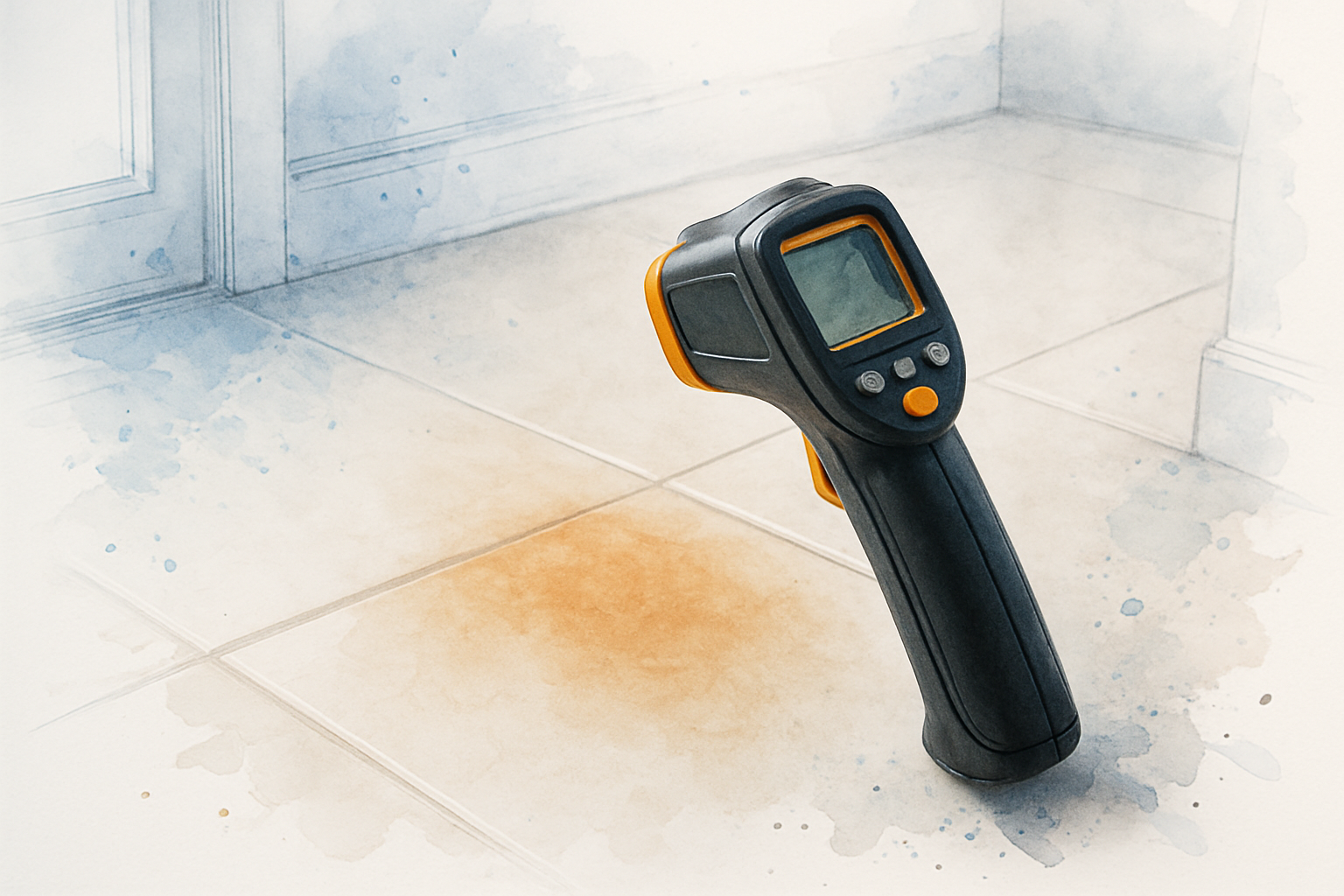
This is usually the first physical signal I hear homeowners describe, and it’s the one most people write off the longest. You step barefoot onto your tile or hardwood floor and notice one section feels noticeably warmer than everything around it. There’s no heating vent, no appliance, no sunbeam, just heat coming up from below.
What’s happening is that a hot water supply line running beneath the slab has a breach. Because those lines are pressurized, water escapes continuously from the moment the pipe fails. It pools against the underside of the concrete and transfers heat upward through the slab.
A supply-side leak is the more urgent of the two slab leak types, and here’s why: it never stops. Whether you’re asleep, at work, or on vacation, water is leaving the system. A drain-side leak only releases water during active fixture use, so it’s slower to cause structural damage, but it’s also harder to catch early because the signal is less obvious. Either way, warm floor patches deserve a closer look, not a shrug.
2. The Sound of Running Water When Every Fixture Is Off
This one is unsettling when you first notice it. The house is quiet, nothing is running, and there it is, a faint hiss or flow sound coming from the floor or wall.
Before you call anyone, I’d recommend running a quick meter check. Here’s how:
- Turn off every fixture, appliance, and irrigation valve in and around the home
- Go to your water meter at the street, typically set in a small covered box near the curb
- Watch the flow indicator dial (usually a small triangle or star-shaped marker) for one to two minutes
- If it moves with everything off, water is actively leaving your system somewhere
This test won’t confirm a slab leak specifically, the loss could be at a supply line in a wall, a running toilet, or a failing irrigation valve. But a moving meter with all fixtures off means there’s an active leak that warrants a professional evaluation. If you’ve already ruled out the simpler explanations and the sound persists, the slab is a strong candidate.
For more background on reading your meter, this walkthrough covers the process step by step.
3. An Unexplained Jump in Your Water Bill
If your household habits haven’t changed, same number of people, same routines, no new appliances, and your bill climbs anyway, that gap needs an explanation.
A supply-side slab leak loses water continuously, day and night, and that volume adds up fast across a billing cycle. Watsonville’s utility rate increase took effect July 1, 2026, with annual adjustments scheduled through 2031. The city’s own rate documents note that the wastewater treatment plant was built in 1961 and infrastructure costs have climbed sharply, and those costs get passed to ratepayers. Water wasted underground now costs more per gallon than it did last year, and that number will go up again next July.
I’m not going to put a dollar figure on what a slab leak might cost you monthly, every situation is different and I’d rather give you an honest evaluation than a guess. But I will say this: the longer it runs, the more billing cycles it touches, and the harder it becomes to recover on a refund or adjustment request with the utility.
The Three-Signal Combination That Points to a Slab Leak
When these three warning signs appear together, they tell a more specific story than any one of them does alone. Here’s how to read the combination.
4. Moisture, Mold, or Musty Smell Along Baseboards
By the time you see or smell this, the leak has been active for a while. Water working its way up through a slab doesn’t just sit in one place, it follows the path of least resistance. That often means it migrates outward and wicks up through flooring material, drywall, or the base of interior walls.
What you might notice:
- Soft or buckling spots in hardwood or laminate flooring near a wall
- Discoloration or bubbling at the base of drywall
- A persistent musty or earthy smell in a room even after cleaning
- Visible mold growth low on a wall, particularly at floor level
Mold in that zone is a separate problem that compounds the repair. You’re now looking at a plumbing fix plus remediation. That’s why the window between early warning signs and expensive secondary damage is shorter than most people expect, the concrete shifts, the slab cracks, and the moisture finds its way into places that are harder and more expensive to address.
If you’re unsure whether what you’re seeing is related to a pipe problem or something else, a professional leak detection evaluation can confirm the source before any access work begins.
5. Central Coast Risk Factors That Make Slab Leaks More Likely Here
Not every home carries the same risk. A few specific factors push Watsonville and Santa Cruz County properties toward slab leaks more than the regional average.
Hard water is common throughout Santa Cruz County. Mineral buildup from hard water doesn’t just affect fixtures and water heaters, it accelerates corrosion inside copper supply lines from the inside out, over time. If you want to understand the broader impact of hard water on your plumbing, this overview covers what it does to your system over time.
Seasonal soil movement is the other factor. The Watsonville and Santa Cruz area soil shifts noticeably after wet winters followed by dry summers. That lateral movement puts stress on buried supply lines. Homes that sat through significant rainfall this past season and then baked through a dry stretch are particularly worth watching.
Older copper piping adds another layer of risk. Homes with original copper supply lines and a history of hard water exposure are working with pipes that may have years of internal corrosion built up. If your home is older and hasn’t had a plumbing assessment recently, this guide on when repiping makes sense is worth a read.
The U.S. Geological Survey’s Water Resources data for California confirms that groundwater mineral content varies significantly by region, Central Coast water sources tend to run harder than many parts of the state, which is consistent with what we see in the field here.
Supply-Side vs. Drain-Side Slab Leaks: What’s Different
Both types of slab leaks cause damage, but they behave very differently, and that affects how quickly you need to act.
| Supply-Side Leak | Drain-Side Leak | |
|---|---|---|
| Water escapes when? | Continuously, line is always pressurized | Only during active fixture use |
| Urgency level | High, loss never stops | Moderate, but harder to detect early |
| Common early sign | Warm floor, running sound, high bill | Slow drainage, intermittent odor |
| Structural risk | Faster erosion under slab | Slower, but still causes long-term damage |
| Detection method | Pressure testing, acoustic detection | Camera inspection, dye testing |
What Happens If You Wait
A slab leak does not stabilize on its own. Water working under a foundation erodes the soil beneath the concrete. That erosion causes the slab to shift and crack. The cracking puts stress on the structure above, walls, door frames, flooring systems. And the moisture trapped in that zone creates the conditions for mold to take hold beneath your floors and along your baseboards.
By the time a homeowner calls because a door won’t close properly or a floor section has become visibly soft, the scope of what started as a pipe repair has grown considerably. I’ve seen cases where the plumbing fix was straightforward, but the secondary damage, to the slab, the flooring, and the drywall, added significant time and cost to the overall project.
If you’re not sure whether what you’re dealing with is an immediate emergency or something that can wait until morning, this breakdown helps you think through the timing decision. But with slab leaks specifically, earlier is almost always better.
Frequently Asked Questions About Slab Leak Detection in Watsonville
Can I confirm a slab leak myself before calling a plumber?
You can do a basic meter check, turn off everything in the house, then watch the flow indicator dial on your street-side meter. If it moves with all fixtures off, there’s an active leak somewhere in the system. That result alone doesn’t confirm a slab leak specifically, but it does confirm you need a professional evaluation. Leak detection equipment, including acoustic sensors and pressure testing, is what actually locates the breach beneath the slab.
My floor feels warm in one spot but my bill hasn’t changed yet. Should I still call?
Yes. A supply-side slab leak may not show up clearly on your bill until a full billing cycle has passed. The warm floor is already telling you something. Getting an evaluation now, before the bill arrives, is the better move.
Does a slab leak always mean the floor has to be torn up?
Not always. The approach depends on where the leak is, what type of pipe failed, and what the licensed plumber finds during the detection phase. In some cases a targeted repair is possible with minimal access. In others, particularly with older copper pipe and hard water corrosion throughout the system, a repiping evaluation makes more sense than a spot fix. That determination should come from a professional assessment, not an assumption.
How long do slab leak repairs typically take?
It varies. A straightforward targeted repair might be completed in a day. A more involved job that requires rerouting a supply line or repiping a section of the home takes longer. The detection phase typically happens first, and the repair plan follows from what that reveals. Maverick Plumbing handles both the detection and repair so the process stays with one licensed contractor from start to finish.
Is slab leak detection available as an emergency service?
Yes. 24/7 emergency service is available through Maverick Plumbing Technicians, Inc. If you have a supply-side slab leak and water is actively escaping, that qualifies as an urgent situation. Call (831) 515-9903 any time.
Ready to Get a Professional Evaluation?
If two or more of the signs in this article sound familiar, the right next step is a professional leak detection evaluation, not more waiting. Maverick Plumbing Technicians, Inc. (CSLB #1102966) handles slab leak detection and repair in Watsonville and throughout Santa Cruz County. Jorge takes the time to explain what’s happening before any work begins and follows up after the job to confirm everything is resolved. Call (831) 515-9903 any time, 24/7 emergency service is available, or request service at maverickplumbingtechnicians.com.
