

Direct Answer: Watsonville utility rates are increasing starting July 1, 2026, and rising annually through 2030. Any leak already adding to your bill will cost noticeably more per month going forward.
If you’ve noticed your water bill creeping up and chalked it up to normal usage, this is worth a few minutes of your time. Watsonville’s City Council proposed utility rate increases effective July 1, 2026, with water and wastewater rates set to climb annually through 2030. That’s not a temporary adjustment, it’s a multi-year shift in what every gallon costs.
The rate increases are tied to real infrastructure needs, including roughly $57 million in upgrades to the city’s wastewater treatment plant, which was built in 1961 and hasn’t had a major overhaul since 1986. According to reporting from Santa Cruz Local, the average household could see about $14 more per month to start, with further increases layered in each year after that.
What that means practically: a leak that felt like a minor annoyance last year is now a bigger monthly expense, and it’s going to get worse, not better, as the rate schedule climbs. I want to walk through what hidden leaks actually look like in Watsonville homes, and what the process of finding and fixing them involves.
Why Watsonville’s Water Chemistry Makes Leaks More Likely Over Time
Watsonville’s water supply comes from a combination of groundwater wells and surface sources. The city is also working to address chromium-6 in groundwater through treatment upgrades, which is part of what’s driving the rate increase. But for homeowners, there’s a direct plumbing implication that often goes unmentioned.
The mineral content and water chemistry running through older pipes in Watsonville homes accelerates corrosion over time. Galvanized steel pipes, which were common in homes built before the 1970s, are especially vulnerable. But even copper pipe, which was considered the upgrade, develops pinhole leaks as it ages, particularly when the water chemistry is working against it.
I’ve seen this play out in homes throughout Santa Cruz County. A homeowner notices a soft spot in drywall or a small stain on the ceiling and assumes it’s an old repair. A few months later, the water bill is up noticeably and the damage has spread. The pipe had been leaking slowly the whole time.
Hard water is prevalent throughout the region, and that mineral content doesn’t just cause scale buildup in water heaters, it contributes to the kind of long-term pipe degradation that leads to slow, hidden leaks. If your home has older supply lines, that’s relevant context when you’re looking at a higher utility bill with no obvious explanation.

What Hidden Leaks Actually Look Like Before You See Water
Not every leak announces itself with a wet floor or a dripping pipe under the sink. The ones that cost you the most money are usually the ones you don’t see for weeks or months. Here’s what actually tips people off in most cases:
- A water bill that’s higher than it should be for normal household usage, with no change in habits
- A sound of running water somewhere in the house when every fixture is off
- Unexplained moisture, soft spots in flooring, or a musty smell in a room that shouldn’t be damp
- Warm spots on a concrete floor, which can indicate a hot-water line leak beneath the slab
- A water meter that’s still moving when all fixtures are shut off
That last one is something any homeowner can check themselves. Your water meter can tell you if you have a leak, it only takes about a minute and requires no tools. If the dial or digital readout is moving with everything off, water is going somewhere it shouldn’t be.
The EPA estimates that household leaks waste nearly 10,000 gallons per year on average across U.S. homes, with roughly 10 percent of homes losing 90 gallons or more every single day. Against a backdrop of rising per-unit water charges in Watsonville, that kind of loss compounds fast.
A slab leak or a supply line leak inside a wall can run for a long time before causing visible damage. And the longer it runs, the more you’ve paid for water that soaked into your foundation or subfloor, not water your family used.
The Two-Step Process: Detection First, Then Repair
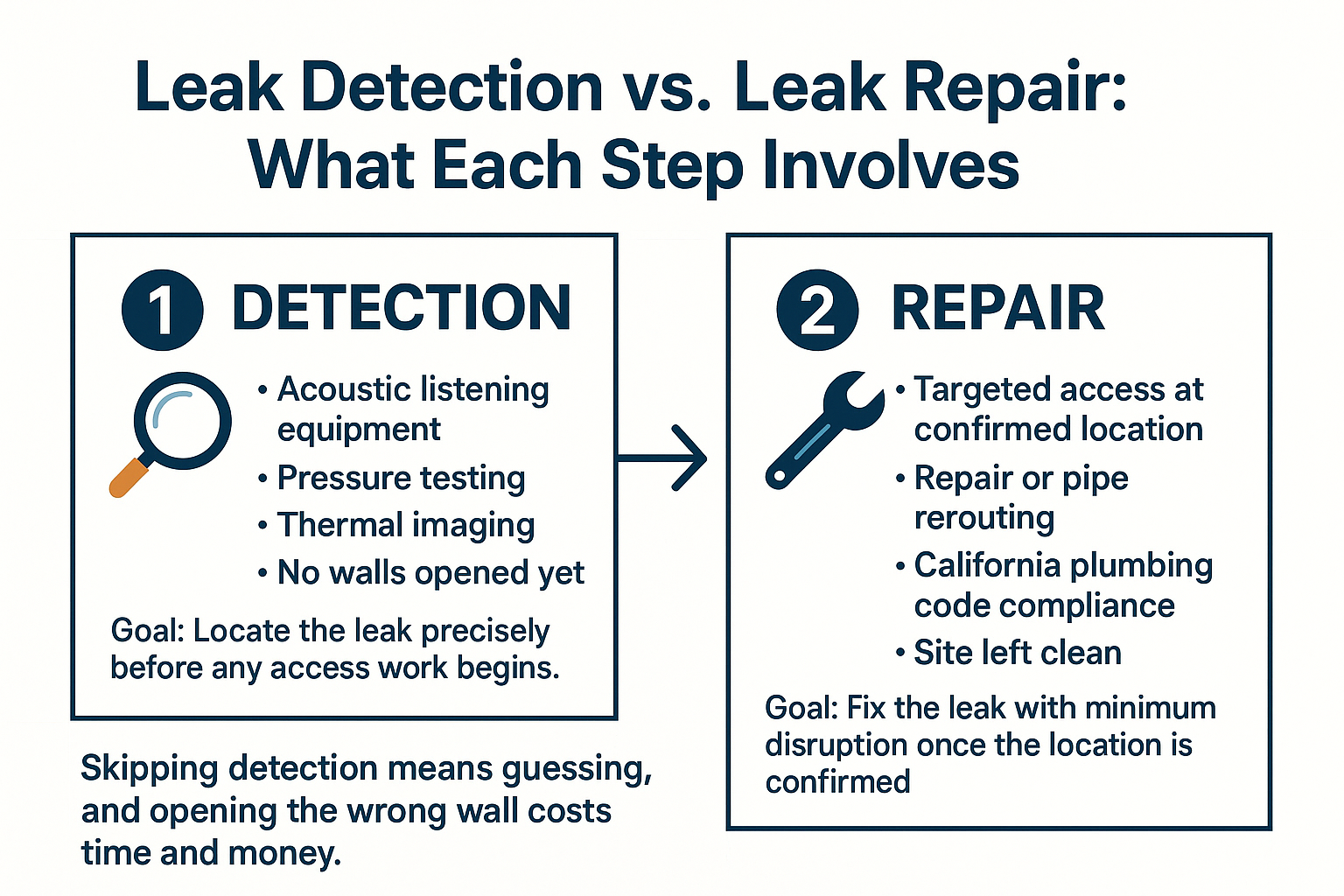
One thing that confuses a lot of homeowners is what actually happens when a plumber comes out for a suspected leak. Detection and repair are two separate steps, here’s how they work.
Detection Is Not the Same as Repair, and Knowing the Difference Helps
I want to spend a moment on this because it’s one of the questions I hear most often from homeowners who have never dealt with a hidden leak before. When someone calls us and says ‘I think I have a leak somewhere,’ the first job is to find it, not to start opening walls.
Leak detection is the diagnostic step. Using acoustic listening equipment, pressure testing, or thermal imaging, a plumber locates where water is escaping before any access work begins. This is especially important for slab leaks, where the pipe is embedded in concrete and the wrong guess means breaking up the wrong section of your floor.
Leak repair comes after the location is confirmed. At that point, the access is targeted and deliberate, not exploratory. For many supply line leaks inside walls, this keeps the repair footprint much smaller than people expect.
Understanding this two-step process helps you ask better questions when you call a plumber. Ask whether detection is included in the visit, what equipment they use, and what the findings will tell you before any repair work is authorized. A professional evaluation gives you a confirmed location and a clear scope, not a guess.
If you’re trying to figure out whether what you’re dealing with is urgent, our guide on when a plumbing problem becomes an emergency walks through that decision in plain terms.
Common Hidden Leak Types and What Usually Signals Them
Different leak types leave different clues. This table covers the most common ones I see in Watsonville and Santa Cruz County homes.
| Leak Type | Common Early Signs | What Makes It Harder to Catch |
|---|---|---|
| Pinhole leak in copper pipe (inside wall) | Soft drywall, small stain, faint musty smell | No drip visible; damage spreads slowly behind the wall |
| Slab leak (below foundation) | Warm floor spot, sound of running water, rising bill | No surface water; requires pressure testing or acoustic equipment to locate |
| Supply line leak (under sink or behind toilet) | Small puddle inside cabinet, rust staining on cabinet floor | Easy to miss if cabinet is full; can soak subfloor before noticed |
| Toilet flapper or fill valve leak | Toilet runs intermittently, water bill increase, hissing sound | No water on the floor; all water goes down the drain invisibly |
| Irrigation line or hose bib leak | Wet soil near exterior walls, higher bill in dry months | Below-grade lines and covered connections make visual checks difficult |
What Rising Rates Actually Mean for a Leak You’ve Been Putting Off
I’ve talked with homeowners who knew they had a slow leak for months, a toilet that runs a few minutes after flushing, a faucet that drips steadily overnight, and kept it on the ‘fix eventually’ list. That math changes when the per-gallon rate goes up.
A running toilet can waste 200 gallons or more per day depending on the severity of the flapper leak. At the current rate that’s already a meaningful line item. At the rates Watsonville is moving toward through 2030, the same toilet running the same way costs more every single year.
Fixture leaks are often the most straightforward to address. A dripping faucet or a running toilet that’s been ignored for months can frequently be resolved in a single visit, new flappers, fill valves, or cartridges are inexpensive parts, and the labor involved is usually minimal. The longer they run, the more you’ve spent on water your family didn’t use.
For anything more involved, a suspected slab leak, an unexplained bill spike, or moisture showing up in a place it shouldn’t, a professional diagnostic visit is the right starting point. Waiting costs money both in water loss and in the potential for structural damage that grows with time. You can find out more about what happens to a home when a slab leak goes undetected if you want the full picture of what’s at stake.
Frequently Asked Questions About Hidden Leaks and Rising Watsonville Water Bills
How do I know if my high water bill is from a leak or just normal usage?
The quickest check is your water meter. Shut off every fixture in the house, including the ice maker and any irrigation, and watch the meter for 15 to 20 minutes. If the reading changes, water is moving somewhere without your knowledge. This walkthrough explains exactly how to read your meter for a leak check.
Can I find a slab leak myself?
You can notice the signs, warm spots on the floor, a running-water sound with everything off, a water bill that’s gone up without explanation. But locating a slab leak precisely requires acoustic listening equipment or pressure testing. Opening concrete in the wrong spot adds cost and time. This is one where a professional diagnostic visit makes a real difference before any work begins.
Is leak detection a separate charge from the repair?
That depends on the contractor and the situation. Some visits fold detection into the service call; others quote them separately once the scope is clearer. The important thing is to ask upfront, before anyone starts work, what the visit includes, what equipment will be used, and what information you’ll have at the end of the diagnostic step. That sets clear expectations on both sides.
My toilet runs for a few minutes after flushing. Is that actually a significant leak?
It can be. A toilet with a worn flapper or a faulty fill valve can waste hundreds of gallons per day depending on how often and how long it runs. That’s been a nuisance line item for a while. Against Watsonville’s rising rate schedule, the same toilet running the same way will cost more each year through 2030. It’s worth fixing sooner rather than later.
Does Maverick Plumbing handle leak detection for suspected slab leaks?
Yes. Leak detection, including for slab leaks, is part of the services we offer for residential and commercial properties throughout Watsonville, Santa Cruz, and the surrounding area. If you’re seeing signs of a possible slab leak, a diagnostic visit is the right first step before any repair decisions are made.
Suspecting a Leak Before the Rate Increase Hits?
If your water bill has gone up without a clear reason, or you’re seeing any of the signs described above, a professional diagnostic visit is the right next step, before the new rate schedule makes a slow leak an even more expensive one. We serve homeowners and property managers throughout Watsonville, Santa Cruz, and the surrounding areas of Santa Cruz and Monterey County, with 24/7 emergency service available when the situation can’t wait. Call Maverick Plumbing Technicians at (831) 515-9903 or request service at maverickplumbingtechnicians.com.
