
Direct Answer: If your Watsonville home was built before the 1970s and you are seeing brown water, low pressure, or leaks in multiple locations, galvanized pipes are likely failing from the inside out and a repipe evaluation is worth scheduling.
I get calls from homeowners in Watsonville who already know what is wrong before they can name it. They say something like, ‘we have old galvanized pipes and I think the whole house needs repiping.’ And almost every time, they are right. They have been dealing with recurring leaks, low pressure, or discolored water long enough to recognize the pattern.
Galvanized steel was the standard pipe material in residential construction for decades, and a significant portion of homes here in Santa Cruz County that were built before the 1970s still have it running through the walls. The problem is not just that the pipe is old. It is that galvanized pipe corrodes from the inside out, and by the time the symptoms become obvious at the tap, the deterioration has typically been building for years.
This article focuses on two things: how to tell whether your home’s pipe system is genuinely failing, and what a repipe actually involves when that turns out to be the right path forward. I am not going to walk through every possible plumbing scenario. I am going to explain the specific situation that applies to most older Watsonville homes and what you need to know to make a good decision.
What Galvanized Pipe Actually Does to Your Water
Galvanized steel pipe is coated with zinc on the inside to resist corrosion. That coating does its job for a while, but it does not last forever. Once the zinc erodes, the bare steel underneath begins to rust. That rust does not just sit there, it accumulates on the interior walls of the pipe, narrowing the opening and shedding particles into the water flowing through it.
The first thing most homeowners notice is reduced water pressure. Water that used to come out of the shower with real force gradually gets weaker over years and then suddenly seems dramatically worse. By the time pressure drops noticeably, the interior of those pipes is often heavily restricted.
The other sign is discolored water, usually brown or rust-colored, especially first thing in the morning or after the water has been sitting. Some homeowners assume this is a water quality issue at the source. It usually is not. It is rust from inside the pipe itself coming out at the tap.
From there, pinhole leaks start appearing. A single pinhole leak in one location is worth repairing. But when leaks begin showing up in different areas of the home, in the bathroom, under the kitchen sink, behind an exterior wall, that is the pattern that tells me the pipe material itself has failed, not just one bad spot. Knowing when a repair is enough and when it is not is one of the most important distinctions in plumbing.
Why Hard Water Makes This Worse in Santa Cruz County
Watsonville and most of Santa Cruz County have measurably hard water, meaning the water supply carries a higher concentration of dissolved minerals, primarily calcium and magnesium. On its own, hard water is not a plumbing emergency. But when you pair hard water with galvanized supply lines that are already corroding, you get two damaging processes happening at the same time.
The corrosion weakens the pipe from the inside. The mineral scale builds up on top of that, adding to the restriction and accelerating fitting failures. I have opened walls in older homes here where the pipe interior was almost completely closed off from a combination of rust and scale.
This matters for the repiping conversation because it changes what you are solving for. Replacing corroded galvanized pipe with new copper or PEX addresses the structural failure. But if the underlying water quality issue is not addressed, hard water will continue to shorten the life of fixtures, reduce water heater efficiency, and deposit scale inside fittings over time. A whole-home repipe paired with a water softener installation is a different conversation than addressing either one alone, and it is worth having before work starts. The California State Water Resources Control Board provides public information on regional water quality that can help homeowners understand what is in their local supply.
Partial Repipe vs. Whole-Home Repipe: What Each One Covers
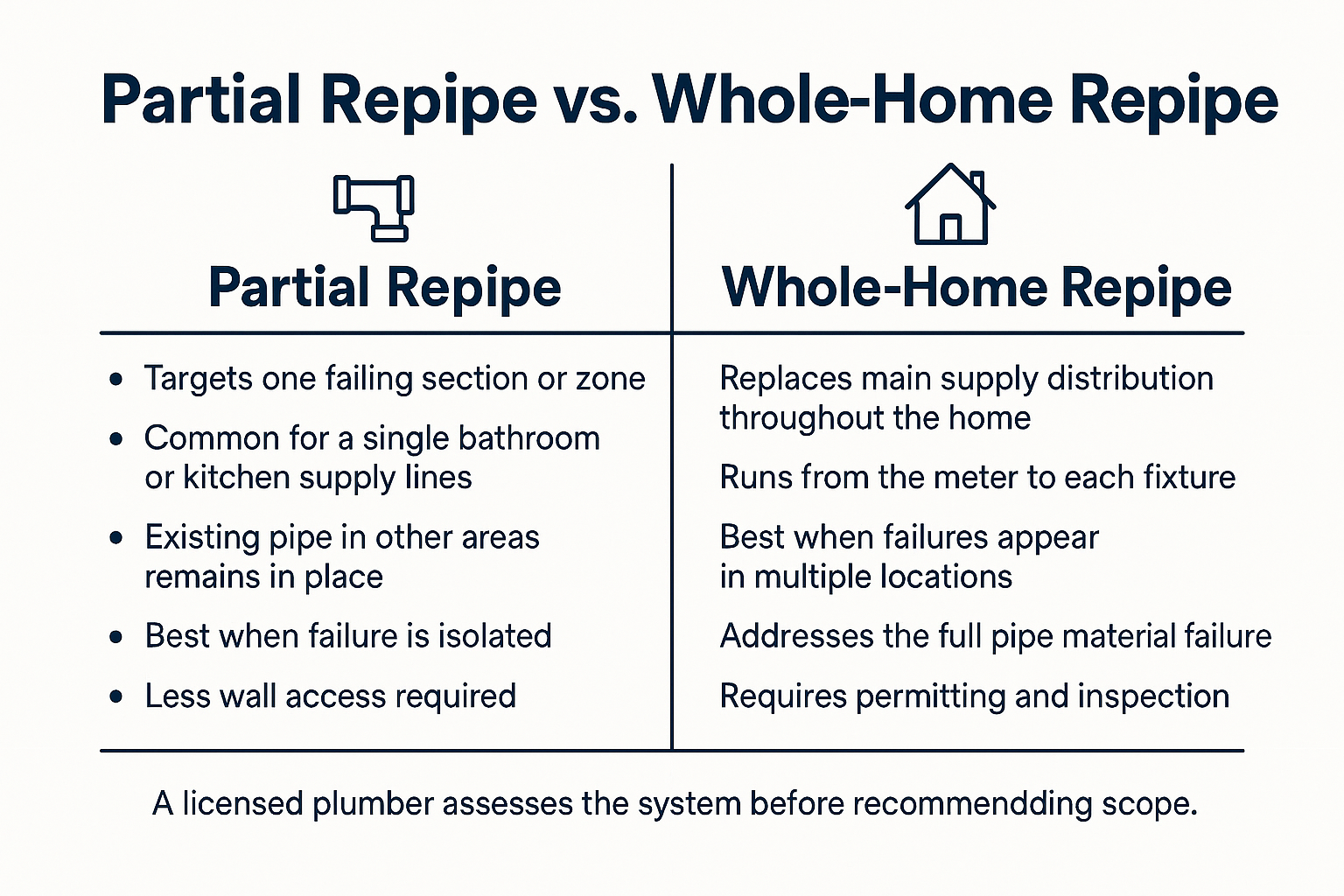
The scope of a repipe depends on how much of the existing pipe system has failed. Here is a straightforward breakdown of what each option typically involves.
Partial Repipe or Whole-Home: How the Decision Actually Gets Made
One of the most common questions I hear is whether a homeowner really needs the whole house repiped or just part of it. The honest answer is that it depends on what we find when we assess the system, and a good plumber will not push one answer before doing that assessment.
A partial repipe makes sense when the failure is genuinely isolated. For example, if the supply lines to one bathroom are galvanized and failing but the rest of the house was already repiped at some point, addressing just that section is practical and appropriate.
A whole-home repipe becomes the more practical path when:
– Leaks have appeared in more than one area of the home
– The same galvanized pipe material runs throughout the entire supply system
– Water pressure is low at multiple fixtures simultaneously
– The pipe interior is heavily restricted or corroded based on inspection
Watsonville homes built in different eras often have a mix of pipe materials from previous repairs or partial updates. That mixed system affects both the diagnosis and the recommended scope. I have been in homes where half the supply lines are copper from a previous repipe and the remaining galvanized sections are clearly the next thing to fail. In that case, finishing the job is usually the better call than waiting for the next leak.
The scope of work also affects the permitting requirements. In Santa Cruz County, plumbing work of this scale requires a permit, and permitted work is inspected. That is not a formality, it is the mechanism that confirms the work was done to California code and protects you when you eventually sell the property.
Copper vs. PEX: The Two Most Common Replacement Materials
When galvanized pipe gets replaced, the two most common modern materials are copper and PEX. Each has real advantages depending on the home and the specific installation.
| Factor | Copper | PEX |
|---|---|---|
| Durability | Very long track record, well-understood by inspectors | Durable and flexible, performs well in mild climates |
| Installation in finished walls | Requires more wall access, typically more cutting | Flexible tubing runs through walls with less surface disruption |
| Temperature range | Handles wide temperature swings well | Performs well in the mild Central Coast climate |
| Local code acceptance | Universally accepted in Santa Cruz County | Accepted under California plumbing code where properly installed |
| Best suited for | Homes where inspectors expect traditional materials, high-end installs | Homes where minimizing wall damage during install is a priority |
Licensing and Permits Are Not Optional for This Job
A whole-home repipe involves opening walls, running new pipe through finished living spaces, pulling a permit, and passing a plumbing inspection. This is not a job where saving money by hiring an unlicensed contractor makes any sense.
I want to be direct about this because I have seen what happens when repiping work is done without a permit or by someone without a valid license. The homeowner ends up with a repair that was never inspected, does not meet California code, and creates real liability problems when they try to sell the home or make an insurance claim.
In California, you can verify any contractor’s license through the California Contractors State License Board. A valid license number means the contractor is legally accountable for code compliance, permit accuracy, and inspection outcomes. Maverick Plumbing Technicians, Inc. holds an active CSLB license (#1102966) and handles permitting as part of every repiping job.
When multiple leaks have already caused water damage, the trail of repair costs adds up fast. Hidden water damage behind walls from slow leaks is a good example of what deferred decisions cost over time. A permitted repipe with a final inspection closes that loop.
Frequently Asked Questions About Repiping in Watsonville
How do I know if my Watsonville home still has galvanized pipes?
The most reliable way is to have a licensed plumber look at the visible supply lines near your water heater, under sinks, and in crawl spaces. Galvanized pipe is a dull gray color, slightly magnetic, and often shows surface rust on the exterior even before the interior has fully failed. If your home was built before 1970 and has not been repiped, there is a reasonable chance galvanized pipe is still in the walls.
Can I just repair the leaks as they show up instead of repiping?
You can, and for an isolated failure in an otherwise sound system, that is sometimes the right call. But when leaks start appearing in multiple locations, the repair-as-you-go approach gets expensive and disruptive fast. Each repair means opening a wall, patching, and repainting. If the underlying pipe material is failing throughout the house, chasing individual leaks one at a time usually costs more over time than addressing the whole system. A licensed plumber can assess whether the failures are isolated or part of a broader pattern.
Does a whole-home repipe require a permit in Santa Cruz County?
Yes. Whole-home repiping is a significant plumbing alteration and requires a permit in Santa Cruz County. Permitted work is inspected, which is actually in your favor as the homeowner. It confirms the work meets California code and protects you during a future sale or insurance claim. Any contractor who tells you a repipe does not need a permit is one I would not hire.
How long does a whole-home repipe typically take?
For most single-family homes, the pipe replacement itself takes one to three days depending on the size of the home, the existing configuration, and how much wall access is required. The permit inspection happens after the work is complete. PEX installs tend to require less wall opening than copper in finished spaces, which can reduce the overall disruption.
Will I need to be out of the house during a repipe?
You will be without running water for portions of the work, but you do not typically need to vacate the home entirely. The specifics depend on the scope and how the work is staged. A good plumber will walk you through the schedule before starting so you can plan accordingly.
Should I address hard water at the same time as repiping?
If your home has galvanized supply lines and measurably hard water, which is common throughout Santa Cruz County, it is worth having that conversation before the repipe is finished. Installing a water softener after new pipe is in place is straightforward. Addressing water quality at the same time means the new pipes and fixtures have a better chance of lasting as long as they should.
Ready to Find Out What Your Pipes Are Actually Doing?
If you are dealing with low water pressure, discolored water, or leaks showing up in more than one spot in your Watsonville or Santa Cruz home, a pipe assessment is the right first step. We serve homeowners throughout Santa Cruz County and parts of Monterey County, and we can tell you honestly whether a partial repair makes sense or whether a full repipe is the more practical path. Call us at (831) 515-9903 or request service at maverickplumbingtechnicians.com to get a straight answer from a licensed plumber who has worked in these homes.
