Direct Answer: Hard water in Santa Cruz County deposits calcium and magnesium minerals inside your pipes, water heater, and fixtures over time, reducing efficiency and shortening equipment life. A whole-home water softener addresses the source of the problem.
If you’ve noticed a white crusty ring around your faucet aerators, spots on your shower glass that won’t wipe off, or a water heater that seems to be working harder than it used to, hard water is almost certainly the reason. It’s not a cosmetic nuisance. It’s a mineral problem that works quietly inside your plumbing for years before it becomes obvious.
Throughout Santa Cruz County and much of the Central Coast, water carries measurable levels of calcium and magnesium. These minerals aren’t harmful to drink, but they are reactive. They build up on everything they touch, pipe walls, heating elements, valve seats, and fixture aerators, and that buildup compounds over time.
I want to walk through what hard water actually does to the specific parts of your plumbing that take the most damage, and what the realistic options are for addressing it. This isn’t a short-term fix situation, it’s a decision worth understanding before you make it.
Where Hard Water Does the Most Damage
The visible effects of hard water are annoying. The invisible ones are expensive.
Scale deposits on faucet aerators and showerheads are easy to see and easy to clean. But the same mineral process happening on the outside of your fixtures is also happening inside your supply lines, inside your water heater, and inside every valve and fitting in your home, just where you can’t see it.
The three areas that take the most consistent damage from hard water are:
- Water heaters, sediment settles at the bottom of tank units and acts as an insulating layer between the burner and the water, forcing the unit to run longer cycles to reach temperature
- Supply lines and pipe interiors, scale narrows the interior diameter over years, gradually reducing flow and putting additional pressure on fittings and valves
- Fixtures and appliances, dishwashers, washing machines, and coffee makers all have internal components that mineral deposits affect over time
Of the three, I’ve seen water heaters take the most consistent beating from hard water conditions in this area. A tank unit operating for several years in hard-water conditions without periodic flushing can lose meaningful efficiency, and often starts showing signs of sediment stress long before it reaches its expected service life. If you’ve found yourself asking how long a water heater should actually last, hard water is often part of the answer when the unit falls short of that range.
What Hard Water Specifically Does to Tank and Tankless Water Heaters
Tank water heaters and hard water have a straightforward conflict. Minerals settle out of heated water and collect at the bottom of the tank. That sediment layer sits between the burner and the water, making the unit work harder to heat the same volume. You might not notice the efficiency loss immediately, but you’ll notice it in your gas or electric bill over time, and eventually in the unit’s behavior, like longer recovery times or the popping and rumbling sounds that indicate sediment is boiling underneath.
Tankless water heaters are sometimes seen as more durable in hard-water conditions, and in some ways they are. But they have a specific vulnerability: scale buildup inside the heat exchanger. The heat exchanger is where cold water passes through a narrow channel and gets heated rapidly. In hard-water conditions, that channel collects mineral deposits on its interior walls. Without regular descaling, typically once a year in hard-water areas, flow restriction builds up and the unit eventually throws error codes or begins delivering inconsistent temperatures. I’ve written about tankless water heater problems that aren’t what they look like before, and scale is behind more of those service calls than most homeowners expect.
Periodic flushing for tank units and scheduled descaling for tankless units are both real maintenance needs, not optional ones, for any property in Santa Cruz County dealing with hard water.
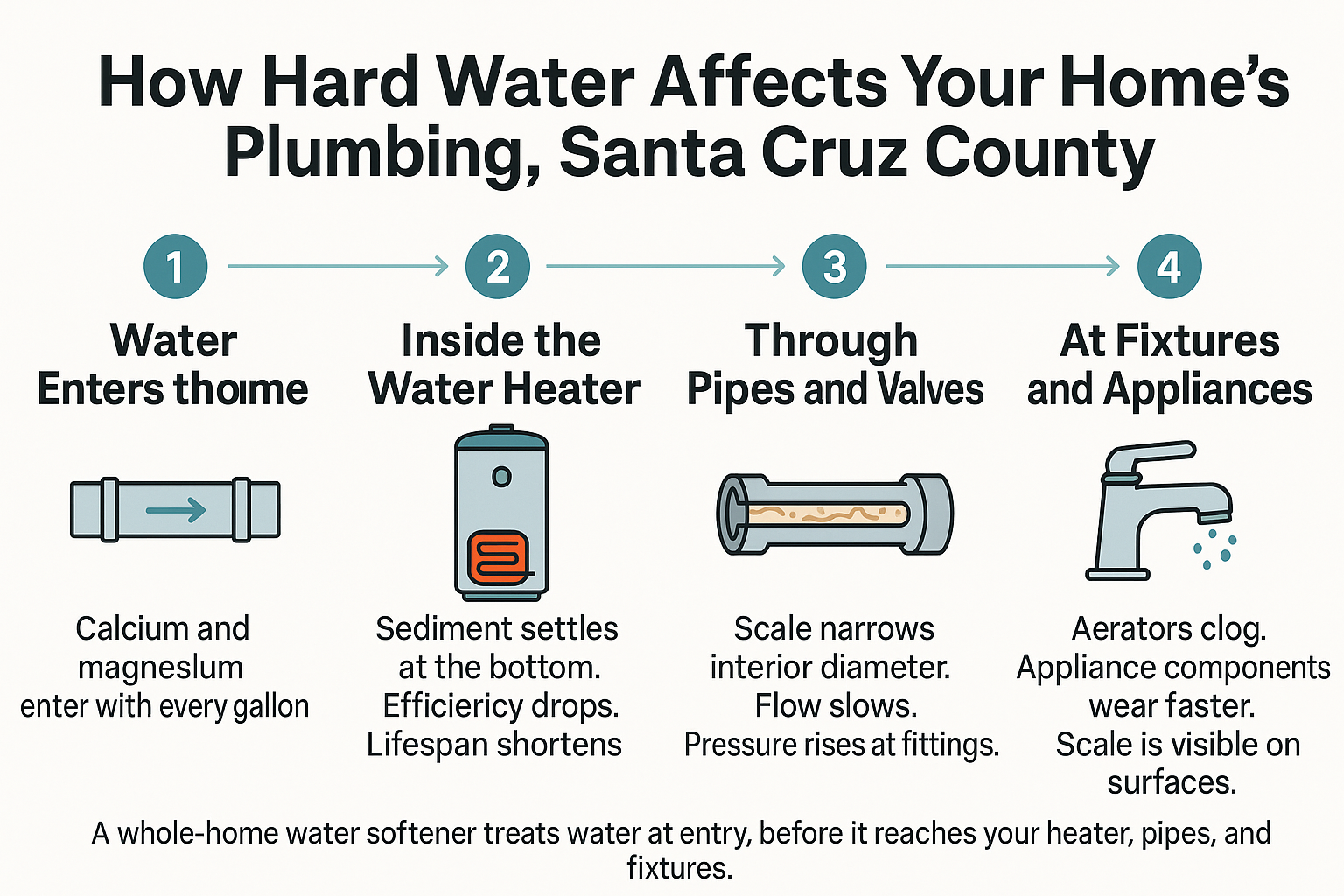
How Hard Water Moves Through Your Home’s Plumbing
This diagram shows the path hard water takes through a typical Central Coast home and where mineral buildup creates the most problems.
How a Water Softener Actually Works, and What It Doesn’t Do
A water softener is a specific type of treatment system, and it’s worth being clear about what it does and what it doesn’t.
A whole-home softener connects to your main supply line and processes water through a resin bed before it reaches your pipes and appliances. The resin exchanges calcium and magnesium ions, the minerals that cause scale, for sodium ions. The result is water that is significantly less reactive with pipe walls, heating elements, and fixture components. That’s the hard water problem, addressed at the source.
What a softener does not do is address drinking water quality concerns like taste, odor, chlorine, or other dissolved compounds. That’s a separate problem, and it’s typically handled by a point-of-use reverse osmosis system at the kitchen tap. Many homeowners in Watsonville and Santa Cruz end up with both: a softener protecting the plumbing and appliances, and an RO system providing clean drinking water at the kitchen sink. The California Water Boards publish information on local water quality reports that can help you understand what’s specifically in your water supply, which is a reasonable starting point before making any treatment decision.
Installing a water softener also comes with ongoing maintenance. The resin bed needs to be recharged with salt regularly, and the brine tank needs periodic cleaning to prevent bridging and buildup that can affect how the system performs. Filter components on some systems have service intervals that matter. One of our customers, Cyndee M., described exactly the kind of maintenance support that makes a difference long-term: ‘Jeorge orders the filters for me and comes to replace them. I do not have to call and remind him that it is time to replace them. He calls me to set a date to care for the soft water system.’ That kind of ongoing relationship is how a softener actually stays effective over years, not just the installation day.
Water Softener vs. Reverse Osmosis: What Each System Treats
These two systems address different problems. Many households benefit from both, but they are not interchangeable.
| System | What It Treats | Where It’s Installed |
|---|---|---|
| Whole-Home Water Softener | Calcium and magnesium (scale-causing minerals) | Main supply line, treats all water in the home |
| Reverse Osmosis System | Taste, odor, dissolved solids, chlorine, sediment | Point-of-use, typically under the kitchen sink |
| Both Combined | Hard water damage to plumbing AND drinking water quality | Softener at entry, RO at kitchen tap |
What Installation Actually Involves
Water softener installation isn’t a plug-in appliance job. It involves connecting to your main supply line, routing a drain for brine discharge, and in many cases, coordinating placement relative to your water heater and other appliances so treated water reaches the right points of use throughout the home.
In Santa Cruz County, installation requires a licensed plumber, and depending on the scope of the connection, particularly if it involves changes to the main supply configuration, a permit may be required. This is one area where going the DIY route or using an unlicensed handyman creates real problems, both for code compliance and for making sure the system is sized correctly.
Undersizing a softener is a common mistake. A system sized for a two-person household won’t keep up with a larger family or a high-use property, and the resin bed will exhaust its capacity before it regenerates, which means you’re back to running hard water through your plumbing. A licensed contractor will look at the home’s current plumbing layout, water usage patterns, and existing water quality before recommending a system configuration. If you’re also dealing with aging supply lines alongside the hard water problem, that’s worth assessing at the same time, old pipes and new problems often show up together in older homes throughout the county.
Frequently Asked Questions About Hard Water and Water Softener Installation
How do I know if my water is actually hard enough to need a softener?
Scale buildup around faucet aerators, spots on glass shower doors, and a water heater that seems to be running less efficiently than it used to are all practical signs. Your local water utility can also provide a water quality report with specific hardness measurements for your area. In Santa Cruz County, measurable hardness is common enough that it’s worth checking rather than assuming your water is fine.
Will a water softener fix my water heater problems?
It will address the cause of mineral-related damage going forward, but it won’t reverse sediment that has already accumulated inside an existing tank unit. If your water heater is already showing signs of sediment stress, flushing or professional service should happen alongside or before installation, not after. A softener protects the equipment from that point on.
Does softened water affect drinking water quality?
Softening replaces calcium and magnesium with a small amount of sodium. For most people, this is not a health concern, but those on sodium-restricted diets sometimes prefer a reverse osmosis system at the kitchen tap rather than drinking softened water. An RO system removes the sodium along with other dissolved solids and is a common pairing with a whole-home softener.
Do I need a permit to install a water softener in Santa Cruz County?
It depends on the scope of the installation. Connections to the main supply line and changes to the home’s plumbing configuration can require a permit under California plumbing code. A licensed plumbing contractor (CSLB #1102966) will determine what’s required based on the specifics of your home’s setup before any work begins.
How much maintenance does a water softener actually need?
The resin bed needs to be recharged with salt on a regular basis, how often depends on water hardness and household usage. The brine tank needs periodic cleaning to prevent bridging, where salt forms a crust that blocks proper regeneration. If your system includes a filter, that has its own service interval. Staying on a consistent schedule matters, a softener that isn’t maintained regularly won’t perform the way it’s supposed to.
Ready to Stop Hard Water from Shortening the Life of Your Plumbing?
We install whole-home water softeners and reverse osmosis systems for homeowners throughout Watsonville, Santa Cruz, and the surrounding areas, and we assess your current plumbing layout before recommending any system so you get the right configuration for your home. If you’re noticing scale buildup, shorter-than-expected equipment life, or you just want to understand what your water is actually doing to your plumbing, give us a call at (831) 515-9903 or request service at maverickplumbingtechnicians.com. We’re licensed and insured (CSLB #1102966) and ready to take a look.
