
Direct Answer: Fall is the window for commercial sewer main line maintenance. A camera inspection first tells you whether grease, roots, a belly, or a broken section is the problem, which decides the clearing method.
A sewer main does not pick a convenient moment to back up. It picks a Friday night with every room occupied, or a Saturday lunch rush with the dining room full and the floor drain in the kitchen starting to burp.
I have watched that call come in from motels on Ocean Street and restaurants out in Watsonville, and the pattern is always the same. By the time the line announces itself, the owner has lost control of the schedule, the method, and the order the work gets done in.
Right now, in the fall, you still have all three. This is about what planned main line work looks like before the rain sets in, what a camera run actually tells you, and how to schedule the visit around guests, tenants, and a kitchen that opens at ten.
The Scheduling Advantage Commercial Owners Have in October
Earlier this year an owner who runs two motels here in town reached out about clearing the main sewer lines at both properties. The part that stood out was not the scope. It was that he said he was flexible on the dates.
That posture is the whole ballgame. A flexible date means we can sequence the two properties, pick low occupancy mornings, and stage the work so no building loses fixtures during check-in.
Compare that to an active backup. Then the date is today, the time is now, and the sequence is whatever stops sewage from reaching a guest room floor.
Here is what you keep when you book the work early:
- The day and the time window, so you can work around occupancy, prep shifts, or tenant notice requirements
- The method, because there is time to inspect first and then choose how to clear the line
- The order of operations across multiple buildings or multiple units
- The documentation, including camera footage and photos that go into the property file
None of that survives an emergency. Plumbing problems in a business hit differently than at home for exactly this reason: the repair is rarely the expensive part of the day.
Why a Line That Drained Fine in September Backs Up in January
Rain does not clog your sewer. It changes the conditions the line has to work in, and a marginal line stops being marginal.
NOAA’s Climate Prediction Center outlook issued in late August 2026 put coastal California in the above normal precipitation category for December through February, with the wettest signal running into late winter and peaking somewhere around January through March. Nobody can promise you a storm season, and I will not pretend to. But the odds are tilted enough to be worth acting on.
Here is the mechanism. When groundwater rises across the Pajaro Valley floor, water pushes into any cracked joint, bad seal, or offset in your lateral. That is infiltration, and it eats the spare capacity your line was quietly relying on.
Now add the other half of the problem. Fats, oils, and grease from food service operations harden on the pipe wall and narrow the usable diameter over time, which is a well documented cause of sewer backups and overflows according to the University of Kentucky grease interceptor program.
So in September you have a pipe at maybe 60 percent of its diameter, draining slowly but draining. In January that same pipe is fighting groundwater coming in, a full house using every fixture at once, and a grease layer that has grown since summer. That is the night it stops.
What a Diagnosis-First Visit on a Commercial Main Line Actually Looks At
Owners rarely see this part, so it gets skipped. A cable run down the line clears an opening and the water goes down, everyone feels fine, and the same call comes back in about eight weeks. The second call almost always lands at a worse hour.
Running a camera first changes the order of the decision. The inspection determines the method and the scope, not the other way around.
On a motel or restaurant main, a camera run is looking for four distinct things:
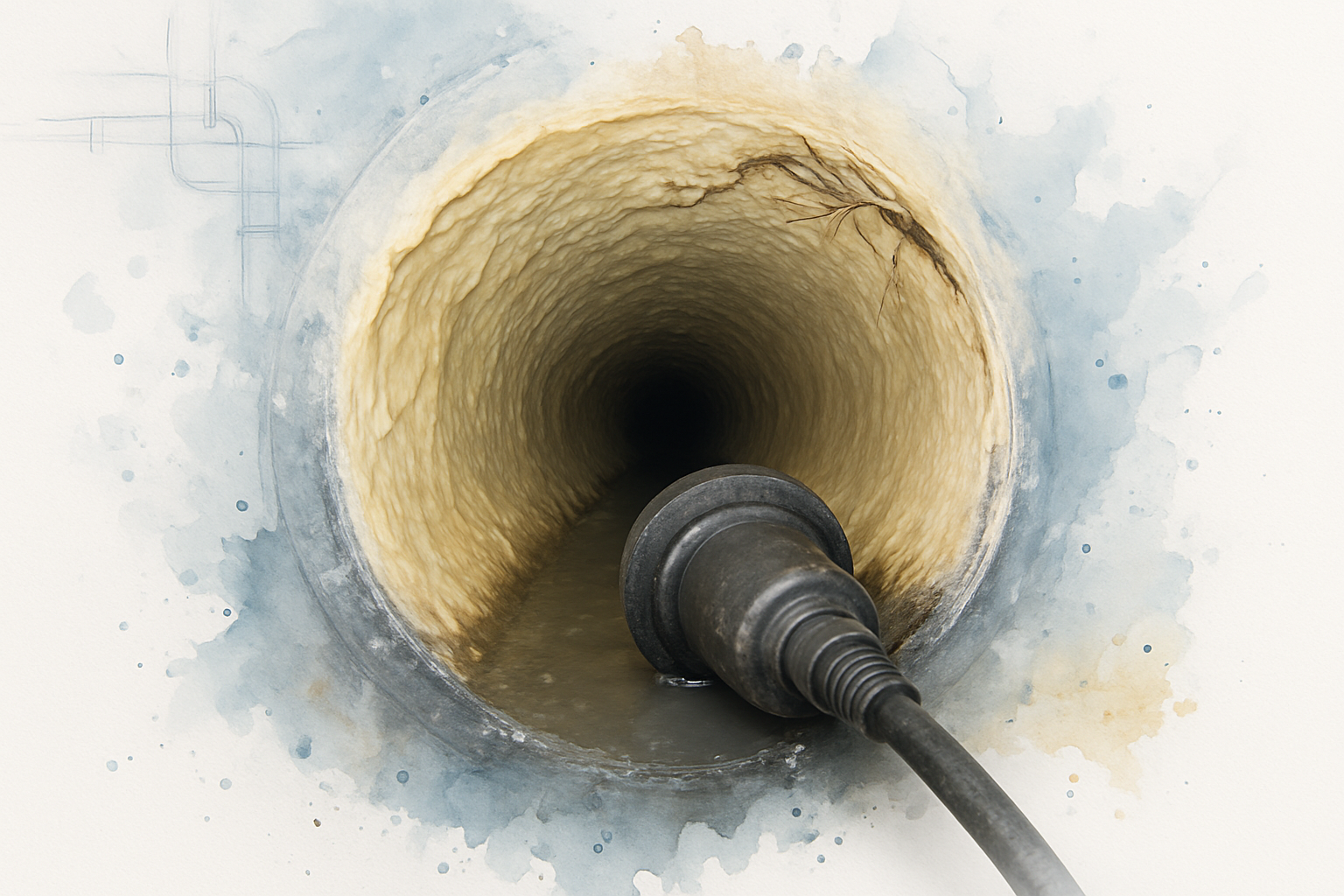
- Hardened grease coating the pipe wall, usually tracing back to a kitchen line
- Root intrusion at a joint, common with the mature trees around older Santa Cruz County properties
- A belly, meaning a sagging section holding standing water that collects solids every single day
- A broken or offset section that no amount of clearing will fix
Those four findings lead to four different conversations. Grease on the wall points toward hydro jetting, because high pressure flushing scours the pipe wall instead of punching a hole through the blockage. Roots at a joint point toward clearing plus a plan for the joint itself.
A belly or a break is a repair discussion, not a cleaning discussion. If you want more on what the footage shows and how to read it, this breakdown of what a sewer camera actually shows covers it.
What the Camera Finds and What It Means for Your Line
This is the shorthand I use when walking an owner or facilities contact through footage on a laptop in the parking lot.
| What the camera shows | Likely cause | What it typically leads to |
|---|---|---|
| Pale buildup coating the pipe wall, narrowed opening | Fats, oils, and grease from kitchen discharge | High pressure flushing of the affected run, plus a look at grease handling upstream |
| Fine root hairs or a root mass at a joint | Root intrusion through a failing joint or crack | Clearing the intrusion, then a decision on the joint itself |
| Standing water sitting in one section with no slope | A belly or sag in the line | Repair discussion, since clearing will not restore grade |
| Offset pipe, visible crack, or collapsed section | Structural failure, shifting soil, or age | Sewer line repair scoped from the footage |
| Clear pipe wall, good flow, clean joints | Line is in serviceable condition | Documented baseline for the property file and a maintenance interval |
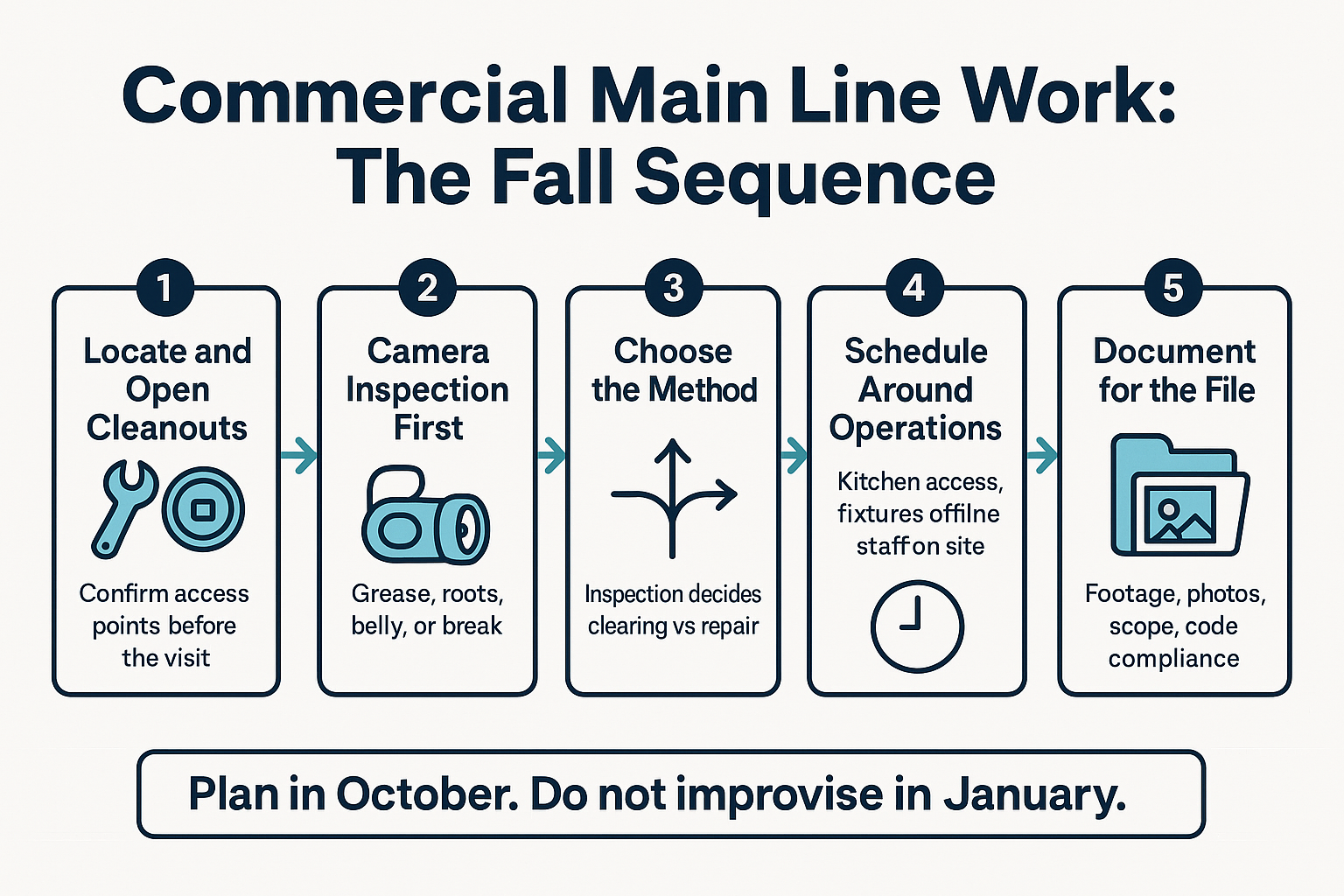
The Fall Window, Start to Finish
Here is the sequence I recommend for a commercial property that wants the work handled before the wet months arrive.
The Scheduling Details That Make or Break a Commercial Visit
Roughly 15 percent of the calls we take in a month come from facilities contacts, property managers, and business owners calling on behalf of a motel, gym, retail space, restaurant, or rental unit. Nearly all of them are working around tenants, business hours, or a guest departure the same day.
That timeline pressure is different from a homeowner’s. A homeowner wants the problem gone. A property manager needs the problem gone without taking the building offline during the hours it earns money.
Winter makes that harder on our end too. Urgent residential calls absorb the same day openings during storm weeks, so placing planned commercial work on a specific October morning is far easier than placing it on a specific February morning.
When a commercial job gets scheduled, these are the questions that actually determine how smoothly the morning goes:
- Kitchen access before prep starts. A main that serves a restaurant line is usually best worked before the first prep shift, not between services.
- Which fixtures go out of service and for how long. Guest rooms, public restrooms, and laundry all need a realistic window, not a vague one.
- Who on staff needs to be there. Somebody has to open gates, point out cleanouts, and sign off on findings.
- Where the cleanouts are and whether they are buried. Paving, landscaping, and storage carts hide more cleanouts than you would think.
- Multi-building sequencing. Two properties in one day only works if the order is set in advance.
If you own apartments or multi-unit buildings alongside commercial space, the same fall logic applies, and multi-unit sewer systems come with their own timing considerations.
Restaurant Build-Outs: The Plumbing Gets Decided on Paper
The second half of this season’s commercial work is tenant improvements. A contractor reached out recently about a restaurant build-out in Watsonville, saying the plans would be ready that week and construction was starting soon.
That is a common pattern, and honestly it is often already a little late in the sequence. By the time plans are final, most of the plumbing decisions have already been made by someone drawing lines on a page.
For a commercial kitchen, the items that get locked in at the plan stage include:
- Grease handling and where that discharge goes before it reaches the main
- Floor sinks and floor drains, including placement under equipment
- Venting for the fixture layout as drawn
- Fixture counts against what the occupancy and use actually require
- Hot water demand, which for a commercial kitchen is a very different calculation than a residence
A licensed plumbing contractor reading the plans early tends to catch conflicts while they are still cheap to move on a drawing. Moving a floor sink on paper is a pencil stroke. Moving it after the slab is poured is a different project.
I am not going to put numbers on any of that here, because scope varies enormously by space, by building age, and by what the previous tenant left behind. That is a conversation to have with a contractor looking at your actual plans.
What Ends Up in Your Property File
For a property manager, the work product is not just a cleared line. It is the record that proves the line was cleared, when, by whom, and what condition it was in.
That means camera footage, photos of the work, the scope that was performed, and confirmation it was completed to code. Those documents matter when a tenant disputes a backup, when a building changes hands, or when you are justifying a maintenance budget to an ownership group.
What commercial clients mention most often in reviews is exactly this habit. One customer put it plainly: “he sent pictures of the plumbing repairs and installation to me even when I didn’t specifically request them” – Karen M.
Another described a courtesy call half an hour before arrival and a follow up call the day after the install to confirm everything was still working. For a facilities contact juggling six properties, that is the difference between a vendor you chase and one you do not.
Frequently Asked Questions About Commercial Sewer Main Line Maintenance
How often should a motel or restaurant main line be cleaned?
It depends on what the camera shows. A restaurant main carrying heavy kitchen discharge usually needs attention on a much shorter interval than a retail space or an office building. The right answer comes from the first inspection, which gives you a baseline to measure against.
Can you do the work without shutting down my business?
Usually, yes, if we plan it. Most commercial main line work gets done before opening or during a slow window, with specific fixtures offline for a defined period rather than the whole building. The key is knowing in advance which fixtures feed the section being worked on.
Is cable snaking or hydro jetting better for a commercial line?
They solve different problems. Cabling punches through a blockage, which is useful for an obstruction or roots. Hydro jetting scours the pipe wall, which is what grease buildup actually requires. Running the camera first is how you know which one your line needs instead of guessing.
What if the camera finds a break instead of a clog?
Then clearing the line will not solve it, and you need a repair scope instead. The upside of finding that in October is that you can plan the repair, arrange access, and notify tenants on your own timeline rather than during a backup.
Do you handle the plumbing on restaurant tenant improvements?
Yes, as a licensed plumbing contractor. The plumbing scope on a food service build-out covers grease handling, floor sinks and drains, venting, fixture counts, and commercial hot water demand. Getting a plumber on the plans early is worth more than getting one on site early.
Planning main line work before the rain?
Maverick Plumbing Technicians, Inc. is a licensed and insured plumbing contractor (CSLB #1102966) serving Watsonville, Santa Cruz, Santa Cruz County, and Monterey County, and our commercial work is documented and completed to code. If a line does fail mid season, 24/7 emergency response is available. You can reach our team at (831) 515-9903 or request service at maverickplumbingtechnicians.com.
