

Direct Answer: A sewer camera inspection shows the inside of your sewer lateral on video — identifying cracks, root intrusion, pipe offsets, and blockages so a plumber knows exactly what’s wrong before any digging starts.
If your sewer has backed up twice in the past year, you already know something is off. The question most homeowners ask me at that point isn’t whether to snake it again — it’s whether something bigger is happening underground that’s going to keep coming back until it’s fixed properly.
That’s exactly the situation where a sewer camera inspection stops being optional. In Watsonville and Santa Cruz, I see this play out regularly: a homeowner gets their drain cleared, things seem fine for a few months, and then the same backup returns. Without a camera, you’re guessing at the cause every single time.
This article breaks down what the camera actually shows, what each condition means for your pipe, and — because it directly affects property owners across Santa Cruz County — how local ordinance requirements tie into the process.
What the Camera Actually Sees Inside Your Pipe
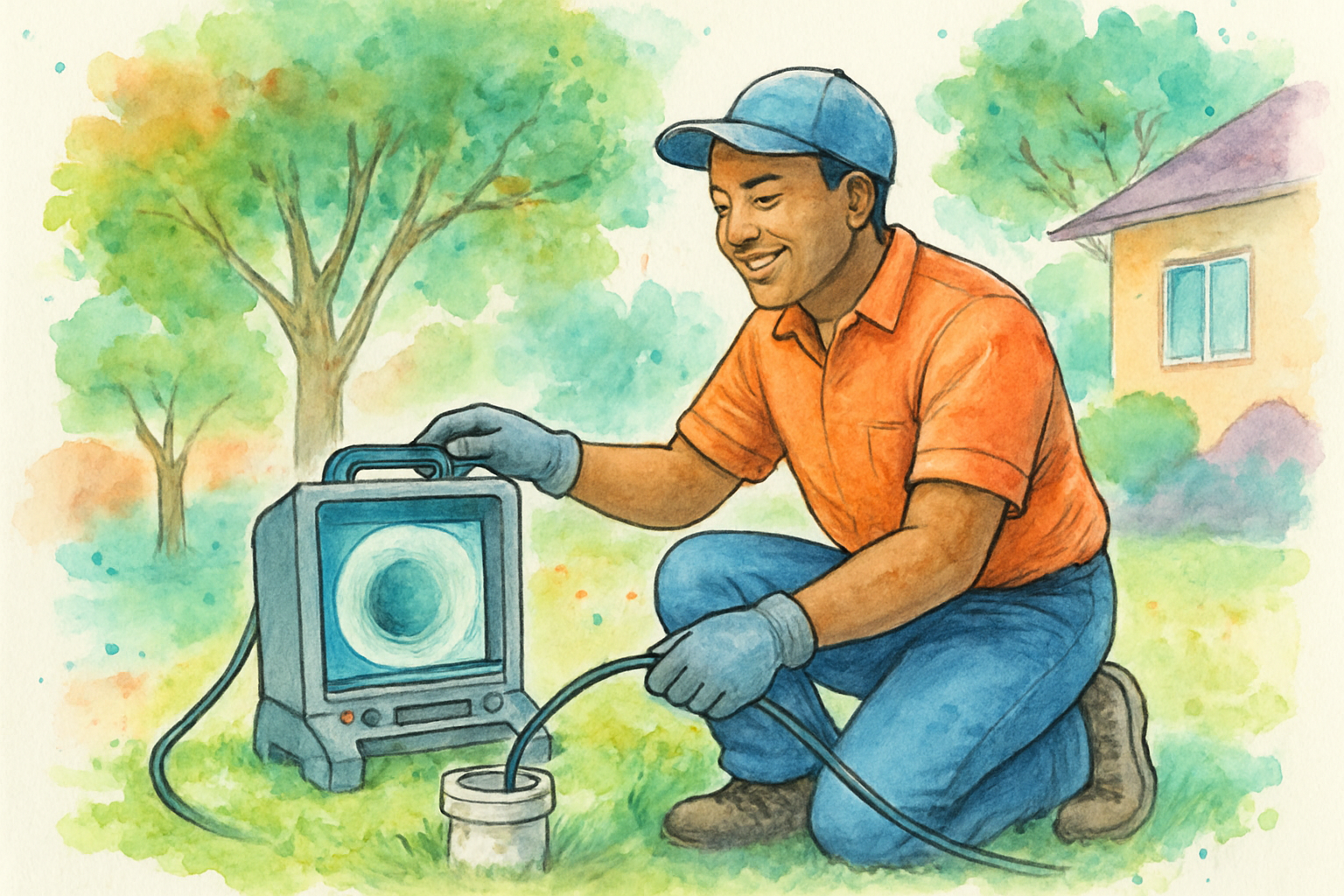
A sewer camera is a waterproof, flexible rod with a high-resolution camera head on the end. It goes into your cleanout access and travels through the pipe while transmitting live video to a monitor. I watch that feed in real time and can record it for documentation.
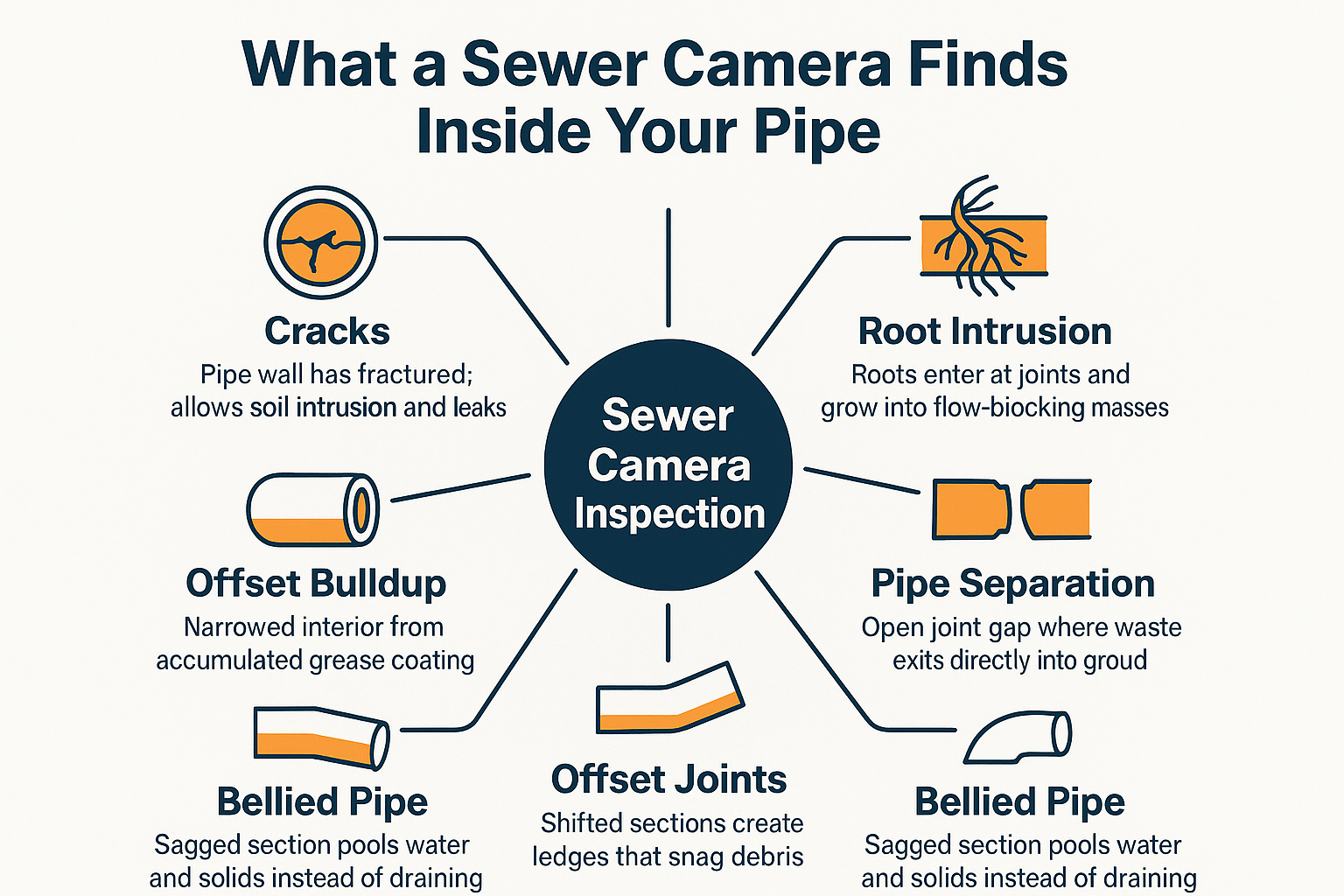
Here’s what shows up on that screen and what each condition actually means:
- Cracks — The pipe wall has fractured, either from ground movement, age, or root pressure. Water can seep out into the surrounding soil, and soil can infiltrate inward.
- Root intrusion — Tree roots have found a joint or crack and grown inside the pipe. They look like dense, fibrous masses that catch solids and build up fast. More on this below.
- Pipe separation — Two pipe sections have pulled apart at a joint. This creates an open gap where waste exits directly into the ground.
- Offset joints — A section has shifted up, down, or sideways, creating a ledge inside the pipe that snags debris and reduces flow.
- Grease buildup — The pipe walls are coated with accumulated grease that has narrowed the interior diameter over time. Common in older kitchens and food service lines.
- Bellied pipe — A section has sagged downward, creating a low spot where water and solids pool instead of flowing out. This often looks fine until the pooled material starts blocking flow entirely.
The reason the same symptom — a slow drain or a backup — can have five completely different causes is that all of these conditions restrict flow, but each one requires a different repair. When a clogged drain is actually a broken one, the only way to confirm it is to look.
Root Intrusion Is More Common Than Most Watsonville Homeowners Expect
Root intrusion deserves its own conversation because it’s one of the most frequent findings I see in Watsonville and Santa Cruz neighborhoods with established landscaping — and it’s consistently misunderstood.
Here’s how it works: tree roots detect the slight moisture that escapes at pipe joints, even hairline ones. They push through those gaps, enter the pipe, and grow. Over time, they form dense masses that act like nets — catching paper, wipes, grease, and anything else moving through the line. The pipe doesn’t fail all at once. It just gets progressively harder to clear, and the backups get more frequent.
The part that catches people off guard is the location. In longer sewer laterals — and many Watsonville homes have laterals running 30, 40, or 50 feet to the public main — the root intrusion may not be anywhere near the cleanout. Running a cable from the cleanout and feeling resistance tells you something is there. But without a camera, you don’t know where it is or what you’re actually hitting.
Clearing roots without knowing their exact location risks treating the wrong section of pipe. I’ve seen cables break through a partial blockage 10 feet in while a denser mass 35 feet down goes untouched. The homeowner gets flow back temporarily, but the root mass that caused the problem is still in the pipe. Why the same drain keeps backing up is a question I get often — and in many of those cases, root intrusion is exactly the answer.
The 6 Things a Sewer Camera Inspection Finds
This breakdown shows each condition a camera can identify inside your sewer lateral and what it typically means for the pipe.
GPS Location and Depth — Why That Detail Matters
A camera inspection doesn’t just show what’s wrong — it shows exactly where it is.
Modern inspection equipment includes a locating signal in the camera head. Once a problem is identified, I can use a surface locator to mark the precise spot above ground — and determine the depth of the pipe at that location. That information goes directly into the repair plan.
If a repair requires excavation, that GPS mark is the difference between a targeted dig and tearing up a yard or driveway looking for a pipe. In older Santa Cruz County neighborhoods where pipes can run under driveways, landscaping, or even sidewalks, accurate depth and location data saves significant time and disruption.
This is also why I always recommend getting the camera inspection before any repair estimate on a buried pipe issue. The repair scope — and whether a section replacement, spot repair, or full lateral replacement is appropriate — depends entirely on what the camera finds and where.
Who Actually Owns the Sewer Lateral — and Why That Question Matters
This is one of the most common misconceptions I run into, and it catches homeowners off guard at the worst possible moment.
In Santa Cruz County, the property owner is responsible for the entire sewer lateral — from the house connection all the way to where it meets the public main. That includes the portion running under a sidewalk or street. The city owns the main; you own the lateral that connects to it.
Most people assume the city handles anything past the property line. They don’t. If your lateral fails under the street, that repair is on you.
The City of Santa Cruz has a sewer lateral ordinance that makes this even more concrete. If you’re selling a property within city limits, the lateral must be inspected by a licensed plumber before the sale closes. If a sewer spill occurs, the property owner is responsible for stopping it immediately and completing documented repairs on a set timeline — or face fines. Watsonville does not currently have a point-of-sale inspection requirement, but that doesn’t change the ownership responsibility or the liability when something fails.
A sewer camera inspection is the documentation mechanism the ordinance calls for. The video record shows the pipe’s condition at a specific point in time — which matters both for compliance and for any dispute about the timing or cause of a failure. If you’re selling a home in Santa Cruz or you’ve had a sewer spill, that video record isn’t just useful — it may be required. Is it one clog or a pattern you shouldn’t ignore? — that’s the question a camera inspection answers with documentation rather than guesswork.
When a Sewer Camera Inspection Makes Sense vs. When It Can Wait
Not every drain issue warrants a camera inspection immediately. Here’s a straightforward reference for when it’s the right call and when a simpler approach may be the starting point.
| Situation | Camera Inspection Indicated? | Why |
|---|---|---|
| Second or third backup in 12 months | Yes — strongly | Recurring backups signal a structural or intrusion issue, not a simple clog |
| Multiple drains slow or backing up at once | Yes | Whole-house symptoms point to the main lateral, not individual drain lines |
| Selling a property in City of Santa Cruz | Yes — required by ordinance | Licensed inspection and documentation needed before sale closes |
| Sewer spill or overflow has occurred | Yes | Ordinance requires documented repair on a timeline; camera establishes cause and location |
| Single slow drain, first occurrence | Not immediately | Start with drain cleaning; camera if cleaning doesn’t hold or problem returns |
| Buying a home with older or unknown pipe material | Recommended | Clay or cast iron pipes common in older Santa Cruz County homes are prone to cracks and root intrusion |
| Property with large mature trees near the lateral | Recommended preventively | Root intrusion is a when, not an if — early inspection prevents emergency response later |
Frequently Asked Questions About Sewer Camera Inspections
How long does a sewer camera inspection take?
Most residential lateral inspections take between 30 and 60 minutes, depending on the length of the lateral and how many access points are available. If there’s a locating step involved — marking the GPS position of a problem — add another 15 to 20 minutes. It’s a same-visit process, not a multi-day project.
Will I get to see the video from my inspection?
Yes. The video record is part of what you’re getting from the inspection. If you need it for a real estate transaction, a permit, or documentation under the Santa Cruz sewer lateral ordinance, that recording is the evidence that matters. Ask about the format when you schedule.
Can a camera inspection go through any cleanout, or does mine need to be in a specific location?
Most cleanouts work fine. If access is limited or your property doesn’t have an easily reachable cleanout, a plumber may need to access the line from a roof vent or through a toilet. It’s worth describing your property’s setup when you call so the technician comes prepared.
My neighbor just had root intrusion cleared. Should I get my lateral checked even if I haven’t had a backup?
It’s worth considering, especially if your properties share similar landscaping or were built in the same era with the same pipe material. Root systems don’t respect property lines. I’ve seen houses on the same block with nearly identical pipe conditions — one had a backup, one hadn’t yet. Older neighborhoods throughout Watsonville and Santa Cruz with large eucalyptus, oak, or fig trees are particularly worth watching.
If the camera finds a problem, do I have to repair it right away?
It depends on what’s found. A fully collapsed section or active spill needs immediate attention. A belly or moderate root mass may give you time to plan the repair properly. The camera inspection tells you what you’re dealing with — then you and your plumber can make an informed decision about timing and scope rather than reacting to another emergency. The signs that say repair, not replace is a useful read for thinking through that decision.
Does a sewer camera inspection satisfy the City of Santa Cruz’s lateral ordinance requirement?
The ordinance requires inspection by a licensed plumber — so yes, a camera inspection performed and documented by a licensed contractor meets that requirement. The key word is licensed: the inspection needs to be done by someone with an active CSLB license, and the documentation needs to reflect that. This is not a DIY checkbox.
Ready to Know What’s Actually in Your Sewer Lateral?
If you’ve had more than one backup, you’re dealing with slow drains throughout the house, or you’re preparing to sell a property in Santa Cruz County, a sewer camera inspection is the only way to get a factual answer instead of a guess. Maverick Plumbing Technicians, Inc. is a licensed and insured plumbing contractor (CSLB #1102966) serving Watsonville, Santa Cruz, and the surrounding areas. Call us at (831) 515-9903 or visit maverickplumbingtechnicians.com to schedule an inspection — we’ll tell you exactly what’s in that pipe.
