Direct Answer: In a Santa Cruz County restaurant build-out, grease control, floor sink layout, and hot water sizing set the schedule. These get decided before plans are final, not after.
A contractor reached out to me last summer about a fast food tenant improvement in Watsonville. The message was short and friendly: where should I send the plans, drawings will be ready this week, and we are starting soon.
That sequence is the problem, and it is the reason I wanted to write this. By the time the plans are done and a start date exists, the plumbing decisions that control your schedule have usually already been made by someone drawing a kitchen layout, not by someone who has installed one.
I am going to stay on the parts that actually move an opening date in Santa Cruz County and the Monterey Bay area: grease control, the inspection sequence, indirect waste and hot water sizing, and the old sewer lateral you are inheriting from the last tenant.
Why Restaurant Tenant Improvement Plumbing Gets Consulted Too Late
Most restaurant owners I talk to think of plumbing as a trade that shows up after the design is finished. On a food service build-out, it works the other way around.
The grease control device, the floor sink locations, and the water heater capacity are all set by the equipment plan and the fixture count. Change the equipment plan later and you are not making a small adjustment, you are moving drains in a concrete slab.
Here is the pattern I see repeat in Santa Cruz County and down into Monterey County:
- The concept and menu get locked first
- An equipment vendor lays out the cook line and dish area
- Drawings get finished and submitted
- A plumber reads the plans for the first time at bid stage
- Someone discovers the grease device, the floor sinks, or the hot water sizing does not work as drawn
Every step after that discovery costs calendar time. Revised drawings mean a re-review. Moved drains in a slab mean saw cutting, and saw cutting means the schedule you promised your landlord no longer matches reality.
The cheapest version of this conversation happens before plan submittal, when a change is a line on paper instead of a jackhammer.
Grease Control Is the Single Biggest Scheduling Variable
If you only get one thing right early, make it grease. It is the item most likely to add weeks to a Central Coast food service build-out, and it is decided before your kitchen layout is locked.
There are two broad categories, and people mix up the words constantly:
- Grease trap: a smaller device, often under a sink or set in the floor nearby, with limited capacity and simpler access
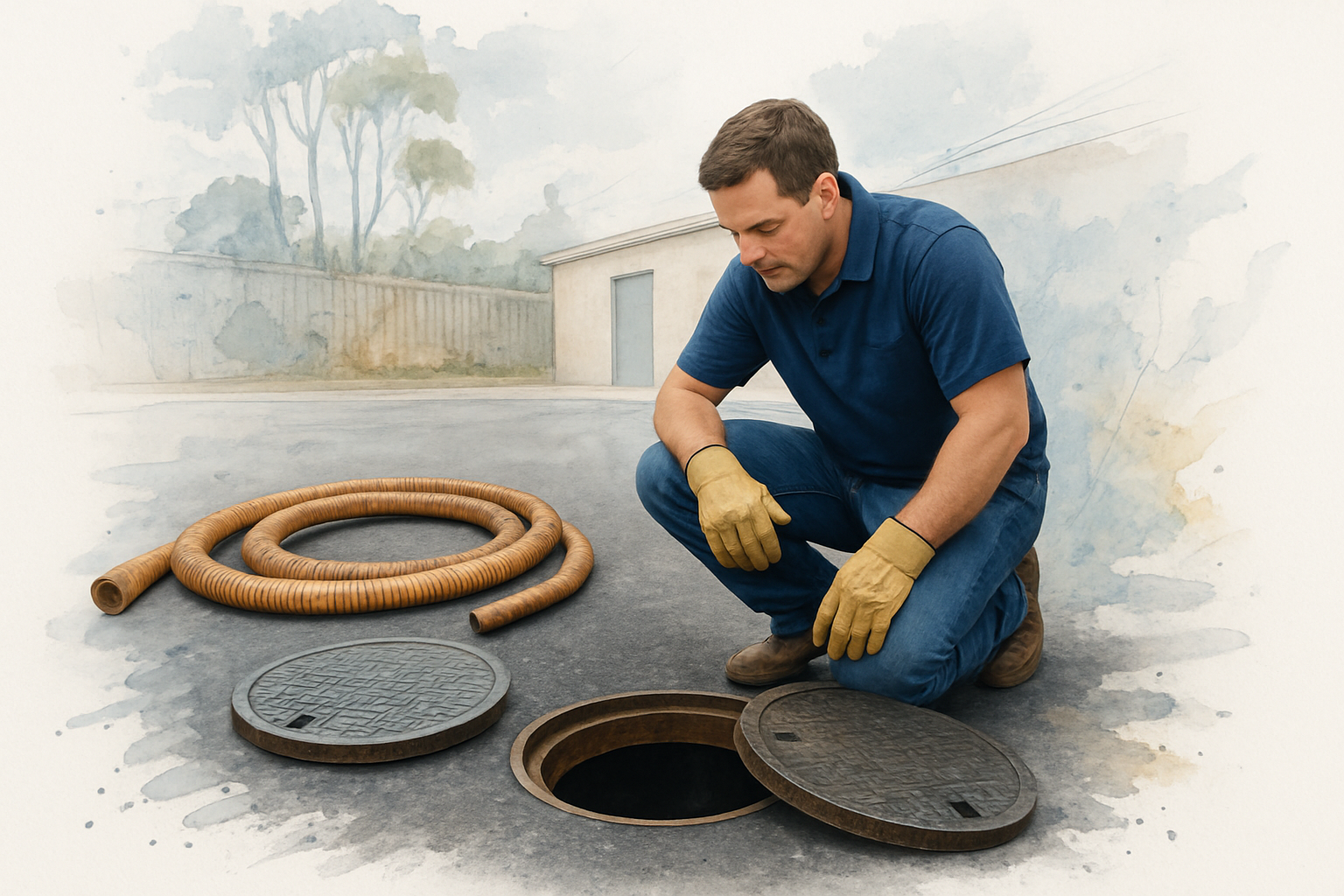
- Grease interceptor: a large multi compartment tank, usually outside and below grade, with far greater capacity, a real excavation footprint, and truck access needs for pumping
Those are different devices with different site impacts. An interceptor affects your parking, your utilities, your landscaping, and sometimes your lease language about what you are allowed to dig up.
Fixtures that typically route to grease control include:
- Three compartment sink
- Prep sinks and pot sinks
- Mop sink
- Floor sinks and floor drains in the cook line and cleanup areas
The surprise that catches owners is the dish machine. A dish machine’s own discharge and its pre-rinse sink are often treated differently from each other, and that distinction can change which device you need.
For general background on how these equipment categories are classified, this public agency pretreatment guideline from Los Angeles County explains the technical difference between a small trap and a large interceptor clearly. It is an out of area document, so treat it as background only. Your local sewer authority sets the binding sizing and connection rules, and you confirm those with your city or district rather than trusting a spec sheet number.
Grease Trap vs. Grease Interceptor: What Changes for Your Schedule
This is a plain comparison of how the two device categories affect a build-out. Your local sewer authority decides which one applies to your address and your fixture load.
| Factor | Smaller Grease Trap | Large Grease Interceptor |
|---|---|---|
| Typical location | Under a sink or set in the floor nearby | Outside, below grade, often in parking or a service area |
| Capacity | Limited, serves a small fixture group | Multi compartment, serves the full kitchen |
| Site impact | Minimal, mostly interior work | Excavation, traffic rated lids, truck access for pumping |
| Schedule risk | Lower, but still must be sized correctly | High, can add weeks if discovered late |
| Who decides | Local sewer authority, based on fixtures and flow | Local sewer authority, based on fixtures and flow |
Your Build-Out Answers to More Than One Desk
Owners routinely assume approvals mean “the building department,” singular. In this region it depends on where your space sits.
- A Watsonville address goes through the City of Watsonville building division
- A downtown Santa Cruz address goes through the City of Santa Cruz, which has its own adopted code amendments
- An unincorporated address, anywhere from Corralitos to Aptos, goes through Santa Cruz County
- On top of all of that, a food facility needs a separate plan review through county environmental health
Those reviews do not run on the same clock, and they do not always ask for the same thing. I have watched openings slip because two of them were running in sequence instead of in parallel.
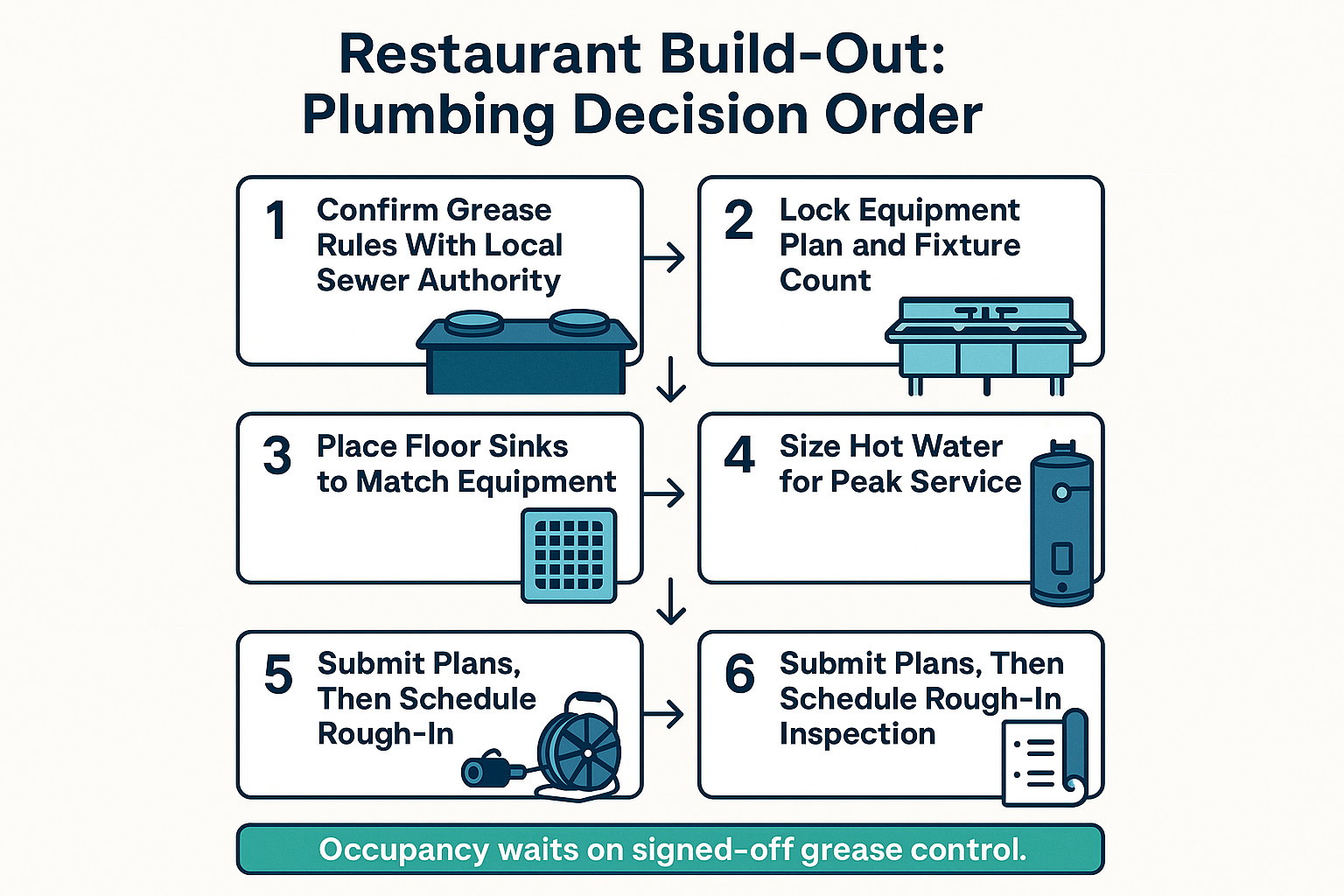
The practical point for your schedule is this: plumbing rough-in inspections gate everything that comes after them, drywall included. No signed rough-in means no cover, which means no finishes, no equipment set, no final.
And occupancy generally will not clear until the required grease control device is installed and signed off. A tank sitting on a pallet in the parking lot does not count.
If you want the broader picture on what triggers a permit in the first place, I wrote a separate piece on which plumbing jobs in Santa Cruz County need a permit. This section is about the commercial food service layer that sits on top of that.
The Order These Decisions Actually Happen In
This is the sequence I wish every restaurant owner saw before their drawings were finished.
Two Technical Items That Derail Openings: Indirect Waste and Hot Water
These two show up late and hurt the most.
Indirect waste. Ice machines, prep sinks, steam tables, and similar equipment generally cannot drain straight into a pipe. They need an air gap to a floor sink, so contaminated water can never back up into the equipment.
That means floor sink placement has to match the equipment plan, not the other way around. I have been on jobs where the ice machine moved four feet after the slab was poured, and now there is a drain line running across a walkway because the floor sink is in the wrong spot.
Hot water capacity. Your system has to carry a three compartment sink and a dish machine at peak service at the same time. That is a sizing calculation based on fixture demand and recovery rate, not a guess based on what the last tenant had.
Then there is the local wrinkle. Hard water is prevalent throughout Santa Cruz County and much of the Central Coast, and it builds scale inside commercial water heaters and dish machines faster than owners coming from other markets expect.
Scale cuts into recovery rate, which means the unit that was barely sized right on day one is undersized by month eight. That is why water treatment sometimes belongs in the build-out scope instead of the deferred maintenance pile. I covered the mechanics of that in more detail in this piece on what hard water does to plumbing in Santa Cruz County.
The Inherited Sewer Lateral Nobody Budgets For
A tenant improvement almost always inherits plumbing older than the concept going into the space. The building’s existing lateral is the wild card.
A camera inspection of the main line before the kitchen goes in tells you whether you are opening onto a line with:
- Root intrusion from mature trees, which is common in older Santa Cruz and Aptos neighborhoods
- A belly, a low spot in the line where waste and solids settle
- Grease already coating the pipe walls from whoever was in the space before you
Hydro jetting an inherited grease-loaded line is a calm conversation in week two of a build-out. It is a very different conversation during a Friday dinner rush with a full dining room and a backing-up floor drain.
This is not hypothetical here. An owner of two Santa Cruz lodging properties, one on Ocean Street and one on Pacific Avenue, reached out asking to have the main sewer lines jetted at both buildings on a flexible schedule. That is exactly the posture that keeps a commercial property out of emergency mode, and the same logic applies to a kitchen before it opens.
There is a second benefit people miss. A camera inspection before you start gives you a documented starting condition, which matters later if there is ever a dispute with a landlord about who caused what.
I have written more about the timing side of this in main line work to do before December and about the operational cost of waiting in summer restaurant drain backups.
What Commercial Callers in This Market Actually Need
Facilities contacts, property managers, and owners make up a steady share of the calls I take. Almost every one of them is working against something fixed: a tenant, a lease, business hours, or an opening day.
What they ask for is rarely speed by itself. It is reliability and documentation against a date that does not move.
That means commercial work documented and completed to code, clear communication about what was found and what was done, and someone reachable when a line fails outside business hours. One customer put it this way in a review: “They get the job done, they keep you updated on the progress until it is complete, and they explain everything thoroughly.” That is Mercy G., and that is the standard the commercial side of this trade should be held to.
The other half of that is knowing what happens when nobody answers. I covered that in what happens when a business plumbing emergency goes unanswered.
Frequently Asked Questions About Restaurant Build-Out Plumbing
When should I bring a plumber into my restaurant project?
Before the drawings are final, not after. Once the equipment plan is locked and plans are submitted, changing grease control or floor sink locations means revised drawings, a re-review, and often cutting concrete.
Do I need a grease trap or a full grease interceptor?
That depends on your fixture count, your flow, and your address. Your local sewer authority makes that call, whether that is the City of Santa Cruz, the City of Watsonville, or the district serving an unincorporated area. Do not assume a number off an equipment spec sheet is the one they will accept.
Can I open if the grease device is ordered but not installed?
Generally no. Occupancy typically will not clear until the required grease control device is installed and signed off. Lead time on a large interceptor is one of the most common reasons an opening date slips.
Why do my ice machine and prep sink need a floor sink instead of a regular drain?
Because they require an air gap, so nothing from the drain line can ever siphon back into food or ice. That air gap only works if the floor sink is in the right place, which is why floor sink locations have to follow the equipment plan.
Is a sewer camera inspection worth it on a space I am only leasing?
In my experience, yes. You find out whether you are inheriting roots, a belly, or a grease-coated line before you open, and you get a documented starting condition that protects you in a future dispute with the landlord.
What does this kind of work cost?
That depends entirely on the space, the fixture count, the condition of the existing lateral, and what your local authority requires. There is no honest number to give without seeing the plans and the site, so it is worth getting a real scope conversation on the calendar.
Thinking Through a Build-Out Timeline?
Questions about scope are worth asking early, while the drawings can still change, rather than at plan submittal when every revision costs calendar days. Maverick Plumbing is a licensed and insured plumbing contractor, CSLB #1102966, working across Santa Cruz County and parts of Monterey County, with commercial work documented and completed to code and 24/7 response available when a line fails outside business hours. If you want to talk through where plumbing sits in your schedule, we are reachable at (831) 515-9903.
