

Direct Answer: In the first hour, isolate water instead of diagnosing pipe. Close the property shutoff, confirm whether the break sits before or after the meter, and note which units lost service.
The call almost never comes while you are standing on the property. You are driving Highway 1, a tenant or an on-site manager is on the other line, and water is coming up through a parking lot or running down a landscaped strip at a building you are responsible for.
I have taken those calls from property managers across Santa Cruz County and Monterey County, including one for an active 8-inch main break at a mobile home park. The common thread is not panic. It is the manager trying to figure out what to do next while being twenty minutes away.
So here is how that first hour actually works. What to confirm before you arrive, who owns the pipe past the meter, and what to ask for in writing while the work is happening.
The First Hour Is About Isolating Water, Not Diagnosing Pipe
Nobody can tell you what failed underground in the first sixty minutes. What you can do in that window is stop the flow and get an accurate picture of who lost service.
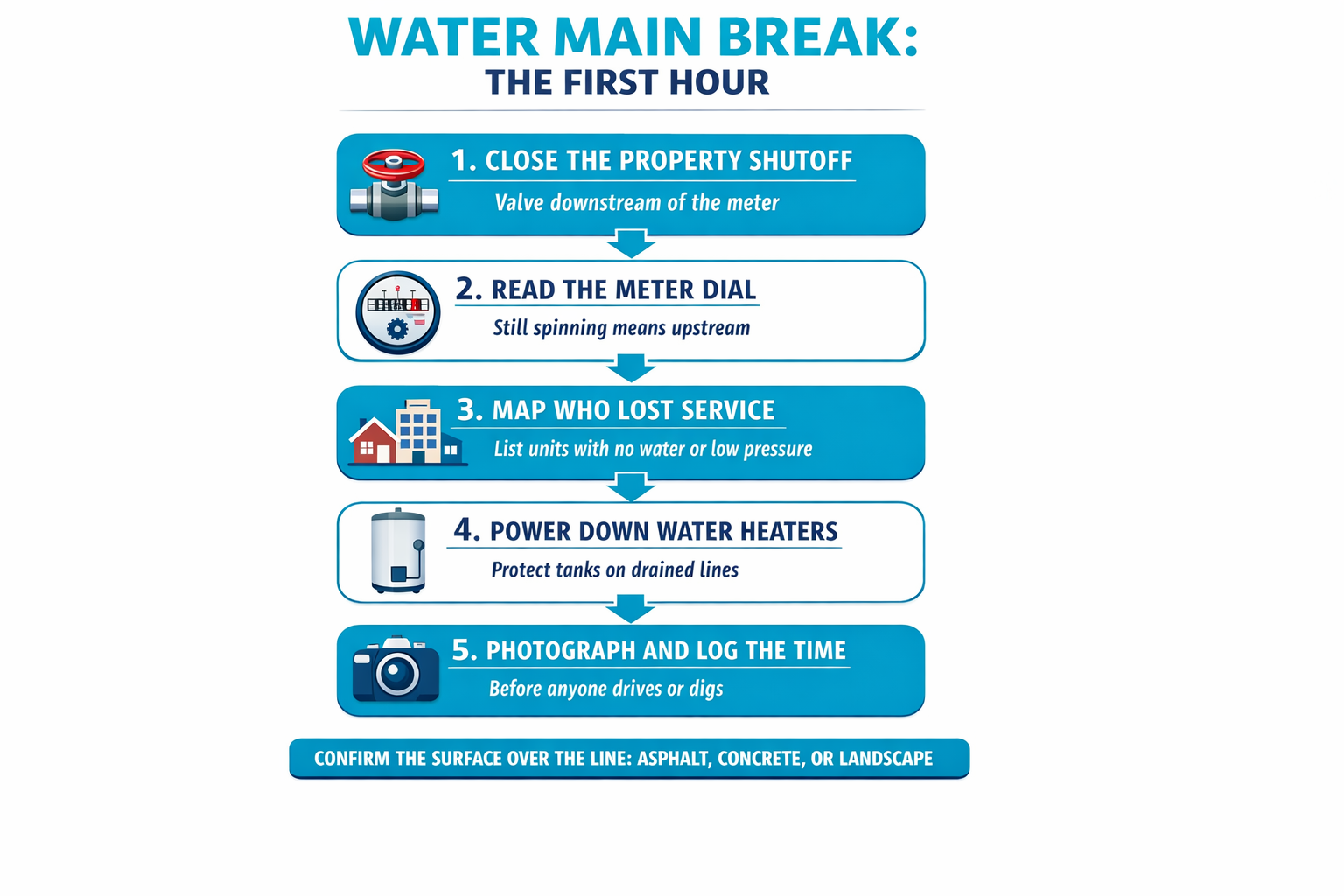
Work through this list while you are still on the road:
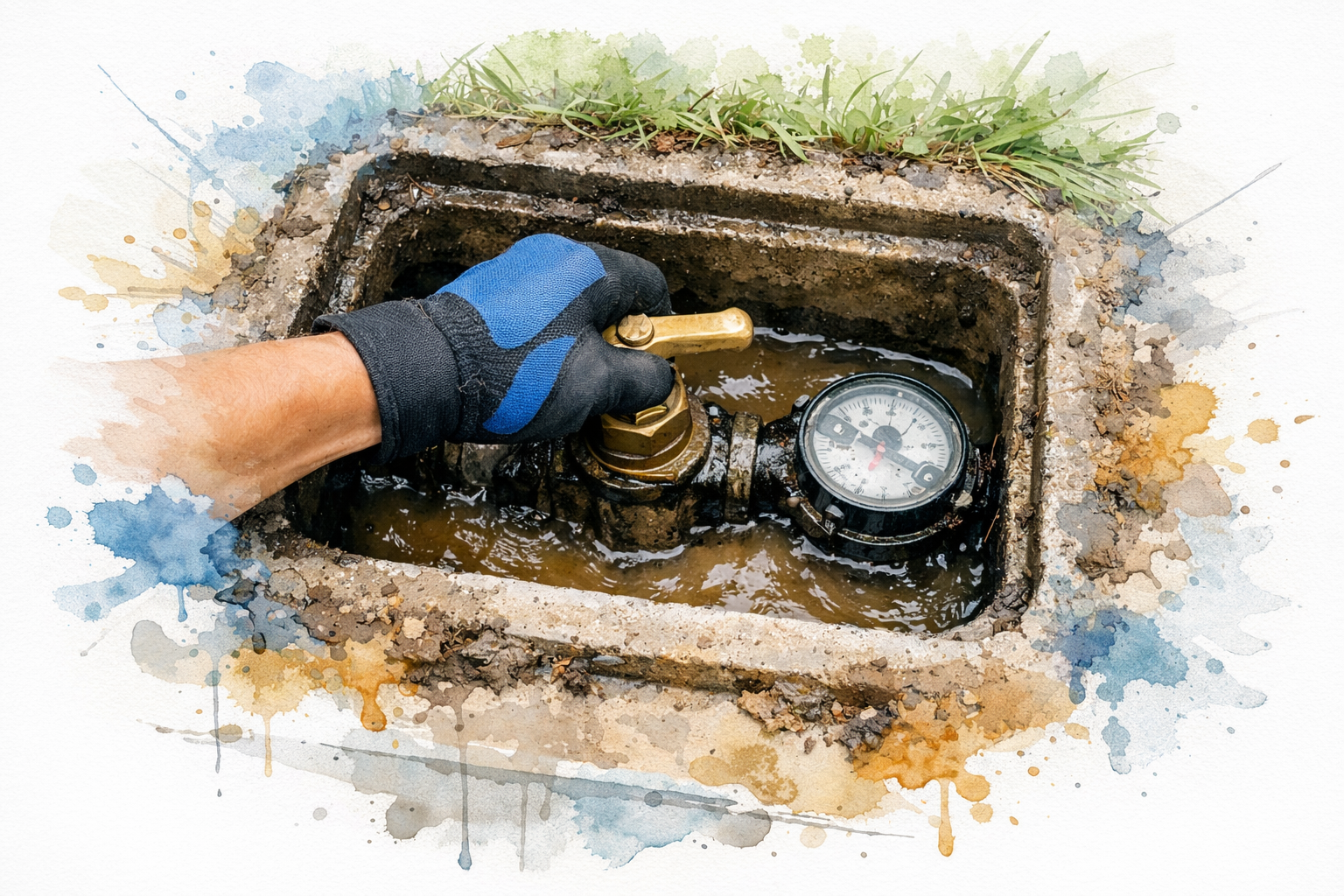
- Find the property shutoff. On multi-building sites it is usually a gate or ball valve downstream of the meter, often in a concrete box near the street or inside a utility closet. Someone on site needs eyes on it.
- Check whether water keeps running after the valve is closed. If it does, the break is likely on the agency side of the meter, or you have a second feed.
- Look at the meter dial. With the property valve shut, a spinning dial points upstream. A stopped dial with water still surfacing points to private piping past the meter.
- Count affected units or suites. Which ones have no water, which have low pressure, which are fine. That map tells a crew a lot about where the break sits.
- Kill power or gas to electric and gas water heaters in any unit that lost supply, so tanks are not firing on an empty or partly drained vessel.
- Photograph everything before anyone drives over it or walks through it.
When you call a plumber, lead with the surface over the line. Asphalt, stamped concrete, and lawn are three different excavation plans and three different truck loadouts.
Past the Meter, the Main Belongs to the Property
This is the part that trips up managers who are used to single family homes. At a house, the water agency owns the service line up to the meter and the homeowner owns the short run after it.
At a mobile home park, an apartment complex, a motel, or a retail center, the pipe past the meter is private distribution piping. It can run hundreds of feet, branch to a dozen buildings, and still be entirely the property’s responsibility.
Here is the sentence you can repeat to an owner, a board, or a tenant: the break is on private distribution piping downstream of the meter, so the repair, the permit path, and the surface restoration all land on the property rather than the water agency.
That single fact drives the rest of the project:
- A licensed plumbing contractor performs the work, not the agency crew.
- The repair is completed to California plumbing code, and the jurisdiction may require a permit and an inspection depending on the scope.
- Restoration of asphalt, concrete, or landscaping is part of your scope, not someone else’s.
- If the dig touches a public right of way, an encroachment permit may come into play.
Confirm which side of the meter the problem sits on before you promise anyone a timeline. It changes who signs off and how long the whole thing takes.
Where the Break Sits and What That Determines
Use this to sort responsibility quickly while you are still gathering information.
| Location of the break | Who typically handles it | What you should do |
|---|---|---|
| Street side of the meter | The water agency’s service line in most cases | Report it, get a ticket or reference number, and log the time you called |
| At or inside the meter box | Usually the agency, but it needs confirming | Ask the agency to verify before scheduling private work on it |
| Between the meter and the buildings | Private distribution piping, the property’s responsibility | Bring in a licensed contractor, confirm the permit path, plan restoration |
| Under a slab or inside a building | Private, the property’s responsibility | Leak detection first, before any access or demolition work begins |
| Irrigation branch off the private main | Private, the property’s responsibility | Isolate the irrigation zone and check the backflow assembly condition |
The First Hour, Step by Step
This is the sequence I walk property managers through over the phone when they are not on site yet.
Ask for the Paper Trail Up Front, Not After
Documentation is what separates a handled emergency from a disputed one. You are going to have to explain this event to an owner, an insurer, or a tenant who lost water for half a day, and memory is not evidence.
Ask for these at the time you authorize the work, not after the invoice shows up:
- A written scope before excavation starts, including what is being opened and what is being restored
- Photos before, during, and after the dig, including the failed section of pipe itself
- A log of which units or suites lost service and for how long
- Written confirmation of the appointment and a call before the crew arrives
- A final invoice that matches the written scope, with any change clearly explained
Good contractors already work this way. One customer put it like this in a review: “Jorge responded very quickly to my requests and provided clear details in the estimates. I appreciated that he sent pictures of the plumbing repairs and installation to me even when I didn’t specifically request them.” That was Karen M., and she is describing documentation that arrived without being chased.
If a vendor hesitates when you ask for photos and a written scope, that tells you something about how the rest of the job will go. This is also worth reading alongside what happens when a business plumbing emergency goes unanswered.
Winter Does Not Break the Pipe. It Finds the One Already Failing.
Underground mains on Central Coast properties rarely fail out of nowhere. They weep quietly for months, soften the soil around themselves, and then announce it the week the weather turns.
Saturated ground, shifting soil, and pressure swings during the rainy season all put stress on aging piping. The storm is not usually the cause. It is the thing that exposes what was already going.
Forecasters have been pointing to a wetter than normal stretch for much of California this winter, and the California Coastal Commission’s informational memo on El Nino conditions advises coastal property owners and agencies to take basic preparatory steps ahead of the season.
For a managed property, preparation is not complicated. A dry-weather walkthrough in October or November beats a diagnostic call during a January atmospheric river. What I would look at:
- The condition and accessibility of every shutoff valve, including whether it actually closes
- Soft or persistently green spots in landscaping over known pipe runs
- Unexplained movement on the water bill across the last few billing cycles
- Below-grade spaces, crawl areas, and whether the sump pump there has been tested since last spring
On the drainage side, a wet winter shows up in the drains first, and the same pre-season timing logic applies to main line work at motels and restaurants before December.
What a Licensed Crew Does Differently on a Private Main
A private main is not a bigger version of a house service line. The difference shows up in the order the work is done.
On a job like this, the sequence I follow is:
- Locate the line first. Tracing the route and depth before a shovel moves means one dig instead of three exploratory holes across a parking lot.
- Confirm the break point. Surfacing water travels. Where it comes up is often not where the pipe failed.
- Plan a staged shutdown. Occupied units should lose water for the shortest window the repair allows, and tenants should know when it starts.
- Repair or replace the failed section to code, with the material and fittings the application calls for.
- Restore service with pressure and contamination checks, then verify fixtures across the affected buildings before calling it done.
A crew that digs first and locates second will cost you time, pavement, and credibility with whoever you answer to.
If you are evaluating whether a contractor can handle work at this scale, ask them to describe that sequence out loud before you book. Scope clarity matters more than speed here, and it is the same mindset behind what happens after you call an emergency plumber. Cost questions on a private main depend entirely on line length, depth, surface, and access, so those belong in a direct conversation about the specific property.
Frequently Asked Questions About a Water Main Break at a Managed Property
How do I tell if the break is on my side of the meter?
Close the property shutoff downstream of the meter and watch the meter dial. If the dial keeps moving with that valve shut, the problem is likely upstream and on the agency side. If the dial stops but water keeps surfacing, you are looking at private piping past the meter, which is the property’s responsibility.
Do all the units lose water during the repair?
Not necessarily. On properties with sectional valves, a repair can often be staged so only the affected branch goes dry. That depends on whether those valves exist and whether they still close, which is exactly why a pre-season valve check is worth doing.
The ground is soggy but there is no geyser. Is that still a main break?
It can be. A pressurized line can leak underground for a long time before it surfaces, showing up as a wet spot, unusually green landscaping, or a water bill that crept up with no change in usage. Those are the ones that turn into a break during the first big storm.
What should I have ready when the crew gets there?
Site access and a point of contact on the property, the location of the meter and shutoff, any site plans or as-builts you have, and your list of which units lost service. If there is a commercial kitchen, a medical suite, or a laundry on site, say so when you call, because those change the shutdown planning.
Can I get a property looked at before the rain really starts?
Yes, and that is the better time to do it. A dry-weather walkthrough of shutoffs, valve condition, and known soft spots gives you a plan instead of an emergency. 24/7 emergency service is available either way, but November work beats January work every time.
Planning Ahead for the Properties You Manage
We are a licensed and insured plumbing contractor, CSLB #1102966, owner operated by Jorge Ortiz out of Santa Cruz, with documented commercial work across Santa Cruz County and Monterey County and emergency response available around the clock. If you manage multi-unit or commercial property here and want a conversation about shutoff condition, main line age, or an active situation, you can reach us at (831) 515-9903. Service requests also come through maverickplumbingtechnicians.com.
