

Direct Answer: Before a winter trip, decide on the water: shut the main and drain down for longer absences, or close individual fixture valves for a weekend. Check the water heater first.
A drip under a kitchen sink is a towel and a phone call when somebody is standing in the room. The same drip running for ten days behind a wall or under a crawl space turns into soaked framing, ruined flooring, and a much longer repair.
The water did not change. The only thing that changed is how many days passed before anyone noticed. That gap is the real risk when you lock up a Santa Cruz or Monterey County house and head out for the holidays.
My position is simple: unattended time is the one variable you actually control, and a short walkthrough before you leave is the cheapest version of this problem you will ever deal with. Below is how I think about the shutoff decision, the water heater, and what changes if you are responsible for a property you do not live in.
Why an empty house in winter is a different kind of risk
Two things line up badly this winter. Holiday travel empties out homes, second homes, and rentals across Santa Cruz County right when the storm window opens.
NOAA’s October 2026 update puts the odds of a historic strength El Nino at better than eight in ten for the October through December window, with strong to very strong conditions expected to hold through January to March 2027. Coastal California carries an above normal precipitation signal that peaks in late winter. The California Coastal Commission has published its own public memo on a potentially historic El Nino event for the 2026 to 2027 season.
Nobody can tell you a storm will hit Capitola on January 12th. But you can decide in October or November whether your crawl space, your roof drainage, and your shutoff valve are in a condition you would be comfortable leaving for two weeks.
What tends to go wrong in an empty house during a wet stretch:
- A supply line or angle stop that weeps slowly behind a cabinet
- Groundwater pushing into a crawl space or below-grade room with no pump running
- A sewer line with root intrusion that backs up when heavy rain loads the system
- A water heater that finally gives out, either while you are gone or the week you return
One caller learned about a leak only because the water utility flagged unusual usage and told them it was on their side of the meter. That is usually how it goes. Water moves for a while before anybody notices.
The shutoff decision most people only half do
You already know where your main valve is. That is not the hard part. The real question is when to use it, how to drain down afterward, and what you just took offline.
Here is the rule I give people. For a short trip with nobody in the house, leave the water on and reduce exposure at the fixtures that fail most often. For anything longer, shut the main and drain the lines so you are not leaving pressurized pipe sitting unwatched for two weeks.
For a weekend away, close these supply valves:
- Washing machine hot and cold valves
- Dishwasher and refrigerator water line
- Any angle stop under a sink that already looks corroded or damp
For a longer absence, shut the main at the meter or the house valve, then open the lowest fixture in the house and a high fixture so air can enter and the lines drain. Skipping that second step leaves a line half full, which is the part people miss.
Before you close that valve, think about what else runs on it:
- Irrigation timers, which may keep cycling dry depending on where your valve sits
- The refrigerator ice maker and water dispenser
- A tenant, house sitter, or neighbor who still needs water
- A backflow preventer on an irrigation line that may need attention before the rainy season anyway
If someone will be in the house at all, leave the water on and show them the valve instead.
Matching your water plan to the length of the trip
There is no single right answer here. The length of your absence and whether anyone has access should drive the call.
| How long the house sits empty | What I would do with the water | Check before you go |
|---|---|---|
| 2 to 3 nights | Leave the main on, close washer and dishwasher valves | Look under every sink, check the water heater pan |
| 4 to 14 days | Shut the main, open a low and a high fixture to drain down | Confirm sump pump runs, clear gutters and downspouts |
| Over two weeks | Shut the main and drain down, set the heater per manufacturer guidance | Have someone walk the property after major storms |
| House sitter or tenant on site | Leave water on, show them the main valve | Give them one phone number to call and permission to use it |
| Vacant rental between tenants | Shut the main and drain down, document the condition | Written checklist, named key holder, photos of what was found |
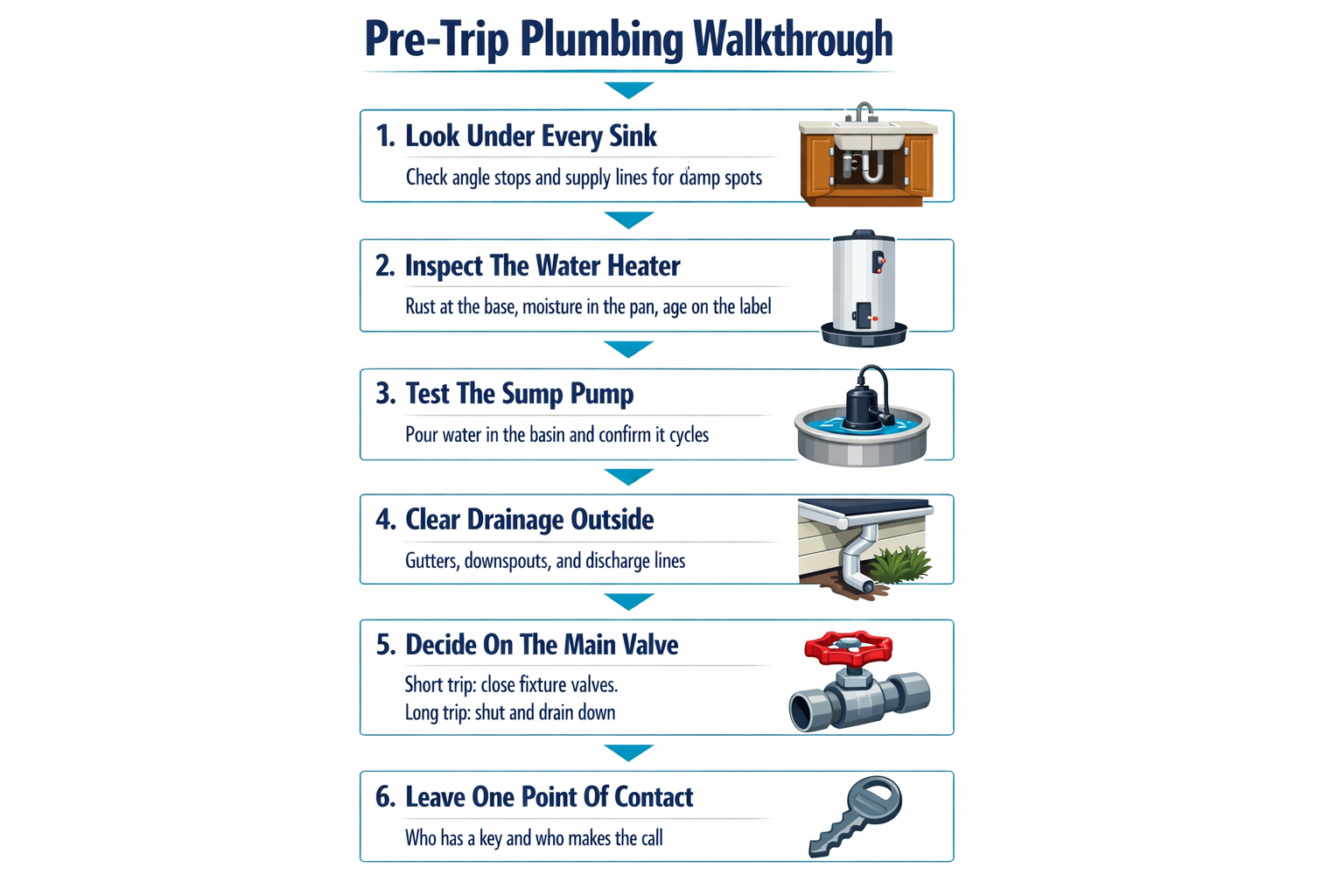
A pre-trip walkthrough you can do in under an hour
This is the order I would walk a house the day before leaving for a winter trip.
The water heater is the most likely thing to fail while you are gone
If I had to bet on one appliance causing trouble in an empty Central Coast house, it would be the water heater. Hard water is prevalent across Santa Cruz County and much of the Central Coast, and it works on a tank from the inside.
Sediment settles in the bottom of the tank, holds heat against the steel, and speeds up corrosion. A unit already near the end of its service life tends to give out when demand swings hard, which is exactly what happens when a house sits cold for a week and then four people come home and all want showers.
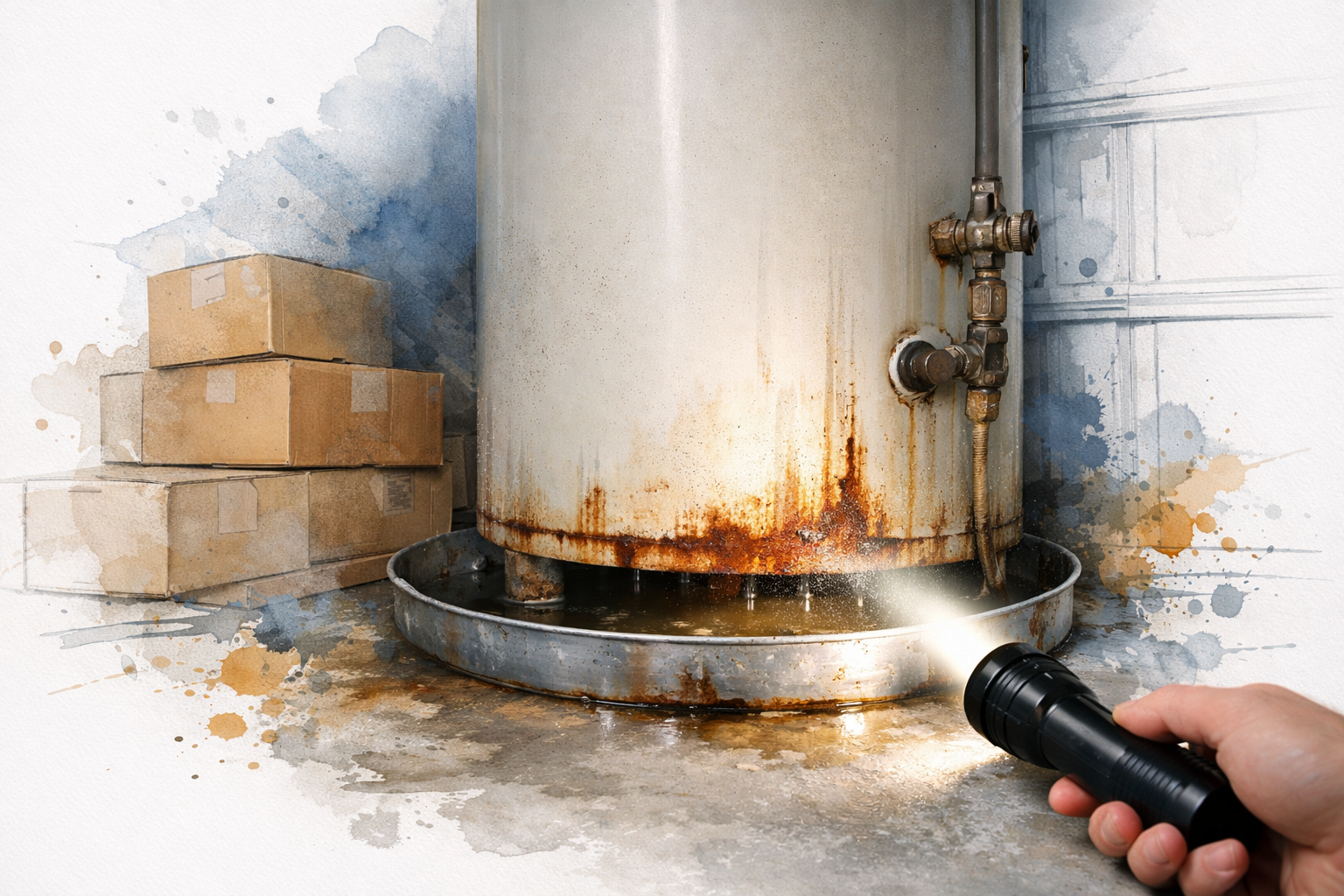
Before you pack, go look at the tank with a flashlight and check for:
- Rust or staining at the base of the jacket
- Moisture in the drip pan or a damp ring on the slab
- A manufacture date on the label that puts the unit past its expected range
- Rumbling or popping sounds during a heating cycle, which usually means sediment
The vacation or low setting on the thermostat saves energy and keeps the tank from cycling hard while you are away. It does not stop a corroded tank from leaking. A tank showing any of those signs deserves a look before a trip, not after.
One customer put the timing well in a review: “Jorge came on a Sunday when my hot water heater was leaking. We were leaving the next day and were able to coordinate the replacement without missing any of our vacation.” That only worked because the problem got caught before they drove away.
If you manage a property you do not live in
Property managers and second home owners have the same exposure as any empty house, plus the access problem. Nobody is on site, keys are spread around, and if something fails in January you will be asked to explain the timeline.
I have seen this from both sides of the Monterey Bay. A property management company called in with an active main line break at a mobile home park. A motel owner scheduled hydro jetting across two properties in the same month, well ahead of the busy season.
Before a holiday closure or a vacancy, I would put three things in writing:
- A short pre-closure checklist listing what gets shut off, drained, or left running
- A named point of contact for access, with a backup, so a technician is not waiting in a driveway
- Written confirmation of what was checked and what was found, with photos where it matters
For commercial kitchens and multi-unit buildings, grease-heavy lines and shared mainlines are the usual weak point during a closure. Clearing them before the building empties out is far less disruptive than handling a backup when tenants return. The same logic applies to a business plumbing emergency that goes unanswered over a long weekend.
Frequently Asked Questions About Leaving a House Empty in Winter
Should I turn my water heater off completely when I leave town?
For most trips, the vacation or low setting is the practical choice. It keeps the tank from cycling at full temperature without letting it sit fully cold. If you are shutting the main and draining the lines for a long absence, follow the manufacturer’s instructions for your specific unit, since the steps differ between gas, electric, and tankless systems.
Does shutting off the main also shut off my irrigation?
It depends on where your irrigation ties in. Some systems branch off downstream of the house valve and stop with everything else, while others are fed ahead of it and keep running on their timer. Check before you leave so you are not watering an empty house through a storm week.
What order should I turn things back on when I get home?
Open the main slowly, not all at once. Leave a couple of faucets open so air can push out, then close them once the flow runs steady. Walk the house and look under sinks and at the water heater while the system repressurizes, since that is when a weak connection usually shows itself.
I smell gas when I walk in after a trip. What do I do?
Leave the building immediately. Do not flip light switches, use appliances, or light anything, and call from outside the property once you are clear. Gas leak response is available 24 hours a day, seven days a week, and this is not a situation to investigate on your own.
My house has a crawl space, not a basement. Does any of this apply?
Yes, and in some ways more. Crawl spaces around Santa Cruz County take on groundwater pressure during long wet stretches, and a leak down there can run for days without a single sign upstairs. A look at the crawl space before a trip is worth the ten minutes.
Thinking through a pre-trip check before you lock up?
We handle pre-trip plumbing checks and storm season problems for homeowners, property managers, and businesses across Santa Cruz County and Monterey County, as a licensed and insured contractor under CSLB #1102966. Our line at (831) 515-9903 is answered 24 hours a day, and service requests also come through maverickplumbingtechnicians.com. If you are arranging work remotely or through a house sitter, we can document what was checked so you are not reconstructing the timeline later.
