

Direct Answer: The notice is a Proposition 218 mailer about proposed rates, not adopted ones. The change that touches your plumbing is fixed charges based on water meter capacity rather than usage alone.
If you own property in the City of Santa Cruz, a water rate notice probably landed in your mailbox this fall. It runs several pages, it is full of tables, and it is easy to mistake for a bill.
It is not a bill. It is a Proposition 218 notice, and the rates printed inside have not been adopted. The City Council public hearing is set for November 17, 2026, written legal objections were due November 1, 2026, and the new structure would take effect January 1, 2027 if it passes.
My take after reading it: the percentage on the front page is not the part worth your attention. The change that actually touches your plumbing is the proposal to base fixed monthly charges on water meter capacity, and most homeowners in Santa Cruz County have never checked whether their meter matches the house they live in today.
What the notice is, and what nothing about it changes yet
The city published the proposal on September 14, 2026. That mailing is a legal requirement before a public agency can change rates, which is why it showed up whether you asked for it or not.
A few things are worth getting straight before you read a single table:
- The rates in the notice are proposed, not adopted. The city says so on its own page.
- Nothing on your October or November bill changes because of this notice.
- The hearing on November 17, 2026 is where the Council takes it up.
- If adopted, the structure starts January 1, 2027 and the proposal covers 2027 through 2031.
For the actual numbers, go to the source. The dollar figures, the tier breakpoints, and the meter size schedule all live on the City of Santa Cruz Water Department’s rates page. Those belong to the city, not to a plumber, and I am not going to paraphrase them here.
What I can tell you is what the structural changes mean for the pipes on your property, because that part nobody mails you a notice about.
The real plumbing question: is your meter sized for the house you have now?
The proposal lists basing fixed charges on water meter capacity as one of its structural changes. That shifts part of the conversation from how much water you use to what size service you are signed up for.
Santa Cruz has a lot of older housing stock. Walk the Westside or Seabright and you will find homes where the meter size was decided decades ago, under a completely different set of fixtures.
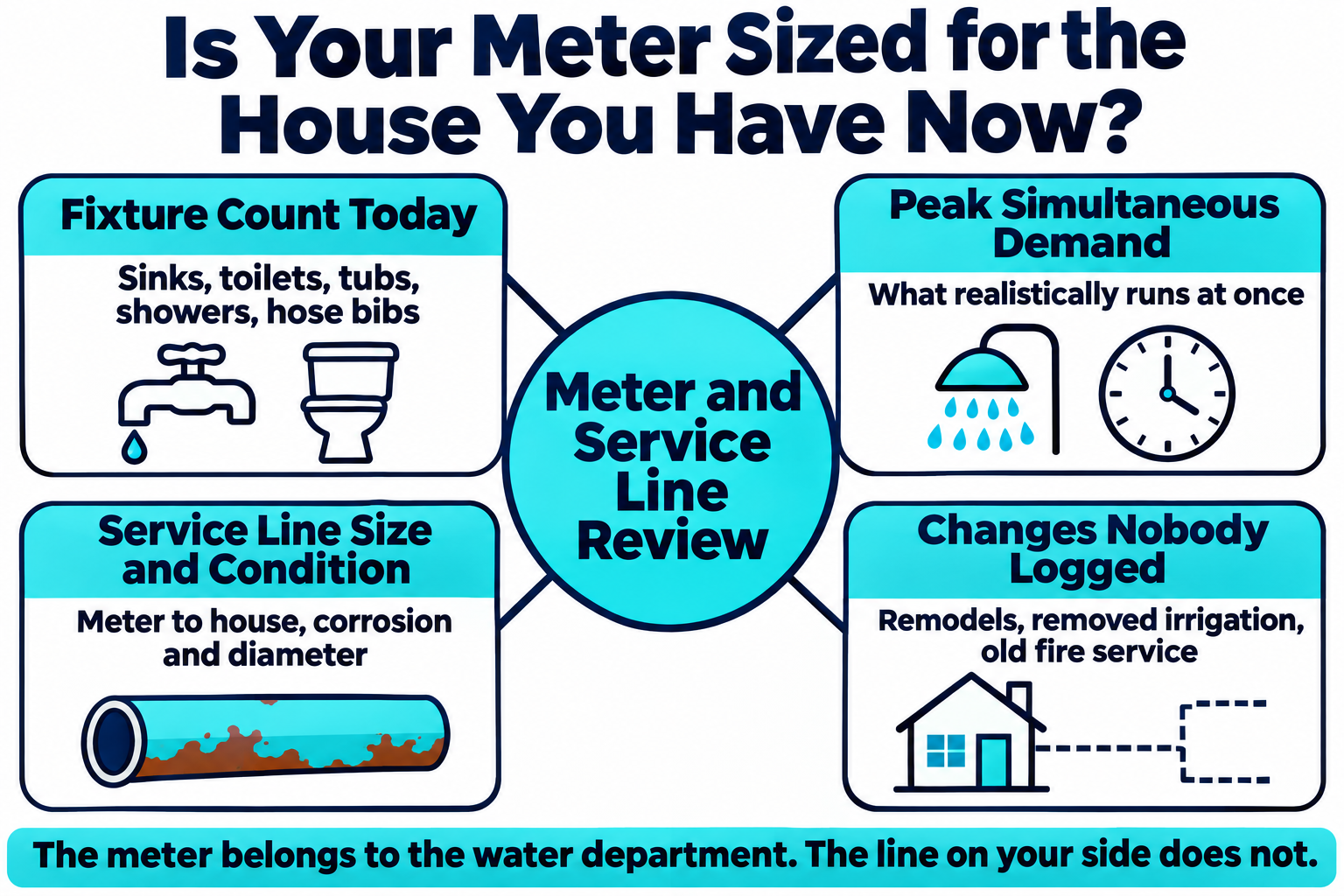
When a homeowner asks me whether their meter and service line match their current plumbing, here is what I look at:
- Fixture count and type. How many sinks, toilets, tubs, showers, and outdoor hose bibs exist today, not in 1968.
- Realistic peak demand. How many of those could honestly run at the same time in a normal morning.
- Service line size and condition. The pipe from the meter to the house matters as much as the meter. A corroded or undersized line creates pressure problems that a bigger meter will never fix.
- History the paperwork forgot. A remodel that removed a bathroom, an irrigation system that got pulled out years ago, or an old fire service line can leave a property sitting on more meter than its plumbing calls for.
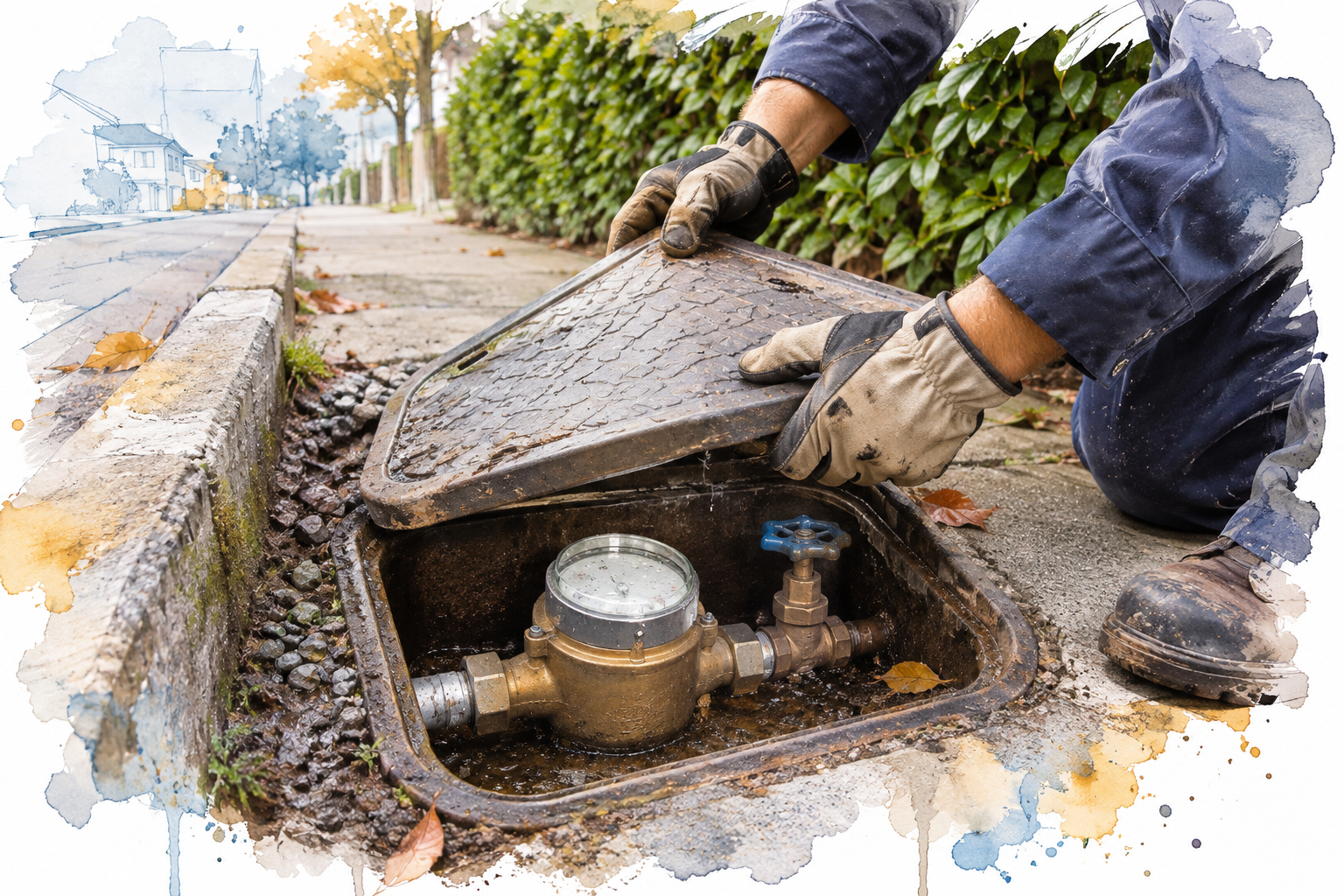
One honest limit: the meter belongs to the water department. Changing its size is their call and their process. Everything downstream of it is yours, and that side is what a licensed plumbing contractor can actually evaluate.
Who owns what between the street and your house
A lot of confusion about meter questions comes from not knowing where one party’s responsibility ends and the other’s begins. This is the general split in most Central Coast jurisdictions.
| Component | Generally whose side | Who to ask about it |
|---|---|---|
| The meter itself and its sizing | Water department | City of Santa Cruz Water Department |
| Meter box and the connection to the main | Water department | City of Santa Cruz Water Department |
| Service line from the meter to the house | Property owner, in most cases | A licensed plumbing contractor |
| Main shutoff valve at the house | Property owner | A licensed plumbing contractor |
| Interior piping and fixtures | Property owner | A licensed plumbing contractor |
| Irrigation backflow assembly | Property owner | A licensed plumbing contractor, with testing records filed to the water authority |
What goes into a meter and service line review
These are the four things I walk through with a homeowner before anyone talks about changing anything.
Irrigation accounts, drought surcharges, and the backflow assembly nobody checked
The second structural change in the proposal consolidates dedicated landscape irrigation tiers from three down to two and adds drought surcharges that could be switched on during a declared shortage.
That lands hardest on properties with a separate irrigation account. In my experience those are often the same properties with an irrigation line nobody has looked at in years.
Water moving through a buried irrigation line at two in the morning does not announce itself. No puddle, no sound inside the house, no dripping ceiling. A drought surcharge structure changes nothing about whether that line leaks. It only changes how much a slow leak matters.
Then there is the backflow assembly. California plumbing code requires backflow prevention on irrigation systems, and many jurisdictions require annual testing by a certified tester. We field questions about this constantly, usually from owners who got a notice from their water authority and realized they had no idea when their assembly was last tested.
What you can see at the assembly yourself:
- Obvious corrosion, a cracked body, or a missing test cock cap
- Continuous water discharging from the relief valve, which is not normal
- Visible wet ground or unusually green turf near the assembly or along a lateral line
What you cannot see is whether the internal check valves still hold under pressure reversal. That is the entire point of the test, and it is the only way to confirm the assembly is still doing its job.
Telling a rate change apart from a plumbing change
Starting in January, two very different things could show up on the same bill and look nearly identical: a change in how the city structures its charges, and a change in how much water is actually leaving your property.
The reasoning test is simple. A structural rate change applies to everyone on the system at the same time. A plumbing change is personal to one property.
So if your neighbors’ bills moved the same way yours did, that is the rate structure. If yours jumped and theirs did not, something on your side deserves a look.
The usual early signs of a hidden leak in this region are consistent:
- A bill increase you cannot explain by season or household changes
- The sound of running water with no fixture in use
- Unexplained moisture, warm spots on a slab floor, or a musty odor
I am not going to rebuild the hands-on meter check here, because we already covered it in detail when Watsonville water rates went up and hidden leaks got more expensive. If you want the step-by-step, that is the one to read. And if a utility has already told you the leak is on your side, this explains exactly what that means.
What drives the scope on service line and irrigation work
The next question is always what it costs to deal with any of this. I cannot give you a number from a blog post, and I would be suspicious of anyone who did without seeing the property.
What I can do is tell you what moves the scope. Once you know the variables, you are in a far better position than someone who was handed a figure over the phone:
- Access. A service line running under a driveway, a mature hedge, or a finished patio is a different job than one under open lawn.
- Trenching distance. How far the meter sits from the house changes everything about the work.
- Condition of what is already in the ground. Galvanized pipe that has been there since the Eisenhower administration behaves differently than copper from a 1990s remodel.
- What the inspection finds. On an irrigation question, whether the problem is a lateral, a valve, or the backflow assembly itself changes the whole conversation.
- Permitting and code requirements. Work has to be done to California plumbing code, and that is not optional.
A written assessment should spell out the scope, the conditions attached to it, and what happens if something unexpected turns up once the ground is open. One of the clearest things a caller ever said to our office was that they needed someone to look at it and tell them what it would cost before any work started. That is a reasonable ask, and it is how it should work.
It is also what customers tend to mention afterward. As one reviewer, Karen M., put it: “Jorge responded very quickly to my requests and provided clear details in the estimates.”
Frequently Asked Questions About the Santa Cruz Rate Notice and Meter Sizing
Are the rates in the notice final?
No. The city’s own rate page states the proposed rates have not been adopted. The Council hearing is November 17, 2026, and the rates would take effect January 1, 2027 only if approved.
Can a plumber change my water meter size?
No. The meter belongs to the water department, and any change to its size goes through them. What a licensed plumbing contractor can do is evaluate the fixtures, the service line, and the pressure on your side of the meter so you walk into that conversation with real information instead of a guess.
My bill went up but I did not change anything. Is it a leak or the rates?
Compare notes with a neighbor on the same system. A structural rate change hits everyone at once, while a leak is personal to one property. If yours moved and theirs did not, the next things to check are the sound of running water with no fixture on, unexplained moisture, and the meter dial with everything shut off.
How do I know if my irrigation backflow assembly still works?
You mostly cannot, by looking. Visible corrosion or water dripping steadily from the relief valve are red flags, but the internal check valves can fail with no outward sign. Annual testing by a certified tester is the only way to confirm it, and many jurisdictions require it anyway.
Should I deal with this before January?
If you have a separate irrigation account, a backflow assembly of unknown age, or a service line that has been quietly on your mental list for a couple of years, yes. Sorting it out while it is a planning question is easier than sorting it out after a bill surprises you.
Questions about your side of the meter
Maverick Plumbing is a licensed and insured plumbing contractor, CSLB #1102966, working throughout Santa Cruz County and Monterey County with service available 24 hours a day. For rate questions, the city’s published tables are the right source. For anything on the property side, including service line condition, meter sizing questions, or an irrigation backflow assembly nobody has tested in years, we can talk it through at (831) 515-9903.
