

Direct Answer: SB 222, signed in late September 2026, requires every California city and county to offer one unified, automated permit covering heat pump water heaters and heat pump HVAC. It takes effect January 1, 2027.
Your water heater quits on a Tuesday. You call around, find someone who can do the work, and then you hear the word that stalls everything: permit.
For planned water heater upgrades in Santa Cruz County and Monterey County, the permit counter has often been the slowest moving piece of the job. Every city and county runs its own process, its own forms, and its own queue.
That changes on January 1, 2027. Governor Newsom signed SB 222, the Heat Pump Access Act, in late September 2026, and it requires local jurisdictions to offer a single unified permit type for heat pump water heaters and heat pump HVAC, with an automated process behind it. My position on it is simple: this is a real improvement for people who are planning ahead, and it should not change a single thing about what you do if your tank is already dead.
What the new California heat pump water heater permit law actually requires
SB 222 was signed as part of the Governor’s late September 2026 bill actions. Bills signed without an urgency clause take effect January 1, 2027, and the Rural County Representatives of California confirmed that timing for the 2025-26 session. This applies to cities and counties statewide, so Santa Cruz, Watsonville, Monterey, Salinas, and every other jurisdiction in the region are covered.
According to the Office of Governor Gavin Newsom, the bill creates an automated and streamlined permitting process for standard heat pump water heater and HVAC installations. The Building Decarbonization Coalition, which backed the bill, lists what jurisdictions have to provide:
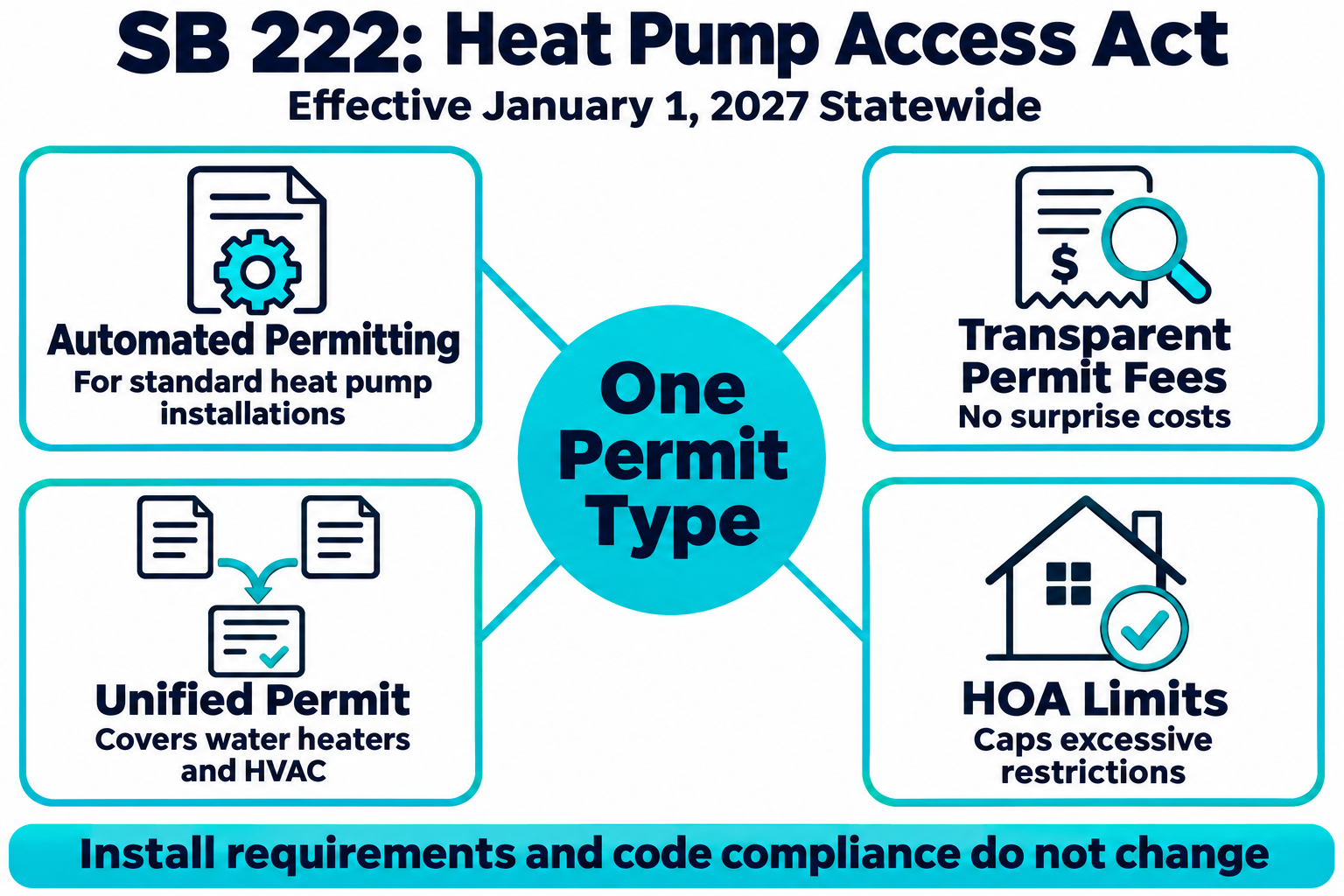
- Automated permitting for standard heat pump installations
- Reasonable, transparent permit fees with no surprise costs
- A single, unified permit type covering both heat pump HVAC systems and water heaters
- Limits on excessive HOA restrictions, documentation, or aesthetic requirements
Read that third point carefully. Today a homeowner swapping a gas tank for a heat pump water heater and adding a heat pump HVAC system can end up pulling separate permits through separate paths. After January 1, that is meant to be one permit type.
To be clear about scope on my end: we are a licensed plumbing contractor, CSLB #1102966. We handle the water heater side of that unified permit. We do not do HVAC work.
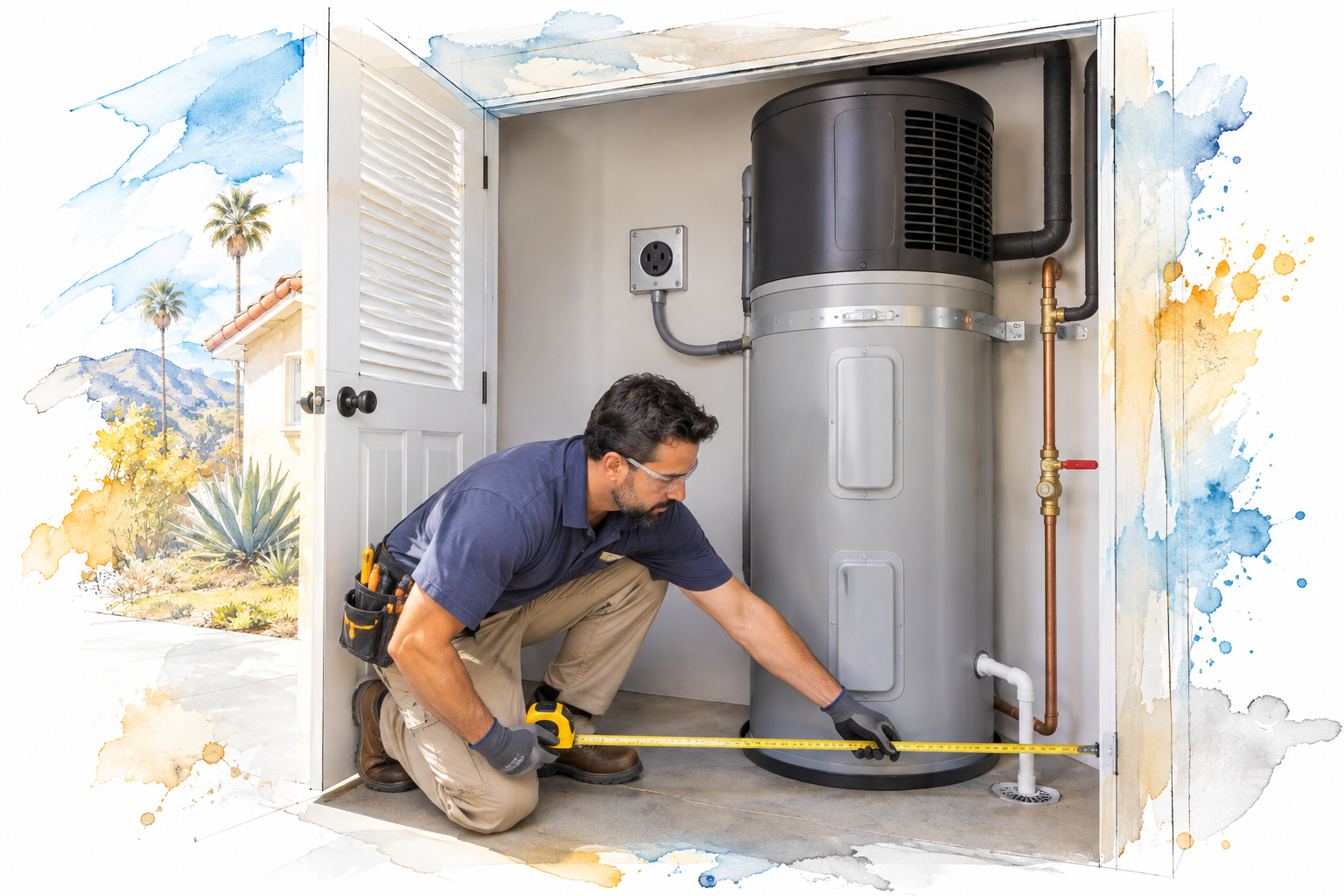
Why the permit was the bottleneck here in the first place
Most homeowners I talk to assume the permit is a formality that happens in the background. On a heat pump water heater, it has not worked that way.
A conversion from a gas tank to a heat pump unit is not treated like a simple like-for-like swap at the counter. It can touch the water side, the electrical supply, the condensate routing, and sometimes the gas line that gets capped off. Different departments, different review paths, different wait times depending on which city or county you are in.
I have had callers in both counties tell me some version of the same thing: “I already have everything ready, I just need someone to come out.” The equipment is sitting in the garage. The homeowner is ready. The paperwork is what is standing still.
A unified, automated permit type attacks that specific problem. It should shorten the wait between “yes, let’s do it” and “we’re pulling the truck up,” and it should make the permit portion of your project cost more predictable, since the law calls for transparent fees without surprises.
If you want the general lay of the land on when permits are triggered around here, we covered that in which plumbing jobs in Santa Cruz County need a permit.
What SB 222 does not change about your install
Here is where I push back on how this news is getting read. A faster permit does not make the physical job faster, and the physical job is where most heat pump water heater projects actually stall in Monterey County and Santa Cruz County homes.
The things that still have to be true on install day:
- Space and air volume. Heat pump water heaters pull heat from the surrounding air, so a sealed closet that fit a slim gas tank may not work. We wrote about this in detail in will a heat pump water heater even fit where my old tank sits.
- Electrical supply. Standard units need a dedicated 240 volt circuit. If your panel is older and full, that is a separate piece of work by a licensed electrician.
- Condensate drainage. These units produce water. It has to go somewhere legal and safe, which is a real design question in a garage or interior closet.
- Clearances, drain pan, and seismic strapping, all to California code.
- Equipment availability for the specific model and capacity your home needs.
One more local factor that gets ignored: hard water is common throughout Santa Cruz County and much of the Central Coast. Mineral scale builds on heating elements and tank bottoms and quietly shortens the life of whatever you install. If you are spending money on a new system in 2027, water quality deserves a look at the same time. We broke that down in hard water in Santa Cruz County and what it does to your plumbing.
Before and after January 1, 2027
Here is a plain comparison of what the new law touches and what it leaves alone.
| Part of the project | How it generally works now | Under SB 222 starting Jan 1, 2027 |
|---|---|---|
| Permit type | Can require separate permits for water heater and HVAC work | A single, unified permit type covering both |
| Review process | Varies by city or county, often manual review | Automated permitting for standard installations |
| Permit fees | Set locally, not always clear upfront | Reasonable and transparent, no surprise costs |
| HOA rules | Restrictions and aesthetic requirements vary widely | Limits on excessive HOA restrictions and documentation |
| The actual install | Space, electrical, condensate, code compliance | No change, same requirements apply |
SB 222 at a glance
Four requirements the Heat Pump Access Act places on every California city and county.
What I would tell you if you called me this week
If your water heater is dead right now, do not wait for January. No hot water is a problem today, and a January permit rule will not warm up tonight’s shower. We cover why a replacement is rarely a same-hour swap in no hot water in Santa Cruz and why a new water heater isn’t a same-hour swap.
If your tank is 10 years or older but still working, you are in the group this law actually helps. Use the next couple of months to get the site questions answered, then schedule the work once the unified permit process is live.
And if you live in a condo or an HOA community on the Monterey Peninsula where a previous heat pump request got shot down over appearance or paperwork, it is worth revisiting in 2027. The new limits on excessive HOA restrictions were written for exactly that situation.
One scheduling note from our side. We book out, and fall and winter run heavy with drainage and water heater calls across both counties. Planned work gets planned dates, so earlier conversations get better slots.
Frequently Asked Questions About the New Heat Pump Water Heater Permit Law
Do I still need a permit for a water heater replacement in Santa Cruz or Monterey County?
Yes. SB 222 changes how the permit is issued, not whether you need one. Water heater replacement is permitted work, and a licensed contractor should be pulling it for you, not handing you the task.
Does the new law make the permit free?
No. The law requires reasonable, transparent permit fees with no surprise costs, which is different from eliminating fees. Fees are set by your local jurisdiction, and the rest of your project cost depends on the equipment, the site conditions, and the work involved. For what your specific job looks like, call and we will walk through it.
The permit covers HVAC and water heaters together. Does one contractor do both?
Not necessarily. The unified permit is about paperwork, not licensing. We are a licensed plumbing contractor and we handle water heater installation and repair. We do not do HVAC, electrical, or general contracting work.
My HOA turned down a heat pump unit before. Does this help?
It may. The Heat Pump Access Act places limits on excessive HOA restrictions, documentation, or aesthetic requirements starting January 1, 2027. If your denial was based on how the unit looks or on a stack of extra paperwork, that is worth raising again next year.
Should I convert from gas to a heat pump water heater at all?
It depends on your space, your electrical panel, and where the unit would sit. Some homes here are an easy fit. Others need electrical work first, or the only available closet has no air volume to work with. That is a site visit question, not a phone question.
Planning a water heater project for 2027?
If you are weighing a heat pump water heater for a home in Monterey County or Santa Cruz County, the site questions are worth answering now so the work is ready to go once the new permit process starts. Maverick Plumbing is a licensed and insured plumbing contractor, CSLB #1102966, with 24/7 emergency service available across both counties. You can reach us at (831) 515-9903 or through maverickplumbingtechnicians.com when you want to talk it through.
