

Direct Answer: In most Santa Cruz County homes the main water shutoff sits where the supply line enters: an exterior wall, the crawl space, or near the water heater. The curb meter valve belongs to the utility.
You closed on the house a few weeks or a few months ago. You know which breaker runs the kitchen, you have met the neighbors, and you still have no idea where the main water shutoff is.
That is normal. Almost nobody goes looking for it until water is already crossing the floor, and I have taken plenty of calls from new owners who found out the hard way. One of them opened with a line I think about a lot: they had just bought the house and there was already a flooding problem.
Here is my position after years of these calls in Santa Cruz County and Monterey County: finding the valve is only half the job. A shutoff you have never turned is not a shutoff you have. This is a dry-Saturday walkthrough, about 20 minutes, that ends with you knowing where every valve is and whether it actually works.
Step 1: Start at the curb and learn where your responsibility begins
Walk out to the street edge of your property and look for a rectangular lid set flush in the dirt, grass, or sidewalk. That is the meter box. Lift the lid with a screwdriver tip and take a look before you touch anything.
Inside you will usually see:
- The water meter itself, with a dial or digital register
- A valve on the street side of the meter, which belongs to the water utility
- A valve on the house side of the meter, which is the one you are generally expected to operate
- Sometimes a small leak indicator triangle or dial on the meter face
That line between the meter and your house is worth understanding, because a surprising number of leaks land right there. Several times a year I meet an owner who got a notice from the water utility saying a detected leak is on the customer side of the meter, and they had no idea that stretch of pipe was theirs.
The street-side valve is not yours to play with. Leave it alone and let the utility operate it. What you want is the house-side valve, and your own main valve at the structure.
Step 2: Find the main house valve where the water enters the structure
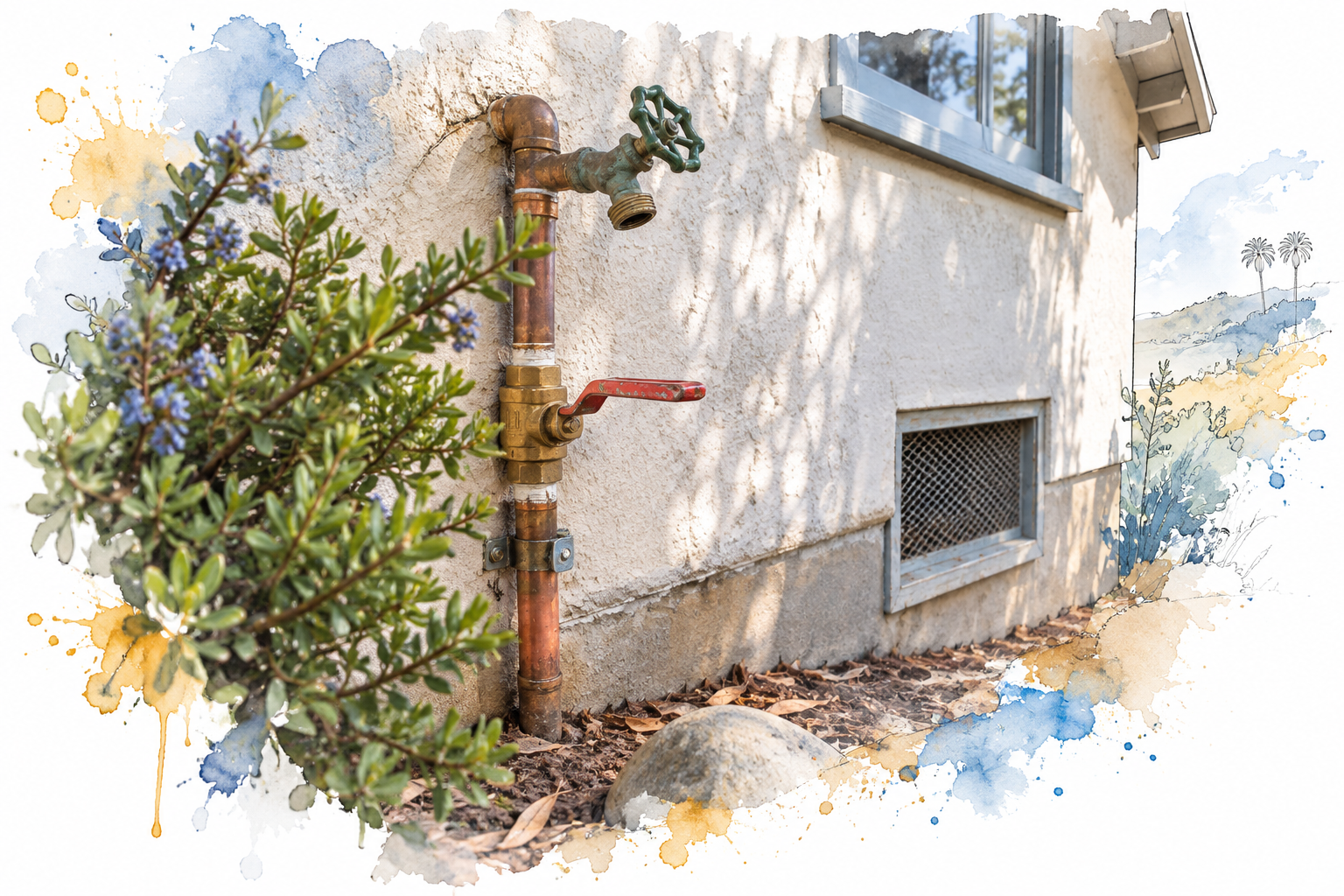
Older Central Coast homes mostly do not have basements, so forget the image of a valve on a basement wall. In Santa Cruz County and Monterey County, the main house valve usually turns up in one of a few places.
Start your search here:
- On an exterior wall, often on the side of the house facing the street, near a hose bib
- Inside the crawl space, close to where the supply pipe comes through the foundation
- In the garage, along a wall near the front of the house
- Near the water heater, especially in homes where the heater sits in a closet or exterior enclosure
- In a utility closet or behind an access panel in a condo or newer build
Follow the pipe. If you can see the line coming up out of the ground outside, trace it with your eyes until you hit a handle. That is almost always it.
When you find it, do two things. Take a photo on your phone, and tell everyone else who lives there. A shutoff only one person can find is a half-measure at 11pm in January when that person is out of town.
Step 3: Turn it. This is the part people skip.
Now actually operate the valve. Gently.
There are two common handle types and they behave differently:
- A ball valve has a lever. A quarter turn, so the lever ends up crosswise to the pipe, shuts the water off.
- A gate valve has a round wheel. It takes several full turns clockwise to close, and these are the ones that seize.
Use steady hand pressure. If it will not budge, stop. Do not reach for a wrench or a cheater bar, because an old gate valve that snaps gives you an open pipe and no way to close it.
After you close it, go inside and open a faucet. The flow should drop to a trickle and then stop within a few seconds. If water keeps running, the valve is passing water and is not doing its job. Then open it back up, run the faucet again, and check the valve body and stem for weeping or dripping over the next hour.
The local reason these fail is hard water, which is prevalent across Santa Cruz County and most of the Central Coast. Mineral scale builds up on the internal parts of valves that sit untouched for years. The same scale is what quietly shortens the life of your fixtures and angle stops.
A valve that fails this test is a scheduled repair, not a crisis. In October that is an appointment. In February it is a flood.
What You Found and What It Means
Here is a quick reference for whatever is sitting in front of you once you lift that lid or crawl under the house.
| Valve type | What it looks like | How it should feel | What a bad result means |
|---|---|---|---|
| Ball valve (house main) | Lever handle, often red or blue | Firm but smooth quarter turn | Stiff or spongy lever usually means internal scale or a worn seat |
| Gate valve (house main) | Round wheel handle | Several smooth full turns | Will not move, or moves but water keeps flowing. Common on older homes |
| Customer-side meter valve | Small valve in the meter box past the meter | Turns with a meter key or by hand | Stuck or buried in dirt means you cannot isolate the service line |
| Angle stop (under sink or toilet) | Small oval or football-shaped knob | Turns with light finger pressure | Frozen knob or a drip at the stem after turning |
| Utility-side meter valve | Valve before the meter, sometimes locked | Not yours to operate | Call the water utility, not a plumber, for this one |
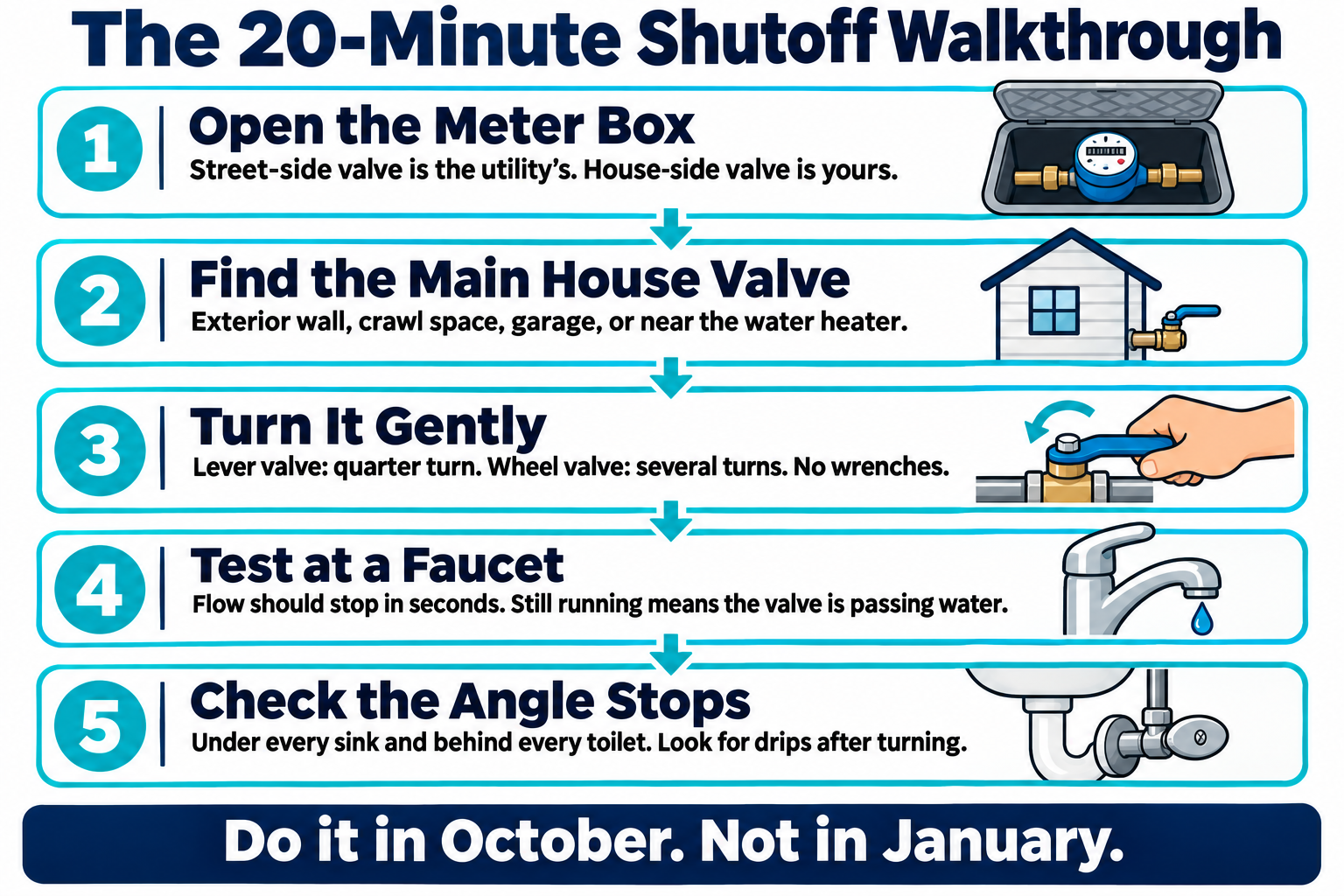
The 20-Minute Shutoff Walkthrough
This is the whole routine in order, from the curb to the inside of the house.
Step 4: Check the small valves while you are at it
Your main valve stops everything. The angle stops under sinks and behind toilets stop one fixture, which is often all you need and a lot less disruptive.
Go fixture by fixture:
- Under each bathroom and kitchen sink, there should be two stops, hot and cold
- Behind each toilet, there should be one
- At the washing machine, two valves or a single lever box
- At the water heater, a cold supply valve above the unit
Turn each one closed and back open with light finger pressure. If a knob is frozen solid, leave it and note it. If it turns but then drips at the stem, note that too.
Those supply lines and stops take the same hard water abuse as everything else, and I have seen deferred stops turn into cabinet and wall damage that costs far more attention than the original part. A failed stop under a vanity can soak a cabinet floor for weeks before anyone notices.
Step 5: Know where the gas shutoff is, but do not go looking during a gas smell
While you are outside, find the gas meter. It is usually mounted on an exterior wall or in a side yard enclosure, and the shutoff is a rectangular tab on the pipe going into the meter, turned with a wrench so the tab sits crosswise to the pipe.
Know where it is so you can point a responder to it. But the first move when you smell gas is not to go find that valve.
If you smell gas, get everyone out of the building first. Do not flip light switches, do not use anything with an open flame, and make your calls from outside the property. Our gas leak response runs 24 hours a day, 7 days a week at (831) 515-9903.
Step 6: Do this in the fall, not in the middle of a storm
Timing is the real argument for doing this now instead of someday.
Forecasters have been pointing toward a strong winter pattern. A USDA Climate Hubs summary of NOAA’s El Nino outlook put roughly a 63% chance of a very strong event between about November 2026 and January 2027. No forecast promises anything about your street, but California’s storm season reliably runs December through March, and that is when the calls stack up here.
What that looks like on our end is simple. Demand for plumbers across Santa Cruz and Monterey County runs at a fraction of its winter level in October and November, then multiplies in January and February. Schedules in this trade get booked out further during those months.
So a stuck valve discovered in October is a scheduling item. The same stuck valve discovered during an atmospheric river in January puts you in line behind everyone else on the Central Coast who just learned the same thing. If you are going to be away during the winter, the same logic applies to an empty house in a storm.
Frequently Asked Questions About Finding Your Main Water Shutoff
I cannot find a main shutoff anywhere on my house. Is that possible?
Yes, and it happens more than you would think on older Santa Cruz County homes that have been remodeled a few times. Sometimes the valve got buried behind drywall, enclosed in a deck, or covered by landscaping. In that case the customer-side valve in the meter box is your only shutoff, which is workable but not ideal. A licensed plumber can trace the line and talk through adding a proper main valve at the house.
Should I turn the main shutoff off and on every so often to keep it working?
Exercising a valve once or twice a year does help keep it from seizing. Just do it gently, and do it on a dry day when a failure is an inconvenience rather than an emergency.
What is the difference between the valve at the meter and the one at my house?
The valve at the meter sits at the property line and controls the service line coming in from the street. The main house valve sits where that line enters the structure. Everything between those two points is generally the homeowner’s pipe, which is why utility leak notices often land on owners who assumed the whole run was the city’s.
My shutoff turns but water still runs. How bad is that?
It means the valve is passing water and will not isolate the house when you need it to. It is not an emergency by itself, but I would get it replaced before storm season rather than after.
Is an automatic shutoff valve worth considering?
Some insurers now ask for one, and they close the main line on their own when they detect abnormal flow. It is a different conversation from a manual valve, and worth reading up on if your policy renewal mentioned it.
Found a valve that will not turn?
Shutoff and valve assessment is the kind of thing a licensed plumber can look at during a normal visit, alongside whatever else is on your list. As a licensed and insured contractor (CSLB #1102966) working across Santa Cruz County and Monterey County, we are reachable at (831) 515-9903 or at maverickplumbingtechnicians.com. One customer put the experience plainly in a review: “Communicative, quick, and helpful. Immediately knew what the problem was and fixed it.”
