

Direct Answer: Sometimes, but not always. A heat pump water heater needs roughly 750 cubic feet of air around it plus a gravity condensate drain, so tight closets usually need a different plan.
About one in seven calls we take starts the same way: “Do you even work on this kind of unit?” Heat pump water heaters come up by name more and more, right alongside tankless flushing and sump pumps.
And before anyone asks about brands or gallons, they ask the question that actually decides the job. Will this thing fit where my old tank sits?
I have had that conversation in Watsonville, in Santa Cruz, and across Monterey County. The honest answer depends on three things: air volume, condensate drainage, and sizing for how your household actually uses hot water. Here is how I walk a homeowner through each one.
The Real Space Requirement Is Air, Not Floor Space
This is the part that surprises almost everyone. A heat pump water heater does not make heat the way a gas burner or an electric element does. It pulls heat out of the surrounding air and moves it into the water.
So the unit needs a supply of air to work with. A common manufacturer recommendation is roughly 750 cubic feet of open air space around the unit, and the Department of Energy’s code compliance brief on heat pump water heaters backs that up along with the alternative of ducting air in and out.
To picture 750 cubic feet, think of a room about 10 feet by 10 feet with a 7.5 foot ceiling. A hallway closet with a solid door is nowhere close.
Here is what I look at when I walk a space:
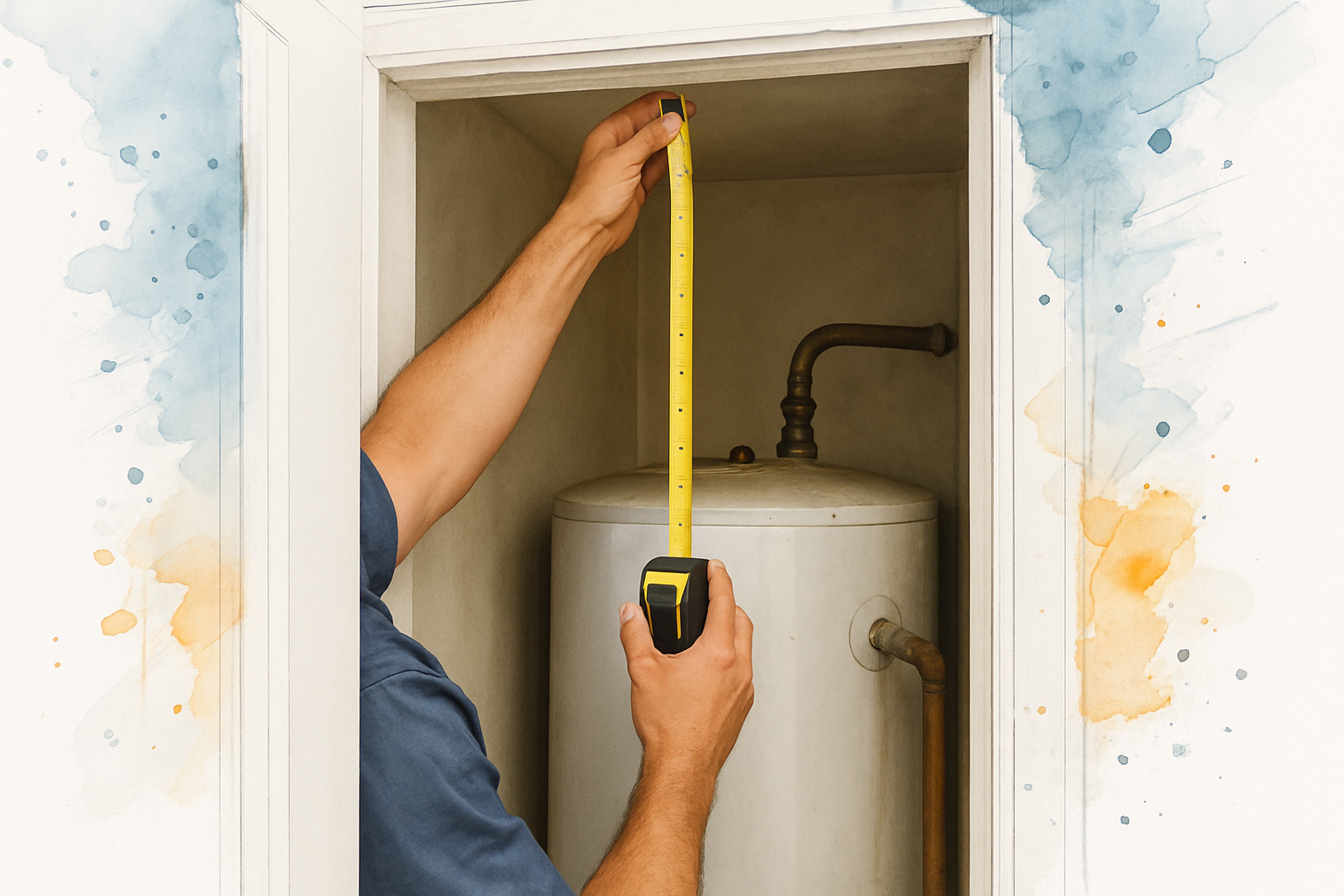
- Ceiling height above the tank. These units are taller than the tank they replace because the compressor sits on top.
- Door type. A solid slab door blocks airflow. Louvered doors or a transfer grille change the math.
- Room volume, not just footprint. A wide garage bay works. A 3 foot by 3 foot alcove does not.
- Service clearance. There has to be room to pull the air filter, reach the panel, and get a tool on the fittings.
- What else is in the room. A furnace or dryer sharing a tight space competes for the same air.
Plenty of older homes around the Monterey Bay keep the water heater in a narrow interior closet. Those installs are not impossible, but they need a different plan than a simple garage swap.
Condensate Is the Detail That Decides Most of These Jobs
If air volume is the first question, condensate is the one I check right behind it. Because these units pull moisture out of the air, they produce a steady trickle of water all day long that has to go somewhere.
That water has to drain by gravity. No section of the drain line can sit higher than the discharge port on the unit, or it backs up.
Acceptable places to route it include:
- A floor drain in the garage or utility room
- A laundry standpipe
- A utility sink
What it cannot do is dump straight into drain waste vent piping without the right connection. And here is the local wrinkle: most older Central Coast homes have no floor drain anywhere near the water heater. Slab-on-grade houses in particular.
When gravity will not work, a condensate pump comes into the picture, which adds a small piece of equipment with its own power need and its own failure mode. Not a dealbreaker, just something you should know about before the unit shows up on a truck.
While I am looking at condensate, I am also checking two other things in the same space: the drain pan under the tank and where its drain goes, and the temperature and pressure relief discharge line. On a lot of older installs, one or both of those were never done right in the first place.
Common Water Heater Locations and What Each One Means
Here is roughly how different spots around Santa Cruz and Monterey County tend to play out when a homeowner asks about a heat pump unit.
| Where the tank sits now | Air volume outlook | What usually needs solving |
|---|---|---|
| Attached garage | Usually workable | Vertical clearance and a condensate route to a drain or utility sink |
| Interior hallway closet, solid door | Rarely workable as-is | Louvered door, transfer grille, or ducted air; often a condensate pump |
| Utility or laundry room | Often workable | Standpipe access for condensate, plus clearance for filter service |
| Exterior alcove or small closet | Depends on the door and volume | Air supply and freeze considerations for the condensate line |
| Crawlspace or under-house | Case by case | Service access, pan drainage, and a gravity path out |
The Five Things I Check Before Saying Yes to the Space
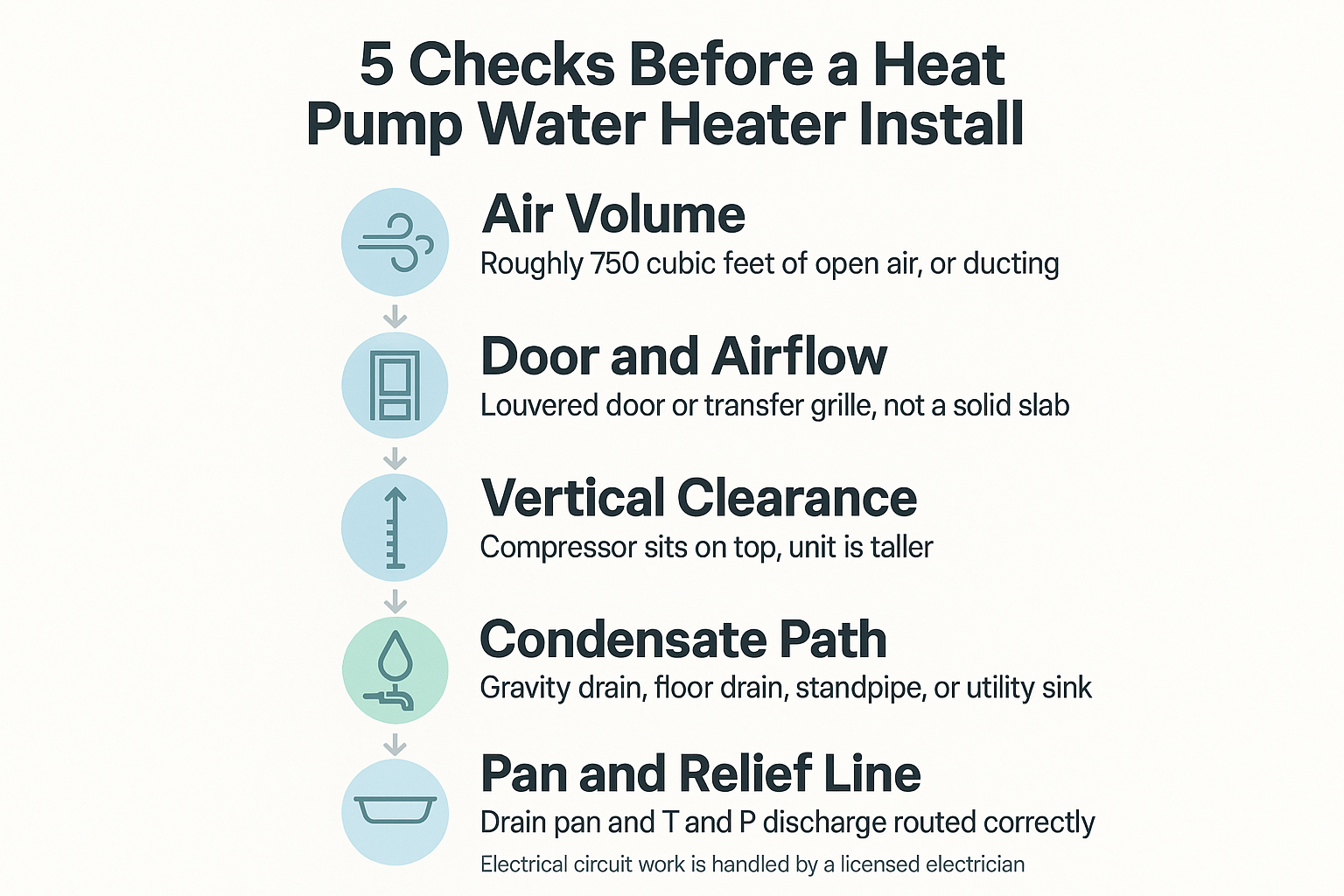
This is the short version of the walkthrough I do on site, in the order I do it.
Sizing: Why “Hot Water Only Lasts Five Minutes” Keeps Coming Up
One caller described a tank that was only about a year and a half old and said the hot water ran out in five minutes. That is almost never a broken part. That is a sizing and recovery problem.
Heat pump units recover differently than gas tanks. They heat more slowly in normal operation, then fall back on electric resistance elements when demand spikes, which is where efficiency drops off.
So the conversation that matters is not gallons printed on the label. It is:
- First hour rating versus your real morning demand
- Household size and how many people shower back to back
- Whether the laundry or dishwasher runs during peak hot water hours
- Incoming water temperature, which is colder here on a January morning than in July
- Distance from the unit to the furthest fixture
I have seen homeowners buy a unit off a spec sheet and end up right back where they started. If you are already living with hot water that disappears too fast, read up on what a newer tank running out early is actually telling you before you assume a new unit type solves it.
A professional evaluation walks the fixtures, checks the existing setup, and matches capacity to how your house actually runs. For anything specific to your home, a phone conversation beats a spec sheet every time.
Being Straight With You About Scope
These units run on a dedicated 240 volt circuit, and most manufacturers call for a 30 amp supply. If your current tank is gas, that circuit does not exist yet.
That electrical work is performed by a licensed electrician, separate from the plumbing. I want that clear up front so nobody is surprised mid-project.
Maverick Plumbing is a licensed plumbing contractor, CSLB #1102966, and we handle the water side of the job:
- Water connections and any repiping the swap requires
- Condensate routing and the pump if gravity will not work
- The drain pan and its drain line
- The temperature and pressure relief discharge line
- Removal and disposal of the old unit
We do not do electrical panel or circuit work. Different license, different trade.
One more thing I get asked about: those Bay Area headlines on gas water heater rules. Those air district rules cover Bay Area counties, and I cover that separately in what Watsonville homeowners should know about changing gas water heater rules. For this article, stick to physical fit.
Hard Water Does Not Care What Kind of Tank It Fills
Some homeowners assume a heat pump unit is maintenance free. It is not, and our water here makes sure of that.
Hard water is prevalent across Santa Cruz County and much of the Central Coast. Sediment buildup, a worn anode rod, and slipping efficiency show up in a heat pump tank the same way they show up in a conventional one.
These units also add two items to the yearly list:
- An air filter that needs periodic cleaning, which is why service clearance matters
- A condensate pan and line worth checking once a year for clogs or slime buildup
If you already see white scale crusting on your shower head and faucet aerators, that same mineral load is going into the tank. That is usually where a water softener conversation makes sense, and it is worth having before you install new equipment rather than after.
Plan on giving a new unit the same yearly attention the tank you own right now already deserves. That is the honest way to think about how long a water heater should actually last.
Frequently Asked Questions About Heat Pump Water Heater Installation
Can a heat pump water heater go in a closet?
Only if the closet can supply enough air. A small closet with a solid door is not a workable spot on its own. Adding a louvered door, a transfer grille, or ducting air in and out can change that, but it has to be evaluated on site rather than assumed.
Are these units louder than my old tank?
Yes. There is a compressor and a fan running, so it makes noise similar to a window air conditioner while it operates. That is another reason a garage or detached utility room is often a better spot than a closet next to a bedroom.
What if there is no floor drain near my water heater?
That is common in older Central Coast homes. The condensate can often go to a laundry standpipe or a utility sink instead, as long as the whole line runs downhill from the discharge port. When no gravity path exists, a condensate pump is the usual answer.
Will it cool down my garage?
A little. The unit pulls heat out of the surrounding air, so the room it sits in runs slightly cooler and drier. In a garage that is usually fine, and some homeowners like the dehumidifying effect. In a small conditioned space it works against your heating.
How much does a heat pump water heater installation cost?
I am not going to put a number on it here, because the space, the condensate solution, the electrical work, and the unit itself all move it. Call us at (831) 515-9903 and we can talk through your setup.
Wondering If Your Space Works?
What our customers tend to mention afterward is the assessment and the explanation, not the sale. One homeowner put it simply after a water heater job: “He verified that I did, indeed, need a new water heater, and expertly assessed what size and capacity was necessary.” That is the part we care about getting right. Maverick Plumbing serves Watsonville, Santa Cruz, and the surrounding Monterey Bay area, licensed and insured, with 24/7 emergency service available for no hot water situations. If you want to talk through whether the spot your tank sits in today would work, call (831) 515-9903.
