Direct Answer: As of July 28, 2026 at 12:00 p.m. PT, TECH Clean California is accepting reservation applications for multifamily central heat pump water heater optimization pathway incentives, statewide, through TECH enrolled contractors.
If you own or manage an apartment building in Monterey County or Santa Cruz County and the central water heating plant is limping along, the funding picture just changed in your favor.
On July 28, 2026 at 12:00 p.m. PT, TECH Clean California started accepting reservation applications for its multifamily central heat pump water heater optimization pathway incentives. It is statewide, and it is available through TECH Clean California contractors supporting multifamily properties and buildings.
I get calls from property managers all the time who are trying to decide whether to patch a failing plant one more time or replace it. Below is what actually changed, who it covers, and what a central plant swap looks like in a real Central Coast building.
What changed on July 28, 2026
TECH Clean California announced that its multifamily enhanced support pathway for central heat pump water heater optimization incentives is now open. The announcement is dated July 28, 2026, out of Oakland, and it states plainly that reservation applications are being accepted as of that date and time.
Two details matter more than the rest:
- The incentives are available statewide, not limited to one utility territory
- They are available to TECH Clean California contractors across the state supporting multifamily properties and buildings
That second point is the one that trips people up. This is not a rebate form you fill out yourself after the work is done. It runs through an enrolled contractor, and the program materials are clear that TECH Clean California incentives are only available through contractors who have completed the required training.
It is also a reservation program. Funds are set aside when an application is submitted and approved, not after the install. You can read the announcement directly on the TECH Clean California news page.
So the practical move for an apartment owner in Salinas, Seaside, Marina, or Watsonville is not to start shopping equipment. It is to confirm who in your contractor lineup is enrolled with the program before anything else happens.
Why multifamily owners have a route single family homeowners don’t
This is the part that surprises people. Right now, an apartment owner has a funding door open that the homeowner down the street does not.
The program states that as of February 24, 2026, HEEHRA single family rebates are fully reserved for projects statewide. It also states the program is no longer accepting new income verification applications for single family projects statewide.
So the picture as of this writing:
- Single family HEEHRA rebates: fully reserved statewide, no new income verification applications for single family
- Multifamily central heat pump water heater optimization pathway: accepting reservation applications as of July 28, 2026
The Switch Is On, run by the Building Decarbonization Coalition, publishes the same onboarding and enrollment details on its TECH incentive resources page.
I would not treat that open door as permanent. These programs have run out early before, and a reservation window that opens at noon on a Tuesday is not a window that stays wide open for years. If you have a central plant that is past its useful life, the calendar matters as much as the equipment does.
Where the two funding paths stand
Here is the short version of who is covered and how each path works, based on the program’s own published status.
| Pathway | Status | How it gets applied for |
|---|---|---|
| Multifamily central heat pump water heater optimization | Accepting reservation applications as of July 28, 2026, 12:00 p.m. PT | Through TECH Clean California contractors supporting multifamily properties |
| Single family HEEHRA rebates | Fully reserved for projects statewide as of February 24, 2026 | No new income verification applications for single family projects statewide |
| Contractor requirement | Applies to both | Incentives available only through TECH contractors who completed required training |
What a central plant replacement actually involves in a Central Coast building
Incentive money is only half the decision. The other half is what the work does to your building and your tenants for the days it is underway.
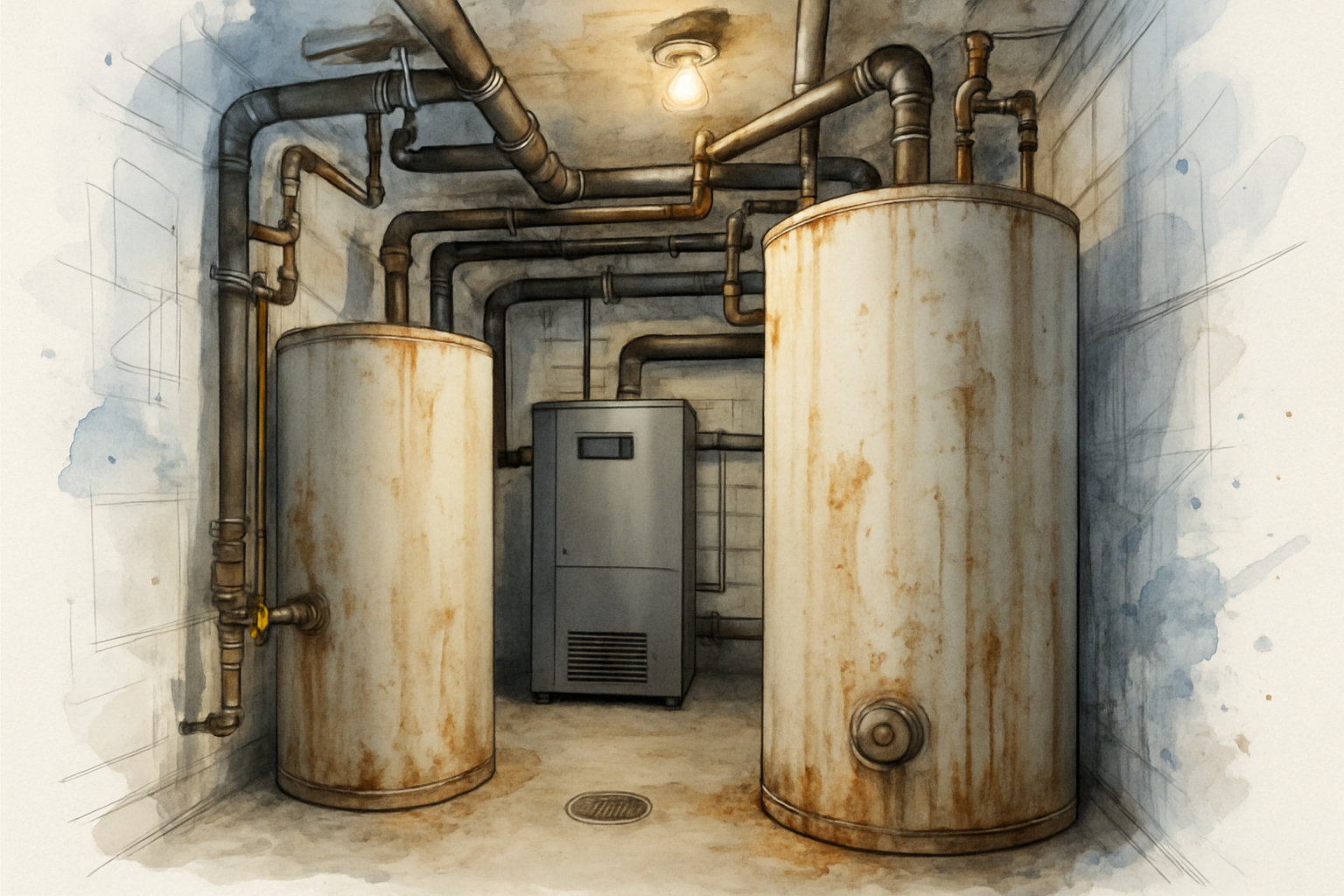
Here is what I look at first in an older Monterey County or Santa Cruz County multifamily property:
- Space and air access. Heat pump equipment needs air volume and clearance. A cramped 1970s boiler closet that fit a gas plant may not fit a heat pump plant without rework.
- Storage volume and recirculation. Central heat pump systems recover differently than gas. Sizing storage and the recirc loop wrong means morning complaints from the top-floor units.
- Electrical capacity. This is an electrician’s scope, not a plumber’s, and on older buildings it is often the long pole in the schedule.
- Hot water downtime. Tenants notice within the hour. Staging matters.
- Permits and code. Water heating work gets done to California plumbing code, and on multifamily jobs the documentation is part of the deliverable.
Then there is our water. Hard water is common throughout this region, and mineral scale is hard on any water heating equipment, including heat pump systems. If you have ever pulled a failed element out of a building plant here, you have seen the crust. I have written more about what hard water does to plumbing in Santa Cruz County, and it applies just as much to a 24-unit building as it does to a single house.
One more thing worth saying out loud: a central plant replacement is not a same-day swap. Even on a single-family tank, the timeline is longer than most people expect. On a multifamily plant, plan in weeks, not hours.
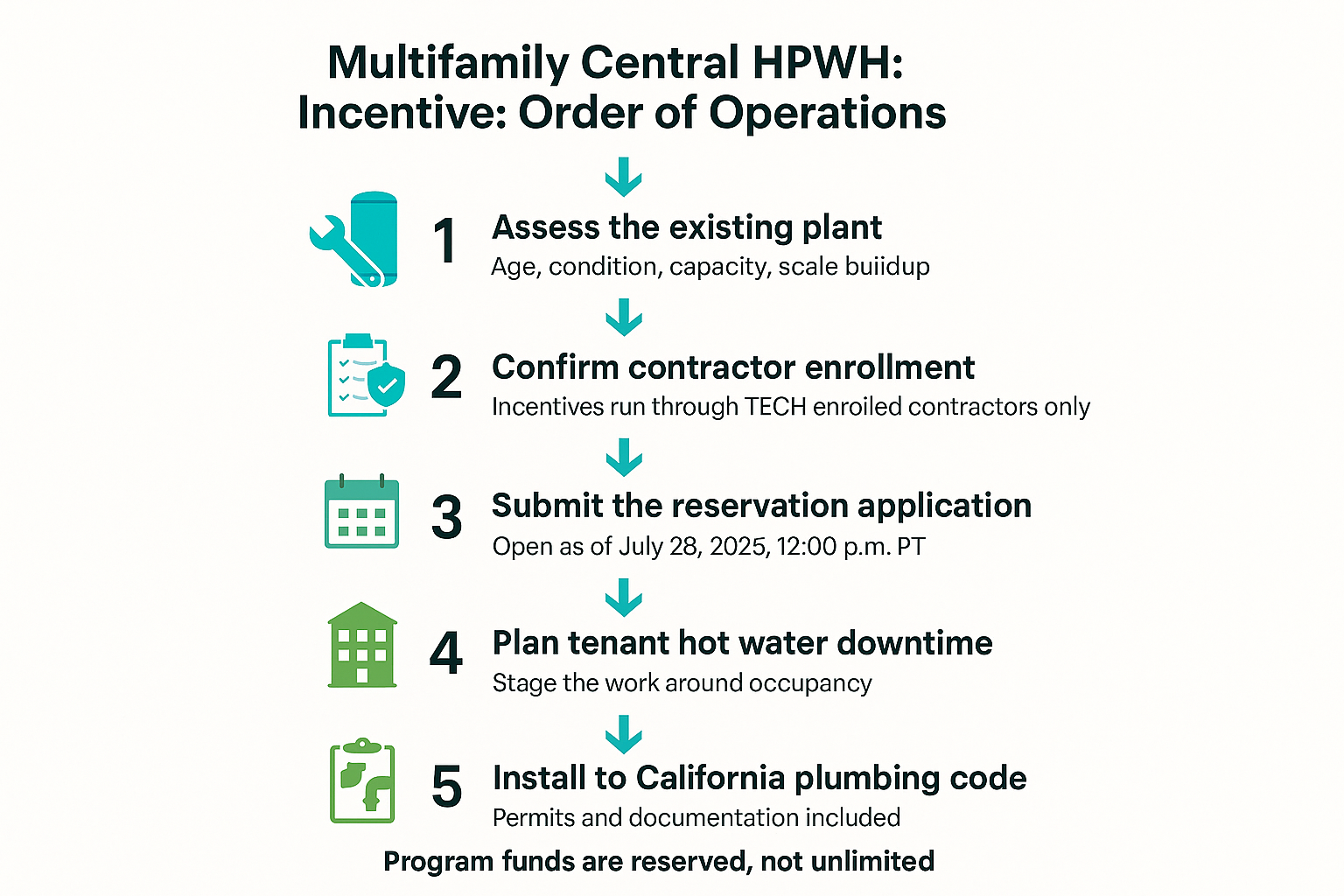
The order of operations for a reservation
This is the sequence I would follow if I owned a building with a plant on its last legs.
What I would do this month if I owned the building
Most of the multifamily owners who call me are not chasing incentive money. They are calling because a plant failed on a Saturday and 18 units had cold showers.
That is the worst time to make a capital decision. You end up buying whatever can be sourced fastest, and the reservation window is irrelevant because the work is already underway.
If your central plant is aging, do three things now:
- Get the plant assessed while it still works. Age, capacity, scale, and recirculation performance tell you how much runway you have.
- Ask your contractor directly whether they are enrolled with TECH Clean California. The answer is yes or no, and it decides whether an incentive reservation is even on the table for your project.
- Check what else in the building is on the same clock. Apartment owners here are already facing sewer system inspection timelines, and California has also been tightening the rules on gas water heating equipment.
One property manager I talked with recently had four separate items she wanted looked at in a single visit. That is the right instinct on a multifamily property. Bundling the assessment saves you trips and gives you a clearer picture of what the building needs over the next few years.
And if the plant is already down, that is an emergency, not a planning project. Cold water in occupied units is a habitability issue, and it moves to the front of the line.
Frequently Asked Questions About the 2026 Multifamily Heat Pump Water Heater Incentive
When exactly did the multifamily incentive open?
July 28, 2026, at 12:00 p.m. PT. TECH Clean California announced that it began accepting reservation applications for multifamily central heat pump water heater optimization pathway incentives at that date and time, statewide.
Can I apply for this myself as the property owner?
No. The program states these incentives are available to TECH Clean California contractors supporting multifamily properties and buildings, and that TECH incentives are only available through contractors who have completed the required training. The reservation goes in through the contractor.
I own a single family rental. Does this apply to me?
Not through this pathway. This one is specifically the multifamily central heat pump water heater optimization pathway. On the single family side, HEEHRA rebates were fully reserved for projects statewide as of February 24, 2026, and the program stopped accepting new income verification applications for single family projects statewide.
How much will a central plant replacement cost my building?
That depends on plant size, storage volume, mechanical room layout, electrical work, and recirculation piping, and it varies too much between buildings for anyone to give you a real number over the phone. The honest answer is that it takes an on-site assessment. Call (831) 515-9903 and we can talk through what your building has.
Is a heat pump plant going to struggle in our coastal climate?
Our mild coastal air is actually reasonable for heat pump equipment compared to inland climates with hard freezes. The bigger local factor I watch is hard water and the scale it leaves behind, which shortens the life of any water heating equipment in Santa Cruz and Monterey County.
Planning ahead on an aging water heating plant?
We work on residential and commercial water heating systems throughout Santa Cruz County and Monterey County, and we are licensed and insured under CSLB #1102966. If you want a straight assessment of what your building’s plant has left in it before you make any decisions, we are available at (831) 515-9903, including 24/7 for emergencies.
