Direct Answer: A whole-home softener ties into the main water line before it branches, so it needs floor space near that entry point, a drain within reach, power in most cases, and a bypass.
Most people who call about a softener have already decided they have a hard water problem. They have seen the crust on the shower head, the film on the glasses, the water heater that sounds like a gravel truck.
What they have not figured out is the part that actually decides the job: where the thing would physically go. That question comes before brand, before size, before anything else.
I have walked plenty of homes in Santa Cruz County and up into Monterey County where the answer was easy, and plenty where it took real problem solving. Here is how to look at your own house before anyone comes out, so you show up to the conversation already informed.
Where a Whole-Home Water Softener Has to Sit
A whole-home softener treats water for the entire house, which means it ties into the main water line before that line branches off to the water heater, the kitchen, and the bathrooms. Tie in after the split and half your house stays hard.
That single requirement drives everything else. The equipment needs four things in roughly the same spot:
- Floor space near the point where the main line enters the house, enough for a resin tank and a brine tank plus room to lift the lid and pour salt
- A drain within reach for regeneration discharge, usually a laundry standpipe, a utility sink, or a properly routed line to an approved connection
- Power in most cases, since demand-based valves need a standard outlet nearby
- A bypass, so the system can be taken offline for service without shutting water off to the whole house
This is where local housing stock matters. A newer home in Aptos or Scotts Valley with an attached garage, the main coming through the garage wall, and a laundry drain ten feet away is close to ideal.
An older Westside cottage or a Seabright place with no garage, a raised floor, and the main entering under the house is a different job. The options narrow to an exterior pad, a crawlspace location, or a side yard setup, and the drain routing becomes the hard part instead of an afterthought.
Walk Your Own House First: What to Look For
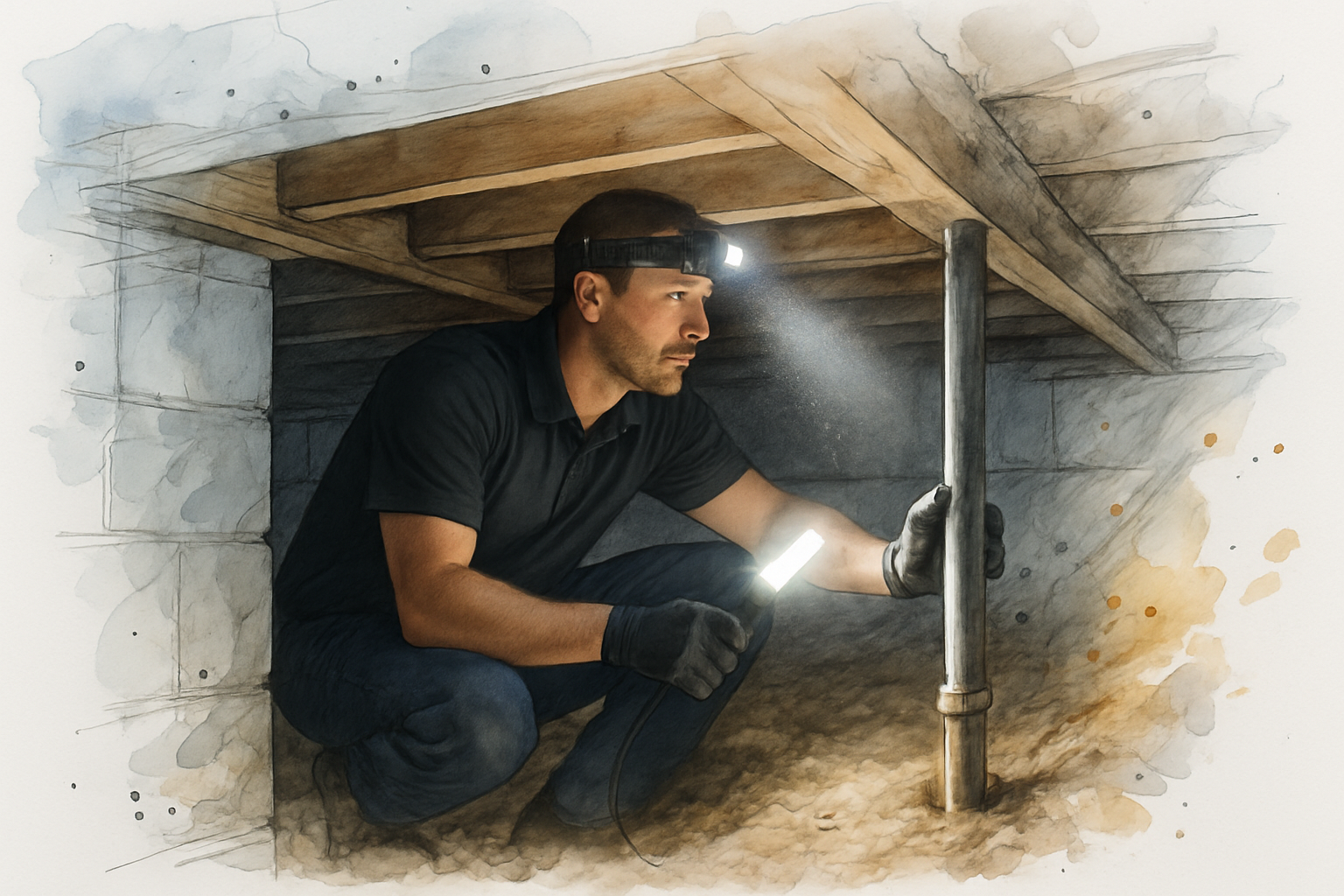
You can answer most of these yourself in about fifteen minutes with a flashlight. It makes the site evaluation faster and it tells you early whether your home is a simple install or a complicated one.
| What the system needs | Why it matters | What to check at your house |
|---|---|---|
| Main line access before branching | Treats the whole house instead of part of it | Find where the water line enters: garage wall, crawlspace, exterior side wall, or under a slab |
| Floor clearance | Two tanks plus working room and salt loading space | Look for an open corner near that entry point, not a shelf or a closet packed with storage |
| A drain for regeneration | Discharge has to go somewhere approved, not on the ground | Note the nearest laundry standpipe, utility sink, or drain and how far it is from the tie-in |
| Electrical outlet | Most modern control valves need power | Check for a standard outlet within cord reach, no extension cords |
| Bypass and shutoff room | Lets the system be serviced without shutting off the house | Make sure there is pipe run available, not a fitting jammed against a wall |
| Sewer or septic | Changes which type of system is even appropriate | Know which one your property is on before any equipment gets discussed |
Get Your Hardness Number Before Anyone Sizes Anything
Sizing is a function of your hardness reading, your household water use, and your fixture count. It is not a rule of thumb, and it is not the same number for everyone in the county.
Water hardness here varies by source. City of Santa Cruz water blends surface and groundwater and shifts by season. Groundwater fed districts toward Scotts Valley tend to run harder. Private wells in the San Lorenzo Valley and the mountains vary parcel to parcel with no published figure at all.
You will also find different hardness numbers published for the same general area depending on which system and which sampling year the source used. That inconsistency is exactly why a real evaluation starts with a test at your own tap.
So here is a fair thing to ask anyone who gives you a recommendation: what was the hardness reading, and where did that number come from? If nobody tested your water, the size is a guess.
I am not going to re-argue the damage case here, since we have covered what hard water does to plumbing in Santa Cruz County and how it quietly shortens the life of fixtures. If you are already shopping, you have probably lived it.
In California, the Type of Softener Is a Legal Question Too
This is the part a big box purchase does not tell you. In California, not every residential softener is appropriate to install at every address, and that has nothing to do with the equipment quality.
State law treats two arrangements differently:
- Off-site regeneration, often called an exchange tank system, where a service company swaps the tank on a schedule and regenerates it somewhere else. No brine goes down your drain.
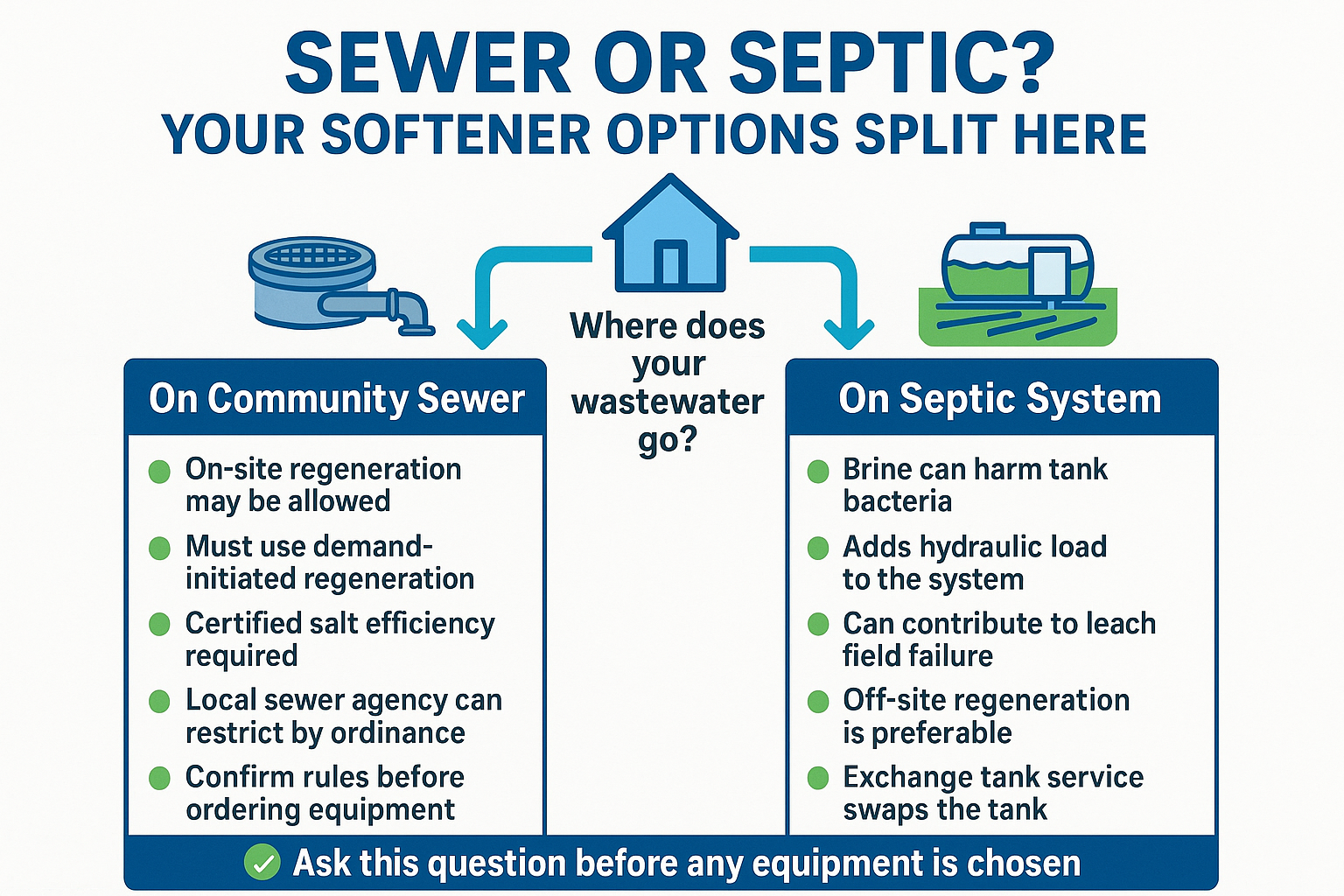
- On-site regeneration that discharges brine to the community sewer, which comes with conditions attached, including demand-initiated regeneration rather than a simple clock timer, and a certified salt efficiency rating.
On top of that, California Health and Safety Code section 116786 gives local agencies authority to limit or prohibit sewer discharging residential softeners by ordinance where salinity is a problem for the treatment plant. The framework sits in sections 116785 and 116786 and has been amended over the years.
Which means the honest answer to “can I install this here” depends on your specific sewer agency, not on one blanket statewide rule. I have not found a Santa Cruz County or City of Santa Cruz ordinance banning residential softeners, so this is not a warning that you cannot have one. It is a reason to confirm requirements with the sewer agency before equipment gets ordered, not after a unit is sitting in your driveway.
If You Are on Septic, the Conversation Changes Immediately
A lot of property in Santa Cruz County sits outside the city sewer service area. Much of the San Lorenzo Valley, the Summit area, and rural parcels running toward the Monterey County line are on septic systems.
Brine from an on-site regenerating softener going into a septic tank is a known problem, not a theoretical one. The salt load can interfere with the bacteria the tank depends on to break down solids, it adds hydraulic load with every regeneration cycle, and it can contribute to leach field trouble down the line.
The County of Santa Cruz Environmental Health Services publishes a homeowner handout on exactly this, walking through how softener discharge affects septic tanks and leach fields and pointing toward off-site regeneration as the preferable arrangement for septic properties. You can read it here: water softener effects on septic systems.
So sewer or septic is one of the first questions I ask before a softener discussion goes any further. If you are on septic, your equipment choices narrow before they widen, and that is better to learn now than after installation.
Nobody wants to solve a scale problem by creating a septic problem.
Sewer or Septic: How That One Answer Changes Everything
This is the decision fork that shapes the rest of the project, so it is worth seeing side by side.
What Ownership Looks Like After the Truck Leaves
This is the part shoppers underestimate. A softener is not a set-and-forget appliance like a garbage disposal.
What ongoing service looks like depends on the system:
- Salt-based systems need salt added on a regular basis, and the brine tank needs an occasional look for bridging or crust
- Exchange tank systems need scheduled tank swaps handled by whoever services them
- Any point-of-use filtration paired with the system needs cartridge changes on a calendar, not whenever someone remembers
One customer review describes the arrangement plainly after a soft water system install: “He also installed a soft water system for my house. The filter has to be changed every six months.” That is Cyndee M., and the useful detail is that the technician tracks the schedule and initiates the visit instead of waiting for the homeowner to think of it.
Ask whoever installs yours two questions. What is the maintenance schedule, and who is responsible for tracking it? The difference between a system that keeps softening and one that quietly stops is almost always service, not equipment.
Frequently Asked Questions About Water Softener Installation in Santa Cruz
Can I buy a softener online and just have a plumber hook it up?
Sometimes, but check first. California treats on-site regenerating systems that discharge brine to the sewer differently than off-site exchange tank systems, and conditions like demand-initiated regeneration and salt efficiency certification apply. If you are on septic, an on-site regenerating unit may be the wrong equipment entirely. It is worth confirming before the box arrives, not after.
What if my house has no garage and the main line runs under the floor?
It is still usually workable, it just takes more planning. The realistic options become a crawlspace location, an exterior pad on a side wall, or a spot near the laundry, and the deciding factor is almost always how far the regeneration drain has to travel.
How hard is the water in Santa Cruz County?
It depends on your source, and published figures differ by system and sampling year. City water blends sources and shifts seasonally, groundwater districts toward Scotts Valley tend to run harder, and private wells vary parcel to parcel. That is why a test at your tap is the only number worth sizing from.
Will a softener make my drinking water taste better?
That is a separate issue. A softener handles hardness minerals that cause scale. Taste, odor, and dissolved solids are a drinking water quality question, which is usually handled at the kitchen tap. We break down the difference in our piece on reverse osmosis versus a water softener.
What does a water softener installation cost?
I am not going to throw a number at you online, because the scope varies too much between an easy garage tie-in and a crawlspace job with new drain routing. An on-site evaluation looks at the tie-in point, the drain distance, clearance, power, bypass work, and your hardness reading. Call (831) 515-9903 and we can talk specifics for your property.
Thinking Through a Softener for Your Home?
We evaluate water softener installations and replacements across Santa Cruz County and parts of Monterey County, CA, including the main line tie-in, drain routing, and bypass work the install depends on. If you want to talk through what your property can take, you can reach us at (831) 515-9903 or request service at maverickplumbingtechnicians.com. We are a licensed and insured plumbing contractor, CSLB #1102966, and you are welcome to look that up before you call.
