

Direct Answer: California is moving toward phasing out new gas water heater sales, with a statewide target around 2030. Your existing unit can stay until it fails — but if it’s aging, now is the time to understand your options.
If you own a home in Watsonville or anywhere in Santa Cruz County, you’ve probably seen headlines about California restricting gas appliances. Most of that coverage is confusing — and some of it conflates different rules that apply to different regions. I want to cut through that and give you something useful: a plain-language explanation of what’s actually changing, what isn’t, and what it means for the gas water heater in your home right now.
The short version is this: California is steering the market toward electric water heating, and if your gas tank water heater is already 10 to 12 years old, you are almost certainly going to face a replacement decision in the same window that these regulations are advancing. That’s not a reason to panic — but it is a reason to pay attention before the unit fails and you’re making a rushed decision.
I’ve seen how that plays out firsthand. A homeowner calls on a Saturday morning with no hot water, the unit is 14 years old, and they’ve never thought once about what their options are or what the permitting process looks like. That’s the situation we want to help you avoid.
What the Regulations Actually Say — and What They Don’t
There are two separate regulatory actions in play here, and they’re easy to confuse.
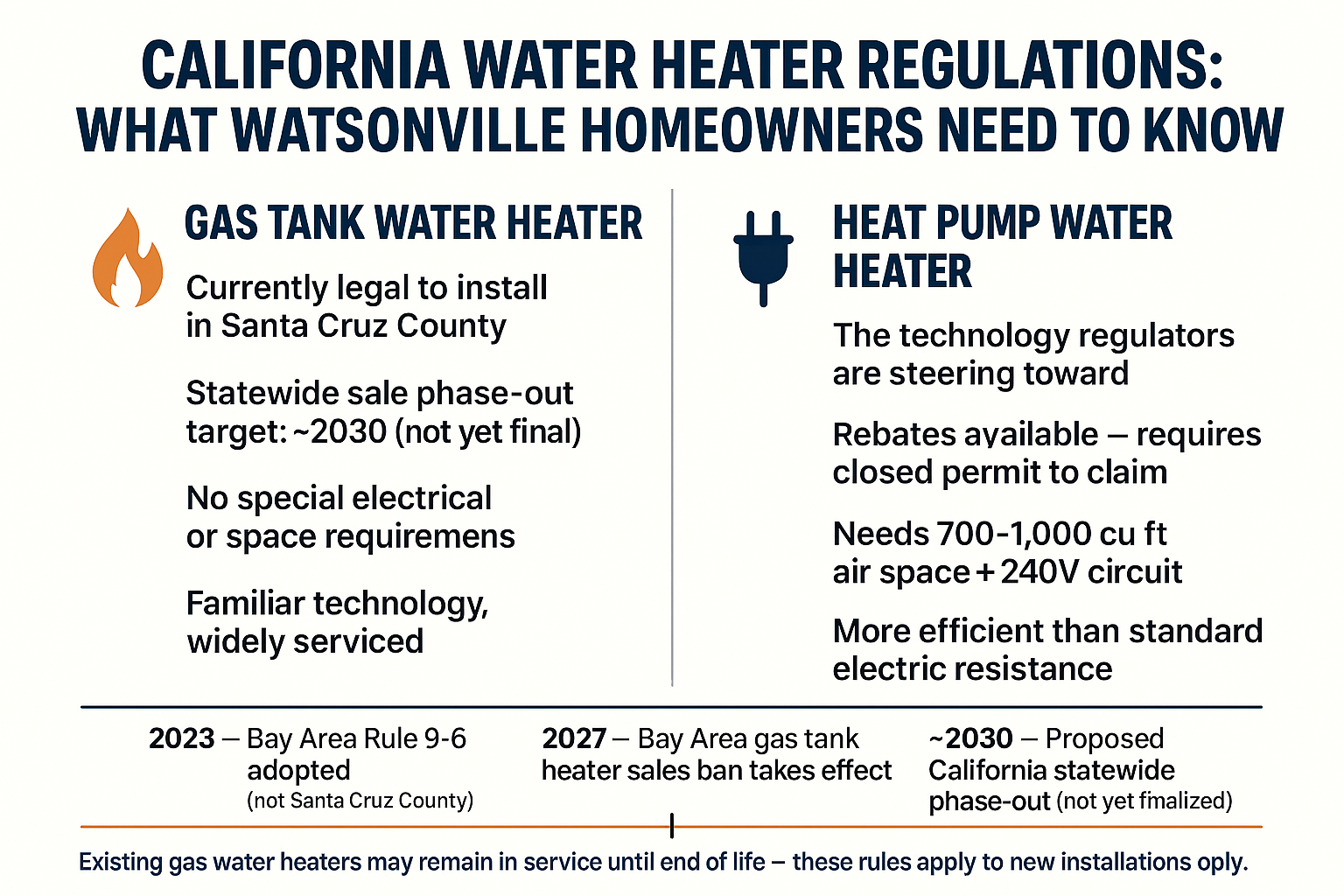
The Bay Area Air Quality Management District adopted Rule 9-6 in March 2023. That rule prohibits the sale and installation of standard gas tank water heaters in all nine Bay Area counties starting January 1, 2027. This gets a lot of press — but Santa Cruz County is not part of the BAAQMD. That specific deadline does not apply to Watsonville or Santa Cruz.
Separately, California’s Air Resources Board has been developing a statewide rule that would phase out the sale of new gas water heaters across California. The target year cited most often in state-level coverage is 2030, though as of mid-2026, that rule had not been formally finalized. You can follow the current status directly through the California Air Resources Board’s rulemaking page.
Here’s what this means practically for a Santa Cruz County homeowner:
- Your current gas water heater is not affected. Regulations under development apply to new sales and installations — not equipment already running in your home.
- Repairs on existing gas units remain legal. If your unit needs a repair, that’s still a normal service call.
- The statewide rule is real, even if not yet final. The direction California is heading is not in question — only the exact timing.
The reason this matters now is timing. If your unit is approaching the end of its service life, you may be replacing it right as the rules tighten. Understanding that in advance gives you options that a last-minute call doesn’t.
The Permit Requirement Most Homeowners Don’t Know About
This is the part of water heater replacement that catches people off guard — and it has real consequences if it’s skipped.
California Plumbing Code requires a permit for every water heater installation. That includes a direct, like-for-like swap when your old unit fails. It’s not just for new construction or major renovations. If a new water heater is going in, a permit is required — full stop.
As a licensed plumbing contractor, that permit is our responsibility to pull. We handle it, schedule the inspection, and make sure the work closes properly. But the homeowner carries the downstream risk if a contractor skips it — and some do, usually as a way to lower the quoted price.
Here’s where unpermitted water heater installs tend to surface and cause problems:
- At resale. A home inspection or permit history pull will flag an unpermitted installation. Buyers’ agents know to look for this, and it can stall or complicate a close of escrow.
- On insurance claims. If a water damage claim is connected to a water heater that was installed without a permit, insurers may dispute the claim on those grounds.
- When applying for rebates. Heat pump water heater rebates — and there are meaningful ones available through California utilities — typically require a closed and passed permit before the rebate pays out. An unpermitted installation disqualifies you from that money before you even apply.
For a homeowner in Watsonville who’s already navigating the decision between a standard replacement and a heat pump unit, losing that rebate is a real financial loss that could have been avoided. The permit process exists for your protection, not as a bureaucratic hurdle.
If you’re ever unsure whether an installation was permitted, your city or county building department can look up the permit history on your property. It’s worth checking before any water heater issue comes up at the wrong time. You can also read more about how long a water heater should actually last to get a clearer sense of where your unit stands.
Gas vs. Heat Pump Water Heaters: What’s Actually Changing in California
This overview shows the regulatory timeline and the key practical differences between gas tank and heat pump water heaters — the two options most Watsonville homeowners will be weighing.
What Heat Pump Water Heaters Actually Require — and Why Space Matters
Regulators are steering the replacement market toward heat pump water heaters, and I think it’s worth explaining what that actually means before you’re standing in front of a failed unit trying to decide quickly.
A heat pump water heater doesn’t generate heat directly. It pulls heat from the surrounding air and transfers it into the water — similar in principle to how a refrigerator works, just in reverse. That makes it significantly more efficient than a standard electric resistance unit. But it also comes with physical requirements that a gas tank heater does not.
The main ones to understand:
- Air volume. A heat pump water heater needs roughly 700 to 1,000 cubic feet of surrounding air space to operate efficiently. A cramped interior closet with no airflow isn’t the right location. A garage, basement, or larger utility room usually works well.
- Electrical circuit. These units require a 240-volt dedicated circuit. If your home currently has a gas water heater and no 240V outlet near the installation location, you’ll need an electrician to add one before the water heater goes in.
- Exhaust air. As the unit pulls heat from the surrounding air, it discharges cooler, drier air. In a garage or utility room with ventilation, that’s not an issue. In an enclosed space, you may need to plan for how that exhaust moves.
For many Watsonville homes — especially those with garage installations or larger utility areas — a heat pump water heater is entirely straightforward. For others with tight interior closets or older electrical panels, it takes more planning. That’s not a reason to avoid the technology, but it is a reason to have a licensed plumber evaluate your space before you’re committed to a direction.
If your current unit is a tankless system, the evaluation is different. Tankless water heater problems and decisions follow their own logic, and the regulatory picture there is somewhat different as well.
Quick Reference: Gas Tank vs. Heat Pump Water Heater — Key Differences
This table summarizes the practical differences that matter most when you’re evaluating a replacement — not as a sales comparison, but as a decision-making reference.
| Factor | Gas Tank Water Heater | Heat Pump Water Heater |
|---|---|---|
| Currently installable in Santa Cruz County | Yes | Yes |
| Affected by Bay Area 2027 rule | No (outside BAAQMD) | Not applicable |
| Statewide phase-out target | ~2030 (proposed, not final) | Not being restricted |
| Space requirement | Standard utility closet or garage | 700–1,000 cu ft air volume recommended |
| Electrical requirement | Gas line + standard 120V for controls | 240V dedicated circuit required |
| Permit required in California | Yes, every installation | Yes, every installation |
| Rebate eligibility | Generally not eligible | Rebates available; closed permit required |
| Hard water impact | Sediment buildup accelerates wear | Same — flushing maintenance still matters |
Hard Water in Santa Cruz County Makes Timing Even More Important
One local factor that doesn’t show up in state-level regulatory coverage: hard water. Santa Cruz County water supply is notably mineral-heavy in many areas, and that has a direct effect on how long a water heater lasts and how quickly it degrades.
Sediment from hard water accumulates at the bottom of a tank over time. It insulates the burner from the water, makes the unit work harder, and reduces efficiency before any mechanical failure shows up. I’ve seen 10-year-old units in Watsonville that were already heavily sediment-loaded and well past their useful life, even though they were still technically running.
What this means for the regulatory timing question: if your unit is in hard water territory and hasn’t been maintained with regular flushing, its actual remaining service life is shorter than the nameplate age would suggest. That’s worth factoring in when you’re deciding whether to repair or start thinking about replacement options.
The signs that say repair, not replace article on our site goes into that decision in more detail. And if you’ve been noticing other plumbing symptoms alongside water heater performance changes — like slow drains or pressure irregularities — it’s worth reading why Watsonville drains clog faster than you’d expect as well.
Frequently Asked Questions About California’s Gas Water Heater Regulations
Does the Bay Area’s 2027 gas water heater ban apply to Watsonville or Santa Cruz?
No. The Bay Area Air Quality Management District’s Rule 9-6 — which prohibits the sale and installation of standard gas tank water heaters starting January 1, 2027 — applies only to the nine-county Bay Area jurisdiction. Santa Cruz County is not part of the BAAQMD, so that specific deadline does not apply here. The statewide regulation being developed by CARB is a separate matter, and its final form has not been confirmed as of mid-2026.
Can I keep using my gas water heater if it’s still working?
Yes. Regulations under development or already in effect elsewhere apply to new sales and installations, not equipment already in your home. A gas water heater that’s currently running can remain in service until it reaches the end of its useful life. Repairs on existing gas units remain legal.
Do I really need a permit just to replace my water heater?
Yes, in California, a permit is required for every water heater installation — including a direct replacement of the same type. The licensed contractor handling the job is responsible for pulling the permit and scheduling the inspection. An unpermitted install can surface at resale, affect insurance claims, and disqualify you from heat pump water heater rebates that require a closed permit before they pay out.
My utility closet is pretty small. Can I still install a heat pump water heater?
It depends on the specific space. Heat pump water heaters generally need 700 to 1,000 cubic feet of surrounding air volume to work properly, plus a 240-volt circuit and a way to exhaust cooled air. A tight interior closet without airflow is usually not the right location. A garage or larger utility room typically works fine. The honest answer is that an on-site evaluation is the only way to know for certain — the space requirements aren’t negotiable based on how much you want the unit to fit.
What’s the best time to start thinking about replacement if my unit is aging?
If your gas tank water heater is 10 years old or older, it’s worth having a licensed plumber assess it — not because it will fail tomorrow, but because you’re better served making a planned decision than a panicked one when it finally stops working. In hard water areas like much of Santa Cruz County, units can degrade faster than the nameplate age suggests. A proactive evaluation gives you time to understand your options, research rebates, and plan for any electrical or space requirements.
Are there rebates for switching to a heat pump water heater?
Yes, rebates are available through California utilities and state programs for qualifying heat pump water heater installations. The amounts and terms vary and change periodically, so checking with your utility directly gives you the most current picture. The consistent requirement across most programs is that the installation must have a closed and passed permit on record before the rebate is issued. This is another reason an unpermitted install — even one that works fine — ends up costing you money you didn’t have to lose.
Have Questions About Your Water Heater Before the Decision Gets Made for You?
We work with homeowners throughout Watsonville, Santa Cruz, and the surrounding Santa Cruz County area — and water heater evaluations are one of the most useful things you can do before a unit fails. If your gas water heater is aging and you want a straight answer on where it stands and what your options look like, give us a call at (831) 515-9903. Maverick Plumbing Technicians, Inc. holds an active CSLB license (#1102966) and handles permits as part of every installation. You can also reach us through maverickplumbingtechnicians.com if calling isn’t convenient right now.
