Direct Answer: In the City of Santa Cruz, private sewer collection systems at apartment buildings and HOAs must pass inspection every 10 years, with pipeline cleaning every two to five years depending on line size.
If you own or manage an apartment building or an HOA in Santa Cruz, you probably track rent rolls, lease renewals, and roof age. I would bet you are not tracking when your private sewer collection system was last inspected.
Most owners I talk to have no idea there is a schedule at all. They find out when a notice arrives, or worse, when a line backs up into a ground floor unit on a Saturday night.
I work on sewer lines across Santa Cruz County and parts of Monterey County, and this is one of the few plumbing obligations that runs on a calendar instead of a symptom. Here is what the schedule looks like, what a camera inspection actually shows, and why older properties keep failing for the same reason.
The Inspection and Cleaning Cycles Multi-Unit Owners Are Missing
In the City of Santa Cruz, private sewer collection systems and pump stations at apartment complexes and homeowner associations are held to a maintenance schedule. This is not the same as the single lateral a house has. It is a small network of lines you own that feeds the public main.
The basic structure looks like this:
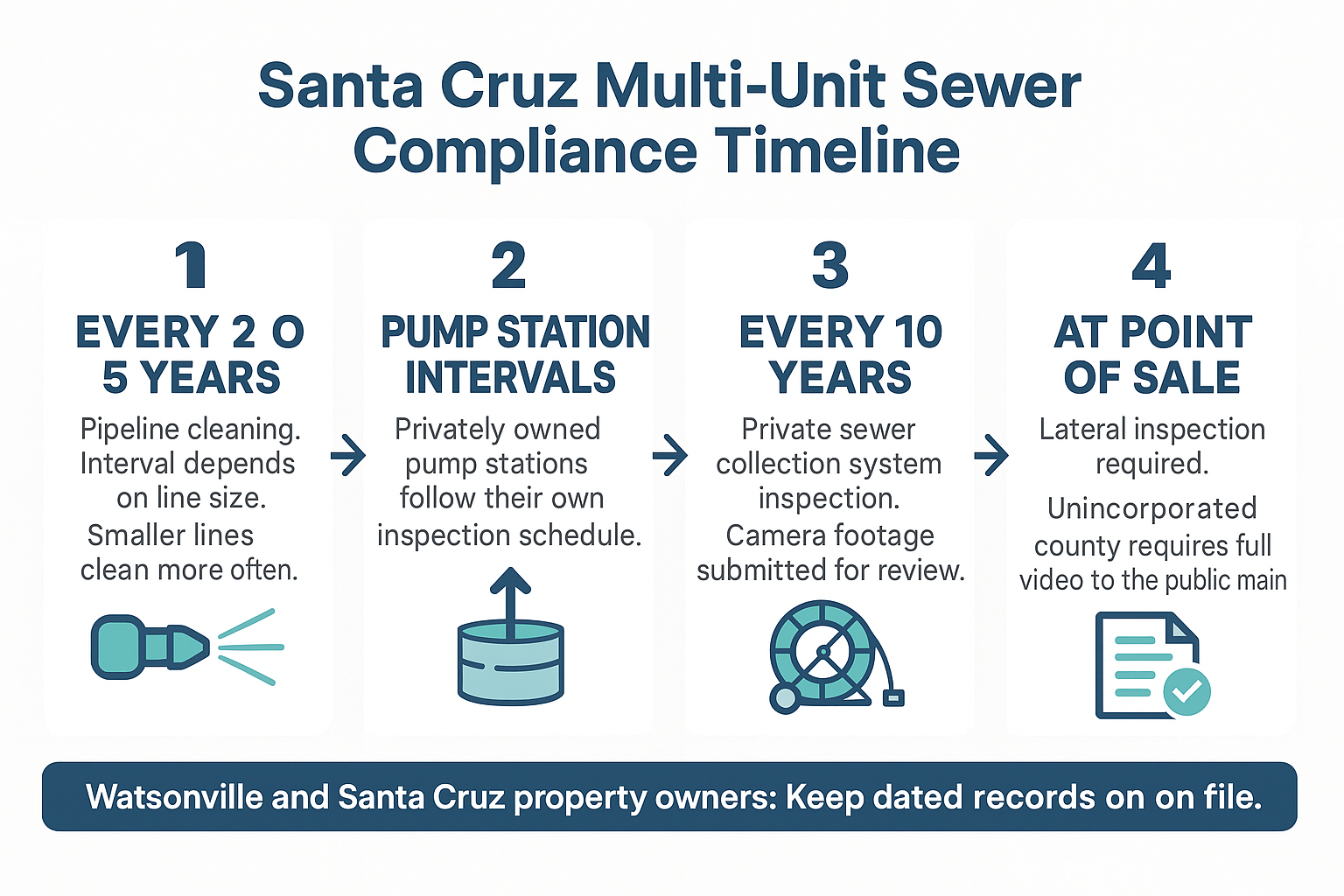
- Inspection of the private collection system every 10 years, documented and submitted
- Pipeline cleaning every two to five years, with the interval depending on line size
- Privately owned pump stations carrying their own separate inspection intervals
- Documentation that shows the work was actually performed, not just claimed
The smaller the line, the more often it needs cleaning. A four inch line serving a cluster of units fills with grease and soap scale faster than a larger main.
I am not trying to make this sound like a crisis. Plenty of properties sail through. But if a line backs up and there is no record of cleaning on file, you are the party holding the bag for the overflow, the cleanup, and any tenant displacement that follows.
What a Sewer Camera Inspection Actually Shows the Reviewing Agency
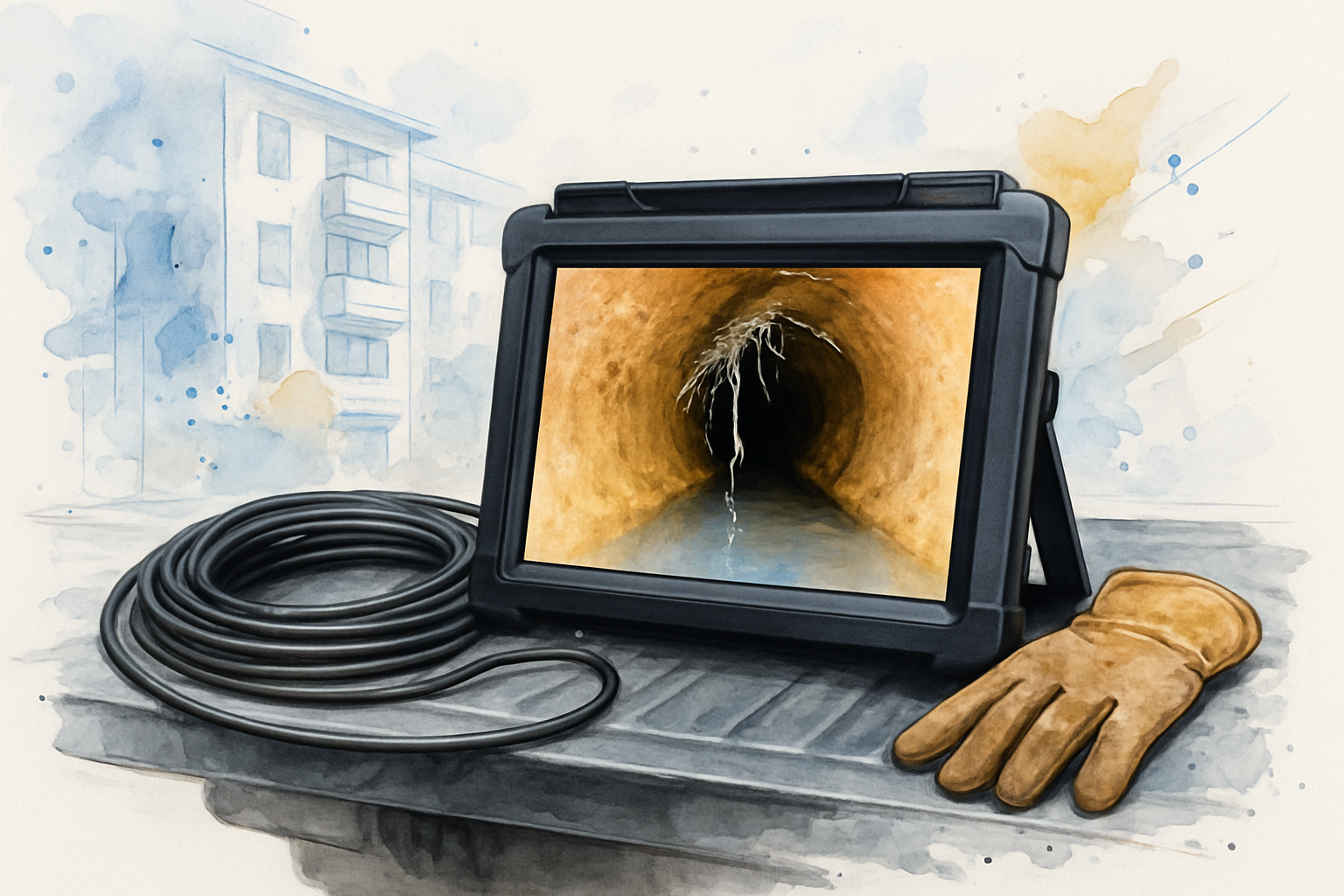
The camera is the whole reason compliance documentation is possible. The footage is what the City or County reviewer uses to decide whether your lateral passes or comes back with repair requirements.
On a multi-unit property, the run usually starts at a cleanout and travels the length of the line toward the public main. A good inspection captures the full run, not a partial pass that stops at the first obstruction.
What the reviewer is looking at on screen:
- Pipe material and condition, including clay, cast iron, and older concrete sections
- Joint separation, where sections have shifted apart over time
- Root intrusion entering through those joints
- Bellies or sags where water pools instead of draining
- Offsets, cracks, and collapsed sections
- Grease and scale buildup narrowing the usable diameter
Several property managers have told me they went through this before with another contractor and never received usable footage. That is a real problem. If the recording is not clear, continuous, and traceable to your address and date, you may be paying for the same inspection twice.
If you want a plain breakdown of the tool itself, I wrote about what a sewer camera actually shows and when it is worth running one.
Pass Versus Repair Required: What Separates the Two
The line between a clean report and a repair order is not always obvious on screen. Here is roughly how findings sort out.
| What the camera finds | Likely outcome | Why it matters |
|---|---|---|
| Light grease or scale buildup, pipe otherwise sound | Typically passes after cleaning | Hydro jetting restores full diameter |
| Fine roots at a joint, no structural damage | Often cleaning plus a follow-up inspection | Roots return if the joint stays open |
| Heavy root mass with joint separation | Repair usually required | The pipe is no longer sealed |
| Belly holding standing water | Repair or spot replacement | Solids settle and cause repeat backups |
| Cracked, offset, or collapsed section | Repair required before sign-off | Structural failure, not a maintenance issue |
| Camera cannot complete the run | Inconclusive, must be re-run | An incomplete report is not documentation |
The Compliance Calendar at a Glance
This is the timeline I walk property managers through when they ask what they are actually on the hook for.
Roots Are the Reason the 10-Year Cycle Exists
Root intrusion is the single most common finding I see in lateral inspections on older properties around Santa Cruz County. It is not a sign anyone did anything wrong. It is what happens to buried pipe over decades.
Three things stack up on older multi-unit properties here:
- Mature trees with root systems that follow moisture toward pipe joints
- Aging clay or concrete sections that were never meant to stay sealed forever
- Seasonal groundwater movement during our wet winters, which shifts soil and separates joints
A lateral that was inspected and cleared five or six years ago can look very different today, especially after a run of heavy rain seasons. Ground moves, a joint opens slightly, and roots find the gap within a season or two.
That is exactly why the inspection cycle repeats instead of being a one-time clearance. The EPA notes that root intrusion and pipe deterioration are leading causes of sanitary sewer overflows nationwide.
When roots are caught early, mechanical clearing or hydro jetting usually restores the line. When they are found after years of growth, the joint itself is often the repair.
If You Are Thinking About Selling in the Next Year or Two
There is a second, separate requirement that catches owners off guard. The City of Santa Cruz requires a sewer lateral inspection at the point of sale for residential property connected to the city sewer system.
In unincorporated Santa Cruz County, the requirement goes further. The seller has to complete a video inspection of the entire lateral from the structure to the public main, complete any required repairs, and submit documentation before close of escrow.
The timing is what hurts. I get calls from agents and sellers who are already inside an escrow window and just learned they need footage, and possibly a repair, in a matter of days.
Running the inspection before you list gives you room to price the repair, schedule it, and hand a buyer a clean report instead of a negotiation point. If you own a single-family rental alongside your multi-unit portfolio, the rules for that property are covered in my post on why your sewer lateral is your responsibility when selling.
And while you are pulling records together, check your backflow preventer test date too. Properties with irrigation systems face annual testing in many jurisdictions, and it lands in the same compliance folder.
Frequently Asked Questions About Multi-Unit Sewer Inspections in Santa Cruz
How do I know when my building’s last sewer inspection was?
Start with your own property records and any prior maintenance invoices. If the property changed hands or changed management companies, that paperwork often did not follow. When there is no record at all, the practical answer is to run a fresh camera inspection and start a dated file from there.
Does the cleaning interval really change based on pipe size?
Yes. Smaller diameter lines get cleaned more often, generally on the shorter end of the two to five year range, because it takes less grease and scale to restrict flow. Larger collection lines can go longer between cleanings.
My tenants say sewage is backing up into the shower and tub. Is that a lateral problem?
Usually yes. When water comes up at the lowest fixtures instead of draining, that points to a mainline blockage downstream, not a single clogged fixture. Multiple units affected at once makes it more likely. That is an emergency situation, and 24/7 service is available for it.
What does a repair look like if the inspection fails?
It depends entirely on what the camera found. A single separated joint with roots is a different job than a collapsed run under a parking area. The footage drives the scope, which is why the inspection has to come first and be clear enough to make decisions from.
Can the same inspection cover both the 10-year requirement and a point-of-sale sale?
They are separate requirements with separate submission processes, and the timing rarely lines up. If you are close to both, it is worth confirming with the reviewing agency what documentation each one needs before scheduling.
Getting your inspection records in order
We handle sewer camera inspections, mainline cleaning, and hydro jetting for residential and commercial properties across Watsonville, Santa Cruz, and parts of Monterey County, and we document the work so you have something to file. If you are not sure where your building sits on the inspection cycle, a call is a reasonable place to start. Reach us at (831) 515-9903 or through maverickplumbingtechnicians.com, and 24/7 emergency service is available if a line is backing up right now.
