

Direct Answer: Sustained rain raises the water table, and that groundwater presses against basements, crawlspaces, and low garages. The result is seepage, sump pump failure, and drain backups even when the yard looks dry.
Most below-grade water problems I get called about do not start with a flood. They start with a musty smell in the garage, a damp baseboard in a converted lower room, or a homeowner noticing the floor feels cold and clammy in one corner.
By the time water is visible, the ground outside has usually been holding water for days. That is how a wet winter works on the Central Coast, whether you are in Watsonville, Freedom, or up on the west side of Santa Cruz.
So I want to explain what is actually happening under and around your house during a long stretch of rain, what fails first, and which checks are worth doing before the first real storm instead of during it.
Why a Wet Winter Pushes Water Up, Not Just Down
Heavy, sustained rain does not simply run off. It soaks in, and the water table around your property rises. Once that saturated soil sits higher than your slab or crawlspace floor, it starts pressing inward and upward.
That pressure is the part homeowners miss. Surface flooding is obvious. Groundwater pressure is quiet, and it works through hairline cracks, cold joints, pipe penetrations, and old block walls.
It is also why I hear the same confused sentence every winter: “But my yard looks fine.” It can look fine. The groundwater below it is still rising.
A few conditions make this worse around Santa Cruz County and northern Monterey County:
- Clay-heavy soil in parts of the Pajaro Valley that drains slowly and stays saturated for days after a storm
- Below-grade garages and daylight basements carved into hillside lots in Santa Cruz, Soquel, and Aptos
- Older homes with unsealed crawlspace walls and no vapor barrier
- Downspouts that dump right at the foundation, concentrating water exactly where you do not want it
- Back-to-back atmospheric river storms, where the ground never gets a dry week to recover
One storm rarely does it. Three storms in ten days is what fills the sponge.
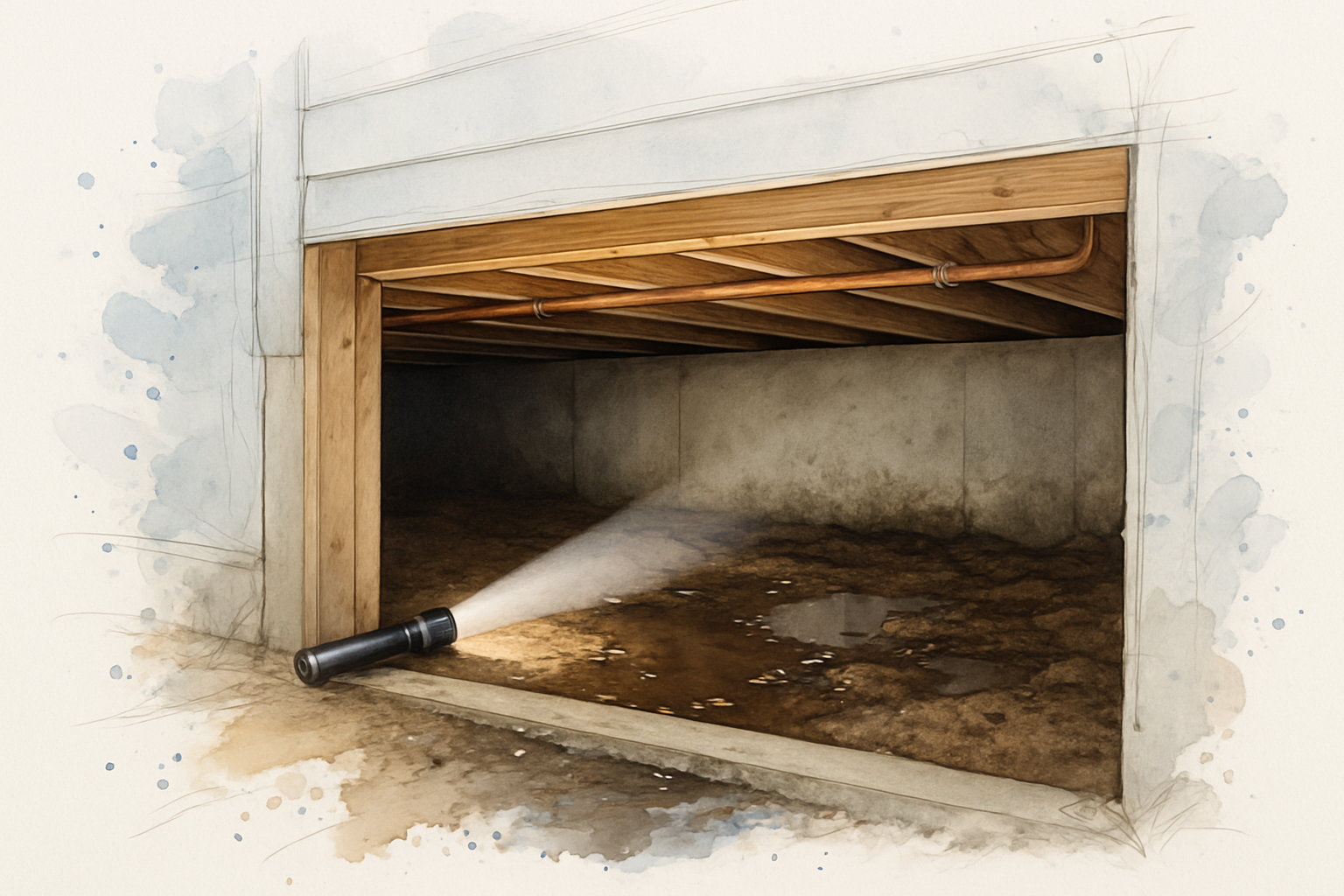
The Sump Pump Nobody Tested Since Last Winter
A sump pump is the one piece of plumbing in the house that can sit unused for eight months and then be asked to run for six hours straight. That is a rough job description.
When these fail during a storm, it is almost never dramatic. It is a stuck float, a seized motor, a discharge line clogged with debris, or a pump that never had the capacity for the property in the first place.
Here is what I would check on a dry weekend in October or early November, well before the rain sets in:
- Pour water into the basin and confirm the pump kicks on, moves water, and shuts off cleanly
- Listen for it cycling on and off rapidly, which usually points to a float or check valve problem
- Follow the discharge line outside and make sure it is clear, not crushed, and not draining back toward the foundation
- Look at the basin itself for gravel, mud, or debris that can foul the intake
- Ask whether you have a backup, because a pump on grid power alone is useless in a storm outage
That last point comes up a lot. A homeowner near the west side of Santa Cruz reached out last summer asking specifically about a sump pump upgrade with battery backup because the storms had gotten heavier. That is the right instinct and the right timing.
When we install or replace a sump pump, the work is about matching pump capacity to the property, sizing the basin correctly, and routing the discharge so the water actually leaves the site. A pump dropped into a poorly built pit will fail again.
Early Signals of a Below-Grade Water Problem
Below-grade problems announce themselves quietly first. Here is how I read the early signals when I walk a property before storm season.
| What you notice | What it usually means | What to do about it |
|---|---|---|
| Musty or earthy smell in a garage or lower room | Moisture is already moving through the slab or walls, even without visible water | Check the crawlspace and slab edges now, before rain raises the water table further |
| Damp baseboard, soft drywall, or peeling paint low on a wall | Water is wicking up from below grade or from a hidden supply leak | Have the source identified before you patch anything cosmetic |
| White chalky residue on concrete walls | Water has been passing through the concrete and leaving minerals behind | Treat it as a drainage and groundwater issue, not a paint issue |
| Sump pump that has not run or been tested in a year | Unknown condition, and storm season is the worst time to find out | Test it on a dry day and confirm the discharge path is clear |
| Slow floor drain or laundry drain in a lower level | Partial blockage that heavier winter flow will overwhelm | Get the line inspected before it becomes an active backup |
Storm Season Turns a Slow Drain Into a Backed-Up One
This is the part of a wet winter that surprises people most. The storm does not only affect the drains during the storm. It aggravates problems that were already there.
Storm debris, silt, and heavier water flow push against blockages that had been getting by. Root intrusion is the big one in older Watsonville and Santa Cruz neighborhoods, where mature trees sit near clay or cast iron sewer laterals. Roots chase moisture, and a wet season gives them plenty of it.
So the drain you have been meaning to deal with becomes the drain you have to deal with. I have watched a line go from “a little slow for a few months” to a full mainline backup inside a single week of rain.
One caller described it plainly: sewage backing up into the shower and tub. That is what a mainline blockage looks like from inside the house, because the lowest fixtures are where it comes out first.
Watch for these before the rain sets in:
- More than one fixture draining slowly at the same time
- Gurgling from a tub or toilet when the washing machine drains
- Sewage odor near a cleanout, floor drain, or side yard
- Water rising in the tub when a toilet is flushed
Any of those point past a simple clog. This is where a camera inspection earns its keep, because it shows whether you are dealing with grease and buildup or a cracked, root-filled, or offset line. I have written more on what a sewer camera actually shows and on when a clogged drain is actually a broken one.
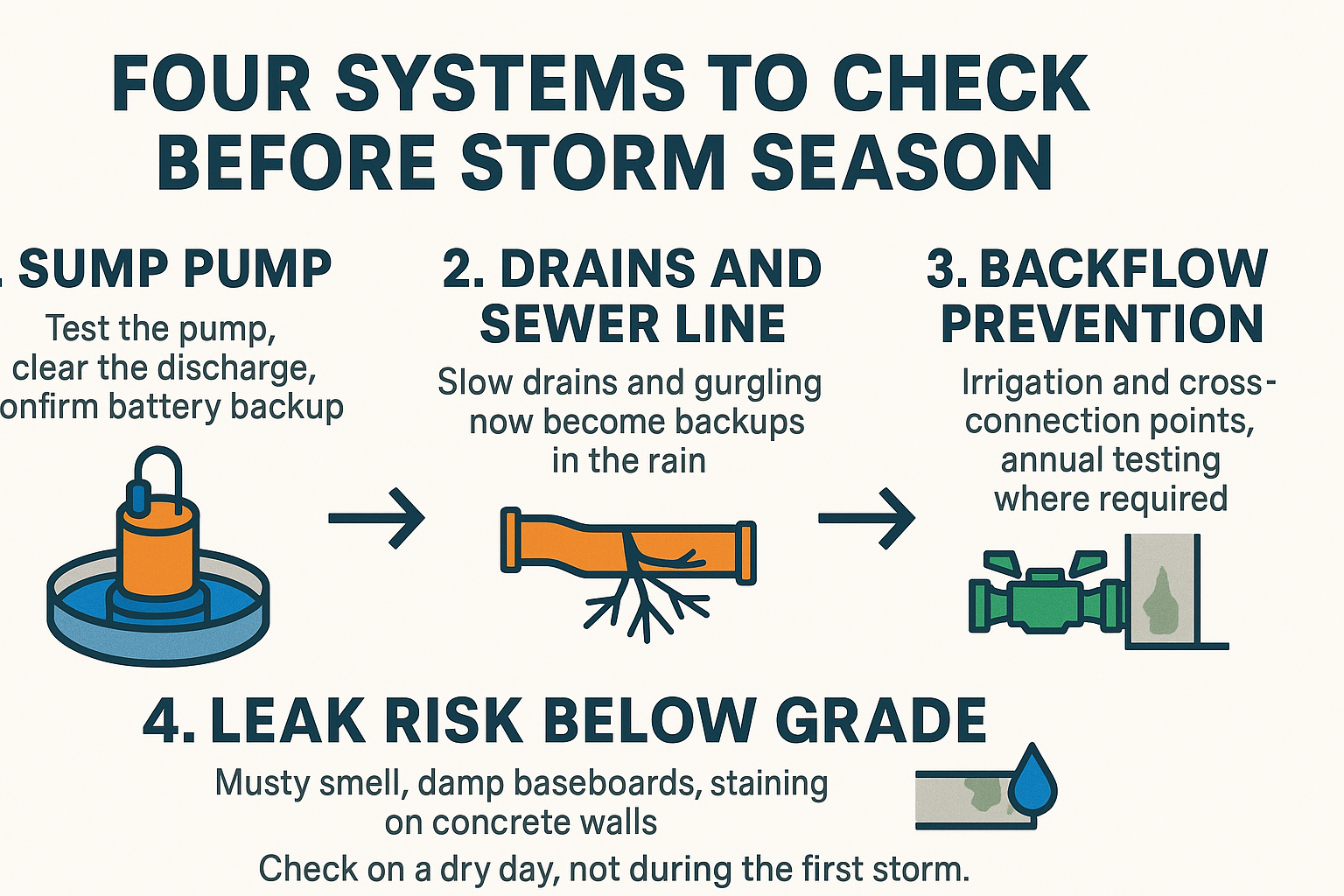
The Four Systems Worth Checking Before the Rain
When I look at a property for storm readiness, I am checking four things in a specific order. This is the short version.
Backflow, Irrigation, and the Compliance Piece People Forget
If your property has an irrigation system, a commercial kitchen, or any other connection to a non-potable source, you likely have a backflow preventer on it. Winter is when that device matters more, not less.
During storms, pressure in the system can swing. A pressure reversal is exactly the condition a backflow preventer exists to stop, keeping contaminated water from being drawn back into the clean supply.
California plumbing code requires these devices at cross-contamination risk points, and many jurisdictions require annual testing with documentation submitted to the water authority. Property managers in Santa Cruz County get those testing notices and often set them aside until the deadline is close.
A few practical notes:
- Test notices are date-driven, so handle them before the storm calendar fills up
- A device that failed testing last year does not get better sitting through a wet winter
- Documentation matters as much as the repair for multi-unit and commercial properties
If you are doing work that changes or replaces one of these assemblies, it is also worth understanding which plumbing jobs in Santa Cruz County need a permit.
When It Stops Being a Project and Becomes an Emergency
There is a real line between something you schedule and something you call about at 2 a.m. I want you to know where it is, because below-grade problems can jump that line fast.
Call right away, any hour, for:
- Active water entering a below-grade space with a sump pump that is not running
- Sewage backing up into a tub, shower, or floor drain
- Multiple fixtures backing up at once, which points to the mainline
- A burst or broken pipe you cannot isolate with a shut-off valve
Things that can usually wait for a scheduled visit include a single slow drain, a drip you can catch in a bucket, and a sump pump you want inspected but that still runs.
One more thing while we are on safety. If you ever smell gas, that is a different protocol entirely: leave the building, do not touch light switches or anything with a flame, and call from outside the property. We respond to gas leaks 24/7, and that call should never wait.
For the fuller breakdown, I put it in plain terms here: when does a plumbing problem become an emergency and middle-of-the-night plumbing, what counts and what can wait.
The Best Time to Do This Is a Dry Weekend
Everything I have described is easier, cheaper in effort, and far less stressful when the ground is dry and nothing is actively flooding. In our area that window is roughly late September through early November, before the first sustained storms arrive.
If you want a walkthrough of all four systems in one place, the Rainy Season Plumbing Preparedness page covers the sump pump, drain and sewer, backflow, and leak-risk checks step by step. There is also a longer storm-focused version here: how to storm-check your Santa Cruz plumbing.
Work through the list on a dry Saturday. The homeowners who do that are almost never the ones calling me at midnight in January.
Frequently Asked Questions About Below-Grade Plumbing and Wet Winters
My yard drains fine, so why is water getting into my garage?
Because this usually is not surface runoff. Sustained rain raises the water table under and around the property, and that saturated soil presses against your slab and walls from below. A yard can look perfectly dry on top while the ground three feet down is holding water.
How do I know if my sump pump still works?
Pour a bucket of water into the basin and watch it. The pump should turn on, move the water out, and shut off without cycling rapidly. Then go outside and confirm water is actually leaving through the discharge line and not draining back toward the house. If any part of that looks off, get it looked at before the rain starts, not after.
Is a battery backup sump pump worth it in Santa Cruz County?
For most below-grade spaces, yes. Our worst storms are also the storms most likely to knock out power, and a pump running on grid power alone stops exactly when you need it most. We install battery backup systems as part of sump pump work.
Why do my drains get worse in the winter?
Two reasons. Heavier flow and storm debris push against buildup and root intrusion that was already narrowing the line, and roots are actively chasing the extra moisture in the soil. A drain that has been “a little slow” for months is the one most likely to become an active backup once the rain sets in.
Sewage came up in my shower. What do I do first?
Stop running water in the house, including the washing machine and dishwasher, because everything you send down the line has to come out somewhere. Then call for emergency service. Sewage in a tub or shower almost always means a mainline blockage, and it is a health hazard as much as a plumbing one.
What does it cost to get a sump pump or sewer line checked?
It depends on the property, access, and what the system looks like, so I will not guess at a number here. Give us a call at (831) 515-9903 and we will walk through your situation and give you a straight answer for your specific job.
Thinking Through Your Below-Grade Setup Before the Rain?
If you have a crawlspace, a low garage, or a sump pump you have not thought about since last winter, working through those checks on a dry day is time well spent. Maverick Plumbing Technicians is a licensed and insured plumbing contractor (CSLB #1102966) based in Santa Cruz, serving Santa Cruz County and Monterey County with 24/7 emergency availability. If you want a licensed set of eyes on it, we are reachable at (831) 515-9903 or through maverickplumbingtechnicians.com.
