

Direct Answer: Walk your property in October: find and turn the main water shutoff, test the sump pump with a bucket, clear yard drains, and camera the sewer lateral before storms start.
Every year around late October my phone starts doing the same thing. The first real storm rolls through, and by the next morning I have voicemails from people whose drains were “a little slow” all summer and are now backing up into the shower.
This winter the odds are stacked heavier than usual. NOAA’s Climate Prediction Center moved to an El Niño Advisory in June 2026, and its August 13 discussion put the chance of a very strong event through fall and winter 2026-2027 above 90%, with roughly a 97% chance it hangs on into early spring 2027. Forecasters also put a 69% chance that the October through December stretch outruns every El Niño going back to 1950.
Nobody can promise you a flood. But the odds lean wet, and October is when you look at your plumbing instead of January. Here is the walk-around I tell people to do, in order, in an afternoon.
First, Read the Forecast as Odds, Not a Promise
A strong El Niño signal is a probability, not a schedule. It does not tell you which week the atmospheric rivers line up, or whether your street gets four inches or fourteen.
What it does tell you is that the cost of being unprepared went up. In a dry winter, a half blocked sewer lateral stays quietly half blocked. In a wet one, groundwater rises, infiltration picks up, and that same line stops moving on a Sunday night.
So I treat the forecast the way I treat a slow drain. It is not proof of a problem. It is a reason to look now, while looking is a scheduling decision instead of an emergency call.
The two things I care about most on the Central Coast are groundwater pressure under the house and anything that carries water away from it. Everything on this checklist ties back to one of those two.
Know Where the City’s Job Ends and Yours Begins
Most homeowners in the Pajaro Valley have never been told where the line sits, so here it is.
The public side is the river, the sloughs, the levees, and the street storm drain system. The Pajaro River at Watsonville Project is a $599 million effort to bring Watsonville and the town of Pajaro up to 100-year flood protection. Right now, according to the Pajaro Regional Flood Management Agency, those levees provide only an 8-year level of protection, among the lowest of any federal flood control project in California. Since the original 1949 system went in, five major floods have overtopped or breached them: 1955, 1958, 1995, 1998 and 2023.
Construction is real and underway. But many areas of Watsonville and Pajaro hit by flooding may not be protected for close to a decade, so this fall the walk-around is on you, not the levee.
The city’s own flood information also points out something people miss: flooding happens outside the mapped river and slough zones, in spots where runoff collects and overwhelms or clogs storm drain inlets and pipes.
On your side of the property line, the equivalent failure points are:
- The sewer lateral running from the house to the main
- Yard drains and area drains, plus their outlets
- The crawl space or any below-grade room
- The sump pump and its discharge line
Those are plumbing problems with plumbing answers.
Step 1: Find the Main Water Shutoff. Then Actually Turn It.
This is the one I push hardest, because it takes ten minutes and it is the check almost nobody has done.
Find your main shutoff. In most Watsonville and Santa Cruz homes it is either at the meter box near the street or on the supply line where it enters the house, often near a hose bib on the street-facing wall.
Now turn it. All the way off, then back on. A valve that has not moved in fifteen years is exactly the valve that will not move at 11pm with water coming through a ceiling.
What I am looking for:
- The handle or gate turns without a cheater bar
- Water actually stops at an open fixture inside
- No weeping or dripping at the valve stem after you cycle it
- Everyone in the house knows where it is, not just you
If it seizes, drips, or spins without doing anything, that is a repair to schedule in dry weather. It is also the difference between a wet floor and a wet floor plus drywall, cabinets and flooring. If you are not sure whether something you find rises to an after-hours call, our guide on when a plumbing problem becomes an emergency breaks that down.
Step 2: Pour a Bucket Into the Sump Basin and Watch What Happens
If you have a sump pump, do not assume it works because it worked last March. Pour a five gallon bucket of water into the basin and stand there.
You want to see the float rise, the pump kick on, and the basin draw down without the motor hunting or short cycling. If the float sticks or the pump groans and does not move water, you found your problem in October instead of during the first atmospheric river.
Then go outside and follow the discharge line. This is the part people skip. A line that dumps three feet from the foundation is just recycling the same water back into the ground next to your house.
Check that the discharge:
- Exits well away from the foundation and not into a low spot
- Is clear of leaves, dirt and crushed sections
- Is not tied into something that backs up during heavy rain
One homeowner up on the west side near UCSC wrote in this summer asking about a sump upgrade with battery backup, saying she wanted something reliable because of the heavier storms. That is the right month to ask. Battery backup matters here because our worst storms and our power outages tend to arrive together.
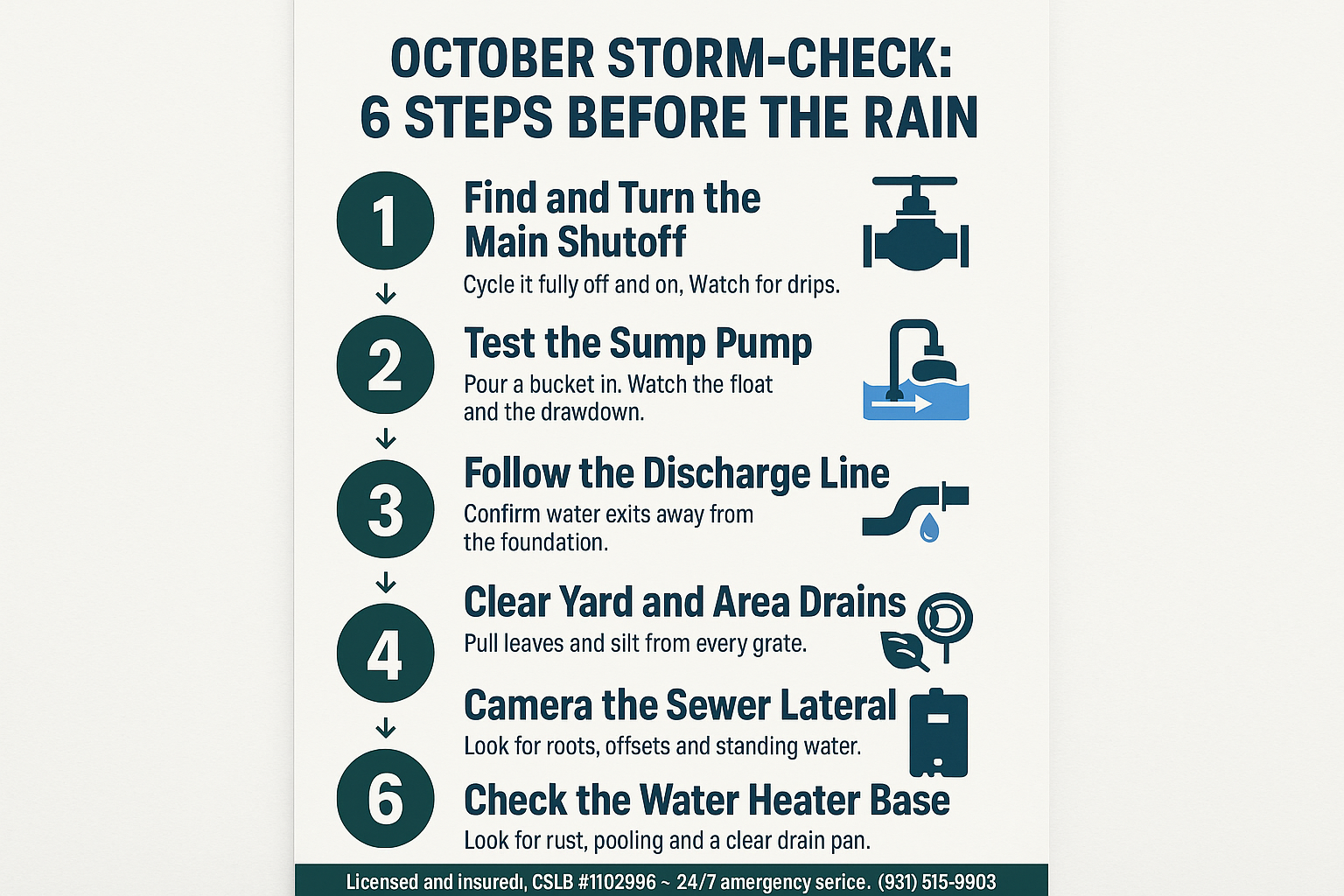
The October Storm-Check, Start to Finish
Here is the whole walk-around in the order I would do it, from the street to the crawl space.
Step 3: The Sewer Lateral Is the One People Skip and Regret
Rain does two things to a sewer lateral. It raises the groundwater around the pipe, which drives infiltration through cracks and bad joints, and it pushes root growth toward the water inside the line.
That is why a lateral that behaved all August backs up the week the storms start. It was already half blocked. The rain just took away the margin.
Here is the part I want you to sit with. Nobody calls me and says “I believe I have a mainline blockage.” They call and say sewage is backing up into the shower and tub, usually while it is still happening. At that point the choice of when to schedule is gone.
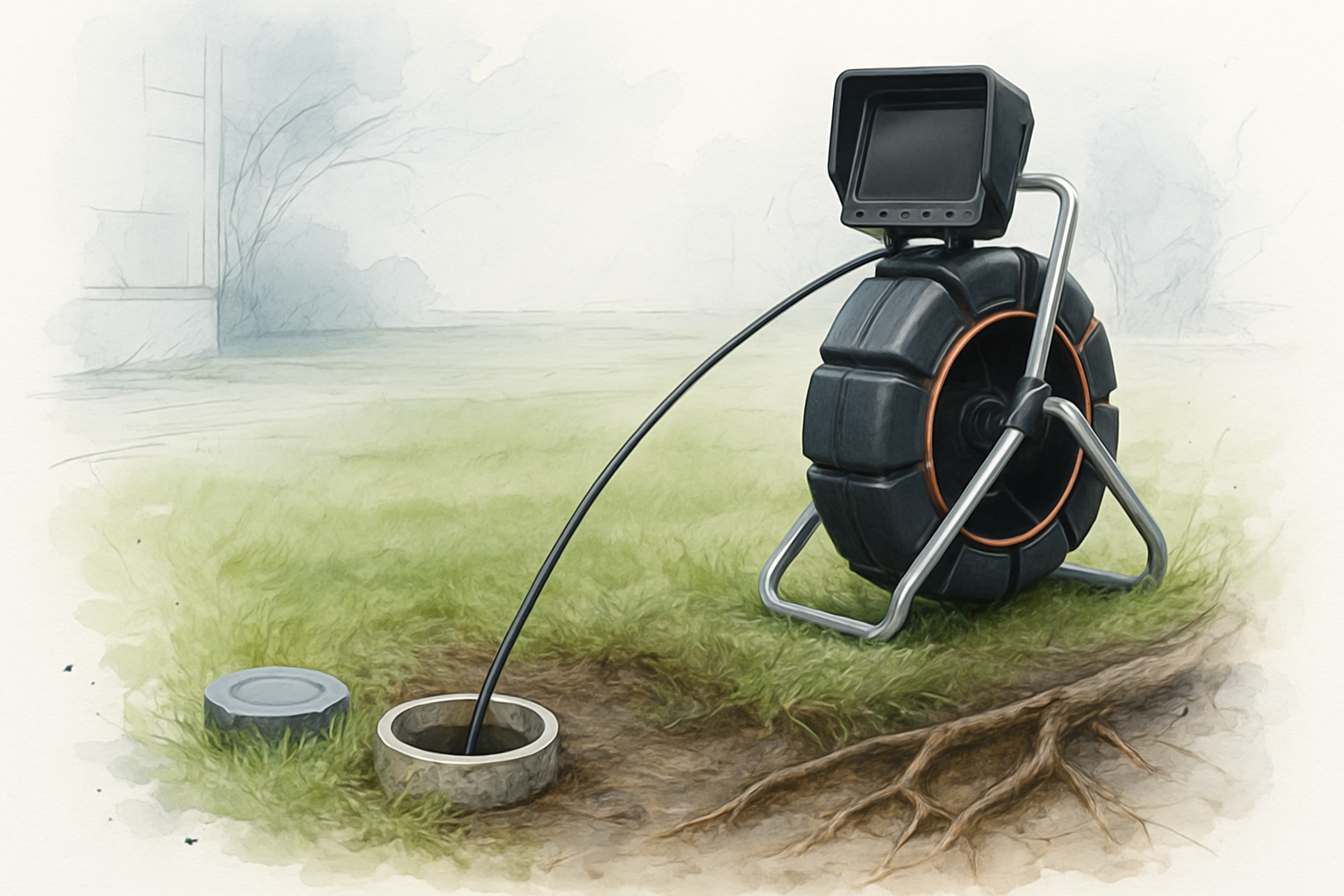
A camera inspection in October is an appointment. The identical inspection in January is an emergency. Same pipe, same camera, completely different day.
Signs worth a look before the rain:
- More than one fixture draining slowly
- Gurgling in a tub or toilet when a washer drains
- Any sewage odor in the yard or a bathroom
- A home you bought without knowing the lateral’s history
What Each Check Is Actually Telling You
This is the short version of the walk-around, and what it means when something does not pass.
| Check | What I am looking for | What happens if it fails in a storm |
|---|---|---|
| Main water shutoff | Turns fully by hand, no drip at the stem | Water keeps running through a burst line until someone reaches the meter |
| Sump pump | Float rises, pump starts, basin draws down | Standing water in a crawl space or below-grade room |
| Sump discharge line | Clear, and exits well away from the foundation | The same water cycles back and the pump runs until it burns out |
| Yard and area drains | Grates clear of leaves and silt, water moves | Runoff pools against the house and finds the crawl space |
| Sewer lateral | No roots, offsets, bellies or standing water on camera | Backups into showers and tubs during the first heavy week |
| Water heater base | No rust at the base, dry pan, no pooling | A slow leak becomes a failure while nobody is home |
The Storm Is Rarely What Gets You. The Pipe You Never Checked Is.
People assume winter damage comes down the roof. Insurance claims data tells a different story.
Across 2019 through 2023, water damage and freezing made up roughly 22.6% of all homeowners insurance claims, second only to wind and hail. About one in 67 insured homes files a claim like that in a given year.
What matters locally is where that water starts. Most of it begins inside the building at supply lines, water heaters, and failed drains, not at the shingles.
Our hard water makes that worse. Mineral buildup shortens the life of water heaters and fixtures across Santa Cruz County, which is why I check the base of every tank I walk past in the fall. If you have never looked at what our water does to equipment, hard water in Santa Cruz County covers it.
And if your water use has not changed but your bill has, that is worth chasing before the rain hides the evidence. There is more on that in our piece on Watsonville water bills and hidden leaks.
If You Manage Property, You Are Working on a Different Clock
This market is full of readers who are not single-family homeowners. Motel operators, restaurant owners, apartment managers, and portfolio managers all deal with the same storms and none of the same flexibility.
A motel owner in Santa Cruz reached out this summer asking about hydro jetting the main sewer lines at two of his properties before committing to any work. That is the right instinct. A backed up line during a December atmospheric river does not mean an inconvenience, it means rooms you cannot rent or a kitchen you cannot open.
For commercial properties I would treat these as operations items, not repairs:
- Pre-season hydro jetting on grease-heavy kitchen lines
- Camera inspection with documentation on mainlines you have never seen inside
- Sump pump assessment on any below-grade storage or mechanical space
- Backflow preventer testing if you have irrigation, since many jurisdictions require it annually
Documentation matters here as much as the work. If you have to justify the spend to an owner or a supervisor, photos and a written condition report do that better than a verbal summary.
Frequently Asked Questions About Storm Prep and Plumbing
Does a strong El Niño mean my house is going to flood?
No. A forecast gives you odds, not an outcome. What it changes is the math on waiting. If your lateral or sump was borderline, a wet winter is when borderline becomes a Sunday night problem.
I have never had a sewer backup. Do I really need a camera inspection?
Not everyone does. But if the house is older, you have mature trees near the line, or you have noticed more than one slow drain, a camera is the only way to see what is actually in there. Age of the pipe and root pressure are the two biggest factors around here, and neither one shows up until it fails.
My sump pump is only a few years old. Should I still test it?
Yes. Age is not the issue, stuck floats and clogged discharge lines are. A five gallon bucket and two minutes of watching tells you more than the install date does.
What should I do if I smell gas during a storm?
Leave the building immediately. Do not flip light switches, do not use anything with a flame, and call from outside the property once you are clear. Gas leak response is available 24 hours a day, seven days a week, and this is not a wait-until-morning situation.
When is the best time to schedule this kind of assessment?
October, before the first sustained rain. Once storms start, the same calendar fills with active emergencies, and a planned inspection turns into a wait behind people with water on the floor.
Thinking About a Pre-Season Look at Your System?
Maverick Plumbing Technicians is a licensed and insured plumbing contractor, CSLB #1102966, with 24/7 emergency service across Watsonville, Santa Cruz and the wider Monterey Bay area. The thing customers mention most in their feedback is communication: a courtesy call before we arrive, photos of the work, and a follow-up call after the job is done. Pre-season assessments are simply easier to get on the calendar in October than in January, and if you want to talk one through, we are at (831) 515-9903 or maverickplumbingtechnicians.com.
