

Direct Answer: Sometimes. Photos work well for visible problems like a leaking water heater, damaged fixture, or corroded valve. They cannot diagnose slab leaks, sewer line damage, or hidden leaks inside walls.
Your water heater starts dripping on a Tuesday morning and you are already late for work. Before you commit to a service visit, you want to know one thing: can I just send a picture?
I get that question constantly from homeowners in Watsonville and across Monterey County. What surprised me is that my own team started asking for photos on the exact same kinds of jobs, without anyone setting up a formal process for it.
When both sides reach for the same tool on their own, it usually means it solves a real problem. But photos have hard limits, and I would rather you know where those limits sit before you assume a picture is enough.
When a Photo Really Does Move Things Forward
Photos work when the problem has a visible surface expression. If I can see the failure with my own eyes through your camera, I can usually confirm scope, identify the part or unit, and show up with the right material on the truck.
These are the situations where a photo genuinely helps:
- Visible fixture damage like a cracked toilet tank, a split supply line, or a faucet base with corrosion around it
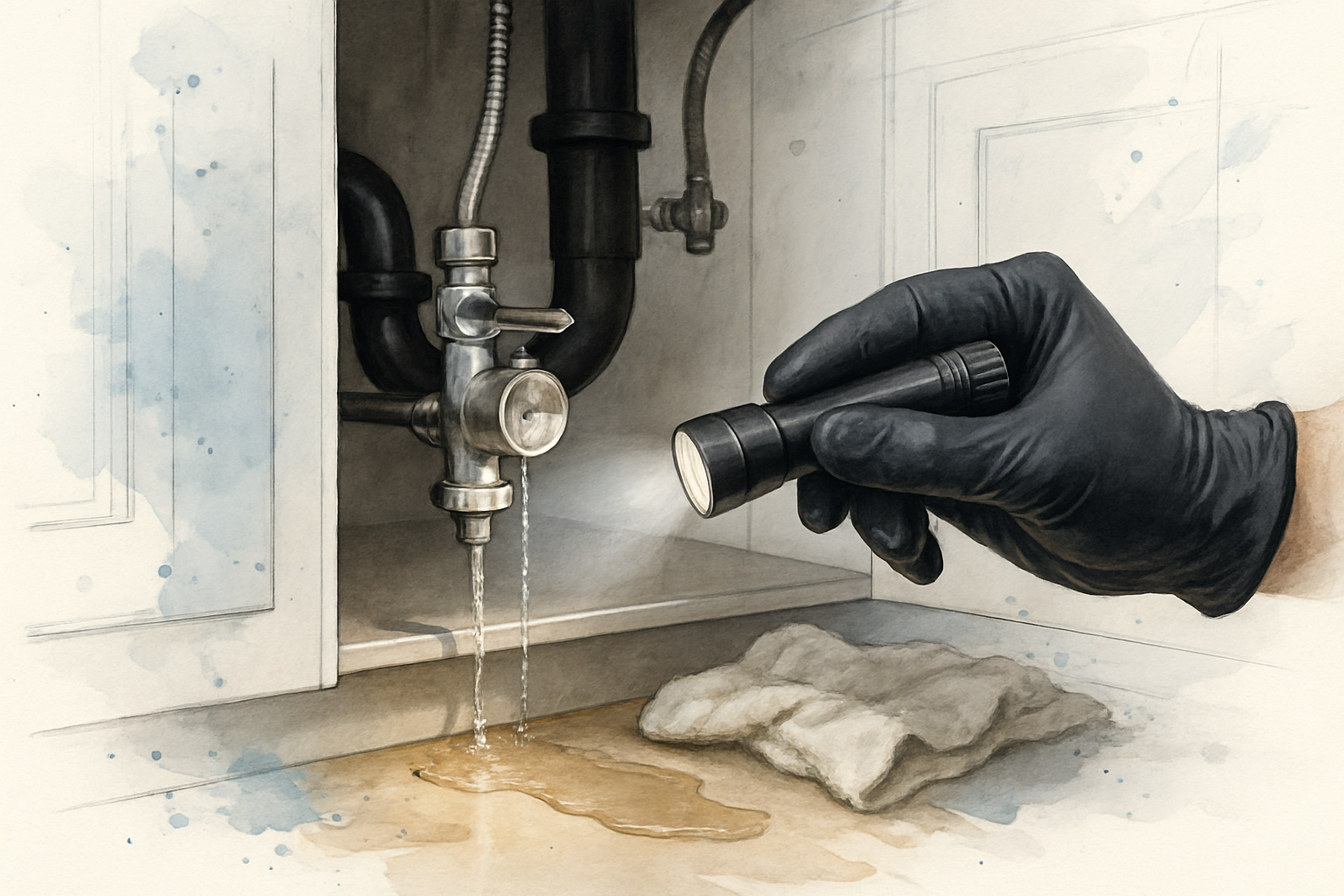
- A leaking water heater where the drip has one identifiable source point, such as a fitting, a T&P valve, or the tank seam
- A corroded shutoff valve or angle stop under a sink or behind a toilet
- Accessible pipe damage in a garage, crawl space opening, or under a cabinet
- A unit with a visible error code on the display panel of a tankless water heater
- The data plate on any appliance, which tells me the make, model, capacity, and age
That last one matters more than people expect. A clear shot of the label on the side of a water heater answers half a dozen questions I would otherwise have to ask on the phone.
For tankless units especially, a photo of the display plus a short description gets me a lot further than a verbal guess. Some tankless water heater problems are not what they look like, and the code on the screen narrows it down fast.
What a Photo Cannot Show, No Matter How Good the Angle
Here is where I have to be straight with people. A picture of the area where you think the problem is does not give me a diagnosis. It gives me a starting point at best.
These problems have no reliable visual signature:
- Slab leaks. The water is under concrete. A photo of the warm spot on your floor confirms a symptom, not a location.
- Sewer line damage or root intrusion. This takes a camera inspection down the line. One of the most common things callers describe is sewage coming up into the shower and tub, and no photo of that shower tells me where the blockage sits.
- Underground supply line failures. Buried pipe, buried problem.
- Hidden leaks inside walls. A stain on drywall can be fed from several feet away. Guessing from the stain is how you end up cutting the wrong wall open.
- Slow pressure loss from scale buildup. Hard water is everywhere in Santa Cruz County and the Monterey Bay area, and mineral buildup happens on the inside of the pipe where no camera reaches.
For these, I use listening equipment, pressure testing, and sewer camera inspection. That is hands-on work, and there is no shortcut around it. If you are seeing signs of a leak you cannot find, our guide on hidden leaks and rising water bills explains what the early signals actually look like.
Same goes for aging galvanized or older copper systems. Photos of one visible section will not tell you whether the whole house needs attention, which is a separate conversation about whether your home needs repiping.
Photo Triage: What Works and What Does Not
This is roughly how I sort incoming photos when someone sends them before a visit.
| Problem | Can a photo help? | What it usually takes |
|---|---|---|
| Leaking water heater with visible drip point | Yes, often enough to confirm scope | Photo plus data plate, then on-site verification |
| Cracked toilet or failing faucet | Yes | Photo of the fixture and the shutoff below it |
| Tankless unit showing an error code | Yes | Photo of the display and the model label |
| Corroded shutoff valve or angle stop | Yes | Close-up plus a wider shot for context |
| Slab leak | No | Leak detection equipment on site |
| Sewer backup or recurring mainline clog | No | Sewer camera inspection |
| Wet drywall with no obvious source | Partly, as a starting point | Moisture and pressure testing on site |
| Low water pressure throughout the house | No | Pressure testing and system evaluation |
How to Send Photos That Actually Help
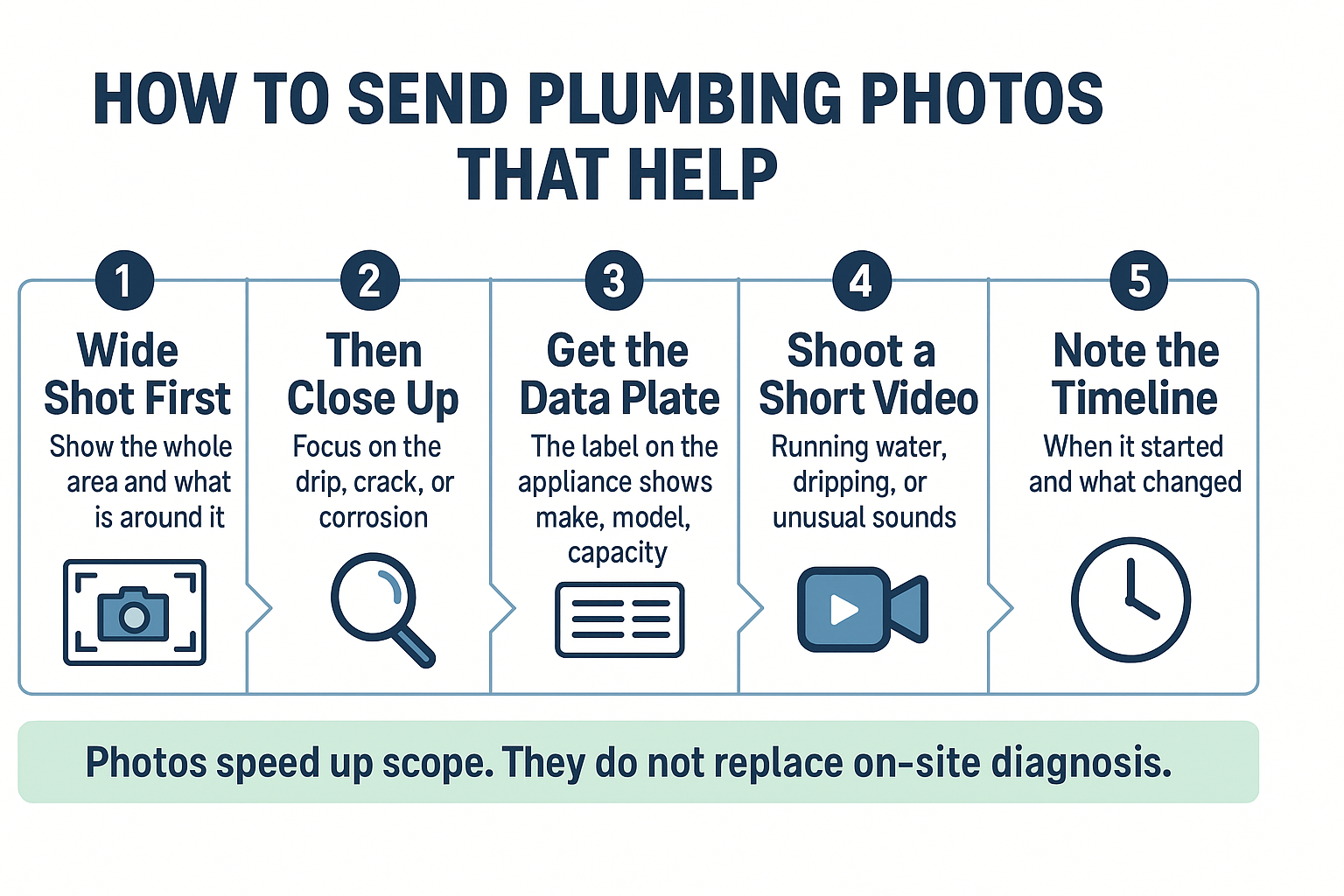
If you are going to send photos, these five steps make the difference between a useful photo set and a folder of blurry close-ups.
The Remote Owner Situation: When You Are Not at the Property
The people who use photo triage most are owners and landlords who are not standing in the room. A tenant calls, a property manager forwards a picture, and somebody two hours away has to make a decision.
This is legitimate and it is getting more common in Watsonville and Santa Cruz. It also tends to stall, because the person with the phone is not the person with the questions.
If you are coordinating remotely, gather this before you call:
- Property address and how we get in. Lockbox, tenant availability, gate code, whoever is meeting us.
- Where the main water shutoff is, if you know. If nobody on site knows, say so.
- Photos from the tenant or manager using the steps above, not one blurry close-up.
- A short video if there is a sound, a drip rate, or a fixture that behaves oddly.
- What already happened. Was a snake run? Was the water shut off? Did somebody pour a store-bought drain cleaner down it?
- Who approves the work and how you want to handle payment and documentation from a distance. Ask about this when you schedule so it does not slow the job down at the end.
One more thing worth doing when you are hiring without being on site: confirm the license. You can look up any California contractor through the Contractors State License Board. Ours is CSLB #1102966, and I would rather you check it than take my word for it.
If the situation feels urgent and you are trying to decide whether it can wait, run through this checklist before calling first.
Frequently Asked Questions About Photo-Based Plumbing Estimates
Can you give me a firm quote from photos alone?
Not usually. Photos help me confirm scope and show up with the right parts, which saves everybody time. But a firm number depends on access, condition, and what we find once panels come off or a fixture gets pulled. Call and we will tell you exactly what we can and cannot determine from what you send.
I sent a photo of a wet spot on my wall. Why do you still need to come out?
Because water travels. The stain shows where water surfaced, not where it started, and it can be fed from a pipe several feet away or from a floor above. Cutting drywall based on a photo is how a small repair turns into a large one.
My home inspection flagged a plumbing issue. Can I just send you that report?
Send it, absolutely. Inspection report photos and notes give me useful context before I arrive. But an inspector’s note is a flag, not a diagnosis, and things like sewer line concerns still need a camera inspection to determine what is actually going on and what the repair involves.
What if I smell gas? Should I take a photo?
No. Leave the building immediately, do not flip any electrical switches or light anything, and call from outside the property. Gas leak response is available 24 hours a day. Documentation can wait until everyone is safely outside.
Do photos speed up a water heater replacement?
They help a lot. A shot of the unit, its data plate, and the space around it tells me the capacity, the venting setup, and whether access is going to be tight. That is often enough to plan the visit properly instead of making two trips.
Not Sure If Your Photos Are Enough?
Send them and ask. We will tell you honestly whether a picture gets us most of the way there or whether the problem needs diagnostic equipment on site, and we handle remote coordination for owners who are not at the property. Maverick Plumbing is a licensed and insured plumbing contractor serving Watsonville, Santa Cruz, and parts of Monterey County, with 24/7 emergency service available at (831) 515-9903 or through maverickplumbingtechnicians.com.
