

Direct Answer: Locate your main water shutoff valve and turn it off. If you smell gas, leave the building immediately and call from outside. Then call a licensed plumber.
Most of the damage I see from plumbing emergencies didn’t happen because of the original failure. It happened in the first five minutes, before anyone made a call, because the homeowner didn’t know what to do and the water kept running. That window matters more than people realize.
In Watsonville and Santa Cruz, I’ve responded to burst pipes on Sunday mornings, sewer backups while families were out of town, and water heaters leaking steadily into garages. Every one of those situations had a right move and a wrong move, and the right move almost always started with one thing: knowing where your main shutoff valve is.
This checklist isn’t about convincing you to call. It’s about what to do in the first two to five minutes so the damage is manageable when we get there.
The Single Most Important Thing Most Homeowners Haven’t Done
Find your main water shutoff valve before you need it. I’m serious about this. A surprising number of homeowners in Santa Cruz County have never located theirs, and that’s the one piece of information that controls almost every water emergency.
In most Watsonville and Santa Cruz homes, the main shutoff is in one of a few places:
- In the garage, near where the main supply line enters the house
- In a utility closet or crawl space access panel
- Outside the home, at the meter box near the street, operated with a meter key or flat-head screwdriver
- Along an exterior wall on the side of the house facing the street
Turning it off stops water from flowing to the entire house. It won’t fix anything, but it buys time and limits damage while you figure out the next step.
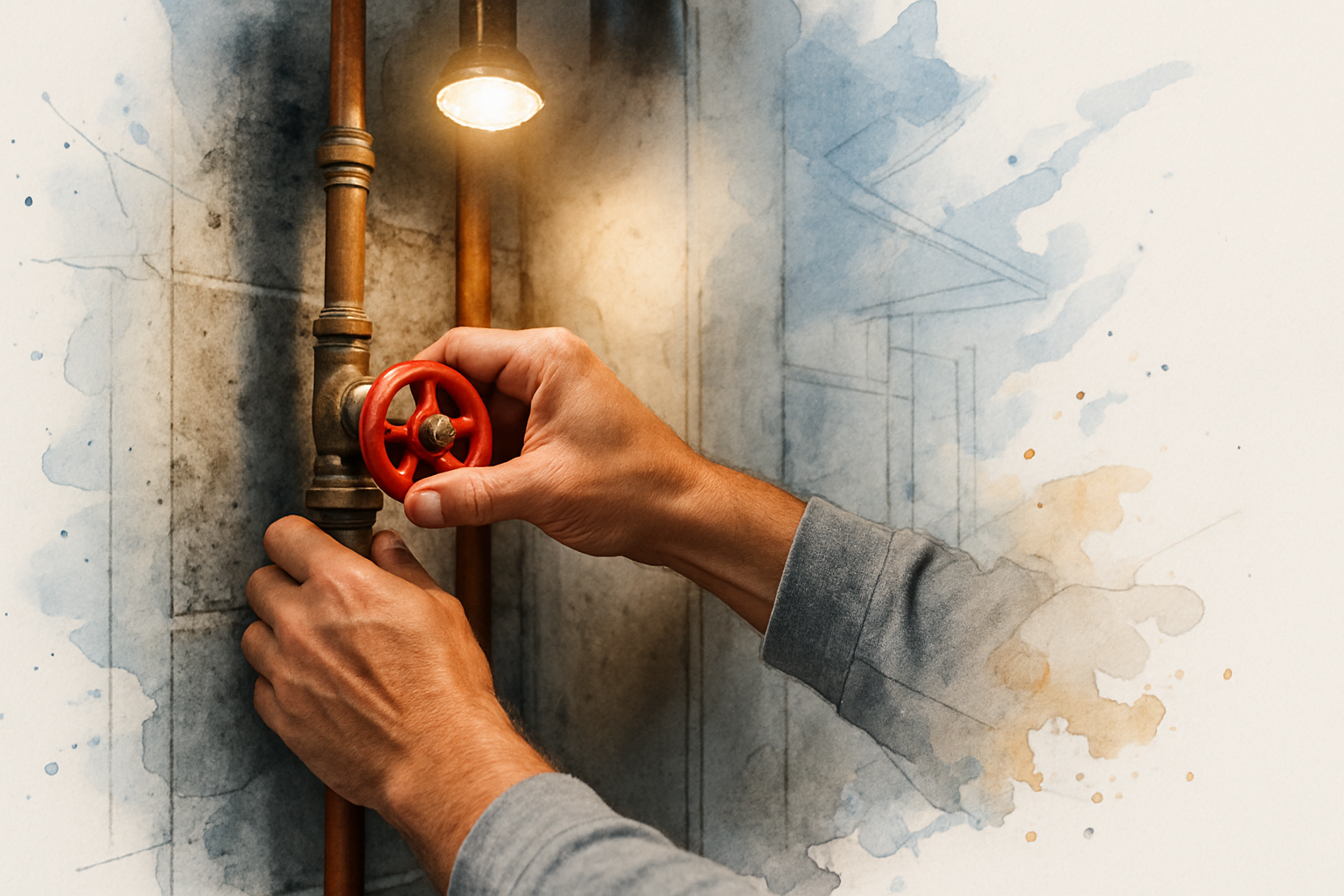
If the leak is isolated, a water heater, a toilet supply line, a sink, look for the local shutoff valve first. Most fixtures have one nearby. Turn it clockwise to close. If it doesn’t budge or you can’t find one, go straight to the main.
Once you’ve done that, open a low faucet in the house to relieve any pressure still in the lines. That’s the right move, and it’s exactly what one Watsonville homeowner did on a Sunday morning when their water heater started leaking before a family vacation. The repair turned out to be manageable partly because they acted correctly before calling.
Two Emergency Types That Need Completely Different Responses
Not every plumbing emergency looks the same, and the right first step depends on which type you’re dealing with. I break them into two categories based on what I see in the field.
Type 1: An active water leak or burst pipe
This is the classic flood scenario, water is coming out somewhere and getting into walls, floors, or structure. Your priority is stopping the flow.
- Shut off the local valve at the fixture, or the main if that fails
- Move anything out of the water’s path that you can without risking injury
- Don’t try to dry it yourself yet, document it with photos first
- Call a licensed plumber
Type 2: A sewer backup
This is a different emergency entirely. I’ve talked to homeowners out of town who called because every toilet and sink in the house was backing up while they had no way to act on-site. The right move there is different from a water leak: stop adding water to the system.
- Don’t flush any toilet
- Don’t run any taps, dishwasher, or washing machine
- Don’t use any drain in the house until a plumber has assessed the situation
- Call immediately, a full sewer backup means the main line is blocked, and it will get worse the more water you add
For more on why these two situations are so different, One Slow Drain vs. Every Drain Backing Up breaks it down clearly.
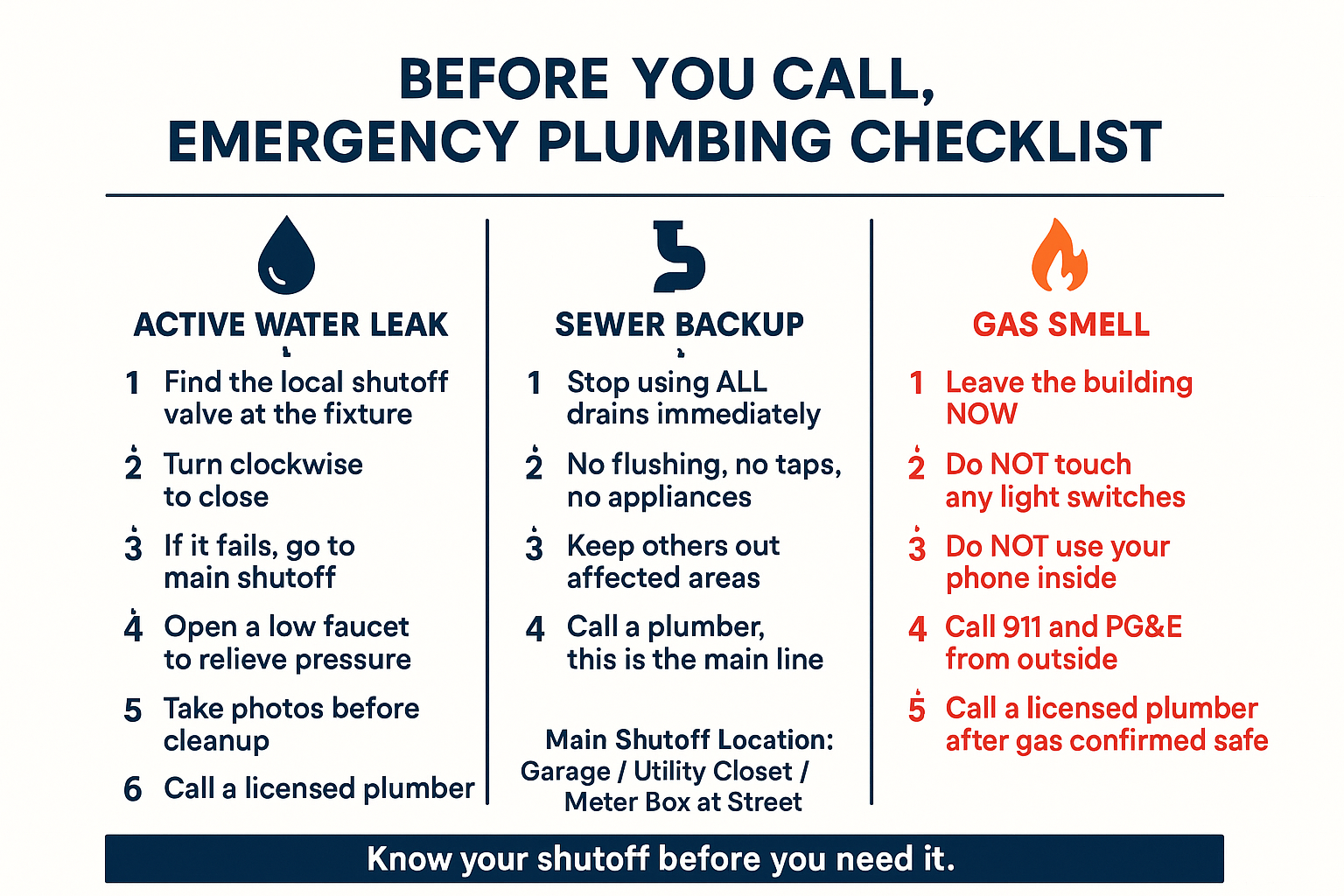
The First 5 Minutes: Emergency Plumbing Checklist
This checklist covers the three most common emergency scenarios and what to do first in each one before you make a call.
If You Smell Gas: This Is a Completely Different Protocol
I want to be direct about this because it does not belong in the same category as a leaking pipe. A gas leak is a life-safety emergency, and the steps are specific.
If you smell gas inside a building:
- Leave the building immediately. Do not stop to gather anything.
- Do not turn any electrical switches on or off, even a light switch can ignite gas.
- Do not use your phone inside the building. Walk outside first.
- Do not use any open flames, no lighters, no candles, nothing.
- Once you are outside and a safe distance away, call 911 and PG&E first. PG&E’s gas emergency line is available 24 hours a day: 1-800-743-5000.
- After the utility has confirmed the gas is safe, a licensed plumber handles the repair.
We handle gas leak repairs and our emergency line is available 24/7, but the first call in a gas emergency goes to the utility and emergency services, not a plumber. That order matters.
I mention this every time the topic comes up because there is no version of this where waiting or second-guessing is the right call.
What Counts as an Emergency, and What Can Wait
One of the most practical things I can tell a homeowner is how to read the actual urgency of their situation. Calling after-hours for something that could wait until Monday costs extra and serves no protective purpose. Here’s a practical breakdown.
| Situation | Real Emergency? | First Step |
|---|---|---|
| Burst pipe actively flooding a room | Yes, call now | Main shutoff, then call immediately |
| Water heater leaking from supply line, shutoff failing | Yes, call now | Main shutoff, then call immediately |
| Sewer backup, every drain affected | Yes, call now | Stop all water use, then call immediately |
| Gas odor inside the building | Yes, leave first | Leave building, call 911 and PG&E, then plumber |
| Water heater leaking slowly, local shutoff holding | Can wait if controlled | Local shutoff closed, monitor, call next day |
| Single slow drain, still functional | No, schedule it | Schedule a service call, no emergency needed |
| Running toilet, no overflow | No, schedule it | Turn off local valve, schedule a service call |
| Dripping faucet | No, schedule it | Catch drips, schedule a service call |
Before You Authorize Any Emergency Work: Check the License
When a plumbing emergency hits at 10 PM on a Sunday, the pressure to say yes to whoever shows up is real. I understand that. But the wrong contractor on an emergency call, someone unlicensed, uninsured, or working outside their scope, can make the situation worse and leave you with no recourse.
One caller put it plainly: “I know your charges, but I also know you guys do good work.” That’s the right way to think about it. When you’re dealing with a real emergency, you’re not shopping for the lowest rate. You’re choosing who you trust to handle your home correctly at a vulnerable moment.
Before authorizing emergency work from any contractor, verify their CSLB license. It takes about 30 seconds at the California Contractors State License Board website. Our license number is #1102966 and it’s verifiable public information. Any legitimate licensed contractor should be able to give you theirs without hesitation.
For more on when a situation actually crosses into emergency territory, When Does a Plumbing Problem Become an Emergency? is worth reading before you’re in that position.
Frequently Asked Questions About Emergency Plumbing in Watsonville
Where exactly is the main water shutoff valve in a typical Watsonville home?
Most houses have it in one of three places: inside the garage near the wall where the main supply enters, in a utility or laundry closet, or outside at the water meter box near the street. The meter box version usually needs a flat-head screwdriver or a meter key to operate. If you genuinely can’t find yours, walk the perimeter of the house and look for a pipe entering the foundation, the shutoff is usually nearby.
Every drain in the house is backing up. Is that a plumbing emergency?
Yes. When every fixture backs up at the same time, that’s a main sewer line blockage, not a single clogged drain. Stop using every drain in the house immediately and call a plumber. Running more water into a blocked main line makes the backup worse and increases the chance of sewage coming up through floor drains or the lowest fixtures. One Slow Drain vs. Every Drain Backing Up explains why that distinction matters.
My water heater is leaking but the local shutoff is holding. Do I need to call after hours?
If the local shutoff valve on the cold water supply to the heater is fully closed and the leak has stopped, you can usually wait until morning or the next business day. The situation is controlled. Document it with photos, leave the shutoff closed, and call for a scheduled appointment. If the shutoff valve fails to hold the leak, or if water is entering walls or flooring, that changes the answer, call right away.
I smell gas. Should I call a plumber first?
No. Leave the building first. Don’t stop to call anyone from inside. Once you’re outside and clear of the building, call 911 and then PG&E’s gas emergency line. The utility confirms whether the gas is safe. After that, a licensed plumber handles the repair. We’re available 24/7 for gas leak repairs, but we come in after the utility has made the scene safe, not before.
How do I know if a plumber responding to an emergency is actually licensed?
Ask for their CSLB license number before authorizing any work and verify it at the California Contractors State License Board website. A legitimate contractor will give it to you without hesitation. Our license number is #1102966 if you want to see what a verified result looks like.
Is a running toilet or a dripping faucet a plumbing emergency?
Almost never. A running toilet that isn’t overflowing, and a faucet that’s dripping but not spraying, can both wait for a scheduled appointment. Turn off the local shutoff valve at the toilet or fixture if the sound is bothersome, and book a regular service call. Calling those emergencies costs more and doesn’t protect your home any better. For context on what genuinely can’t wait, The Difference Between Urgent and “Wait Until Morning” Plumbing Problems lays it out directly.
Need a Licensed Plumber Available Now in Watsonville or Santa Cruz?
If you’ve worked through this checklist and the situation still needs a licensed contractor, we’re available 24 hours a day, seven days a week for genuine plumbing emergencies throughout Santa Cruz County and parts of Monterey County. Call Maverick Plumbing Technicians, Inc. directly at (831) 515-9903, we pick up, we ask the right questions, and we show up ready to work. You can also request service through maverickplumbingtechnicians.com if your situation allows a moment to type rather than call.
