Direct Answer: Use the CSLB Check a License tool. Search by license number, business name, or personnel name, then confirm the status is active and the classification covers plumbing work.
Most people start the same way. They type “best plumber in Santa Cruz” into Google, get a screen full of ads and directory listings, and close the tab knowing exactly as much as when they started.
I understand the instinct. But there is no official scoreboard for “best.” Ranking high in search results is a marketing outcome, not a credential, and it tells you nothing about whether a company is legally allowed to touch your pipes.
There is a free public state record that answers the question search results cannot. It takes about two minutes, and you can run it on anyone, including us. Here is exactly how, and more importantly, how to read what comes back.
Why Search Rankings Are Not a Credential
Every month I talk to Santa Cruz County homeowners who did their homework before calling. They read reviews, they looked at three or four websites, and they still could not tell me which of those companies carried a current license.
That is not a failure on their part. Review counts, ad placement, and a slick website are all things a company can buy or build. None of them are issued by the state.
What a license lookup actually tells you:
- Whether the company is legally permitted to perform plumbing work in California right now
- Whether the classification on file matches the job you need done
- Whether there is a bond filed with the state
- Whether workers compensation coverage is current
- Whether any complaints, citations, or disciplinary actions are attached to the record
That is real information. It is also free, public, and available at two in the afternoon on a Tuesday when nothing is broken.
I tell people the same thing when they ask how to vet a contractor in Monterey County or Santa Cruz: start with the state record, then move on to reviews and conversations. The record filters out the companies that should not be on your list at all.
How to Verify a Plumber’s CSLB License in Santa Cruz, Step by Step
The Contractors State License Board runs the lookup tool. Here is the sequence.
1. Open the lookup page. Go to the state board’s Check a License tool. It is free and requires no account.
2. Pick your search method. You can search three ways: by license number, by business name, or by personnel name. That third option matters more than people expect.
3. Enter what you actually have. If all you have is a name off a truck door, an invoice, or an estimate, that is enough. Business name and personnel name searches both work.
4. Open the detail page. Do not stop at the search results list. Click into the record. The summary line is not the whole story.
5. Read down the page. Status, classification, bond, workers compensation, personnel, and any disclosures all live on that one screen.
6. Write down the license number. If you plan to call this company, save the number with their phone number. You will want it later if you ever compare an estimate to the record.
If a search returns nothing, that is worth a question. Sometimes a company operates under a legal name different from the one on the truck. Ask them directly for the number and search it.
Reading the Results Page in Plain Language
Plenty of homeowners have heard of the license lookup. Far fewer have ever read the detail page closely. Here is what each line is telling you.
License status. You want active. Expired, suspended, or inactive all mean the same practical thing for you right now, which is that this is not the moment to sign anything.
Classification. This is the trade the license covers. More on that in the next section, because it answers a question I get constantly.
Bond. The record shows whether a bond is filed with the state and whether it is current. A missing or lapsed bond is a real flag.
Workers compensation. This covers the people working on your property. If someone gets hurt in your crawlspace and there is no coverage on file, that exposure can land on you.
Personnel. The names listed as officers or qualifying individuals. On a small local company, you should recognize the owner’s name here.
Complaint and disciplinary disclosure. Read this carefully and with some perspective. One resolved complaint across a long career is ordinary. Unresolved complaints, citations for unlicensed work, or a suspension history read very differently.
What Each Field Means and What Should Make You Pause
Here is a quick reference you can keep open next to the lookup page.
| Field on the record | What it tells you | What should give you pause |
|---|---|---|
| License status | Whether they can legally work today | Expired, inactive, or suspended |
| Classification | Which trade and scope they are permitted to perform | Classification does not cover plumbing work |
| Bond | A bond is filed with the state and current | No bond on file, or a lapsed bond |
| Workers compensation | Coverage for the crew on your property | No coverage or an exemption that does not match the crew size you were told about |
| Personnel | Who is legally behind the license | Names you have never heard from anyone at the company |
| Disclosures | Complaints, citations, or discipline on record | Unresolved complaints, citations for unlicensed activity, suspension history |
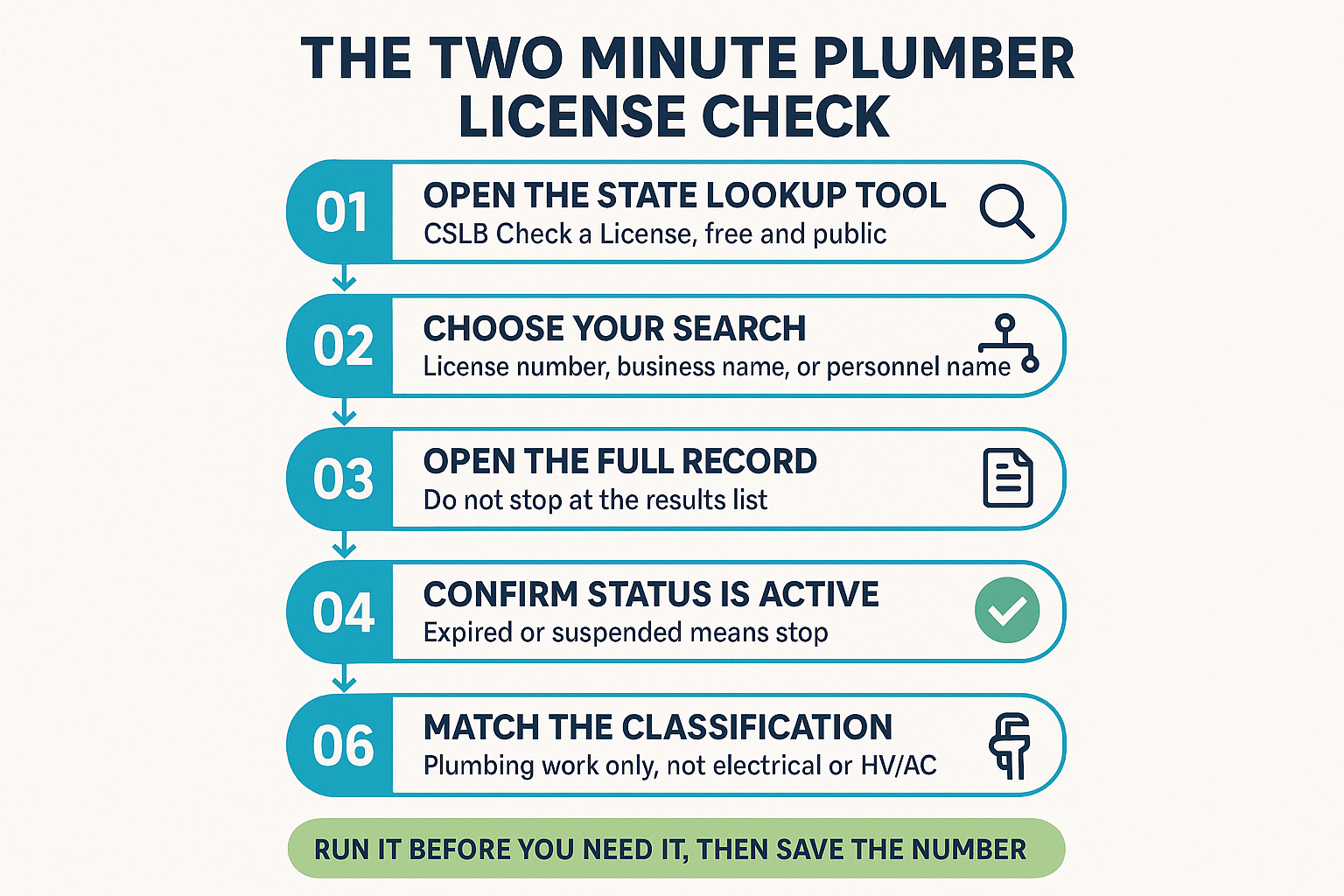
The Two Minute License Check at a Glance
This walks the whole lookup from search box to decision in six steps.
Classification: Can They Even Do Your Specific Job?
California issues licenses by trade classification. The classification defines the scope of work a contractor is permitted to perform and permitted to pull permits for. Permits are their own topic, so I will leave it at that one line.
A plumbing classification does not cover electrical. It does not cover heating and air. That is why a legitimate licensed plumber will turn down certain jobs outright instead of taking the work.
I want to be direct about this: a contractor saying “that is outside what we are licensed to do” is a good sign, not a brush off. It means they are reading their own license the same way the state does.
This comes up here constantly. In a single recent month, roughly one in seven of our calls was some version of “can you handle this specific type of job?” People asked about:
- Underground leak detection and line locating
- Heat pump water heater installation
- Reverse osmosis systems
- Hydro jetting on a mainline
- Water softener compatibility with a septic system
All of those sit inside the plumbing trade. Then there was a website request this summer that read, in full, “Mini Split AC needs recharging.” That is a different trade entirely, and no plumbing license covers it.
So before you book, check the classification on the record against the job in front of you. It beats calling four companies to find out.
Three 2026 Rule Changes That Work in Your Favor
The state board updated several rules this year, and almost nobody locally is explaining them to homeowners. These are the three worth knowing.
Subcontractor disclosure is now something you can ask for. On home improvement projects, a contractor must disclose subcontractor information on request. That includes the sub’s name, contact details, license number, and classification.
This is the most useful change on the list. If you are having a whole home repipe done, or any job large enough that a second crew shows up, you are entitled to know who is actually going to be in your house. Ask in writing, and then run the same two minute check on the sub.
Workers compensation proof now applies across all license classifications. It used to apply to a handful. Now it is uniform, which makes that field on the record more meaningful than it was a year ago.
Minimum civil penalties for unlicensed activity went up as of July 1, 2026. I am not going to put a number on it. The point is that the cost of operating without a license got heavier, which is a nudge in the right direction for everyone doing this work properly.
Run the Check Now, Not While Water Is Coming Through the Ceiling
Here is the part that actually changes outcomes. Nobody is reading a state database at eleven at night with a slab leak soaking the hallway carpet.
In a recent month, about a quarter of our inbound calls opened with some version of “can you come out today or in the next few hours?” Those callers are shopping for availability, not doing research. And the biggest share of booked appointments that month came from direct calls, meaning people who already had the number saved.
The homeowners who vetted someone in advance were the ones who got help fastest. That is not a coincidence.
So if you are sitting on an aging water heater, a repipe you keep putting off, or a crawlspace that worries you every rainy season, do the lookup now while you have the luxury of time. A wet Central Coast winter is a terrible moment to start vetting contractors, which is also why it is worth storm-checking your plumbing before the rain sets in.
Two more habits worth building:
- Save the number in your phone the same day you verify the license
- Recheck the record before signing on any larger job, since license status can change
- Run through a quick checklist before you call, so the first conversation is productive. I wrote one up here: before you call an emergency plumber
And if you suspect a hidden leak but are not sure yet, your water meter can tell you before you call anyone.
Go Ahead and Run It on Us
I would rather you verify than take my word for it. Maverick Plumbing holds an active CSLB license, number 1102966, and we are licensed and insured in Santa Cruz County and Monterey County.
Type that number into the lookup tool and read every line. Status, classification, bond, workers comp, personnel, disclosures. That is the whole point of a public record.
The same transparency shows up in how we handle estimates. One customer put it this way in a review: “Jorge responded very quickly to my requests and provided clear details in the estimates.” Karen M.
Clear details before the work starts is the standard. A verifiable license is just the first one.
Frequently Asked Questions About Checking a Plumber’s License
Is a license number printed on a truck or website enough proof?
No. A number printed anywhere is just a claim until you check it. Look it up yourself. It takes two minutes and the record will tell you whether that number is active, what it covers, and who is behind it.
What if I only know the plumber’s name, not the company?
That works. The state tool lets you search by personnel name as well as by license number or business name. This matters a lot when all you have is a first name off an invoice or a voicemail.
The record shows a complaint. Should I walk away?
Not automatically. Read it with context. A single resolved complaint across many years in the trade is normal. Unresolved complaints, citations for unlicensed work, or a suspension history are a different conversation entirely, and those are worth asking about directly before you sign anything.
Why would a licensed plumber turn down my job?
Because the classification on the license defines what they are permitted to do. Plumbing does not cover electrical or heating and air. When someone tells you a job is outside their license, they are protecting you as much as themselves.
How often should I recheck a license?
For a small repair, once is fine. For a repipe, a sewer line replacement, or any job that runs more than a day, recheck the record right before you sign. License status, bond, and workers comp coverage can all change.
Does the license tell me anything about quality of work?
It does not. It tells you someone is legally permitted to do the work and has met the state’s requirements. Quality comes from reviews, references, and how clearly a contractor explains the job before touching anything.
Looking Up a Plumber Before You Need One?
Run the check on us the same way you would on anyone else, then save the number for the day something actually goes wrong. Maverick Plumbing Technicians, Inc. is licensed and insured with 24/7 emergency service available across Santa Cruz County and Monterey County. When you have questions about a job or want to talk through what you are seeing, we are at (831) 515-9903.
