

Direct Answer: A standard sump pump stops the moment household power fails. A battery backup sump pump takes over on stored DC power, running for a limited time based on how often it cycles.
Most homeowners picture a sump pump failing because it burned out, jammed, or seized up after sitting all summer. The version I run into more often on the Central Coast is different. The pump is completely fine. The power is gone.
That matters because the same storm system that pushes groundwater up under a low-lying Pajaro Valley lot or a west side Santa Cruz property is the same storm knocking branches into power lines. The outage and the water arrive together. They are not two separate problems.
So this article answers one question and stays on it: what happens to a below-grade space when electricity stops mid-storm, and what the real options are if that outcome is not acceptable at your property.
Your Sump Pump Runs on Household Power. That Is the Whole Problem.
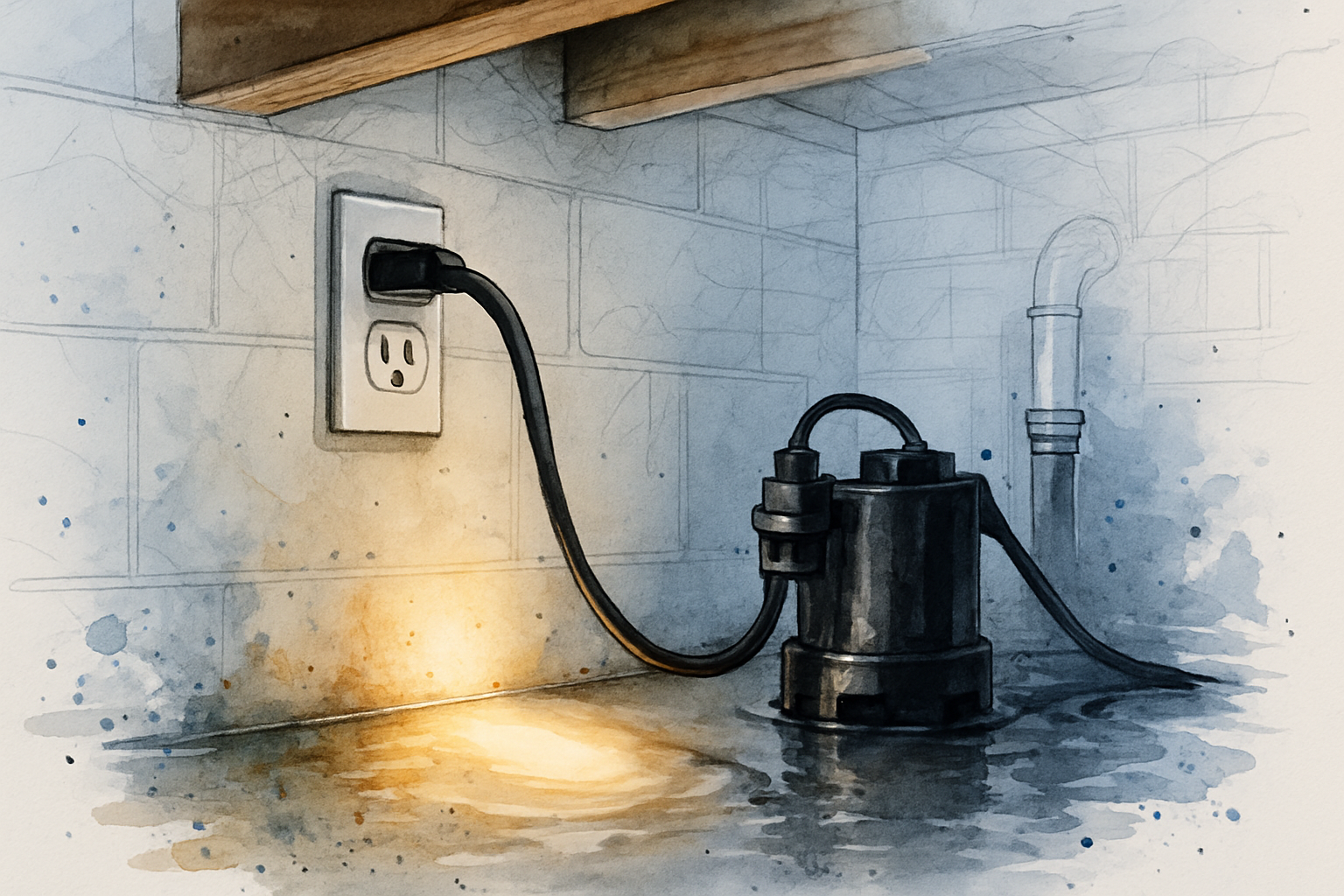
A standard sump pump plugs into a regular outlet. When the grid drops, the float switch can rise all it wants and nothing moves. The pump is dead weight sitting in a basin that keeps filling.
I have had homeowners tell me they tested the pump in October and it ran perfectly. I believe them. A pump that tested fine in October is still a dead pump at 11pm with no electricity feeding it.
What happens next depends entirely on how fast water enters the basin. In saturated soil during a long atmospheric river, the basin can go from a few inches to overflowing in well under an hour. After that, water finds the low points: crawl space dirt, the base of a foundation wall, ductwork, storage, and anything sitting on the floor of a below-grade room.
The frustrating part is that the damage is not caused by a broken pump. It is caused by a working pump that had nothing to run on. That is the one failure point a backup system exists to cover, and it is the reason a homeowner on the west side of Santa Cruz wrote in asking for exactly this. They wanted something reliable and efficient due to increasing heavy storms, which is about as plain as anyone can say it.
Why I Am Bringing This Up Before December
There is a real forecast behind this winter, not just a seasonal reminder. NOAA’s Climate Prediction Center has put the odds at roughly 97% that the current El Niño persists into early spring 2027, with about an 81% chance it reaches very strong intensity between October and December 2026.
Strong El Niño winters in California have historically brought more frequent and more intense atmospheric rivers, with elevated flood risk from December through March. A forecast tilts the odds. It does not script the outcome, and I would not tell anyone otherwise.
But we already know how fast this region loads up. NOAA’s Climate Prediction Center documented multiple atmospheric rivers producing above-normal precipitation and flooding across California in late December 2025, with statewide 14-day precipitation topping 200 percent of normal.
A single stretch of storms like that saturates soil and raises the water table quickly. Once the ground is loaded, every following storm goes straight into the basin instead of soaking in.
The practical point is simple. The time to find out whether a below-grade space has working backup power is before December, not during a storm. If you are also walking the rest of the house, our Santa Cruz storm-check guide for a strong El Niño winter covers the wider plumbing side.
What a Battery Backup Sump Pump Actually Is
People use the term loosely, but there are two different arrangements and they behave differently in an outage.
- A secondary DC pump. A second, smaller pump sits in the same basin, mounted a little higher than the primary. It has its own float and its own battery. When the primary stops, water keeps rising, the secondary float trips, and the DC pump starts moving water on stored power.
- A battery and inverter running the existing pump. Instead of adding a second pump, stored power is converted and fed to the AC pump already in the basin. There is no second pump to install, but everything still depends on that one pump being in good condition.
Both approaches share the same hard limit. Battery run time is finite. How long it lasts depends on how often the pump cycles, and during a real storm it cycles constantly.
A basin that fills every few minutes will drain a battery far faster than one that fills every twenty. Nobody can honestly promise you a specific number of hours without knowing how your basin behaves under load.
The other thing I tell people directly: batteries age. They lose capacity over time whether you use them or not, and they need periodic testing and eventual replacement. A backup system installed six winters ago and never checked is not a backup system anymore.
Comparing Your Options When the Grid Drops
Here is how the three common situations compare during an outage. This is about behavior under load, not a ranking.
| Setup | What Happens When Power Fails | Main Limitation |
|---|---|---|
| Primary AC pump only | Pump stops immediately, basin keeps filling | No protection at all during an outage |
| Secondary DC pump with its own battery | Backup float trips and the second pump moves water | Run time is limited and the DC pump usually moves less volume than the primary |
| Battery and inverter feeding the existing pump | Existing pump keeps running on stored power | Still a single point of failure if that pump has a problem |
| Backup installed years ago, never tested | Battery may have little or no usable capacity left | Gives false confidence going into the rainy season |
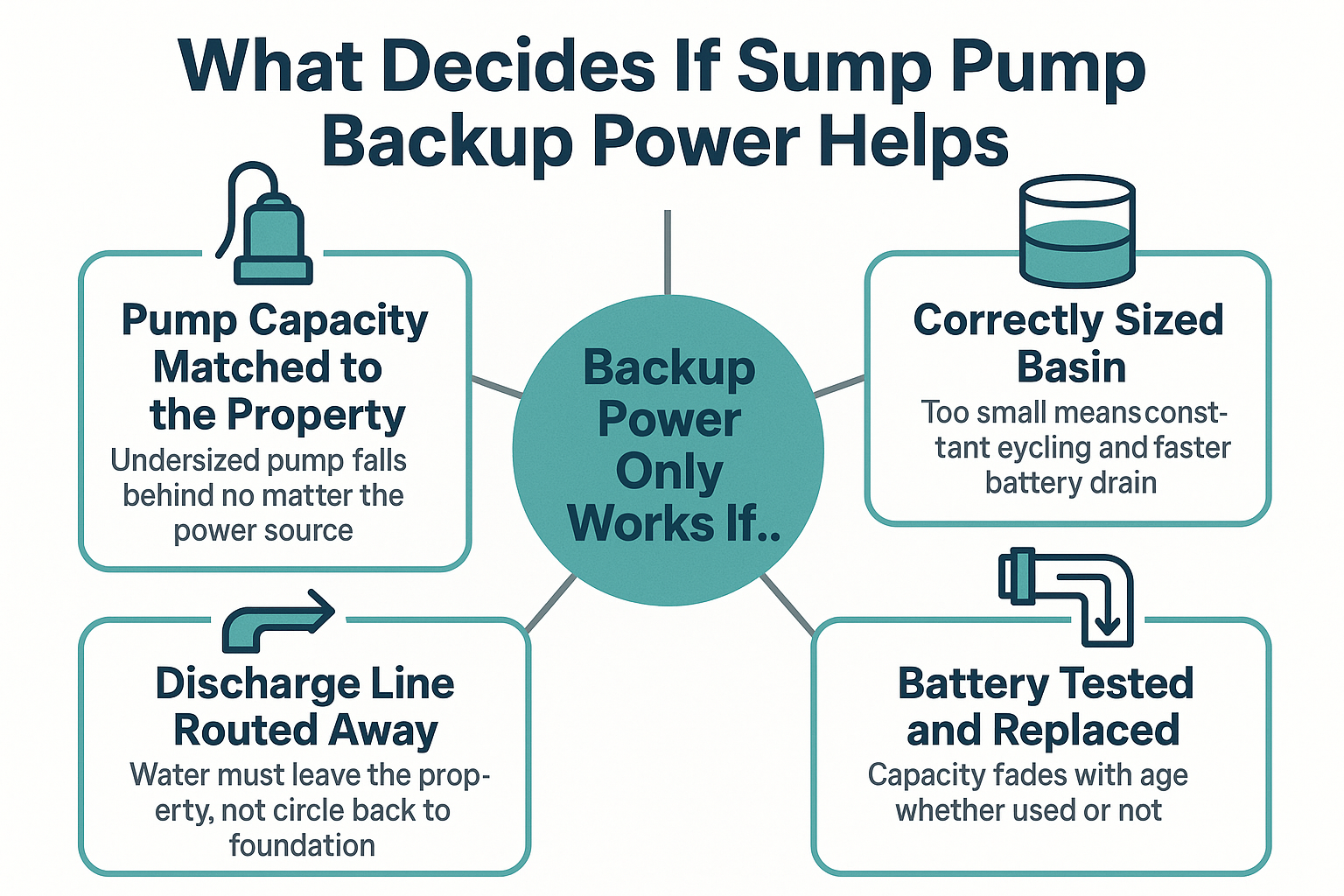
Four Things That Decide Whether Backup Power Actually Helps
A battery does not fix an installation that was undersized or routed poorly to begin with. These four factors decide whether backup power buys you anything.
Where the Water Goes Matters as Much as Whether the Pump Runs
This is the part people skip, and it is the part I check first when I look at an existing installation.
A pump can run beautifully on battery power and still accomplish nothing if the discharge line dumps water ten feet from the foundation on saturated ground. That water soaks straight back down, returns to the basin, and the pump cycles again. You burn through battery run time moving the same water in a circle.
Watsonville’s own public information makes a related point worth knowing. Flooding there is not limited to the mapped Pajaro River, Salsipuedes Creek, and slough zones.
Other parts of the city see local flooding after intense rainfall, where runoff collects and overwhelms storm drain inlets and pipes, or where those inlets are obstructed by debris. A pump pushing water toward an inlet that is already overwhelmed or blocked is moving the problem a few feet, not solving it.
So when I assess a property for backup, I am looking at the whole path:
- Whether the pump capacity matches how fast the basin actually fills
- Whether the basin is sized correctly or forcing short, frequent cycles
- Where the discharge line terminates and what the ground does with that water
- Whether the receiving point has anywhere to send water during a heavy storm
Get those wrong and a battery just extends how long a bad setup keeps failing. For the wider seasonal picture on below-grade spaces, we covered that in our piece on rainy season sump pump readiness in Santa Cruz County.
Frequently Asked Questions About Battery Backup Sump Pumps
How long will a battery backup sump pump run during an outage?
It depends almost entirely on how often the pump cycles. A basin filling every few minutes drains a battery far faster than one filling every twenty minutes. Anyone quoting you an exact number of hours without seeing how your basin behaves in a real storm is guessing.
Can I just use a generator instead?
Some people do, and it can work. The catch is that a generator needs someone awake and available to start it, connect it safely, and keep fuel in it. A battery system takes over on its own at 2am, which is usually when this happens.
How often does the battery need to be replaced?
Batteries lose capacity with age whether or not the pump ever runs. They need periodic testing, and eventually replacement. If a backup was installed several winters ago and nobody has checked it since, treat it as unknown rather than working.
Does a backup pump move as much water as my main pump?
Usually not. A secondary DC pump typically moves less volume than the primary AC pump. It is built to keep the basin from overflowing during an outage, not to match the primary gallon for gallon.
What does an upgrade involve for my specific property?
That depends on the existing basin, pump capacity, discharge routing, and how the space behaves in heavy rain. It is a conversation, not a number. Call (831) 515-9903 and we can talk through what your setup looks like.
Thinking About Backup Power Before This Winter?
We are a licensed and insured plumbing contractor, CSLB #1102966, and we assess existing sump pump installations across Santa Cruz County and Monterey County before a problem shows up rather than after. Maverick Plumbing also keeps 24/7 availability for active flooding, whether that is Watsonville, Santa Cruz, or the surrounding area. If you want to talk through what backup would involve at your property, call (831) 515-9903 and we will walk you through what we would look at.
