

Direct Answer: Check your sump pump in summer, not during a storm. A pump that ran hard all winter has new wear on the float switch, check valve, and discharge line that only shows up under load.
Most homeowners I talk to think about their sump pump exactly once a year. It happens in the middle of a January storm, when water is rising under the house and the pump is either running or it is not.
By that point there is no good option left. A stuck float switch or a partially blocked discharge line gets discovered while water is coming in, not before.
Summer is the quiet window. A pump that pushed water through a wet Central Coast winter has mechanical wear it did not have in October, and July or August is a low stakes time to find out about it.
Why Sump Pump Rainy Season Readiness Is a Summer Job in Santa Cruz County
The rainy season here does not just drop water on your roof. It raises the water table, and that pressure keeps pushing on foundations, crawl spaces, and below-grade utility rooms for weeks after the last storm clears.
That is the load your pump was fighting all winter. And a pump that cycled hundreds of times is not in the same condition it was before the first storm.
What I look at differently in summer than in the middle of a storm:
- Nothing is urgent. There is no water in the crawl space, so a problem can be fixed on a normal schedule instead of at 2 a.m.
- Parts are available. Ordering a replacement pump or a new battery in August is a different situation than trying to source one during a regional storm.
- The failure is testable. You can put the system under load on purpose instead of hoping it works when the weather does it for you.
I have taken plenty of calls from homeowners in Watsonville and Santa Cruz who told me the pump “worked fine last year.” That was true. It also had nothing to do with whether it would work that night.
What Actually Wears Out Over a Wet Winter
A sump pump system is simple, which is exactly why people assume it either works or it does not. In practice it fails in a few specific, predictable places.
- Float switch. This is the part that tells the pump to turn on. Tethered floats can hang up on the basin wall, on the discharge pipe, or on debris that washed in over the winter.
- Check valve. It keeps water in the discharge line from draining back into the pit. When it fails, the pump short cycles and re-pumps the same water, which is hard on the motor.
- Discharge line. Mineral deposits build up inside the pipe, and hard water is common throughout Santa Cruz County and much of the Monterey Bay area. Debris, root growth, or a crushed section at the exit point also restricts flow.
- Impeller and intake screen. Silt, gravel, and grit from a season of groundwater will clog an intake and drag down pumping capacity.
- Power source. A tripped GFCI outlet or a pump quietly unplugged during a garage project is more common than people expect.
The reason a partial discharge blockage is so sneaky is that it does not show up on a light test. Pour a bucket of water in the pit and the pump will probably move it. Ask it to move real volume under sustained load and the restriction finally matters.
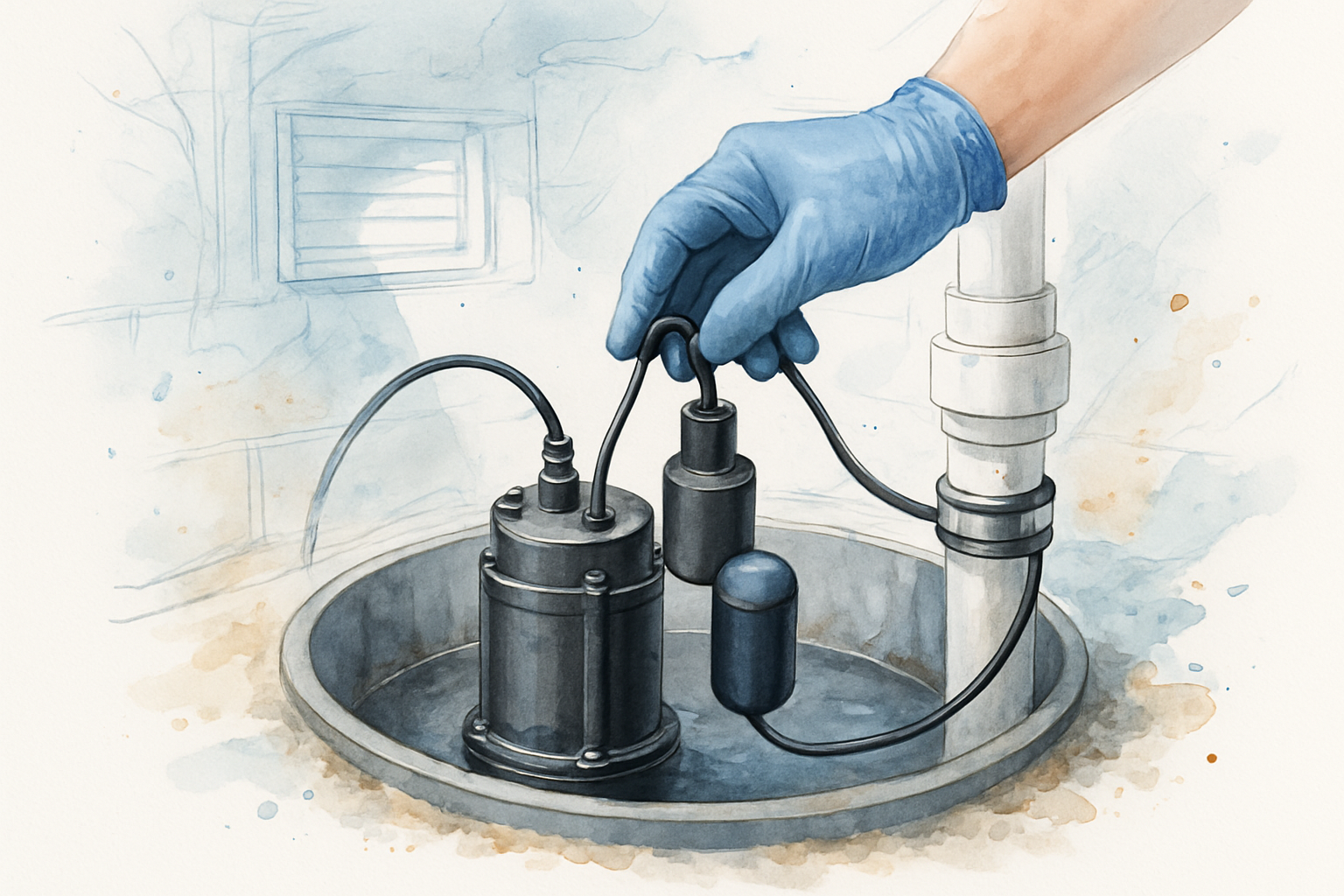
Sump Pump Components: What You Can Check and What You Should Not
This is roughly how I split the work when a homeowner asks what they can look at themselves. The left side is safe observation. The right side is where a licensed plumber should take over.
| Component | What Goes Wrong | What You Can Check Yourself | When to Bring In a Licensed Plumber |
|---|---|---|---|
| Float switch | Sticks, hangs on the basin wall or pipe | Look for debris, confirm the float moves freely by hand | Pump does not start, or starts and will not shut off |
| Check valve | Fails and lets water drain back | Listen for repeated short cycling right after shutoff | Any valve replacement or pipe cut |
| Discharge line | Mineral scale, debris, crushed exit point | Walk the exterior discharge point and clear leaves or soil | Slow flow, gurgling, or suspected blockage inside the line |
| Basin and intake | Silt and gravel buildup | Visually check for sediment depth and standing debris | Pump removal, cleaning, or capacity testing |
| Battery backup | Dead or aged battery, controller fault | Read the install date, look for corrosion or an alarm light | Load testing, battery replacement, or wiring work |
Battery Backup Pumps: The Part Nobody Tests Until It Matters
Battery backup systems have gotten a lot more common in Santa Cruz County homes since the damaging storm years, and for good reason. Around here, the power tends to go out during exactly the same weather event that makes the pump necessary.
A backup system is designed to do one narrow job: run a secondary pump on DC power when the primary pump has no electricity or has failed outright. It is not designed to handle a full winter of pumping on its own.
The problem is what happens after installation. A battery that was installed and never checked again is not a backup, it is an assumption.
How to tell whether the battery is still worth trusting:
- Find the date. Most batteries are marked with a manufacture or install date. Backup batteries generally have a service life measured in a few years, not a decade.
- Look at the terminals. Corrosion, swelling, or a case that looks distorted means the battery is done.
- Check the controller. Most systems have an indicator or alarm that flags a low or failed battery. A silent controller is not the same as a passing controller.
Here is where homeowner self-testing goes wrong. People pour a bucket into the pit and watch the primary pump handle it, which means the backup never engaged and nothing was actually tested. Others unplug the primary and hear the backup hum for ten seconds, which proves the pump turns but says nothing about whether the battery holds under a sustained run.
One Santa Cruz homeowner reached out this summer asking about a sump pump upgrade with battery backup, specifically because the storms have been getting heavier. That is the right question asked at the right time of year.
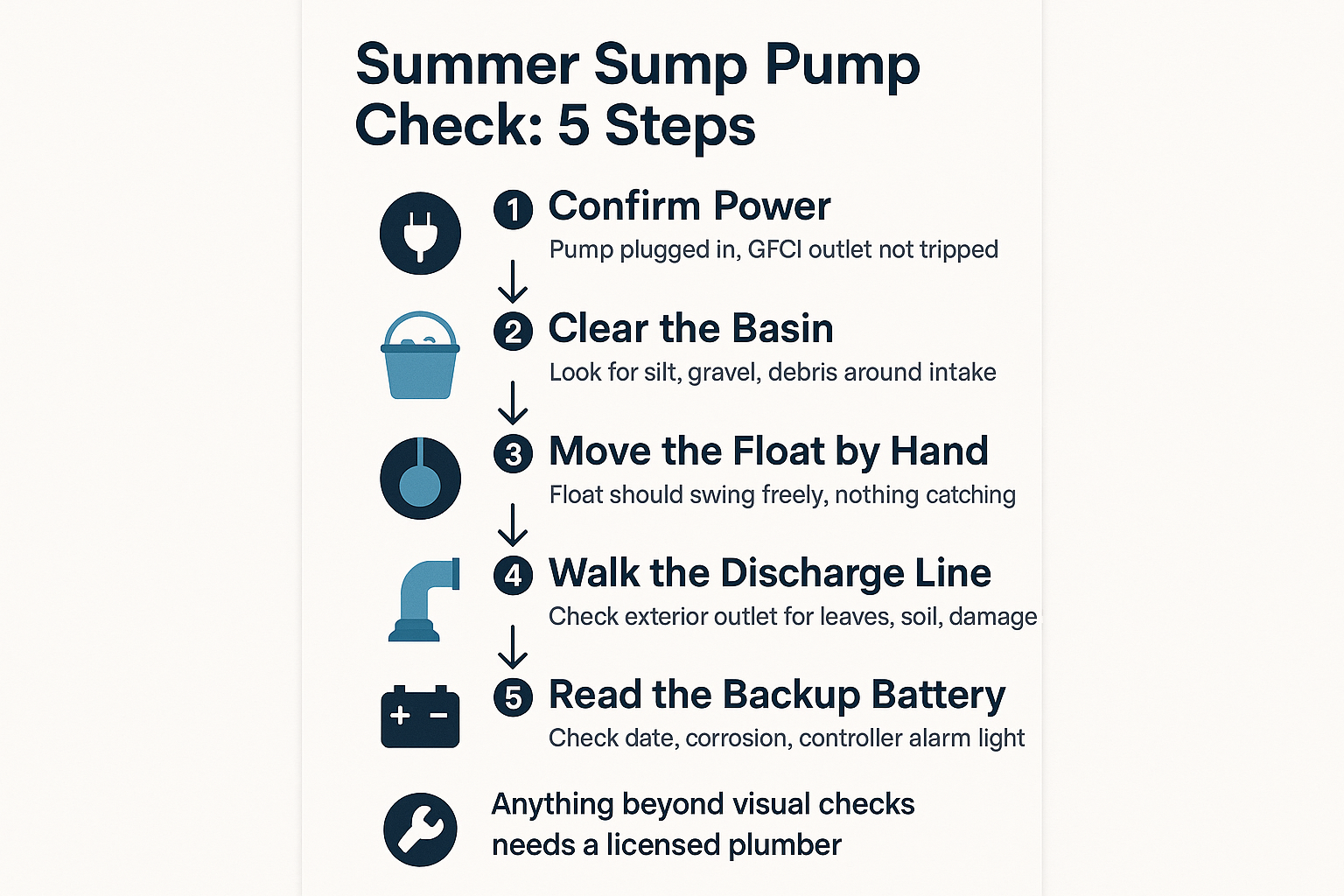
A Summer Sump Pump Walkthrough, Step by Step
This is the order I would go in if you want a basic look at your own system before the rains come back.
Where You Live Changes the Groundwater Picture
Not every home on the Central Coast needs a sump pump. Geography and elevation matter a great deal here.
Properties in the lower-lying parts of Watsonville, including areas along the Pajaro River corridor and pockets with a seasonal high water table, deal with a different pressure profile than homes up on higher ground. When the water table rises to within a few feet of a crawl space floor, water finds its way in through the path of least resistance. The USGS explanation of aquifers and groundwater covers why that pressure behaves the way it does.
That said, I have seen wet crawl spaces on hillside properties too, usually from surface drainage or a spring that only shows up in a wet year. Elevation reduces risk. It does not eliminate it.
The practical takeaway is simple. If your home does not have a sump pump and has never had standing water, you probably do not need one. If your home does have one, it needs to work, and a rainy season backup that fails is worse than no expectation at all.
The Line Between a Visual Check and a Real Evaluation
Everything in the walkthrough above is observation. It is useful, and it catches the obvious problems, like a float tangled on a pipe or a discharge outlet buried under a season of leaf litter.
A system evaluation is different work. It means putting the pump under actual load, checking whether the basin is correctly sized, verifying the discharge routing, testing the check valve, and load testing a backup battery instead of just listening to it hum.
Maverick Plumbing handles sump pump installation, replacement, and assessment of existing systems, including battery backup setups, along with 24/7 response when there is water actively coming in. If you find something during a summer walkthrough that you are not sure about, that is the moment to have someone look, not in December.
It also helps to know where the line is on urgency in general. Our guides on when a plumbing problem becomes an emergency and the difference between urgent and wait-until-morning problems walk through how we think about that call.
Frequently Asked Questions About Sump Pump Readiness
How often should a sump pump be tested?
I would look at it twice a year at minimum, once in late summer before the rains start and once mid-season if it has been running a lot. A pump that sits unused for months can seize just as easily as one that runs constantly.
Can I just pour a bucket of water in the pit to test it?
That confirms the float and motor respond, which is worth knowing. But it does not test capacity, and it will not reveal a partial discharge line blockage or a weak backup battery, because neither one shows up until the pump is working under real volume.
How long does a sump pump usually last?
It depends heavily on how hard it worked. A pump in a low-lying Watsonville crawl space that cycles constantly through a wet winter will wear out well before an identical pump that only runs a handful of times a year. Cycle count matters more than age.
My pump runs but there is still water in the crawl space. What is happening?
Usually one of three things: the pump is moving less water than it used to because of a clogged intake or worn impeller, the check valve failed and it is re-pumping the same water, or the discharge line is restricted and the water is not making it out. All three need someone to actually test the system rather than guess.
What does a sump pump replacement involve?
We start by assessing the existing installation, because a lot of the problems I find are in the basin sizing or the discharge routing rather than the pump itself. Scope depends on what is already there, so call (831) 515-9903 for a look at your specific setup and an accurate quote.
Thinking About Your Sump Pump Before the Rain Starts?
We are a licensed and insured plumbing contractor (CSLB #1102966) working across Watsonville, Santa Cruz County, and parts of Monterey County, and summer is when we have the most room on the schedule for this kind of non-urgent work. If your pump has not been looked at since the last storms, you can reach us at (831) 515-9903 or request service at maverickplumbingtechnicians.com. Emergency response stays available 24/7 if water is already coming in.
