

Direct Answer: A sump pump that runs constantly usually points to a stuck float, a failed check valve, a blocked discharge, or runoff aimed at the foundation. Undersizing is only one possible cause.
It is 11 p.m. in the middle of a storm and you can hear the pump under the house kick on again. Then again four minutes later. You have no idea if that means it is keeping up or slowly losing.
I get that question every rainy season from homeowners around Watsonville, the Pajaro Valley floor, and north Monterey County. One homeowner on the upper west side of Santa Cruz wrote in asking about an upgrade because of increasing heavy storms, and that is the right instinct at the right time of year.
The best month to answer this is October, not January. Below is how I think about a pump that runs nonstop, why sizing is a measurement question, and where the discharge line quietly ruins otherwise good equipment.
Why a Sump Pump Running Constantly Is Usually Not a Sizing Problem
Most people assume constant cycling means the pump is too small. Sometimes it is. More often it is moving the same water twice, or water that should never have reached the basin at all.
Here are the real candidates I check first:
- A genuinely high water table. After weeks of saturated ground in the Pajaro Valley, groundwater pressure is real and the pump may be doing exactly its job.
- A float switch hung up. The float catches on the basin wall or on the discharge pipe and never tells the pump to shut off.
- A failed check valve. The column of water sitting in the discharge line drops straight back into the basin, so the pump lifts the same gallons over and over.
- A kinked or partly blocked discharge line. Debris, a crushed section, or a frozen-solid low spot all reduce flow without stopping the motor.
- Runoff being funneled at the pump. Roof downspouts or a hardscape slope that dumps toward the crawl space will overwhelm a pump that was never installed for it.
A pump running nonstop is a symptom with several possible causes. Swapping in a bigger unit without finding the cause usually buys you a louder version of the same problem.
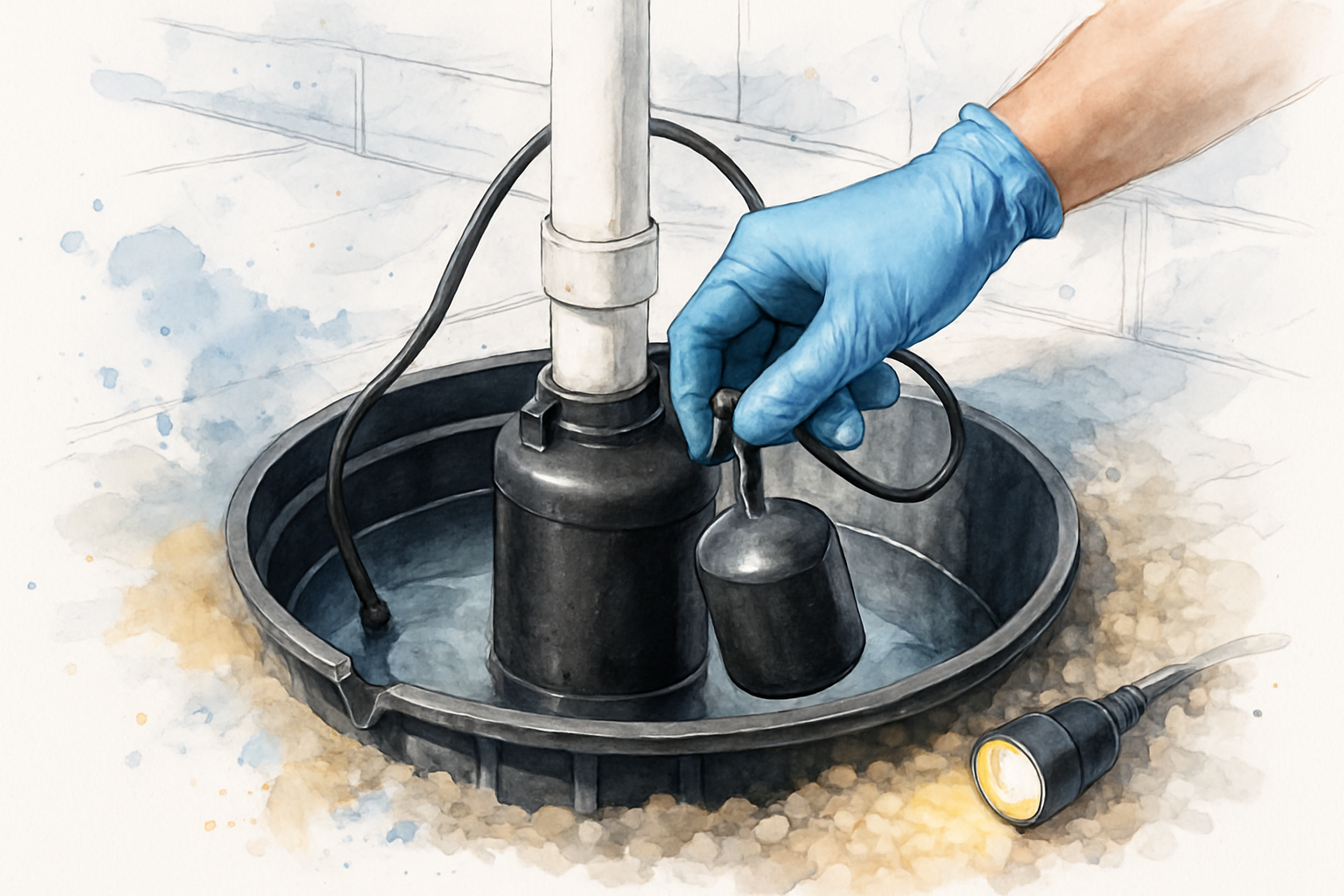
Sump Pump Sizing in Watsonville Is a Measurement Question, Not a Horsepower Guess
Horsepower on the box tells you almost nothing about how a pump will perform under your house. What matters is how much water it can actually move along the path it has to move it.
The variables that decide that:
- Inflow rate. How fast water enters the basin during real rainfall, not on a dry afternoon.
- Vertical lift. The height from the water in the basin up to the discharge point.
- Pipe diameter and run length. A long, narrow horizontal run costs you flow.
- Number of elbows. Every turn the water makes adds resistance.
Capacity drops as lift increases. A pump rated impressively at a few feet of lift can underperform badly in a crawl space with a long uphill run and four elbows.
This is also why replacing a failed pump with the identical model can repeat whatever mistake was made the first time. When I evaluate a property, I look at basin size, pump capacity, and discharge routing as one system, not three separate parts that happen to be connected.
What Constant Cycling Usually Means
Same symptom, very different fixes. This is roughly how I sort it in the field.
| What you notice | Likely cause | What gets checked |
|---|---|---|
| Pump cycles every few minutes, basin refills fast | Failed check valve letting discharge water fall back | Check valve condition and orientation |
| Pump runs and never shuts off | Float switch hung on the basin wall or pipe | Float travel, tether length, basin clearance |
| Motor runs but water level barely drops | Kinked, clogged, or undersized discharge line | Pipe diameter, run length, elbows, terminal point |
| Basin stays full only during heavy rain | Inflow exceeds pump capacity at that lift | Inflow rate, vertical lift, pump curve match |
| Water reappears right after the storm passes | Discharge dumping too close to the foundation | Where the line terminates and how water drains away |
The October Checklist
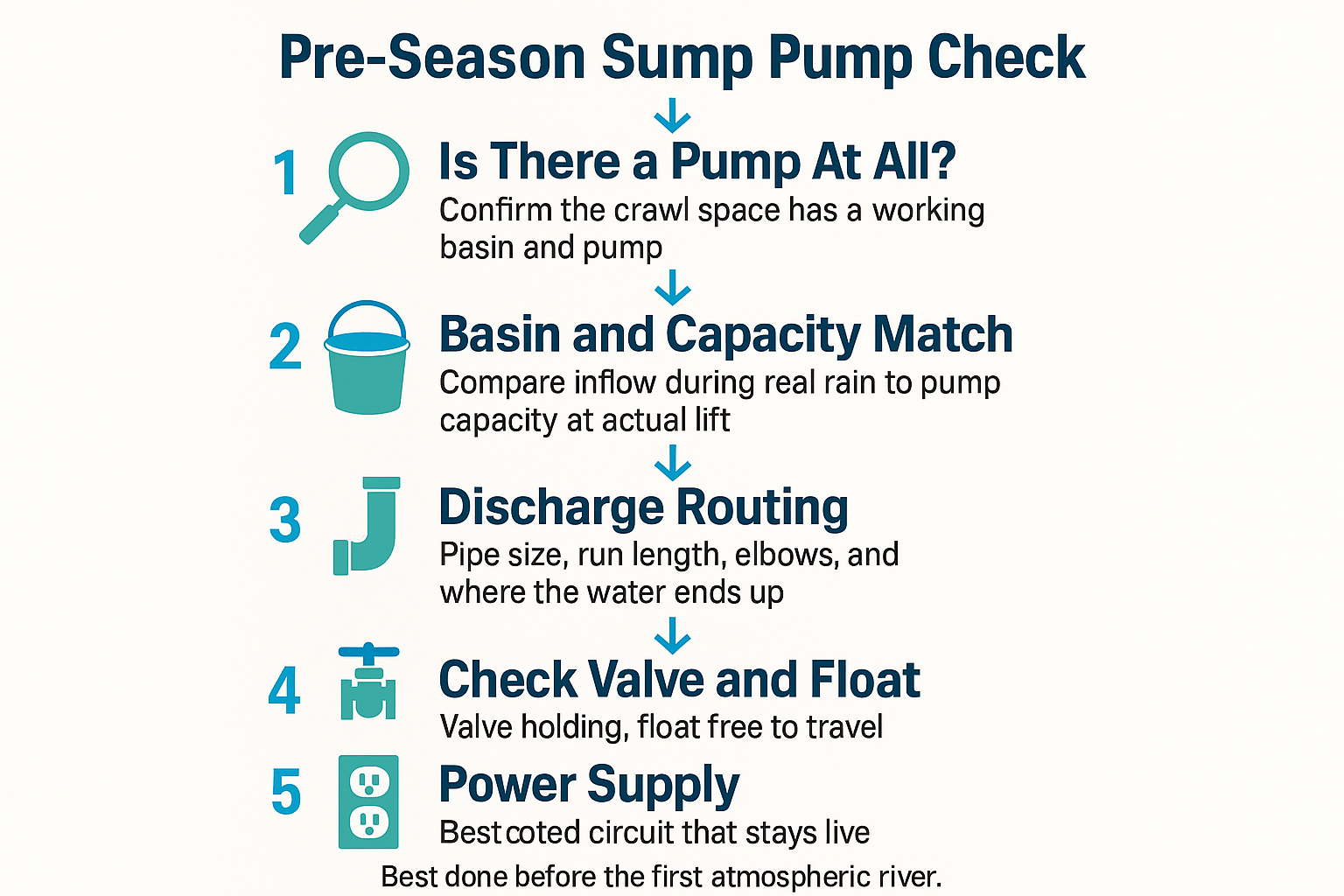
Here is what a pre-season look at a sump system covers, in the order I walk it.
Where the Water Goes Is Half the System
This is the part that gets skipped most often, and it is where local detail matters.
If the discharge dumps a few feet from the foundation, that water soaks right back into the soil the pump is trying to keep clear. The basin refills, the pump cycles, and the loop never closes. Standard public guidance is to carry the discharge well away from the foundation and terminate it somewhere water can flow away overland.
Tying a sump discharge into the sanitary sewer is off limits. That is not a preference, it is a code issue.
Watsonville’s own public information is useful here. Beyond the mapped Pajaro River, Salsipuedes Creek, and slough flood zones, other parts of the city see local flooding after intense rainfall where runoff collects and overwhelms storm drain inlets, or where those inlets are blocked. A discharge line aimed at an inlet that backs up during the same storm is not a plan.
On lots where the ground is flat, routing is the whole puzzle. I would rather spend time solving the discharge path than talking about pumps.
What a Pre-Season Assessment Actually Covers
Callers regularly ask whether a plumbing company even handles this kind of work. It does. Sump pump installation, replacement, and assessment sit squarely inside the licensed plumbing trade, and Maverick Plumbing handles it as a licensed plumbing contractor, CSLB #1102966, with 24/7 response when water is already coming in.
A pre-season look should answer these plainly:
- Whether a pump exists at all in the crawl space, and whether it still runs
- Whether the basin size and pump capacity match the inflow you actually get
- How the discharge is routed, sized, and terminated
- The condition of the check valve and the float
- Whether the pump is on an electrical supply that stays live
Backup power is its own conversation, and worth having separately. If you want to think that part through, read about what happens to your sump pump when the power goes out mid-storm.
One more note on timing. NOAA’s National Weather Service has issued an El Nino Advisory with forecasters expecting the event to strengthen, including a 63% chance it reaches very strong intensity. No forecast promises a specific storm outcome at your address, but it is a reasonable nudge to check drainage equipment this fall rather than next winter.
Crawl Space Work You Cannot See
Here is the honest problem with this kind of job. You are standing in the kitchen while someone else is 30 inches off the ground under your floor, and you have to take their word for what is down there.
That is why I send photos and plain explanations without being asked. One customer put it this way in a review: “I appreciated that he sent pictures of the plumbing repairs and installation to me even when I didn’t specifically request them.”
If you are not sure the water is groundwater at all, it is worth ruling out indoor plumbing first. The signs are different, and reading slab leak warning signs is a good place to start.
Frequently Asked Questions About Sump Pumps That Run Constantly
Is it bad for a sump pump to run constantly?
Yes, over time. Continuous cycling wears the motor and the switch faster than intermittent use, and it hides whatever is really wrong. During a heavy Pajaro Valley storm some near constant running can be normal, but if it keeps going on a dry week, something needs attention.
How do I know if my sump pump is too small for my lot?
You cannot tell from the label. It depends on how fast water enters the basin during real rain, the vertical lift to the discharge point, and the length and number of turns in the discharge run. Those have to be measured on site, because capacity falls off as lift goes up.
Can I just buy a bigger pump and drop it in?
You can, and sometimes it helps. But if the actual problem is a failed check valve or a discharge line aimed at your own foundation, a bigger pump just moves the same water faster and gets louder doing it.
Where should the discharge pipe end?
Well away from the foundation, at a spot where water can run off overland instead of soaking back toward the crawl space. Never into the sanitary sewer. And think about whether the spot you picked floods during the same storms the pump is working in.
When is the best time to have a sump system looked at?
Early fall, before the first atmospheric river of the season. Checking capacity and routing in October is a very different experience than standing in a wet crawl space in January trying to diagnose it.
What does a sump pump assessment or installation cost?
That depends entirely on the property: basin condition, pump capacity needed, and how far the discharge has to travel. I would rather look at the crawl space than guess, so call (831) 515-9903 for numbers specific to your address.
Want a Straight Answer on Your Sump System Before the Rain Starts?
If your pump has been cycling and you would rather know now than find out during a storm, we look at sump systems throughout Santa Cruz County and north Monterey County, including Watsonville and the Pajaro Valley. You can reach us at (831) 515-9903, or request service at maverickplumbingtechnicians.com. Emergency response is available around the clock if water is already coming in.
