

Direct Answer: Maverick Plumbing Technicians, Inc. (CSLB #1102966) handles whole-house repiping in Santa Cruz. Most homes stay livable during the work, with water off during working hours and usually back on each evening.
You patched a pinhole leak in the laundry wall last spring. Then one showed up under the kitchen sink, and now the shower pressure has dropped off. If your Santa Cruz home has old pipes that keep springing leaks, we handle whole-house and partial repiping across Santa Cruz County and parts of Monterey County as a licensed and insured plumbing contractor, CSLB #1102966.
Most repipe articles stop at whether you need one. This one assumes you are past that and are picturing the actual week: how long the water is off, which walls get opened, and whether you can keep living there.
Here is my position after years of doing this work locally. The scope of a repipe gets decided long before anyone cuts a pipe, and once you understand how a plumber counts that scope, you can read any proposal put in front of you and judge it yourself.
Our Santa Cruz home has old pipes and keeps springing leaks. Who does whole-house repiping nearby?
We do. Our crew works out of Santa Cruz and covers Santa Cruz County plus parts of Monterey County, and the same technicians who run leak detection and slab leak repair also handle partial and whole-home repiping. That matters because the first visit is usually a diagnosis, not a demolition.
A repipe scope normally covers:
- New supply lines from the main shutoff to every fixture
- All drops for sinks, toilets, tubs, showers, and the laundry
- New angle stops and supply lines at each fixture
- Hose bibs and the water heater connections where they tie in
- Permit and the required inspection, when it is written into the scope
What moves the timeline and the scope is almost never square footage by itself. It is the number of fixtures, whether the house sits on a slab or a crawlspace, how much attic access there is, and how many walls have to be opened to reach a run.
For an active leak or a line that has already burst, we run 24/7 emergency service and can get water back under control fast. A planned repipe is scheduled work, and during busy stretches our calendar can run a few weeks out, so booking ahead is worth it. For what your specific job would cost, that is a conversation at (831) 515-9903, not a number I can honestly put in an article.
Why Santa Cruz County Houses Keep Doing This
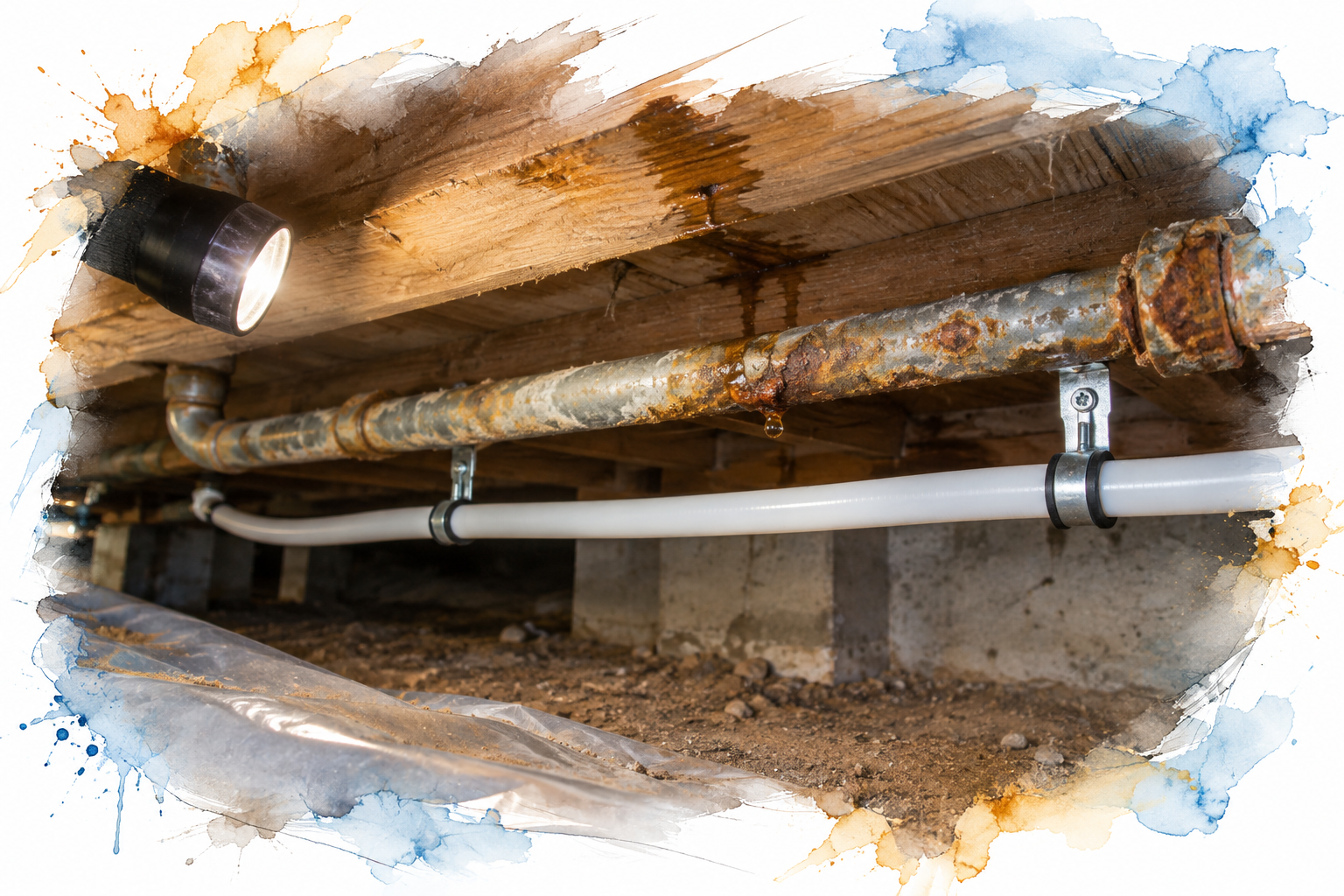
A lot of older housing stock here was plumbed with galvanized steel. It corrodes from the inside out, so the outside of the pipe can look fine while the bore fills with rust and scale.
Hard water speeds that up, and hard water is common across our region. Minerals deposit on an already rough interior surface, the opening narrows, pressure drops at the far end of the house, and thin spots start weeping.
That is why one leak in galvanized pipe is rarely one leak. The whole system aged at the same rate in the same water, so when pinholes start appearing in clusters, they are telling you something about the entire run, not just that one elbow.
Signs that fit the pattern:
- Rust-colored water after the house sits unused for a day or two
- Pressure that fell off gradually over years, not overnight
- Two or more leaks in different parts of the house within a year or two
- Visibly scaled, flaking pipe at every point you can actually see it
One homeowner who wrote to us had a galvanized line burst under a poured slab and had to shut the water off to the whole house. That is the version of this problem nobody plans for. If you are not sure where your shutoff even is, find it before you need it.
How Scope Gets Counted Before Anyone Cuts a Pipe
Plumbers do not price or plan a repipe by bedroom count. We count drops, meaning every point where a water line comes out of the wall or floor to feed something.
One homeowner described their own job to us better than most estimates do: an 1,800 square foot single family home, three bathrooms, roughly 12 to 15 drops for sinks, toilets, tubs, showers, and laundry. That is exactly the unit of measure the work gets built around.
So when you walk your house, count them yourself:
- Each sink, including the utility sink in the garage
- Each toilet
- Each tub and each shower valve
- Washing machine box
- Water heater, dishwasher, refrigerator line, and exterior hose bibs
Then add the part that changes the labor more than the count does: access. A crawlspace with headroom and an attic you can move in is a very different job from a slab home where lines have to be rerouted overhead and through walls.
When somebody hands you a proposal, the drop count and the access plan should both be visible in it. If they are not, you are being asked to trust a number instead of a plan.
The Repipe Week, Stage by Stage
I lay this out by stage rather than by day, because house layout and access move the calendar. A straightforward crawlspace home can run a few days. A slab home with limited access takes longer.
| Stage | What Happens | Your Water During It |
|---|---|---|
| Walkthrough and scope | Drop count, access check, material and routing decisions, written scope | Normal |
| Permit and staging | Permit pulled for the work, materials delivered, floors and furniture protected | Normal |
| Access openings | Small, planned cuts in drywall and some ceilings at drop locations and turns | Normal most of the day |
| Rough-in of new lines | New supply lines run from the main through crawlspace, attic, and wall cavities | Off during working hours, usually back on by evening |
| Tie-in and fixtures | Old lines abandoned, fixtures reconnected, new shutoff valves and supply lines set | Off in blocks while each area is connected |
| Inspection | Rough-in is inspected before anything gets closed up | Normal |
| Close-up and patching | Drywall patch, texture, and paint, handled by whoever the scope says handles it | Normal |
What Daily Life Actually Feels Like
Most families stay in the house. The honest version is that it feels like a loud, dusty week with predictable interruptions, not a gut remodel.
What to plan for:
- Water off during working hours, typically restored before the crew leaves for the day so you have showers and toilets overnight
- One or two days where a bathroom or the kitchen is out of service while that area gets tied in
- Laundry paused on the day the washer box is reconnected
- Furniture pulled off interior walls in the rooms being opened
- Dust control and daily cleanup, which a good crew does without being asked
One customer put it this way after a large job at her home: “The work needed at our house was immense, but Jorge and his team were efficient, thorough, and tidied up after every job.” That daily tidy-up is the difference between living in your house and camping in a job site.
Sequencing matters too. Because the rough-in has to be inspected before walls close, there is usually a short pause with open walls. That is not a crew disappearing on you. It is the order the work has to happen in.
Fill your tubs or keep a few jugs of water on hand the first morning, and ask upfront who is doing the drywall patch and texture. Some plumbers close walls, some coordinate it, and some hand that to you. There is no single right answer, but it needs to be settled in writing.
Partial Repipe or Whole House? Judge the Evidence Yourself
This is where people get nervous about being upsold, and I understand why. A caller once told us another plumber had said repiping would be needed eventually, which left them in limbo for months.
A repair or partial repipe usually makes sense when:
- One section failed and the rest of the accessible pipe looks sound
- The failure has a clear cause, like a single damaged run or an old patch
- Pressure is normal everywhere except the affected branch
Whole-house starts making sense when:
- Leaks have appeared on different runs over a short period
- Galvanized pipe looks degraded at every point you can actually see
- Pressure has dropped throughout the house, not at one fixture
- Walls are already opening up repeatedly for repairs
One homeowner wrote that he got a section of galvanized pipe repaired and “didn’t get the typical upsell.” That is the standard I hold our own recommendations to. If a repair is the right call, that is the call.
If a previous repair already failed and you are second-guessing the diagnosis, a second look checks specific things before anyone recommends more work.
Six Questions to Hold Both Proposals Against
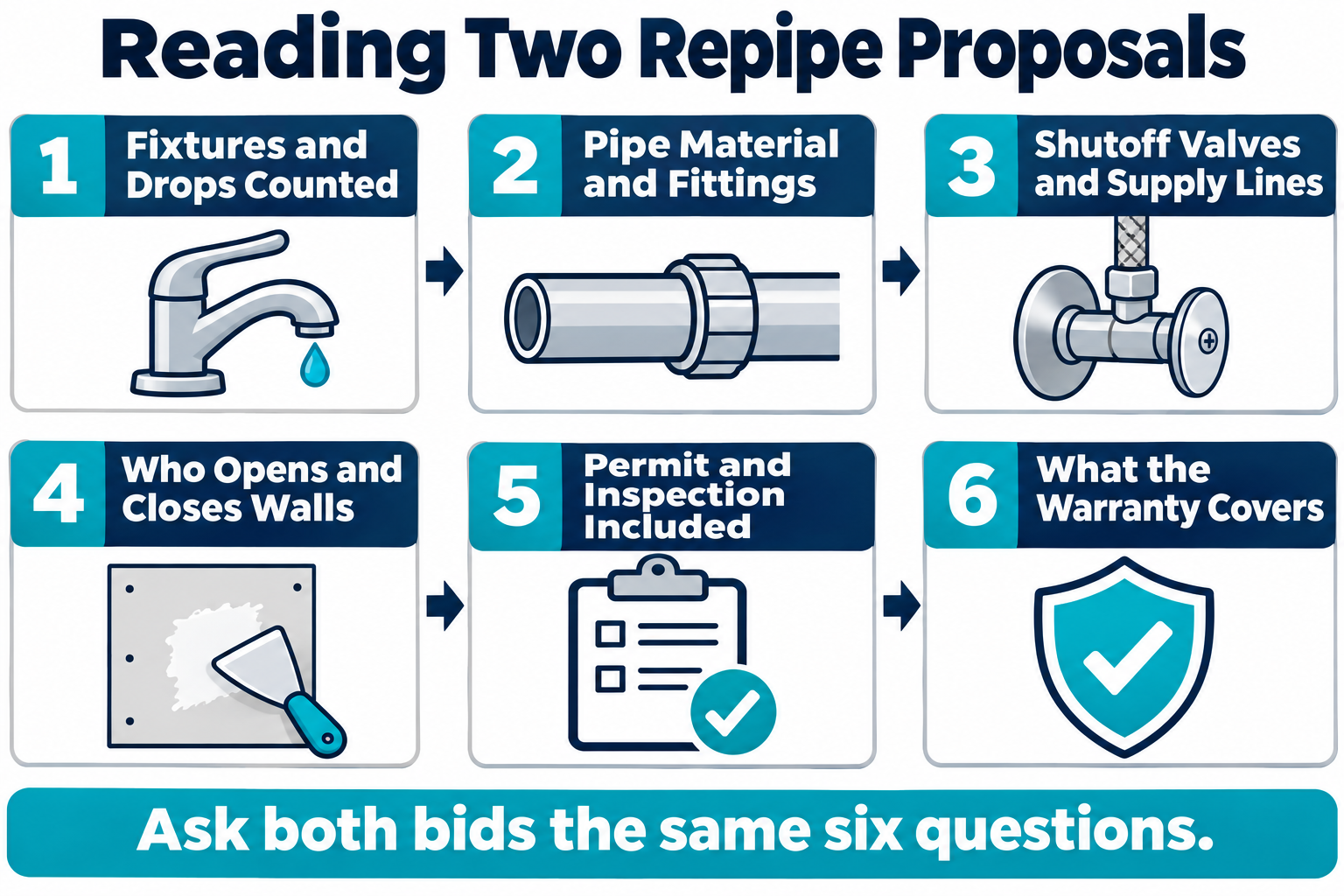
You cannot compare two repipe bids on a number alone. Ask both proposals the same six questions and the differences show up fast.
What a Usable Written Scope Looks Like
A proposal you can actually evaluate spells out the work, not just the total. Photos help, and I send them because they show the homeowner what I am looking at under the house.
Look for these in writing:
- The fixture and drop count the bid is based on
- The pipe material and fitting type being installed
- Whether new shutoff valves and supply lines are included at each fixture
- Who opens the walls and who closes, textures, and paints them
- Whether the permit and inspection are in scope
- What the warranty covers and for how long
If two bids are far apart, the gap is almost always hiding in items three, four, and five. A cheaper bid that leaves drywall and valves to you is not a cheaper job, it is a smaller one.
Ask the questions out loud. Any licensed contractor who is comfortable with their scope will walk you through it without pressure, and you should not be asked to decide on the spot.
While the walls are open is also the sensible time to handle related work, such as an automatic water shutoff valve your insurer is asking about or a water treatment system if hard water has been chewing through your fixtures.
Frequently Asked Questions About Whole-House Repiping in Santa Cruz
Our Santa Cruz home has old pipes and keeps springing leaks. Who does whole-house repiping nearby?
Maverick Plumbing Technicians, Inc. is a licensed and insured plumbing contractor (CSLB #1102966) based in Santa Cruz that handles partial and whole-home repiping throughout Santa Cruz County and parts of Monterey County. The work covers new supply lines to every fixture, new shutoff valves and supply lines, and the permitted inspection process. Emergency response is available 24/7 for an active leak or a burst line, while planned repipes are scheduled work that can book out a few weeks during busy stretches. Call (831) 515-9903 to talk through your house.
Can we stay in the house during a repipe?
In most cases, yes. Water is typically shut off during working hours and restored before the crew leaves, so you have toilets and showers overnight. Expect one or two days where a specific bathroom, the kitchen, or the laundry is out of service while that area is tied in.
How long does a whole-house repipe take?
It depends far more on access and fixture count than on square footage. A crawlspace home with good access and a normal fixture count can move quickly, while a slab home where lines must be rerouted overhead takes longer. The rough-in inspection also has to happen before walls close, which adds a short pause to the schedule.
Another plumber told us we would need repiping eventually. Should we do it now?
Not automatically. Look at the evidence: repeated leaks on different runs, visibly degraded pipe everywhere you can see it, and pressure loss throughout the house point toward a full repipe. A single failed section with a sound system around it is a repair, and it should be priced and handled as one.
Who patches the drywall after the pipes are in?
That varies by contractor, which is exactly why it belongs in the written scope. Some plumbing scopes include patching, some include rough patch only, and some leave finish texture and paint to the homeowner. Settle it before the first cut.
What does a repipe cost?
I will not put a figure in an article, because the honest answer depends on your drop count, access, routing, and what else is included in the scope. Call (831) 515-9903 and we can walk the house and give you something specific in writing.
Want someone to look at what is actually under your house?
Repiping is licensed trade work, and we carry an active CSLB license (#1102966) and insurance for every job we take in Santa Cruz County and parts of Monterey County. The same crew that runs leak detection and slab leak repair handles partial and whole-home repiping, so the diagnosis and the plan come from the same people. If you want your own system looked at and explained before you decide anything, we are reachable at (831) 515-9903 or through maverickplumbingtechnicians.com.
