
Direct Answer: A second opinion should start at the joint itself. A licensed plumber inspects the connection, fittings, slope, and valves, photographs what failed, and tells you whether it was bad work or an aging system.
Almost nobody calls me the day after a repair goes wrong. They call a year later, sometimes two, when a cabinet base is swollen and soft and the stain under the sink has a ring around it.
By then the invoice is filed away and the leak feels like bad luck. One of the most common things I hear on the phone in Santa Cruz and Monterey County is some version of “the previous plumber left it wrong and now it is leaking.”
So let me walk you through what I actually look at when someone wants a second opinion on a plumbing repair that failed. You can check most of it yourself before you decide anything.
A slow failure is still a failure
Plumbing work rarely fails on the day it is finished. The plumber runs the water, nothing drips, everybody is satisfied, and the truck drives off.
What fails later is the part that was never going to hold under real conditions. A compression nut that was snugged but not seated. A drain arm with no support behind the cabinet. A fitting that joins two metals that should never touch directly.
Those take months to show up, and here is the timeline I see most often:
- Weeks to a few months: a slow weep at a supply connection, usually noticed as a musty smell before anything visible
- 6 to 18 months: corrosion at a joint where dissimilar metals were connected without the right transition fitting
- 1 to 3 years: a sagging drain line that starts holding water, then clogs on a repeating cycle
- Varies widely: a toilet seal that was compressed on an uneven flange and gives up when the floor shifts or the bowl gets rocked
If you are second-guessing whether you are imagining a pattern, you probably are not. The gap between the invoice and the leak is normal. It is not proof the work was done right.
Where improper work shows itself in a Central Coast home
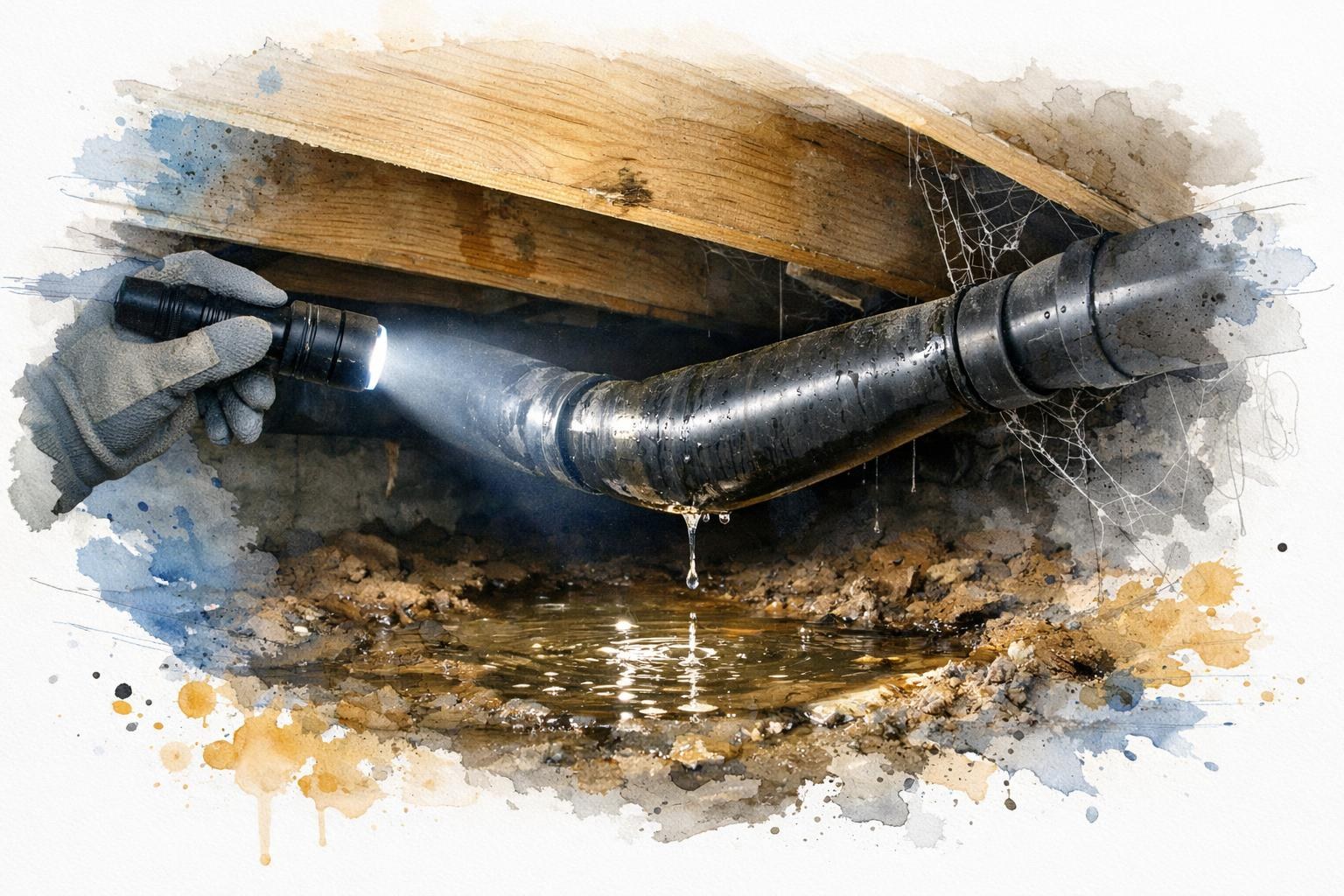
Most bad plumbing work hides in three places you can reach: under the sink, behind the toilet, and in the crawl space. Grab a flashlight and go look before anyone tells you what to think.
Under the sink, check for:
- A dissimilar metal joint, copper screwed straight into galvanized steel with no dielectric transition fitting. You will see white or green crust building at the threads
- Shutoff valves that are frozen, weeping at the stem, or simply not there. Older Santa Cruz County homes often have none at the fixture at all
- A cabinet base that is soft at the back corners, which means it has been wet on and off for a long time
Behind and under the toilet, look for:
- Any rocking at all when you shift your weight on the seat. A bowl that moves has a seal that is already compromised
- Small flies in the bathroom. I traced a sewer fly problem in one home to a blown wax ring that had been leaking under the tile for a long stretch
- Caulk smeared around the base to hide a seep rather than fix one
In the crawl space, I look at slope and support. Drain lines need a steady fall and hangers at regular intervals. A line that sags between supports holds standing water, and that is why a sink keeps clogging every few months no matter how many times it gets snaked.
Some of this only becomes visible once a cabinet base or a section of wall gets opened. I will say that plainly rather than pretend a flashlight answers everything.
What You See and What It Usually Points To
This is the shortlist I run through on a second opinion call before I touch anything.
| What you notice | What it often points to | Where to look |
|---|---|---|
| Damp or swollen cabinet base | Supply connection that was never checked under pressure | Back corners under the sink, at the valve bodies |
| Small flies or a faint sewage smell | Failed wax ring or an out of level flange | Base of the toilet and the subfloor around it |
| Sink clogs again every few months | Drain line with wrong slope or missing supports | Crawl space directly below the fixture |
| White or green crust at a joint | Dissimilar metals joined without a transition fitting | Water heater connections, under sink, crawl space |
| Shutoff valve will not turn | Valve seized or left in place during the last repair | Behind each toilet, under every sink |
| Running water sound with nothing on | Hidden leak in a wall or under the slab | Listen at quiet hours, then check the meter |
Photos are what separate a second opinion from a sales pitch
Anyone can tell you the last guy did it wrong. A photo of your actual joint, under your actual house, is something different. You can hand that to a third plumber and get another read on it.
That is the test I would apply as a homeowner. One of our customers put it this way in a review: “There was no hard sell, just pointing out the issues and giving a good explanation.” He had called about a clogged sink and learned during that same visit that earlier repairs by other plumbers had been done incorrectly, including one serious enough to damage the house over time.
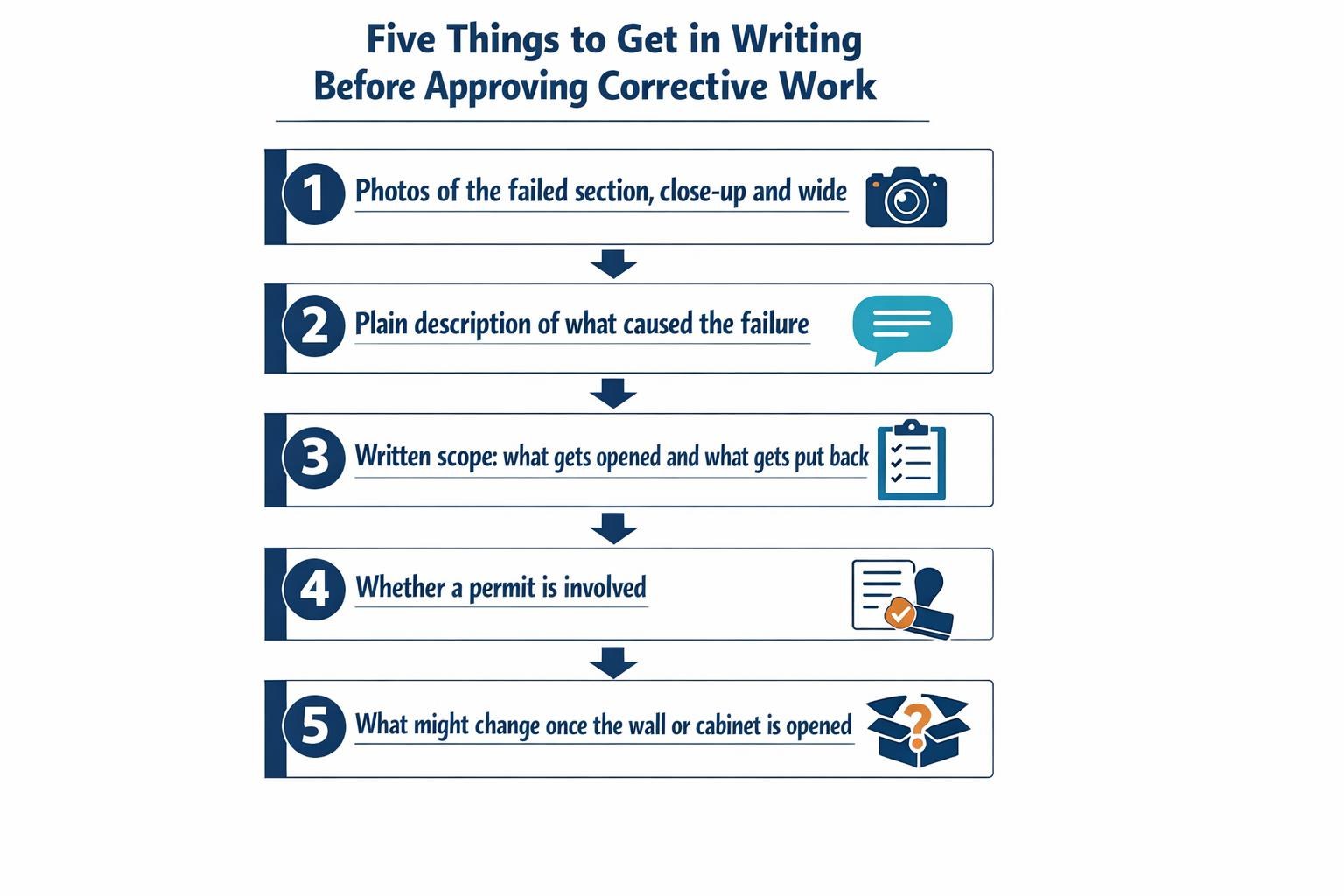
Before any corrective work starts, ask for these in writing:
- Photos of the failed section, close enough to see the fitting and wide enough to show where it sits
- A plain description of what caused the failure, not just what is wet
- The scope, written out, including what gets opened and what gets put back
- Whether a permit is involved
- What might change once the wall or cabinet is opened
Asking a licensed contractor for photos is a normal request. We send them with the written details even when nobody asks, and if you are trying to decide whether a visit is even needed, a plumber can sometimes narrow things down from photos you take yourself.
Five Things to Get in Writing First
Here is the short checklist I would run through before approving corrective work on someone else’s repair.
Bad workmanship and worn out plumbing are two different conversations
This part matters more than anything else in the article. A correct repair on a failing line can still leak later for reasons that have nothing to do with the plumber who did it.
So an honest evaluation should tell you which situation you are in before anyone talks about scope.
Signs the system itself is at the end of its service life:
- Galvanized steel supply lines, common in older housing stock across Santa Cruz and Monterey County. These scale shut from the inside and fail at the threads
- Leaks showing up at several different spots over a short window, not the same spot twice
- Heavy scale at water heater connections and fixture stops, which hard water throughout Santa Cruz County builds up steadily
- Pinhole leaks in copper appearing in more than one run
Signs the repair was the problem:
- The failure is at the exact fitting that was worked on
- The connection method is wrong for the materials involved
- Nothing was supported, sloped, or valved the way it needed to be
One Santa Cruz County homeowner reached out after a galvanized pipe under a poured slab burst and left the whole house with the water shut off. That was not a workmanship question. That was a pipe that had been counting down for decades, and slab leaks give their own set of warning signs before they reach that point.
What happens when old work has to be opened up
This is the part people quietly dread, so I will be direct about it. Opening someone else’s repair sometimes changes the picture.
A wet fitting can turn out to be a wet fitting plus a section of pipe that has been sitting in moisture, or a subfloor that needs attention before anything gets reconnected. A contractor should stop and tell you that before continuing, not after.
Two other things to expect:
- Current code applies, not the code from back then. The 2025 California Building Standards Code, Title 24, which includes Part 5, the California Plumbing Code, took effect January 1, 2026. Corrective work gets held to that standard even if the original repair predates it
- Some of it may need a permit through your local building department, depending on the jurisdiction and the scope. Here is more on which plumbing jobs in Santa Cruz County need a permit
And while you are sorting this out, it takes about two minutes to confirm a contractor’s CSLB license is active. Worth doing for anyone you are considering, including the plumber who did the original work.
Frequently Asked Questions About Failed Plumbing Repairs
How long after a repair can it still be the plumber’s fault?
There is no clean cutoff. A joint that was assembled wrong can hold for a year or more before it weeps, and a sagging drain line may take two or three years to start clogging on a cycle. What matters is whether the failure is at the spot that was worked on and whether the method used was correct for those materials.
Should I call the original plumber back first?
If they are licensed, responsive, and the work is recent, giving them a chance to look at it is reasonable. If they will not come back, cannot explain what happened, or you have already been through this cycle once, an independent look makes more sense.
Will a second opinion tell me whether I need a repipe?
It should at least tell you whether you are dealing with one bad connection or a whole system that is wearing out. Those get very different answers. An evaluation looks at pipe material, where the leaks have appeared, and the condition of the runs we can access before anyone talks about scope.
What does a second opinion visit actually cost?
I will not throw a number at you, because what a visit involves depends on access, what needs to be opened, and how much diagnostic work is required. Call (831) 515-9903 and we can talk through your situation directly.
Is a leaking repair ever an emergency?
If water is actively running and you cannot shut it off at the fixture, yes. Shut off the main if you can reach it. Emergency service is available 24 hours a day, 7 days a week across Santa Cruz and Monterey County, and a gas odor is always a leave-the-building-first situation before you call from outside.
Wondering whether the last repair was done right?
If a fix you already paid for is leaking again, a second look should leave you with photos, a plain explanation, and a clear sense of whether you are dealing with bad work or an aging system. We handle second opinions and corrective work throughout Santa Cruz County and Monterey County as a licensed and insured contractor under CSLB #1102966. Maverick Plumbing is reachable at (831) 515-9903 or through maverickplumbingtechnicians.com, with emergency service available around the clock.
