Direct Answer: A drain that keeps backing up usually has a deeper problem — partial blockage, pipe damage, or root intrusion — that a basic snake doesn’t fully clear. The clog comes back because the cause was never removed.
You’ve had the same drain snaked twice in six months. Maybe three times. It clears for a few weeks, then the water starts pooling again and you’re back where you started. That’s not bad luck — that’s a sign the real problem hasn’t been found yet.
In Monterey County, this comes up constantly in older homes throughout Watsonville and Santa Cruz. Pipes from the 1960s and 1970s, decades of hard water buildup, and root systems from mature trees all create conditions where surface-level drain clearing doesn’t hold.
This article explains why recurring drain backups happen, what distinguishes a simple clog from something more serious, and when to stop trying to clear it and start figuring out what’s actually wrong.
There’s a Difference Between Clearing a Clog and Fixing One
A standard drain snake — the kind a plumber runs in about 20 minutes — breaks up or pulls out whatever is sitting in the drain. It’s effective for a fresh blockage caused by hair, grease, or debris. But it has real limits.
If the clog came back, one of a few things is happening:
- The blockage wasn’t fully removed — the snake punched a hole through it, water started flowing again, and the remaining material eventually closed back in
- There’s buildup on the pipe walls — years of grease, soap scum, or mineral deposits from hard water have narrowed the pipe, and clearing the immediate jam doesn’t address the coating
- Something structural is wrong — a crack, offset joint, or crushed section of pipe is collecting debris because the line no longer drains at the right slope
- Tree roots have grown into the line — roots find even hairline cracks and grow toward moisture; once they’re established, they catch everything that passes by
The difference between a slow drain and a drain that actually needs repair comes down to what’s causing the restriction — and a snake only tells you that water is moving again, not why it stopped.
If your drain backs up more than once a year, a licensed plumber should look further than the drain opening.
What a Camera Inspection Actually Shows
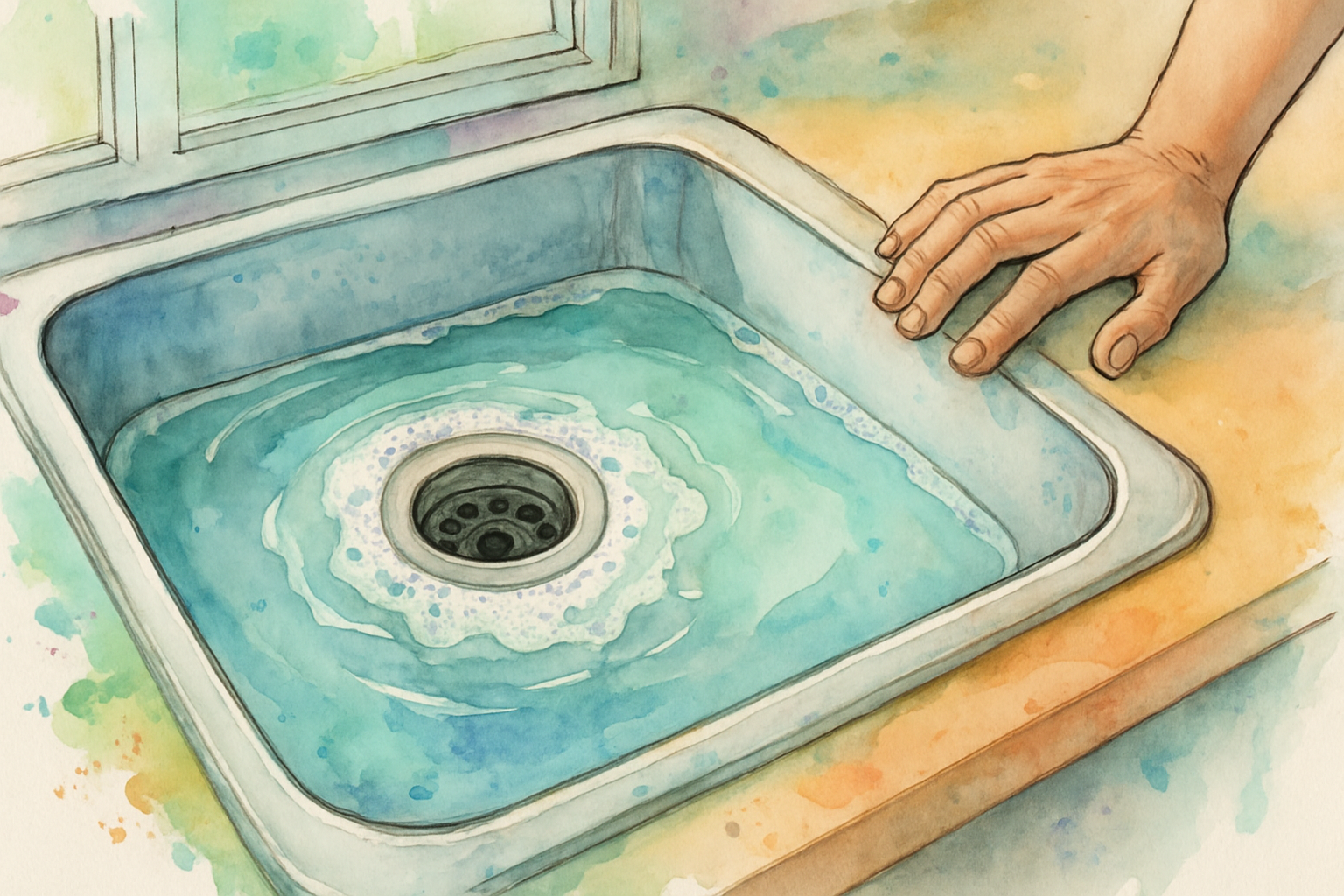
The most useful tool for a recurring drain problem isn’t a snake — it’s a camera. A sewer camera inspection runs a flexible line with a high-resolution camera head through your drain system so a plumber can see the pipe from the inside.
This takes the guessing out of it. Instead of assuming the line cleared, you can see whether it did. More importantly, you can see why it didn’t.
Common findings on repeat-backup calls in Watsonville and across Santa Cruz County:
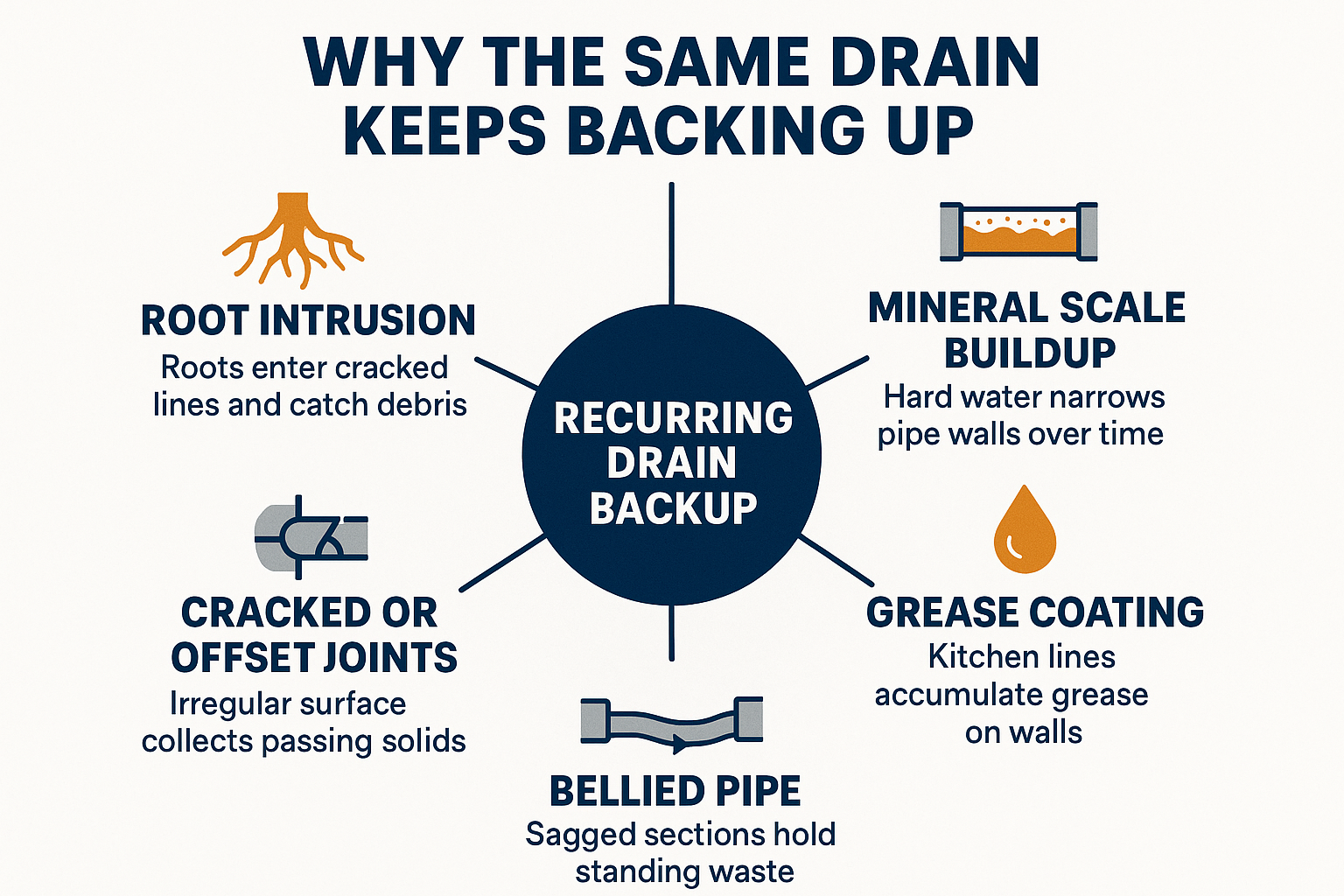
- Root intrusion — roots entering through cracked or offset pipe joints, often in older clay or cast iron lines
- Scale and mineral buildup — hard water throughout Monterey County deposits calcium and minerals over time, which narrows the effective diameter of the pipe
- Grease accumulation in kitchen drain lines — cooking grease coats pipe walls and traps everything else that passes through
- Bellied pipe — a section of the line has sagged, creating a low spot where solids settle and accumulate instead of washing through
- Cracked or offset joints — older pipe materials develop fractures or shift at joints; water can still pass through but the irregular surface catches debris
A camera inspection doesn’t take long — typically under an hour for a residential main line — and it answers the question you actually need answered: what is the pipe doing, and where?
Without that information, you’re clearing the same drain until something forces the real repair anyway.
The Most Common Reasons a Drain Keeps Backing Up
This infographic breaks down the five main causes of recurring drain backups and what each one typically requires to actually fix.
When Repeated Backups Point to the Main Sewer Line
One slow drain in one bathroom is usually a localized problem. But if you’re seeing multiple drains backing up at once, gurgling sounds in the toilet when you run the sink, or sewage smell coming from floor drains — that’s a different situation entirely.
Those patterns point toward the main sewer line, not an individual drain branch. The main line carries all wastewater from every fixture in your home out to the city sewer or your septic system. When it’s partially blocked or damaged, the symptoms show up everywhere.
This matters in Watsonville specifically because a significant number of homes in the older residential areas near downtown and along the east side still have original clay sewer lines from the mid-20th century. Clay pipe doesn’t last forever, and it’s particularly vulnerable to root intrusion and soil movement.
If you’re seeing a pattern across more than one fixture, the problem isn’t the drain — it’s the line connecting all of them. A mainline sewer camera inspection will show exactly where the obstruction or damage is before any repair decision gets made.
Some main line problems can be cleared with hydro jetting — a high-pressure water process that removes buildup and cuts through root intrusion more thoroughly than a standard cable machine. Others require a sewer line repair or section replacement. The camera tells you which one applies.
Recurring Drain Problem: What It Looks Like vs. What It Usually Means
These patterns show up on repeat service calls throughout Santa Cruz County. Matching your symptoms to the underlying cause helps you understand what kind of evaluation is actually needed.
| What You’re Seeing | Likely Location | What Usually Fixes It |
|---|---|---|
| One drain backs up repeatedly | Branch drain line | Camera inspection + hydro jet or targeted repair |
| Multiple drains slow at the same time | Main sewer line | Main line camera + hydro jet or line repair |
| Gurgling toilet when sink runs | Main line or vent | Camera inspection to confirm location |
| Drain clears then backs up within weeks | Partial clog or buildup | Full hydro jet cleaning, not just snaking |
| Sewage smell from floor drains | Main line blockage or dry trap | Camera inspection + main line clearing |
| Roots confirmed on prior service call | Pipe joint cracks | Root cutting + camera to assess pipe condition |
The Hard Water Factor in Monterey County Homes
Hard water is a real variable in this region. Water throughout Santa Cruz County and Monterey County carries a high mineral content — calcium and magnesium primarily — and over years of use, those minerals deposit on the inside walls of your drain pipes.
In supply lines and water heaters, hard water scale causes its own problems. But in drain lines, the deposits act like a rough surface that traps grease, soap residue, and organic material. A pipe that was once 4 inches wide can restrict down significantly over time.
This is especially common in kitchen drain lines and bathroom sink drains in homes that have been in place for 20 or more years without any significant drain maintenance. The buildup doesn’t show up on the outside of the pipes — you’d never know it was happening until the drain starts slowing.
Hydro jetting addresses this directly. The high-pressure water scours the pipe walls rather than just punching through the center of the blockage. In a home with known hard water history and recurring drain problems, a hydro jet cleaning often holds significantly longer than repeated cable snaking — because the surface the debris was sticking to gets removed, not just the debris itself.
Frequently Asked Questions About Recurring Drain Backups
Is it okay to just keep having the drain snaked every few months?
It’ll keep working temporarily, but you’re paying to manage the symptom rather than fix the problem. At some point the underlying issue — pipe damage, roots, buildup — either gets worse or causes a backup that’s more disruptive than a slow drain. A camera inspection after the second or third repeat call is usually the smarter move.
Can chemical drain cleaners fix a recurring clog?
No. Store-bought drain chemicals might dissolve organic material in the immediate drain opening, but they don’t reach deep blockages, they don’t remove mineral scale, and they don’t address structural pipe problems. Some can also damage older pipes with extended use. They’re not a substitute for a professional evaluation.
How do I know if the problem is in my line or the city sewer line?
A sewer camera inspection can trace the blockage to a specific location and depth. If the problem is past your property’s connection point — which is typically at the property line or the city cleanout — the city’s maintenance crew handles that section. A licensed plumber can help you identify where your responsibility ends and document what the camera found if you need to report it to the city.
Do tree roots always mean I need to replace the pipe?
Not necessarily. If roots are present but the pipe itself is structurally intact — meaning no significant cracks, no offset joints, no collapse — hydro jetting can clear the roots and buy significant time. But if the pipe is cracked or deteriorating, roots will return quickly because the entry point is still open. The camera shows the condition of the pipe so you know which situation you’re dealing with.
What’s the difference between a drain cleaning and hydro jetting?
A standard drain cleaning uses a cable machine with a cutting head to break up or pull out blockages. Hydro jetting uses pressurized water — sometimes over 3,000 PSI — to scour the pipe walls and flush everything downstream. Hydro jetting is more thorough, which is why it’s often recommended when a drain has been cleaned multiple times and the clog keeps returning. It’s also what’s typically used for grease-heavy kitchen lines and root intrusion.
When does a recurring drain backup become an emergency?
When wastewater starts backing up into the home — coming up through floor drains, tub drains, or toilets — that’s no longer a slow drain problem. Raw sewage in your living space is a health issue and needs same-day attention. You can read more about when a plumbing problem crosses into emergency territory to understand where that line is.
What to Tell a Plumber When You Call About a Repeat Drain Problem
The more specific you can be, the faster the diagnosis. When you call about a drain that keeps backing up, a few details help right away:
- How often it backs up — weekly, monthly, or a few times a year changes what the plumber expects to find
- Which drains are affected — one fixture or multiple fixtures tells you something about location before any inspection starts
- What was done last time — if it was snaked, how long it held matters; if a camera was run, what did it show
- Age of the home — homes built before 1980 in Watsonville and Santa Cruz often have original clay or cast iron drain lines that behave differently than modern PVC
- Any recent changes — new trees planted near the foundation, recent landscaping, or a change in what’s going in the drain can all be relevant
This isn’t about being overly prepared — it just cuts down the time spent figuring out what’s already been tried. Understanding whether you’re dealing with an urgent problem or something that can wait also helps you decide how quickly to schedule service.
Ready to Find Out What’s Actually Causing the Backup?
If you’re in Watsonville, Santa Cruz, or anywhere in Monterey County and the same drain keeps giving you problems, Maverick Plumbing Technicians, Inc. can run a camera inspection and tell you exactly what’s going on before recommending any repair. We’re a licensed and insured plumbing contractor (CSLB #1102966) with 24/7 emergency service available. Call us at (831) 515-9903 or reach out through maverickplumbingtechnicians.com to schedule a service call.
