

Direct Answer: Call after hours when water is actively damaging your home, sewage is backing up, or you smell gas. Those three situations cannot wait until morning.
It’s 11 PM on a Tuesday and water is dripping through your ceiling. Or your toilet just backed up — and the backup is coming up through the shower drain too. You know something is wrong, but you’re not sure if it’s a right-now problem or a call-in-the-morning problem.
That question matters more than most people realize. Calling too late on a real emergency can mean structural damage, sewage contamination, or a gas hazard that gets worse by the hour. Waiting unnecessarily on something that could hold until 8 AM just costs you more money.
This guide is for homeowners in Watsonville, Santa Cruz, and the broader Monterey County area who want a clear answer: what actually qualifies as an after-hours plumbing emergency, and what can reasonably wait.
The Three Categories That Almost Always Require an After-Hours Call
Most plumbing problems fall into one of two buckets: actively getting worse right now, or stable and manageable until business hours. The hard part is knowing which is which at midnight when you’re stressed.
These three situations are almost never safe to wait on:
- Active water damage — Water running where it shouldn’t be, soaking walls, floors, or ceilings. The longer water sits, the more it spreads. Subfloor damage and mold can start within 24 to 48 hours of sustained exposure.
- Sewage backup into the home — If sewage is coming up through floor drains, tubs, or toilets, your main sewer line is blocked. This is a health hazard, not just a nuisance. It needs same-night attention.
- Gas odor — If you smell gas, leave the building immediately. Do not flip light switches, do not use your phone inside, do not open the garage door with the electric opener. Get outside and call from there. Gas leak response is available 24 hours a day, 7 days a week.
If any of these three are happening in your Watsonville or Santa Cruz home right now, stop reading and make the call. The information below is for situations where you’re trying to decide — not for situations where the answer is already obvious.
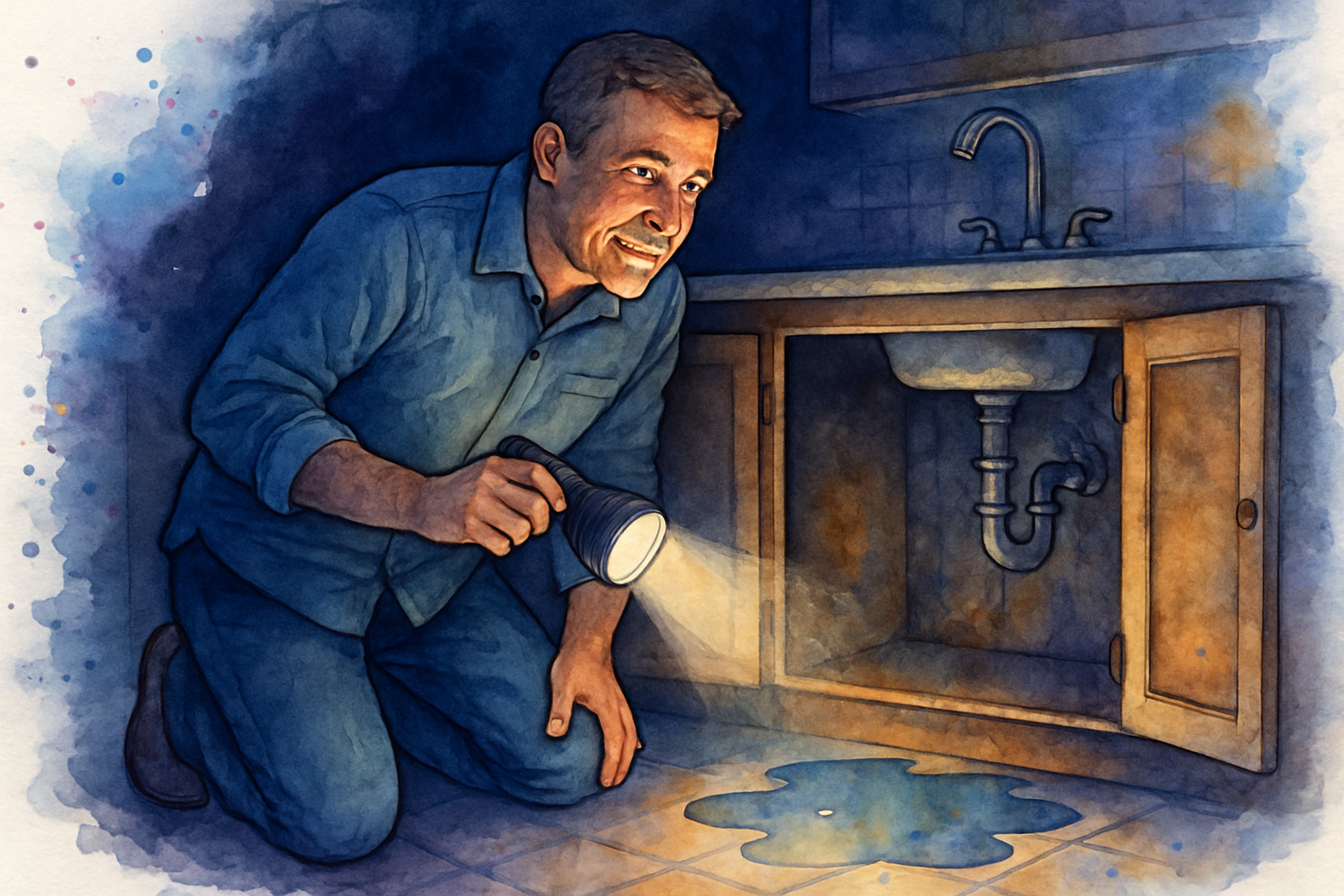
Situations That Feel Urgent but Can Usually Wait Until Morning
Some plumbing problems are genuinely frustrating — a running toilet, a slow drain, a faucet that won’t fully shut off — but they don’t pose immediate risk to your home or your health.
These are situations where waiting until morning is usually the right call:
- A single slow or clogged drain — One slow drain in one sink is almost never an emergency. If it’s isolated, it can wait. If you’re seeing the same drain keep backing up, that’s a different conversation.
- No hot water — Uncomfortable, yes. An emergency, no. Unless the water heater is actively leaking onto the floor, this is a morning call.
- A dripping faucet or running toilet — Wasteful over time, but not a crisis overnight.
- Low water pressure — Worth investigating, but rarely an immediate hazard.
The key question is: is this getting worse right now, or is it stable? A dripping faucet at 10 PM will still be a dripping faucet at 8 AM. A pipe that’s actively spraying water inside a wall will not.
For a more detailed breakdown of how to read the difference, this breakdown of urgent vs. wait-until-morning plumbing problems walks through the logic clearly.
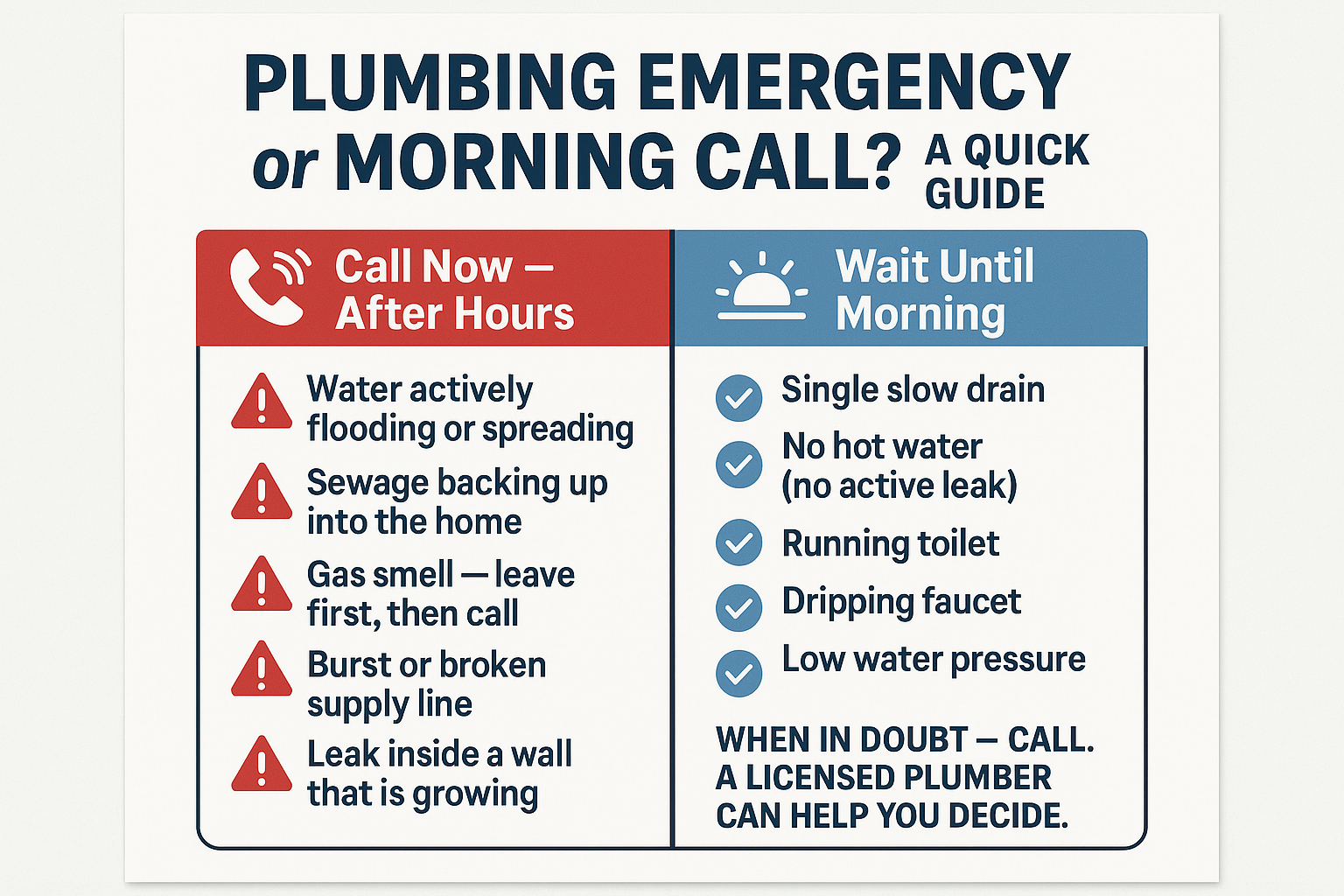
Quick Reference: Emergency vs. Morning Call
Use this as a fast gut-check when you’re unsure whether your situation needs an after-hours plumber or can wait until the next business day.
What to Do While You Wait for the Plumber
If you’ve determined it’s an emergency and you’ve made the call, there are things you can do right now to reduce damage while the plumber is on the way.
Shut off the water supply first. If the problem is at a fixture — toilet, sink, washing machine — there’s usually a shut-off valve directly behind or beneath it. Turn it clockwise to close it. If the leak is bigger or you can’t locate the source, go to your main shut-off and cut the water to the whole house.
Most homes in the Watsonville area have the main shut-off either near the water meter at the street, in a utility room, or along the exterior of the home. If you’ve never located yours, find it now — before you need it at midnight.
For sewage backups, stop using all drains and toilets immediately. Every flush or drain you run adds to the backup pressure. If the main line is blocked, water from one fixture often comes up through another — which is one of the clearest signs you’re dealing with a mainline issue rather than a single isolated clog.
For gas odors: do none of the above. Leave the building. Do not run water, do not flip switches, do not try to locate anything. Get outside and call from there.
After-Hours Plumbing Decision Guide
This table covers the most common after-hours scenarios homeowners in Santa Cruz County and Monterey County face — and the recommended action for each.
| Situation | Emergency? | Immediate Action |
|---|---|---|
| Water actively flooding floors or walls | Yes — call now | Shut off main water supply, call immediately |
| Sewage backing up through drains | Yes — call now | Stop all water use, vacate affected area, call |
| Gas smell anywhere in the home | Yes — leave first | Exit building, call from outside, do not re-enter |
| Burst pipe with active spray | Yes — call now | Shut off water at nearest valve, call immediately |
| No hot water, no visible leak | No — morning call | Check water heater for error codes or pilot light |
| Single slow drain, no backup | No — morning call | Avoid using that drain until it can be inspected |
| Dripping faucet or running toilet | No — morning call | Place a towel or container if dripping, call in the AM |
| Leak under slab suspected | Depends on severity | If water use is spiking or floors are warm/wet, call now |
The Hidden Risk of Waiting Too Long on a Slow Problem
Not every emergency announces itself. Some of the most damaging plumbing failures in homes across Santa Cruz County start as something small that gets ignored.
A slab leak is a good example. The signs are easy to dismiss — slightly warm floors, a small wet spot near a baseboard, a water bill that’s crept up $30 over the past two months. None of those things feel like an emergency. But a slab leak left undetected long enough can erode soil beneath the foundation, crack concrete, and cause structural movement in the home. What happens to a home when a slab leak goes undetected is one of the more serious outcomes in residential plumbing — and it’s almost always more expensive to fix the longer it runs.
The same logic applies to sewer line problems. A drain that backs up once, clears with a plunger, and then backs up again two weeks later isn’t a random event. That’s a pattern. And understanding when a plumbing problem becomes an emergency often comes down to recognizing that pattern before the situation forces your hand.
The point isn’t to create anxiety about every slow drain. The point is that plumbing problems rarely get better on their own — they stabilize or they worsen. Knowing which is happening is worth a phone call.
Frequently Asked Questions About After-Hours Plumbing Service
How do I know if my plumbing problem is bad enough to call after hours?
Ask yourself one question: is this getting worse right now? If water is actively spreading, sewage is backing up, or you smell gas — call immediately. If the situation is uncomfortable but stable, it can almost certainly wait until morning. When you’re genuinely unsure, calling to describe what you’re seeing is always reasonable. A licensed plumber can help you decide over the phone.
What should I do if I smell gas in my home at night?
Leave immediately. Do not flip any light switches, do not use any electrical devices inside the home, and do not re-enter. Once you’re outside and away from the building, call for emergency service. Gas leak response is available 24 hours a day, 7 days a week. This is the one plumbing situation where the answer is always the same: get out first.
Can I shut off my water myself while I wait for the plumber?
Yes, and you should if water is actively flowing where it shouldn’t be. Every fixture has its own shut-off valve — usually underneath sinks or behind toilets. The main shut-off cuts water to the entire house. Closing the supply stops the damage from growing while you wait. Just don’t attempt any pipe repairs yourself while the system is pressurized.
What if I’m not sure whether the problem is a slab leak?
Slab leaks are hard to confirm without equipment, but some signs point clearly in that direction: unexplained warm spots on the floor, the sound of running water when everything is off, or a water meter that keeps moving after all fixtures are closed. If you’re noticing those things, it’s worth a call. Knowing whether a leak is under your foundation starts with professional leak detection — not guesswork.
Does Maverick Plumbing actually answer after-hours calls, or does it go to voicemail?
24/7 emergency service is available. For genuine emergencies — active flooding, sewage backup, gas odors — calling (831) 515-9903 connects you to real service, not a recording.
My toilet backed up into the tub — is that an emergency?
Yes. When sewage comes up through a secondary fixture like a tub or floor drain, that means the main sewer line is blocked — not just one toilet. Stop using all drains and toilets in the home immediately. This is a mainline issue and it won’t resolve on its own. Call for after-hours service.
Not Sure If It Can Wait? Make the Call.
Maverick Plumbing Technicians, Inc. serves homeowners and property managers throughout Watsonville, Santa Cruz, and Monterey County — with licensed, insured emergency plumbing available around the clock. If you’re looking at something and you’re not sure, call (831) 515-9903 and describe what you’re seeing. You can also request service at maverickplumbingtechnicians.com. A quick conversation with a licensed plumber is always better than spending the night wondering.
