Direct Answer: Intermittent hot water, error codes, and cold bursts mid-shower are common tankless water heater problems — but each symptom can point to several different causes, some fixable and some not.
I get calls about this more than almost anything else in the water heater category. A homeowner has had a tankless unit for eight or ten years — it’s worked great — and then things start going sideways. Inconsistent hot water. The shower runs warm for two minutes and then goes cold. Or the unit fires an error code that means nothing without a manual. They want to know: is this fixable, or are they looking at a new unit?
That question is genuinely harder to answer for a tankless system than it is for a traditional tank heater. With a tank, the decision tree is pretty short — how long should a water heater actually last and whether it’s failing structurally usually tells you what you need to know. Tankless systems are different. They have more moving parts, longer expected lifespans, and failure modes that can mimic each other in ways that aren’t obvious from the outside.
If you’re dealing with a tankless heater that isn’t performing the way it used to, here’s what I’d want you to understand before you call anyone — including us.
What ‘Intermittent Hot Water’ Actually Means on a Tankless System
When a traditional tank heater starts delivering lukewarm water, the diagnosis is usually straightforward. A tankless unit going intermittent is a different story — that single symptom can come from at least four or five different places.
Here’s what I look at first when a customer describes uneven hot water or cold bursts mid-shower:
- Dirty inlet filter — Tankless units have a small screen filter on the cold water inlet. When it gets clogged with sediment, the unit reads low flow and either shuts off or reduces output. This is one of the most common causes I see, and it’s one of the least obvious to homeowners.
- Failing igniter or flame sensor — If the burner isn’t lighting consistently, you’ll get hot water some of the time and cold water when the ignition misses. The unit may not throw a code every time this happens.
- Scale buildup on the heat exchanger — This is the one that Santa Cruz County homeowners deal with most. Our water is hard — the mineral content throughout the county is high enough that without a softener or annual descaling, calcium deposits build up inside the heat exchanger over time. Those deposits act like insulation. The unit has to work harder and harder to hit the target temperature, and eventually it can’t get there reliably.
- Gas supply issue — A partially closed shutoff, a regulator problem, or pressure that’s dropped at the meter can all starve the burner. The unit fires but can’t sustain the BTU output it needs.
The reason I walk through these when someone calls is that they each require a different fix. Cleaning a filter takes minutes. Descaling a heat exchanger takes a few hours. A failing igniter means sourcing a part. A gas supply problem might involve your utility. The symptom looks the same from your shower — but the solutions are not.
Error Codes Are a Starting Point, Not a Diagnosis
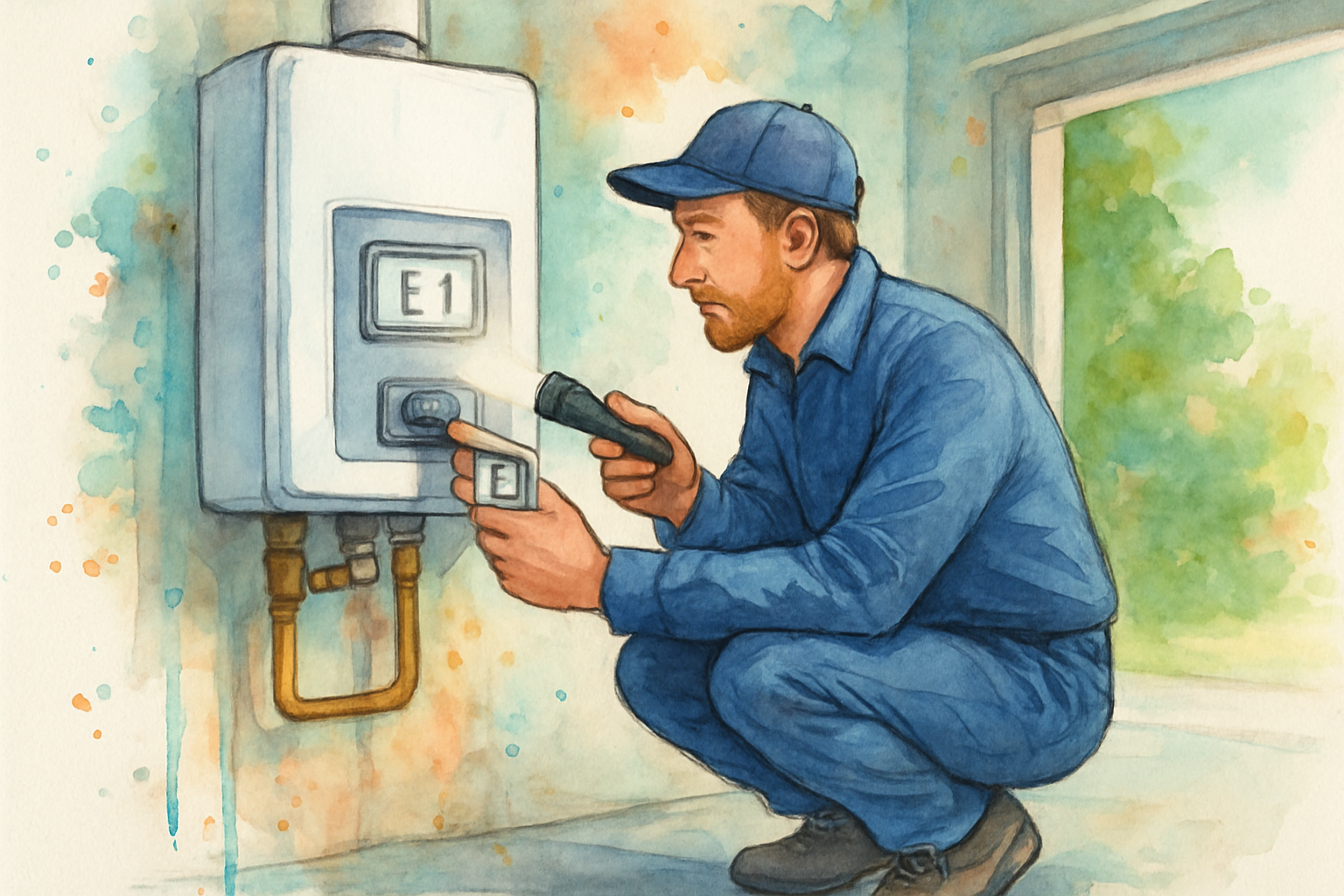
Most modern tankless units — Rinnai, Navien, Noritz, and others — have digital displays that show error codes when something trips the system. Homeowners often read the code, look it up online, and assume that’s the answer.
In my experience, the code tells you where the system detected a problem, not necessarily what caused it. A code for insufficient water flow, for example, could mean a clogged filter, a partially closed valve upstream, or a pressure issue from the street. A combustion error might mean a venting problem, a gas supply issue, or a dirty burner. The code narrows the search — it doesn’t end it.
This matters because I’ve had customers call after replacing a part based on an online forum recommendation, only to find the problem persisted because the code was pointing to a symptom rather than the root cause. For units that are six or seven years old or newer and otherwise in good shape, a proper diagnostic visit is almost always worth doing before any parts get ordered.
For older units — ten years or more, especially if they’ve never been serviced and the heat exchanger hasn’t been descaled — the calculation changes. That’s when the repair-versus-replace question gets serious. The signs that say repair, not replace is worth reading if you’re weighing that decision.
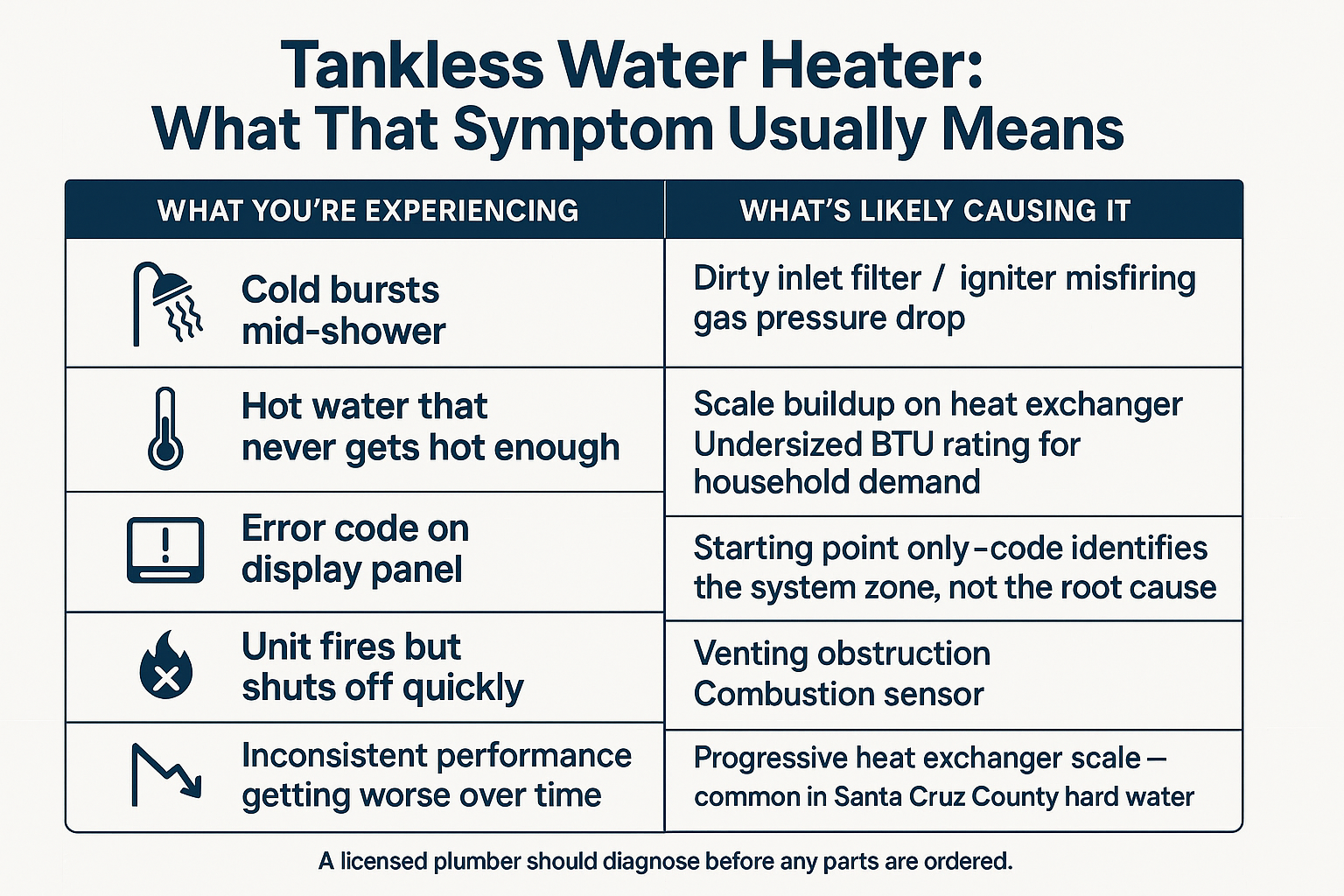
Tankless Water Heater Failure: Symptom vs. Likely Cause
This chart maps the most common symptoms homeowners describe to the most likely causes — and what each one means for your next step.
When Repair Makes Sense — and When It Doesn’t
One caller we spoke with had an older Noritz unit that had been running for over a decade. They’d been dealing with ongoing hot water inconsistencies and were asking whether repair or replacement made more sense. That’s exactly the right question to ask — and the answer depends on a few things I look at together, not in isolation.
Age of the unit. A well-maintained tankless heater can last 15 to 20 years. A unit that’s 12 years old with a history of annual service is in a very different position than a 12-year-old unit that’s never been descaled.
Parts availability. This is something people don’t think about until they’re waiting on a backordered component. Some manufacturers have deep parts networks and fast lead times. Others — especially older or discontinued model lines — can leave you waiting weeks for a heat exchanger or gas valve. When you’re evaluating a repair on an older unit, it’s fair to ask your technician directly about parts availability before you commit to the repair path.
Heat exchanger condition. If the heat exchanger has significant scale damage or is starting to fail structurally, repair economics shift quickly. Heat exchangers are expensive components. On a unit with a limited remaining service life, putting that money toward a replacement with a 15-year heat exchanger warranty from a manufacturer with solid parts supply is a different long-term calculation.
When a caller asks me about specific brands, I try to be straightforward: I don’t push any single manufacturer, but I do think the warranty terms and parts ecosystem matter as much as the upfront unit specs. A higher BTU rating means nothing if parts take six weeks to ship.
And BTU sizing matters more than many homeowners realize. If the original unit was undersized for the household’s actual demand — number of bathrooms, simultaneous fixture use, incoming water temperature — a replacement is an opportunity to right-size, not just swap in kind.
Repair vs. Replace: Key Factors at a Glance
These aren’t hard rules — every unit and household is different — but they’re the factors I weigh when a customer is trying to make this decision.
| Factor | Leans Toward Repair | Leans Toward Replacement |
|---|---|---|
| Unit age | Under 10 years | 12+ years, especially without service history |
| Heat exchanger condition | Minor scale, no structural damage | Heavy scale buildup or physical damage |
| Parts availability | Current model, fast lead times | Discontinued or limited parts supply |
| Service history | Annual descaling performed | Never serviced, hard water exposure |
| Repair scope | Single component (filter, igniter, sensor) | Multiple failing components at once |
| BTU sizing | Unit matched household demand | Household demand has grown since install |
The Permit Reality That Most Homeowners Don’t Know About
California requires a permit for every water heater installation — including a like-for-like tankless replacement. This surprises a lot of people. They assume swapping one unit for the same model is a simple job that doesn’t involve the building department. It does.
A licensed plumbing contractor is responsible for pulling that permit before work starts. The permit triggers an inspection, which confirms the installation meets current code — proper venting, correct gas line sizing, seismic strapping if required.
Skipping the permit creates real problems. It can come up at resale when a buyer’s inspector flags unpermitted work. And it can void your eligibility for rebates — PG&E and other utility programs that offer rebates on high-efficiency tankless units often require a permit as part of the documentation.
When you’re getting quotes for tankless installation or replacement in Watsonville or Santa Cruz, the permit should already be included in what a licensed contractor is proposing. If it’s not mentioned, ask about it directly. A CSLB-licensed contractor — like Maverick Plumbing Technicians, Inc. (CSLB #1102966) — handles permit pulling as part of the job, not as an afterthought.
What the Timeline Actually Looks Like
A lot of callers want to know how fast they can have hot water back. That’s completely understandable — going without it, even for a day, is a real inconvenience. I try to set honest expectations because the two-appointment reality is something a lot of people aren’t prepared for.
Here’s how the process typically unfolds:
- Appointment 1 — Diagnostic visit. A technician comes out to assess the unit, identify the failure, and determine whether repair or replacement is the right path. This visit is required before anything can be scoped or quoted. We don’t recommend a replacement without seeing the unit first.
- Parts sourcing (if repair). If a repair is the right call, parts have to be ordered if they’re not in stock. Lead times vary by manufacturer and component.
- Appointment 2 — Installation or repair. Whether it’s a component repair or a full replacement, this is the second visit. For a replacement, the unit has to be sourced first, which adds time depending on model availability.
I tell customers to plan for a minimum of two to three days from initial call to completed installation in most scenarios — sometimes faster if the repair is straightforward, sometimes longer if a specific unit or part needs to come from a distributor. Planning for that range is more realistic than hoping it all happens in one day.
Frequently Asked Questions About Tankless Water Heater Repair
My tankless heater worked fine for years and now it’s giving me cold water halfway through a shower. What’s happening?
The most common causes I see for this exact symptom are a clogged inlet filter, an igniter that’s misfiring, or scale buildup on the heat exchanger. In Santa Cruz County, hard water scale is the single biggest accelerant — if the unit has never been descaled, that’s usually where I start. A diagnostic visit will tell you which one it is.
How long does a tankless water heater actually last?
A well-maintained unit can run 15 to 20 years. But ‘well-maintained’ means annual descaling, filter cleaning, and servicing — which a lot of homeowners skip. Units in hard water areas that have never been serviced often show significant heat exchanger degradation by year 10 or 11. How long should a water heater actually last covers this in more detail.
Can I fix a tankless water heater myself?
Cleaning the inlet filter yourself is reasonable if you’re comfortable locating it and know how to shut off the water supply first. Beyond that, I’d be cautious. Tankless units involve gas connections, venting, and electronic control boards — any of which can create a safety problem if something goes wrong during a DIY repair. Gas-related work especially should go through a licensed plumber.
Do I really need a permit to replace my tankless water heater?
Yes. California requires a permit for every water heater installation — including replacements. Skipping the permit can affect your home’s value at resale and disqualify you from utility rebates. A licensed contractor pulls the permit as part of the job.
How do I know if my unit is worth repairing or if I should replace it?
Age, parts availability, heat exchanger condition, and service history are the four things I look at together. A unit under 10 years old with a clean service record and a single failing component is usually a good repair candidate. A 13-year-old unit with hard water exposure and no maintenance history is a different story. There’s no universal answer — which is why a diagnostic visit matters before any decision gets made.
What should I ask when getting quotes for a tankless replacement?
Ask whether the permit is included, what the heat exchanger warranty covers and for how long, whether the proposed unit’s BTU rating matches your household’s actual demand, and what the parts availability looks like for that model. Those four questions will tell you more than the sticker price.
Have Questions About Your Tankless Water Heater?
If your tankless unit is acting up and you’re not sure whether you’re dealing with a fixable problem or something more serious, we’re happy to talk it through. We serve Watsonville, Santa Cruz, and the surrounding communities throughout Santa Cruz County. Call us at (831) 515-9903 to describe what you’re seeing — or visit maverickplumbingtechnicians.com to request a diagnostic visit. A conversation costs nothing, and it usually tells you exactly what your next step should be.
