Direct Answer: Grease buildup in kitchen drain lines peaks during high-volume summer service, and a backup mid-shift can force a closure. Pre-season hydro jetting and camera inspection are the practical ways to avoid it.
Tourism spending in Santa Cruz County reached $1.43 billion in 2025. Monterey County hit a record $3.3 billion the same year. For restaurants and food service businesses along the Central Coast, June through August is when the year either gets made or gets derailed, and a drain backup or kitchen line failure in the middle of that window is not a plumbing inconvenience. It is lost covers, a potential health code problem, and in some cases a forced closure on a Saturday night with a full dining room.
I’ve seen this play out more than once. A kitchen that passed inspection in March, running at moderate volume, starts pushing out slower service times in July when tourist traffic doubles. The line was already building. The heat and the volume just finish the job.
This article focuses on two things: why grease accumulation in commercial kitchen drain lines is a fundamentally different problem in summer than it is in winter, and what a practical pre-season evaluation actually looks like for a restaurant or food service operator in Santa Cruz County or Monterey County.
Why Grease Builds Faster in Summer and What That Means for Your Drain Line
Grease does not move through a drain line the way water does. When hot cooking grease enters a drain, it’s liquid. But as it cools inside the pipe, it solidifies and sticks to the pipe wall. Every service shift adds another thin layer.
In a slower winter kitchen, that buildup is gradual. The same kitchen running double the covers from Memorial Day through Labor Day accelerates that process significantly. More food cooked, more grease poured, more byproduct washing through lines that were already carrying a partial load from the previous month.
Temperature also plays a role. On a hot Central Coast summer day, the ambient temperature inside a commercial kitchen can push well above 90 degrees Fahrenheit. The grease that enters the drain is hotter and stays liquid longer, which sounds helpful, but it means it travels further into the line before it cools and deposits. Blockages from summer grease often form deeper in the system, closer to the mainline, where they’re harder to reach with a standard cable machine.
A slow kitchen drain that feels manageable on a Tuesday at 2 p.m. is a different animal during a Friday dinner rush. The signs that distinguish a drain that is slowing down from one that is about to fail completely include:
- Multiple floor drains backing up at the same time, not just one
- Standing water in the three-compartment sink that does not clear within 60 to 90 seconds
- A sulfur or sewage odor coming from floor drains during or after service
- The grease trap requiring service more frequently than its normal schedule
Any of those patterns means the blockage has moved past the trap and into the drain line itself. At that point, a standard cable cleaning may clear enough to get through the night, but it will not solve what’s actually in the pipe. For a deeper look at why recurring clogs come back even after cleaning, this breakdown of drain cleaning methods explains the difference between clearing a symptom and addressing the actual buildup.
What a Pre-Season Commercial Drain Evaluation Actually Involves
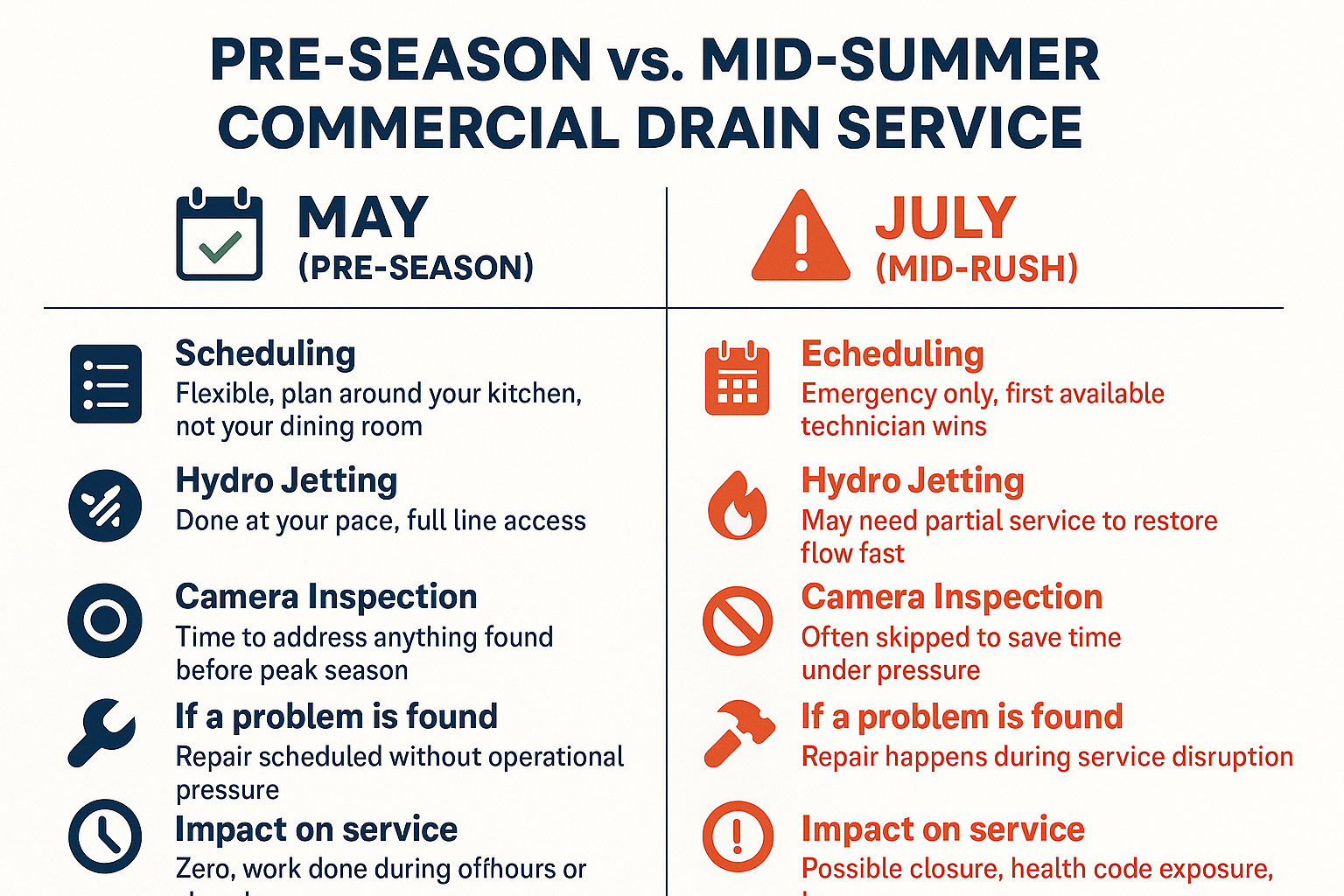
Doing preventive work in May is a completely different conversation than doing it on a Friday afternoon in July when the dining room is full. May gives you time to plan, schedule, and address anything the camera finds. July gives you a crisis.
A practical pre-season evaluation for a restaurant or food service operation covers two things that are not the same job: hydro jetting and a camera inspection. Both matter, and they answer different questions.
Hydro jetting uses high-pressure water, typically at 3,000 to 4,000 PSI, to blast accumulated grease, mineral scale, and debris from the interior pipe walls. Unlike cable snaking, which punches a hole through a clog, hydro jetting actually cleans the pipe wall. After a good hydro jet, the line flows like it did when it was new. For a grease-heavy commercial kitchen line, this is the correct tool.
A sewer camera inspection is different. It shows you what’s in the pipe, but more importantly, it shows you the condition of the pipe itself, cracks, root intrusion, joint offsets, and sections where the pipe belly has settled and water pools. A kitchen line that jets clean but has a belly in it will re-accumulate grease in that low spot within weeks. The camera tells you that before you’re standing in it.
For the City of Santa Cruz specifically, property owners and managers overseeing commercial buildings or multi-unit residential properties should know that private sewer collection systems are required to be inspected every 10 years and cleaned every 2 to 5 years depending on pipe diameter, per local ordinance. This is not a lecture, it’s practical context. If you manage a mixed-use building in Santa Cruz and cannot recall the last time the mainline was documented, that’s the first question worth asking your plumber. What a sewer camera actually shows is a good read if you’ve never had one done and want to know what you’re actually looking at.
The California Restaurant Association notes that health inspections can be triggered by any reported backup or sanitation issue, which is one more reason to treat drain maintenance as a compliance item, not just a facilities task.
Pre-Season vs. Mid-Summer: What Changes When You Wait
This comparison shows why the timing of commercial drain maintenance matters as much as the service itself.
What to Verify Before You Need Emergency Commercial Plumbing
One thing I’ve learned working commercial calls is that businesses are often surprised when they discover that not every residential plumber has the capacity to respond same-day to a commercial kitchen drain emergency. These are different jobs. Commercial drain lines are larger, the access points are different, and the volume of material in the line after months of kitchen service requires proper equipment, not just a residential cable machine.
We had a situation this past June where a medical office in Salinas called with an urgent suction-line blockage on an evening call. They needed same-day service to avoid shutting down the next morning. We could not respond until several days out, and they had to find someone else. That kind of gap is not unique to medical offices. A restaurant in Santa Cruz, a retail space in Capitola, or a food service operation in Watsonville can run into the same wall if they’re calling a plumber for the first time during a crisis.
Before summer hits, commercial operators are better off confirming a few things in advance:
- Does the plumber handle commercial work specifically, or primarily residential?
- Do they have hydro jetting equipment available for grease-heavy lines?
- What is their actual response window for commercial emergencies, same day, next day, or several days out?
- Are they licensed (CSLB license number verifiable at cslb.ca.gov) and insured for commercial work?
- Do they provide documentation after service, which some landlords and property managers require?
Those questions sound simple, but the answers eliminate most of the wrong choices before you’re already in a backup situation on a July weekend.
For a practical reference on how to think through a plumbing emergency before you’re in one, this checklist is a useful starting point.
Hydro Jetting vs. Cable Snaking for Commercial Kitchen Lines
These two drain cleaning methods are not interchangeable for a grease-heavy commercial kitchen line. Here’s how they compare.
| Factor | Cable Snaking | Hydro Jetting |
|---|---|---|
| What it does | Punches a hole through the blockage | Removes buildup from the full pipe wall |
| Best for | Minor residential clogs, fast temporary relief | Commercial grease lines, recurring buildup |
| Grease removal | Partial, clears the path, leaves wall deposits | Complete, flushes the interior surface |
| Reach into mainline | Limited by cable length and diameter | Effective deeper into the system |
| How long results last | Weeks to a few months in a busy kitchen | Longer, especially on a clean pipe wall |
| Camera inspection included | Rarely | Often paired for full diagnostic picture |
The Drain That Looks Fine Is the One to Watch
Here’s the pattern I see most often in commercial kitchens: the drain that causes the emergency is not the one that showed any obvious warning signs. It was draining fine, just a little slower than usual. Staff mentioned it a couple of times, but it never fully backed up, so nobody called anyone.
That slow drain is telling you something. In a kitchen line carrying regular grease load, slow is a leading indicator, not a steady state. The buildup that causes a slow drain in May is the same buildup that causes a full backup in August, just further along.
For operators who manage multiple locations or large mixed-use properties, the one slow drain vs. every drain backing up article explains why the number of affected drains tells you something specific about where the problem lives, whether it’s a branch line serving one fixture group or the mainline serving the building.
Frequently Asked Questions About Commercial Drain Maintenance on the Central Coast
How often should a commercial restaurant kitchen have its drain lines hydro jetted?
It depends on volume, but most high-volume kitchens in Santa Cruz County benefit from hydro jetting at least once a year, with busier operations going twice a year, once before summer and once before the holiday season. If your kitchen runs five days a week at full capacity, the grease load on that line is significant. A licensed plumber can assess the frequency based on what the camera shows after the first cleaning.
Can we keep operating while the drain lines are being cleaned?
Usually, yes, if the work is scheduled during off-hours, before service starts, or on a closed day. That’s one more reason to do this in May rather than July. Mid-summer emergency service often means working around a live kitchen, which limits what can be done and how thoroughly.
What’s the difference between a grease trap cleaning and hydro jetting the drain line?
A grease trap cleaning removes accumulated FOG (fats, oils, and grease) from the interceptor unit itself. That’s a separate service from cleaning the drain lines that run from your kitchen fixtures to the mainline. Both matter. The trap captures grease before it enters the drain system, but over time grease still gets past the trap and deposits inside the lines. Hydro jetting addresses the lines; grease trap service addresses the interceptor. They’re not the same job.
We’re a property manager overseeing commercial tenants in Santa Cruz. Are we responsible for sewer line maintenance?
In most cases, yes. The property owner or manager is responsible for the private sewer lateral that connects the building to the public main. The City of Santa Cruz has specific inspection and cleaning requirements for private sewer collection systems, inspections every 10 years and cleaning every 2 to 5 years depending on pipe size. If your tenants include food service businesses, the grease load on those lines is higher than a standard commercial or residential building. Staying ahead of that schedule is a lot easier than responding to a backup that affects multiple tenants.
If a drain backs up during dinner service, what should we do first?
Stop putting water down that line immediately, stop dishwashing, stop sink use in the affected area. Call a licensed commercial plumber with 24/7 emergency availability and confirm they have hydro jetting equipment on hand, not just a cable machine. Depending on your local health authority’s rules, a backup that affects food prep areas may require you to notify the inspector. Document the incident and the response.
Schedule a Pre-Season Commercial Drain Evaluation
If you operate a restaurant, food service business, or commercial property in Santa Cruz County or Monterey County, the time to look at your drain lines is before the summer rush, not during it. We at Maverick Plumbing Technicians, Inc. are a licensed and insured plumbing contractor (CSLB #1102966) with 24/7 emergency service available for commercial clients throughout the region. To schedule a pre-season commercial drain evaluation or talk through what your property needs, call us at (831) 515-9903 or request service at maverickplumbingtechnicians.com.
