
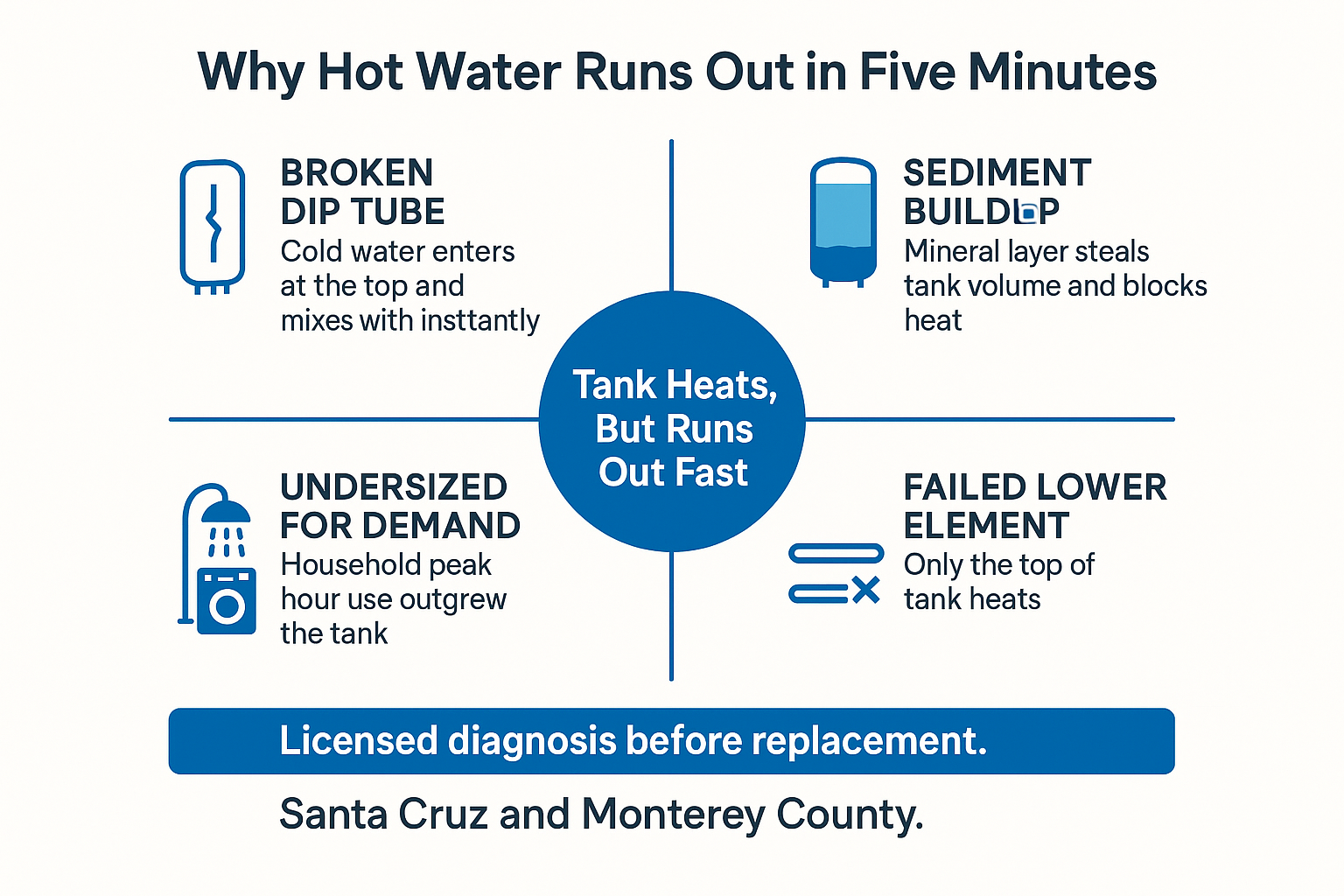
Direct Answer: If a newer tank still makes hot water but runs out in minutes, the usual causes are a broken dip tube, sediment buildup from hard water, a failed lower heating element, or an undersized tank.
A homeowner called me and put it about as plainly as anyone has: “It’s only been a year and a half and the hot water only lasts five minutes.” The unit was still heating. It just could not keep up long enough for one shower.
That is a very different problem from waking up to a cold shower and no hot water at all. A heater that runs but underdelivers is telling you something specific about capacity, sediment, or a failed part inside the tank.
I work on these all over Santa Cruz County and up through Monterey County, and the diagnosis path is not the same as a dead heater. Here is what I actually look for, and what you can check yourself before anyone comes out.
Running Out Fast Is Not the Same as No Hot Water
When a heater produces nothing, the list of suspects is short. A pilot is out, a gas valve failed, a breaker tripped, or the thermostat is dead. If that is your situation, start with figuring out why there is no hot water at all instead.
But when the water starts hot and turns cold in five or six minutes, the burner or element is doing part of its job. Something is either shrinking the usable hot water inside the tank or mixing it cold before it reaches the shower.
That difference matters because it changes what gets inspected:
- No hot water at all points to ignition, power, or control failure
- Short hot water window points to dip tube, sediment, element, or sizing
- Lukewarm from the first second often points to a mixing valve or a crossover between hot and cold lines
I have opened plenty of three-year-old tanks in Watsonville that had a real mechanical problem inside. Age alone does not rule anything out here.
The Three Mechanical Causes I Find Most Often
1. A broken or deteriorated dip tube. Cold water enters the tank through a long plastic tube that carries it to the bottom, where the burner can heat it. If that tube cracks or breaks off near the top, incoming cold water dumps in right next to the hot outlet. The tank mixes itself cold within minutes even though the burner is firing normally.
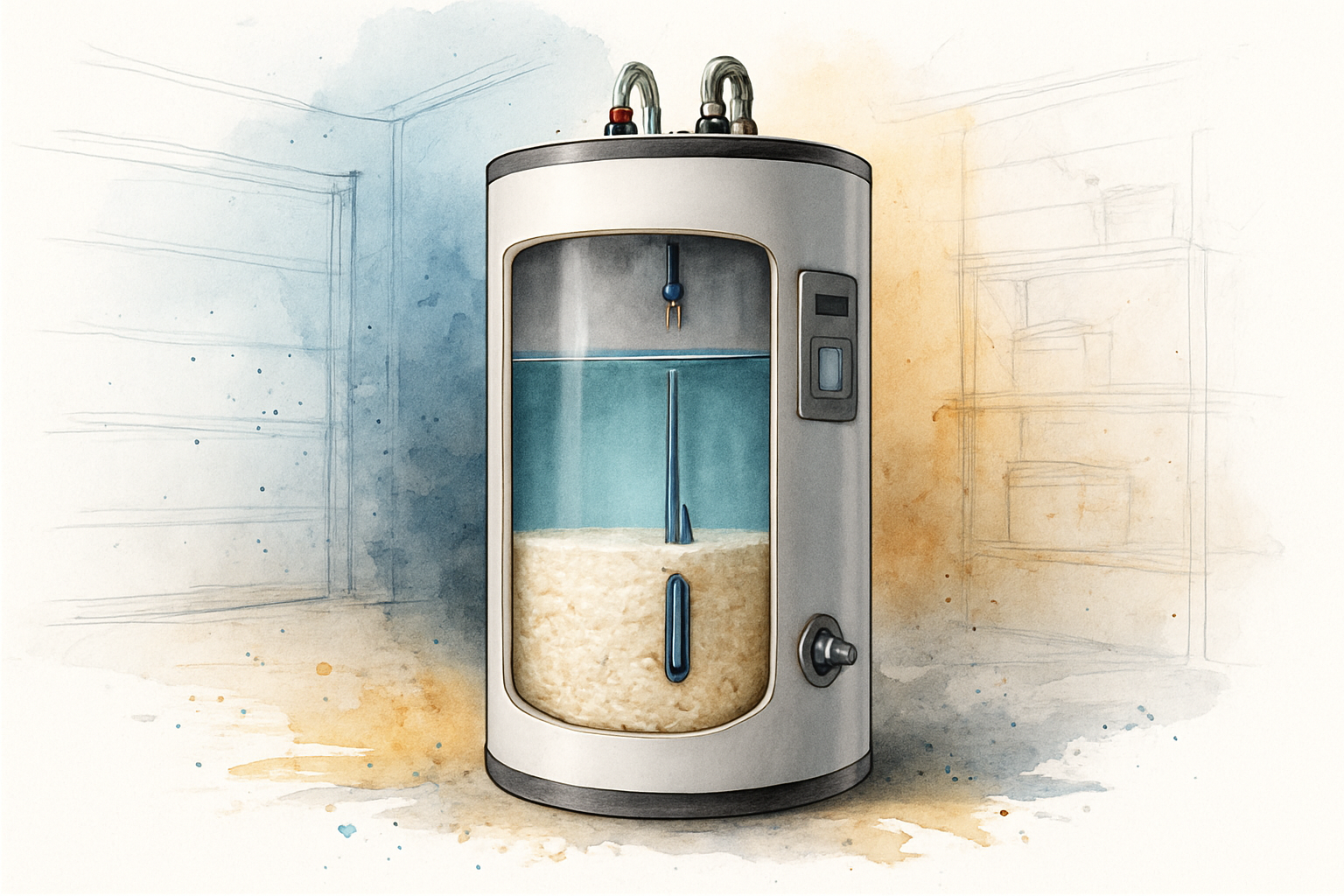
2. Sediment stacked on the tank floor. Minerals settle out of the water and build a layer on the bottom. That layer takes up volume that used to hold hot water, and it insulates the burner from the water it is trying to heat. This is why a 50 gallon tank can behave like a 35 gallon one.
3. A failed lower heating element. On electric units, two elements share the work. When the lower one quits, only the top third of the tank heats, which produces exactly the short burst of hot water people describe on the phone.
The symptom is the same in all three cases. The repair is not, and that is why I do not quote a fix over the phone before looking at the unit.
Why Hard Water Speeds This Up in Santa Cruz County
Hard water is common across Santa Cruz County and much of the Central Coast. Every gallon that enters a storage tank carries dissolved minerals, and a share of those minerals drop out and stay on the bottom.
That happens in a brand new heater in Watsonville the same way it happens in a ten year old one. The difference is only how much has piled up.
Signs the sediment layer is getting thick:
- Popping or rumbling when the burner runs, which is water boiling under the mineral layer
- Hot water that lasts noticeably less than it did last year
- Cloudy or gritty water from the hot side only
- The tank taking longer to recover between showers
This is the honest reason a fairly new heater can lose usable capacity faster than the owner expected. It is also why annual flushing matters more here than in soft water regions, and why some homeowners look at what hard water does to the rest of the plumbing once they understand what is happening inside the tank.
Short Hot Water Window: The Four Usual Suspects
This breaks down what each cause does inside the tank and what it sounds or feels like from the shower.
Sometimes the Heater Is Fine and the Household Changed
Hot water demand grows quietly. A household adds a person. A teenager starts taking long showers. Someone puts in a bigger soaking tub, or the laundry and dishwasher now run during the morning rush.
Storage tanks carry a first hour rating, which is how many gallons the unit can deliver in the first hour starting from a full hot tank. Water heaters are sized by matching that rating to the household’s peak hour demand, according to Department of Energy backed sizing guidance.
If your peak hour demand outgrew that number, the heater is doing exactly what it was built to do. The sizing is the actual problem, not a defect.
I check this before assuming a unit is failing. That means asking how many people live there, how many showers run back to back, what time the laundry goes, and what the tank’s rating actually is. Replacing a heater with the same size it always was will not fix a demand problem, and I would rather find that out first. It also helps to know how long a water heater should actually last before deciding anything.
Matching the Symptom to the Likely Cause
This is roughly how I sort a call before I ever open the unit. It narrows the list, it does not replace an inspection.
| What You Notice | Most Likely Cause | Who Should Handle It |
|---|---|---|
| Hot water dropped off suddenly, over days | Dip tube failure or heating element | Licensed plumber |
| Hot water shrank gradually over a year or two | Sediment buildup or growing household demand | Licensed plumber |
| Popping or rumbling from the tank | Mineral layer on the tank floor | Licensed plumber, tank flush |
| Only one shower goes cold fast | Failing shower valve cartridge letting cold cross over | Licensed plumber, fixture repair |
| Tankless goes lukewarm when two fixtures run | Flow rate demand exceeds unit capacity | Licensed plumber, evaluation |
| Tankless problem started in November or December | Colder inlet water cutting gallons per minute | Licensed plumber, evaluation |
If You Have a Tankless Unit, the Cause Is Different
Tankless units do not run out of hot water the way tanks do, because there is no stored volume to drain. So when the shower goes lukewarm, I am looking at three things.
- Flow rate demand. Two showers plus a dishwasher can ask for more gallons per minute than the unit can raise to temperature at once.
- Scale on the heat exchanger. Hard water leaves mineral deposits on the exchanger surface, and heat transfer drops off.
- Too little flow. A low flow fixture or a partly closed valve can pull under the minimum the burner needs to stay lit, so it cycles off.
Cold inlet water in winter matters here too. Water coming into Central Coast homes is colder between November and February, which cuts how many gallons per minute the unit can heat. That is why this complaint shows up seasonally.
If that sounds like your situation, tankless problems that aren’t what they look like goes deeper on the diagnostics.
Three Checks You Can Run Before Anyone Comes Out
Callers almost always want to know what they are dealing with first. These are safe and they genuinely help me.
- Time it. Run hot water at one fixture with nothing else going and note how many minutes until it turns cold. Write the number down.
- Test every fixture. If the kitchen sink holds hot water but one shower does not, the heater may be fine and the shower valve cartridge may be letting cold cross into the hot line.
- Note the pattern. Sudden change usually means a component failed. Gradual change over months usually means sediment or demand creep.
Here is where I draw the line. Anything involving the gas control valve, the temperature and pressure relief valve, or draining a full tank belongs to a licensed plumber. A T&P valve exists to prevent a pressure failure, and testing or replacing one without knowing what you are doing is not a DIY project.
Frequently Asked Questions About Hot Water Running Out Too Fast
My heater is only two years old. Can it really be the dip tube?
Yes. Dip tubes are plastic and they can crack or break near the top regardless of the unit’s age. I have found failed ones in heaters barely out of their first year.
Will flushing the tank get my hot water back?
Sometimes. If sediment is the main issue and the layer is not fully hardened, a proper flush can restore a good amount of usable capacity. If the sediment has cemented onto the tank floor, or if the real problem is a dip tube or element, flushing will not change much. That is why I look before promising an outcome.
How do I know if my tank is just too small?
Compare the unit’s first hour rating to how much hot water your household uses during its busiest hour. If your demand is higher, the tank is undersized for how you live now, even if it worked fine three years ago.
What does it cost to fix this?
It depends entirely on what the inspection finds, and I will not throw out a number that could be wrong. Tank condition, sediment volume, element and dip tube condition, venting, connections, and sizing all change the scope. Call and we can talk through your actual setup.
Do you cover Watsonville and Monterey County for this?
Yes. We serve Santa Cruz County and parts of Monterey County, with 24/7 emergency service available when hot water disappears entirely rather than just running short.
Want Someone to Check the Unit Before Replacing It?
One customer summed up the standard I try to hold to: “He verified that I did, indeed, need a new water heater, and expertly assessed what size and capacity was necessary.” That is the order I work in, checking the unit and the household demand before recommending anything, as a licensed and insured contractor under CSLB #1102966. If your hot water is running short in Watsonville, Santa Cruz, or anywhere in Monterey County, call us at (831) 515-9903 and we can talk through what you are seeing, with 24/7 service available if it goes out completely.
