

Direct Answer: A plumbing problem that stopped on its own usually means conditions changed, not the cause. Intermittent drains, damp spots, and hot water faults almost always return once the system sees heavier use.
The drain that took forever last Tuesday is draining fine now. The damp spot under the sink dried up. The hot water came back after you cycled the breaker, and nobody has complained since.
So you did the sensible thing and waited. I talk to people in Santa Cruz County and Monterey County every month who tell me they want to see if it clears up before they schedule anything, and I think that is a fair instinct. Some symptoms genuinely do end on their own.
But some are the first half of a pattern. This is about how to tell the difference in your own house, using what you already saw, so you can make the call yourself instead of taking someone’s word for it.
When a Plumbing Problem Stopped on Its Own, the Cause Usually Did Not
There is a difference between a problem ending and a problem going quiet. Most of the time what changed is the load on the system, not the system itself.
Three patterns come up again and again in local homes:
- A drain that clears overnight. Standing water slowly works its way past a partial blockage. The grease, hair, or root mass is still in there, and it fails again the next time the dishwasher drains while someone is washing dishes.
- A damp spot that dries. That usually points to a leak that only shows up under certain pressure or certain use, like a supply line that weeps while the washing machine fills.
- Hot water that came back after a reset. A thermostat, a control board, or sediment sitting on the bottom of the tank is the common story. Resets keep working right up until they do not.
One homeowner wrote in over the summer describing a kitchen drain that had slowed to a crawl and asking for a good snaking. That symptom usually comes and goes for weeks before the sink quits entirely.
Leaks are the quietest of the three. EPA WaterSense reports that household leaks waste more than 9,300 gallons a year on average, and that about 9 percent of homes have leaks running 50 gallons or more per day. A leak you stopped noticing is often still running.
The Fix You Did Yourself Probably Worked. The Part Just Past It Is the Question.
People cancel appointments on me because someone in the house already handled it, and a lot of the time they are right. Tightening a compression nut, plunging a line, or swapping a worn flapper are real repairs, not stopgaps.
The useful question is not whether the repair worked. It is whether the repair addressed the cause or quieted the symptom.
Here is what tends to show up next, in my experience:
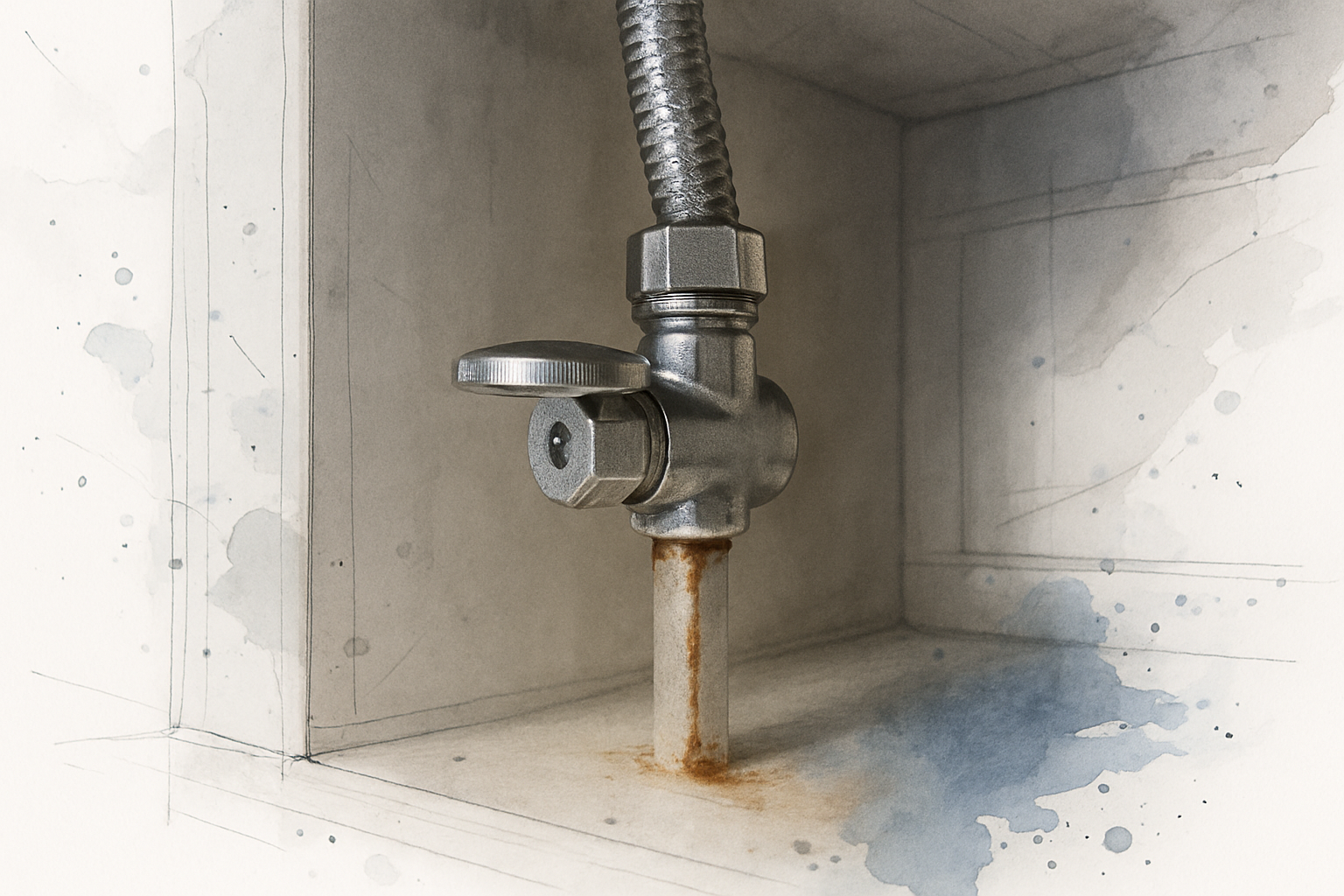
- The shutoff valve. Old angle stops get turned off and back on during a DIY fix, and that is often when a seized stem starts to seep.
- The supply line. If one braided line failed from age, the others under that same sink are the same age.
- The drain just past where you worked. A plunger moves a clog a few feet down. If the real restriction is further along the branch line, it comes back.
- The cabinet floor or subfloor. Particleboard that got wet once will swell and stay soft, and that tells you how long the leak actually ran.
None of that means the work was wrong. It means a five minute look at the adjacent parts usually settles whether anything else is carrying the original problem. If you have a couple of these small items stacked up, it is worth grouping them into one visit instead of calling three separate times.
Reading a Symptom That Went Away
This is roughly how I sort these when someone describes a symptom that already stopped. It is a starting point for your own judgment, not a diagnosis.
| What you saw | Why it likely stopped | What usually happens next |
|---|---|---|
| Sink or tub drained slowly, fine the next morning | Water worked past a partial blockage overnight | Backs up again under full flow, often worse each time |
| Damp spot under a cabinet that dried | Leak only occurs under certain pressure or appliance use | Returns on a cycle tied to the washer, dishwasher, or irrigation |
| No hot water, came back after a reset | Control or thermostat tripped, or sediment interfered briefly | Repeats at shorter intervals until the part fails outright |
| Gurgling from a floor drain or toilet, then quiet | Vent or mainline partially restricted, pressure equalized | Multiple fixtures back up, often during heavy rain |
| Water bill jumped, then settled | Intermittent leak or a toilet flapper that seats sometimes | Shows up again next billing cycle, usually higher |
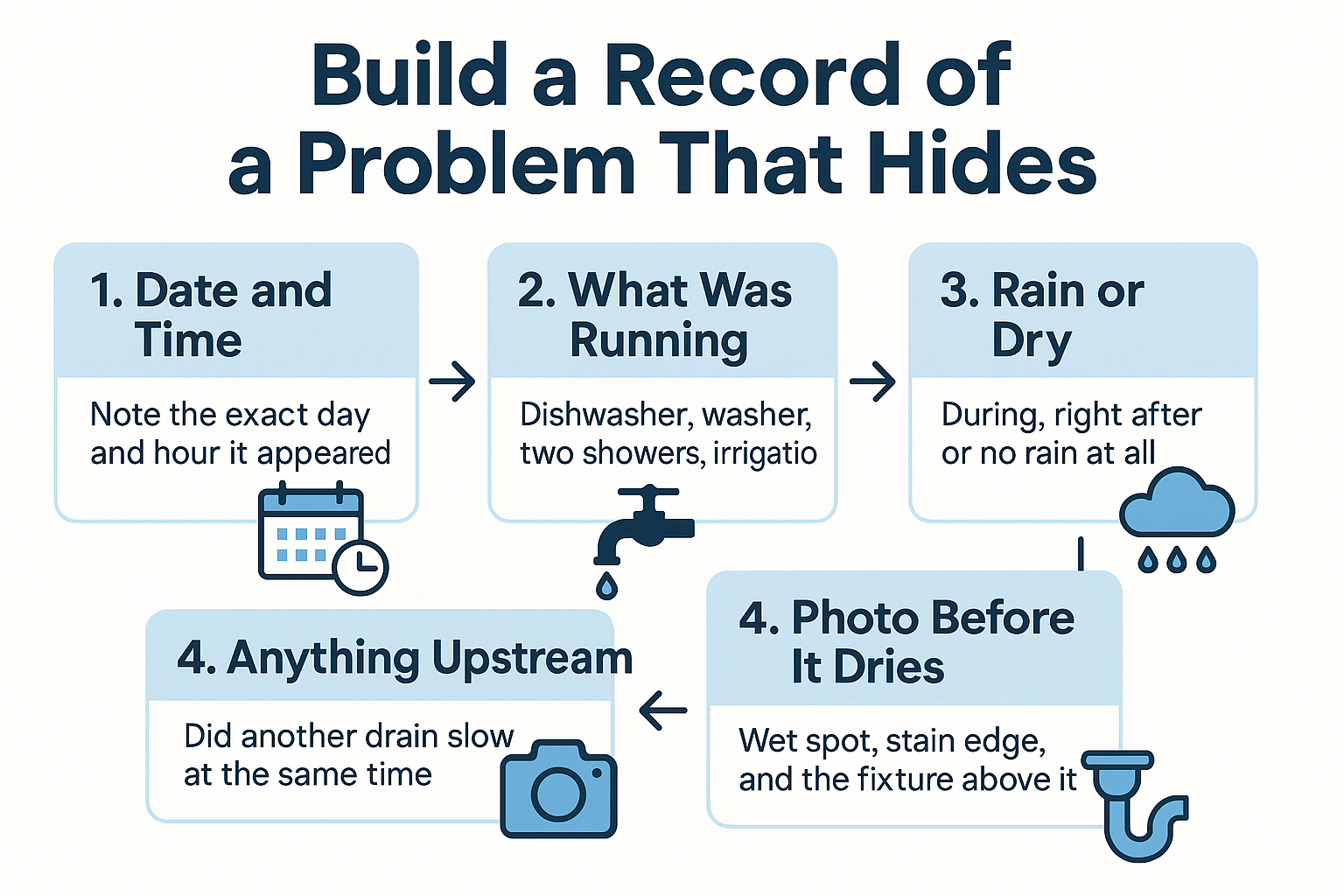
What to Write Down the Next Time It Happens
The hardest part of an intermittent problem is that it is never happening while I am standing there. A short record of two or three appearances narrows things down fast and often shortens the visit.
Why Fall Is the Honest Window on the Central Coast
Plenty of problems here go dormant through a dry stretch and wake up the week real rain arrives. Groundwater rises around crawl spaces and below-grade rooms, roots go looking for a wet sewer lateral, and a drain that only half worked in August suddenly gets storm load stacked on top of normal household use.
The seasonal outlook issued in late August put California in the above normal category for December through February precipitation. I am not predicting a disaster winter. The odds have simply tilted wetter, and that changes the math on a symptom you dismissed in September.
Search patterns in the Santa Cruz and Monterey Bay market tell the same story every year. Calls about drains and plumbers bottom out in October and November, then spike in January and February when storms hit.
On low lying lots around Santa Cruz County, groundwater pressure builds faster than most homeowners expect. A crawl space that was bone dry in September can hold standing water within a day or two of a real storm. That is the same reason I push people to check what a wet winter does to below-grade plumbing and to confirm sump pump readiness before the rainy season rather than during it.
A quiet problem is easier to understand in October, when it can be scheduled, than in the middle of a January storm, when it has to be dispatched.
What a Short Record Actually Gets You
When someone hands me two photos and a note about when the symptom showed up, I can usually narrow the search before opening anything. That means less guessing, less drywall, and a clearer explanation of what I found and why.
Callers already do this instinctively. One asked our office to text so she could send pictures over, which is exactly the right move. Photos will not replace a camera inspection or electronic leak detection, but they often tell me where to start looking and sometimes answer the question outright.
Documentation is part of how we work, not an add-on. One customer put it this way in a review: “Jorge responded very quickly to my requests and provided clear details in the estimates. I appreciated that he sent pictures of the plumbing repairs and installation to me even when I didn’t specifically request them.”
If you are gathering information rather than reacting to an active problem, that is a reasonable place to be. Watch it, write it down, and decide with real information in front of you.
Frequently Asked Questions About a Plumbing Problem That Stopped on Its Own
Is it worth having someone look at it when the problem is not happening right now?
If it has happened more than once, yes. A single odd event with no repeat is usually just an odd event. A second occurrence turns it into a pattern, and patterns are what we can actually trace.
How long should I watch a symptom before I call?
Two to three weeks is a reasonable window for something minor and intermittent, as long as nothing is actively wet. The exceptions are sewage odors, multiple drains backing up at once, and anything involving gas, which should not wait at all.
Someone in my house already fixed it. Do we still need a visit?
Often not. What I would check yourself is the shutoff valve, the supply line, and the cabinet floor around where the work was done. If any of those look crusty, stiff, swollen, or stained, the original problem probably left something behind.
What if the quiet symptom is a faint gas smell that comes and goes?
Treat that one differently. Leave the building immediately, do not flip light switches or use anything with an open flame, and call from outside the property. Gas leak response is available 24 hours a day, 7 days a week.
Can a slow drain that cleared itself really mean a sewer line issue?
It can. When one fixture is slow, the restriction is usually local to that branch. When several fixtures act up, or a toilet gurgles while a tub drains, that points toward the mainline, and a camera inspection is the only way to see what is actually in there.
Still Wondering About a Symptom That Went Quiet?
Maverick Plumbing Technicians is a licensed and insured plumbing contractor, CSLB #1102966, working across Santa Cruz County and parts of Monterey County, with service available 24 hours a day, 7 days a week when a quiet problem stops being quiet. If you want someone to look at your notes and photos and walk through what they point to, we are reachable at (831) 515-9903.
