Direct Answer: An under-sink reverse osmosis system installation adds a cold water tap, a filter bank, a storage tank, a drain connection, and a separate drinking water faucet that usually needs its own hole.
Most homeowners who call me about drinking water have already decided reverse osmosis works. What they actually want to know is what their kitchen looks like after the technician drives away.
That is a fair question, and it is the one I get asked by name. Callers across Santa Cruz County and Monterey County ask about reverse osmosis system installation the same way they ask about hydro jetting or line locating: they want to know the scope before they commit.
So here is the honest version. What goes under the cabinet, what I look at before a single part gets ordered, how our local water affects the filters, and what happens six months later when the system needs service.
What a Reverse Osmosis System Installation Puts Under Your Sink
Reverse osmosis is a point-of-use system. It treats water at one fixture, almost always the kitchen tap, and it lives in the cabinet below.
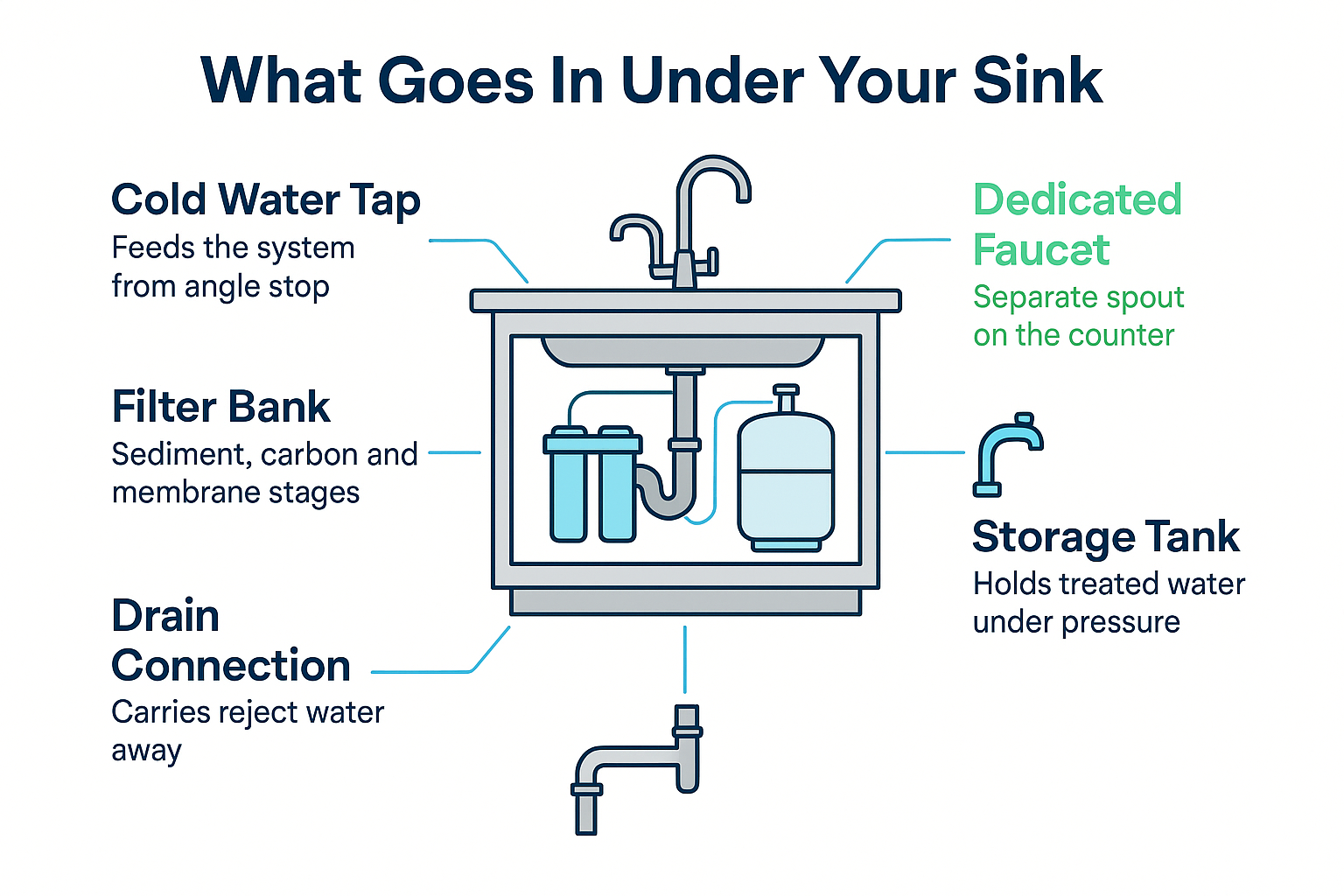
Here is what physically goes in:
- A tap into the cold water supply, usually at the angle stop under the sink, feeding the system
- A multi-stage filter bank with sediment and carbon stages plus the membrane, mounted to the cabinet wall or sitting on the cabinet floor
- A small storage tank that holds treated water under pressure so you are not waiting on the membrane every time you fill a glass
- A drain connection for the reject water, tied into the sink drain with the right fitting
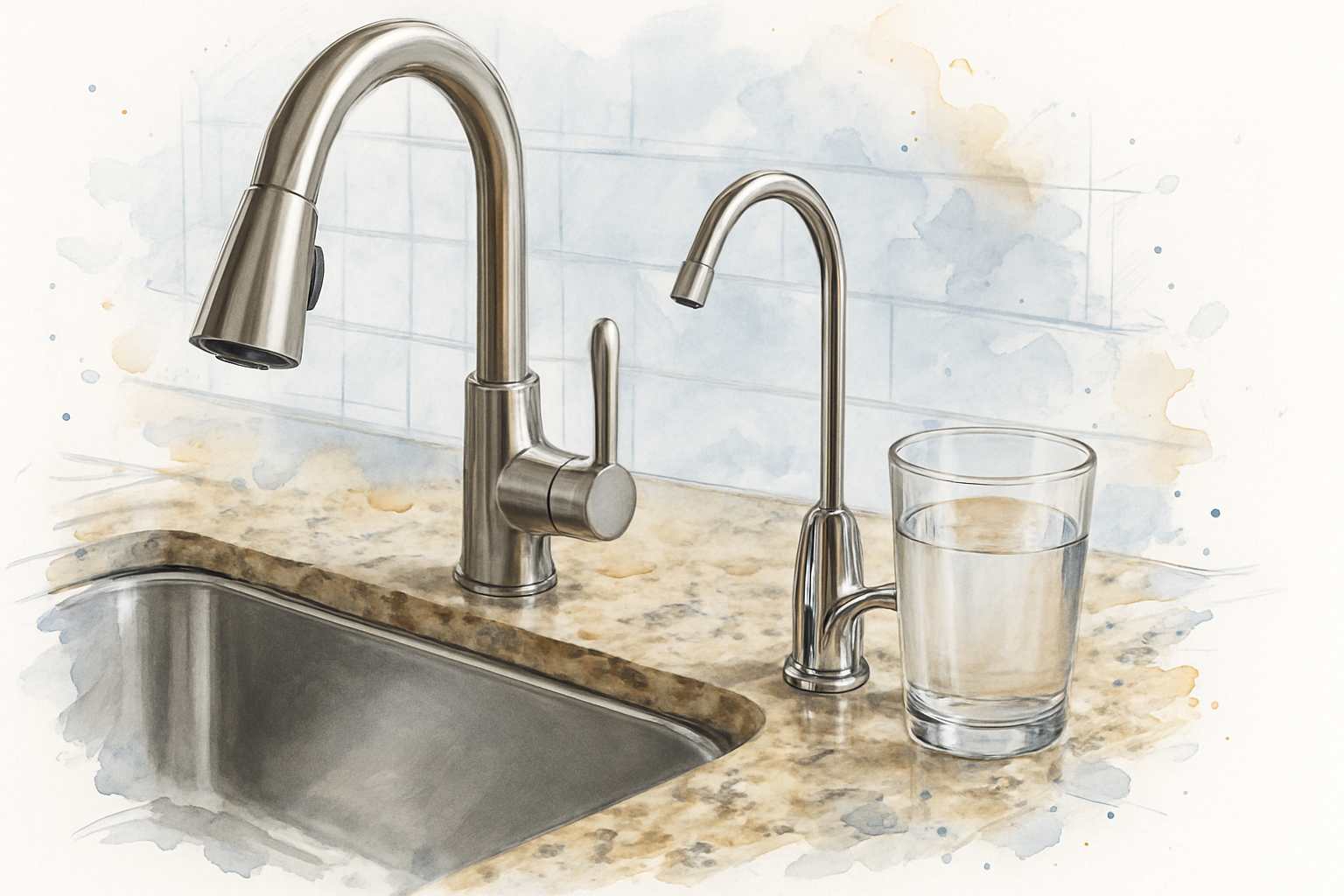
- A dedicated drinking water faucet on the counter or sink deck, separate from your main faucet
Two of those change how the kitchen looks and feels. The tank takes up real space in the cabinet, often right next to the garbage disposal, so whatever you store under there will need a new home.
And the drinking water faucet is a second spout on your counter. Some sinks have a spare knockout or an unused sprayer hole that works. Others do not, which means drilling the counter. I would rather you know that before install day than during it.
The Walkthrough That Happens Before Anything Gets Ordered
The jobs that go sideways are the ones where nobody looked first. A competent evaluation happens before parts are ordered, and the questions you get asked on the phone or by text are how the scope gets pinned down.
Here is what I am looking at in your kitchen:
- Cabinet depth and clearance around the disposal and the dishwasher drain line, because the tank and filter bank both need room and access for future service
- Incoming water pressure, since a reverse osmosis membrane needs pressure to produce properly and a low-pressure supply changes the recommendation
- The sink deck, to see whether there is a spare hole or whether the counter material means drilling granite, quartz or tile
- The drain tie-in, so the reject line is connected correctly and to California plumbing code rather than just jammed onto the nearest pipe
- Anything already upstream, like a whole-home softener or filter, which affects what the membrane is actually treating
One customer put the value of that front-end detail plainly in a review: “Jorge responded very quickly to my requests and provided clear details in the estimates.” That is the standard I try to hold.
If you want a look at how equipment placement decisions get made elsewhere in the house, the same thinking applies to where a water softener even goes in a Santa Cruz home.
What I Check Before Ordering Parts
These five checks decide the scope of the job. Each one can change the plan.
| What I check | Why it matters | What it can change |
|---|---|---|
| Cabinet space around the disposal | Tank and filter bank need room plus service access | Tank size or mounting layout |
| Incoming water pressure | Membranes need pressure to produce treated water | Whether a booster is needed or the unit is a fit |
| Spare hole in the sink deck | The dedicated faucet needs its own opening | Drilling granite, quartz or tile versus reusing a hole |
| Drain line configuration | Reject water must be tied in to code | Fitting type and routing |
| Existing softener or filter upstream | Changes what reaches the membrane | Service interval expectations |
The Five Pieces of an Under-Sink System
A simple map of what gets installed and where each piece connects.
Hard Water Here Shows Up in the Service Schedule
Hard water is a known condition across Santa Cruz County and much of the Central Coast. The City of Santa Cruz Water Department describes local tap water as moderately hard and points residents to its annual water quality report for the average hardness figure.
For a drinking water system, mineral content matters in one specific way: it is part of what shortens membrane life and drives how often the stages get replaced. Two identical systems can land on different service intervals depending on the water feeding them and how much the household uses.
Here is the part I want to be clear about. A system at the kitchen tap does nothing for the rest of the house.
- Scale still builds on your shower head and faucet aerators
- Your dishwasher and water heater still run on untreated water
- Spotting on glassware from other taps does not change
That is not a knock on reverse osmosis. It is just a different job. If whole-house scale is the thing bothering you, read up on hard water in Santa Cruz County and what it does to your plumbing, and on why reverse osmosis and a water softener are not the same thing.
If a softener is already installed upstream, I check how it is performing before I make any call on the drinking water side.
What Happens After Install Day
Almost nobody writes about this part, and it is the part that decides whether you are happy with the system in year three.
Filters and membranes are consumables. The sediment and carbon stages come out on a schedule, and the membrane has a longer life but still has an end date. One customer summed up her routine in a single line: “The filter has to be changed every six months.”
The real question is who is tracking that. In her case, we handle ongoing filter service on her water treatment setup, so the filters get ordered, she gets a call to set a date, and the change happens without her having to remember it.
That is the difference between buying a box off a shelf and owning a system somebody services. Either way, there are a few things worth knowing:
- Pre-filters protect the membrane, so skipping them shortens membrane life
- A drop in flow at the drinking faucet usually means the stages are overdue, not that the unit failed
- The tank holds pressure, and a tank that will not fill is a separate diagnosis from a clogged filter
How It Works and the One Tradeoff Worth Knowing
Reverse osmosis pushes water through a semi-permeable membrane under pressure. What comes out is two streams: the treated water you drink, and a concentrate stream carrying the rejected minerals, which goes down the drain.
That is exactly why the drain connection matters, and why efficiency differs between models. The EPA WaterSense program on point-of-use reverse osmosis systems covers both streams and notes that choosing a WaterSense labeled model saves more than 3,100 gallons per year on average compared with a typical point-of-use unit.
If you are comparing units, two specs are worth asking about:
- Certification to NSF/ANSI 58, the performance standard EPA references for these systems
- The WaterSense label, which speaks to how much water the unit sends to the drain
Ask about those two things and you are walking into the conversation informed rather than taking a salesperson’s word for it.
Frequently Asked Questions About Reverse Osmosis Installation
Do I have to drill a hole in my countertop?
Not always. Many sinks have a spare knockout or an unused sprayer hole that the drinking water faucet can use. If yours does not, and the counter is granite, quartz or tile, drilling is part of the job and I will tell you that during the walkthrough, not on install day.
How much space does the system take up in the cabinet?
Enough that you will notice. The storage tank is the bulky piece and it usually sits next to the disposal, with the filter bank mounted to the cabinet wall beside it. Plan on losing the area where you currently keep cleaning supplies.
How often do the filters need to be changed?
It depends on your water and your household’s use, so I would rather assess your setup than quote a blanket number. The pre-filters come out on a regular schedule and the membrane lasts longer. Local mineral content is part of what sets that interval, which is why two homes can land on different schedules.
Will reverse osmosis fix the scale on my shower head?
No. It treats water at one fixture only, so everything else in the house still runs on untreated supply. Whole-house scale is a different problem with a different solution.
Can you service a system somebody else installed?
Usually yes. I will look at how it was tied into the cold supply and the drain, check the pressure feeding it, and confirm the stages are the right ones for the unit before scheduling any filter work.
Questions About Whether Your Kitchen Will Fit a System?
If you are wondering whether your cabinet and counter will work for a system, or you have one already installed and want ongoing filter service, we are glad to talk it through. Maverick Plumbing Technicians is a licensed and insured plumbing contractor, CSLB #1102966, based in Santa Cruz and serving Santa Cruz County and parts of Monterey County. You can reach us at (831) 515-9903 or through maverickplumbingtechnicians.com.
