

Direct Answer: A sump pump discharge line carries water off your property. If it ends near the foundation, clogs at a storm drain, or sits flat, that same water drains right back into the basin.
You paid for a new sump pump last spring. The basin is clean, the float works, the pump kicks on when you pour a bucket in. And then in February the crawl space is damp again and nobody can tell you why.
Almost every time I get called out for that, the pump is fine. The problem is the discharge line, which is the pipe that carries the water out and away once the pump lifts it from the basin.
This is the half of the system nobody inspects. In this article I want to walk through where discharge lines go wrong on Santa Cruz County and Monterey County properties, what a real assessment of that route covers, and why September and October are the only honest time to check it.
A sump pump is two halves, and only one of them is the pump
When I assess a property for sump pump work, I ask three questions in order:
- Is there a pump at all, or is this a basin somebody dug and walked away from?
- Is the pump sized right for the lot and the water load?
- Is the discharge routed correctly once the water leaves the basin?
Most homeowners only ever get asked the first two. The third one decides whether the system actually works.
Think about what a sump pump does. It does not remove water from your property. It lifts water out of a hole in the ground and hands it to a pipe. If that pipe sets the water down ten feet from the foundation on already saturated soil, the water takes the easy path back through the same gravel bed and into the same basin.
The pump runs again. And again. You hear it cycling all night and you assume the pump is weak, when the pump is doing exactly what it was built to do with water that keeps coming back.
A brand new pump plumbed into a bad discharge route is money spent on half a system. If your pump never seems to shut off, it is worth reading about whether it is sized wrong for your lot too, because sizing and routing are two separate conversations and both matter.

Three discharge routing mistakes I keep finding on Central Coast properties
These are not rare. I see all three in a normal season across Santa Cruz County and the Monterey Bay area.
1. The line ends a few feet from the foundation. Somebody ran the pipe out through the crawl space vent, pointed it at the yard, and called it done. On a flat lot with clay soil, that water has nowhere to go in January. It soaks back down and returns to the basin within minutes.
2. The line terminates at a storm drain inlet. This feels tidy until you look at the inlet in a real storm. Watsonville’s own public flood information points out that parts of the city flood after intense rainfall where runoff collects and overwhelms storm drain inlets and pipes, or where those inlets are blocked. Santa Cruz County crews spend the dry months clearing roadside drainage and checking culverts for exactly that reason. If your discharge depends on an inlet choked with leaves and silt, it fails on the day you need it.
3. The line disappears under landscaping. The pipe goes into a bed of bark and nobody alive knows where it comes out. If you cannot find the outlet, you cannot inspect it, you cannot clear it, and you cannot prove it is working.
Here is something you can do this weekend. Find where the pipe leaves the house, follow it with your eyes, and find the end of it. Then ask yourself one question: once the ground around here is already soaked, where does this water actually go?
What each routing mistake looks like, and what it does in a storm
Use this to make sense of what you find when you go trace your line.
| Routing problem | What you see on a dry day | What happens during heavy rain |
|---|---|---|
| Outlet too close to the foundation | Pipe ends in grass or gravel within a few feet of the wall | Water re-saturates the same soil and drains back to the basin; pump short cycles |
| Terminates at a storm drain inlet | Pipe disappears into a curbside or yard inlet | Inlet backs up with leaves and silt, discharge has nowhere to go, water backs up the line |
| Buried under landscaping, outlet unknown | Pipe enters a planting bed and vanishes | Nobody can check or clear it; a crushed or root-blocked section goes unnoticed until flooding |
| Flat run with a low spot | Pipe looks level, maybe a slight dip mid-run | Standing water sits in the dip, pump works against it every cycle, line can freeze or silt up |
| Pipe diameter steps down | A larger pipe reduced to a smaller fitting partway out | Flow restriction at the reducer, pump runs longer, discharge capacity drops when demand peaks |
Where the water is allowed to go is a code question, not a preference
This is the part that surprises people. You do not get to pick the destination based on what is convenient.
Groundwater pushed into a sanitary sewer line, a floor drain, or straight onto a neighbor’s grade creates a bigger problem than a damp crawl space ever did. Clean groundwater entering the wastewater system is a live concern for sanitation districts around Santa Cruz County, several of which are in the middle of multi-year facility replacement work.
Rules vary by district and by jurisdiction, so I am not going to quote you a code section here. What I will tell you is to confirm the allowed discharge point with your local sanitation or public works district before anyone trenches anything.
That is one of the reasons a licensed plumber asks where your discharge terminates before putting a number on the job. Permit and code requirements are a normal part of this conversation, not a complication or a stall tactic. Sump pump and drainage work gets completed to California plumbing code, and the destination of the water is part of that.
What a discharge line assessment actually covers
Here is the checklist I work through on the route side, separate from anything to do with pump capacity.
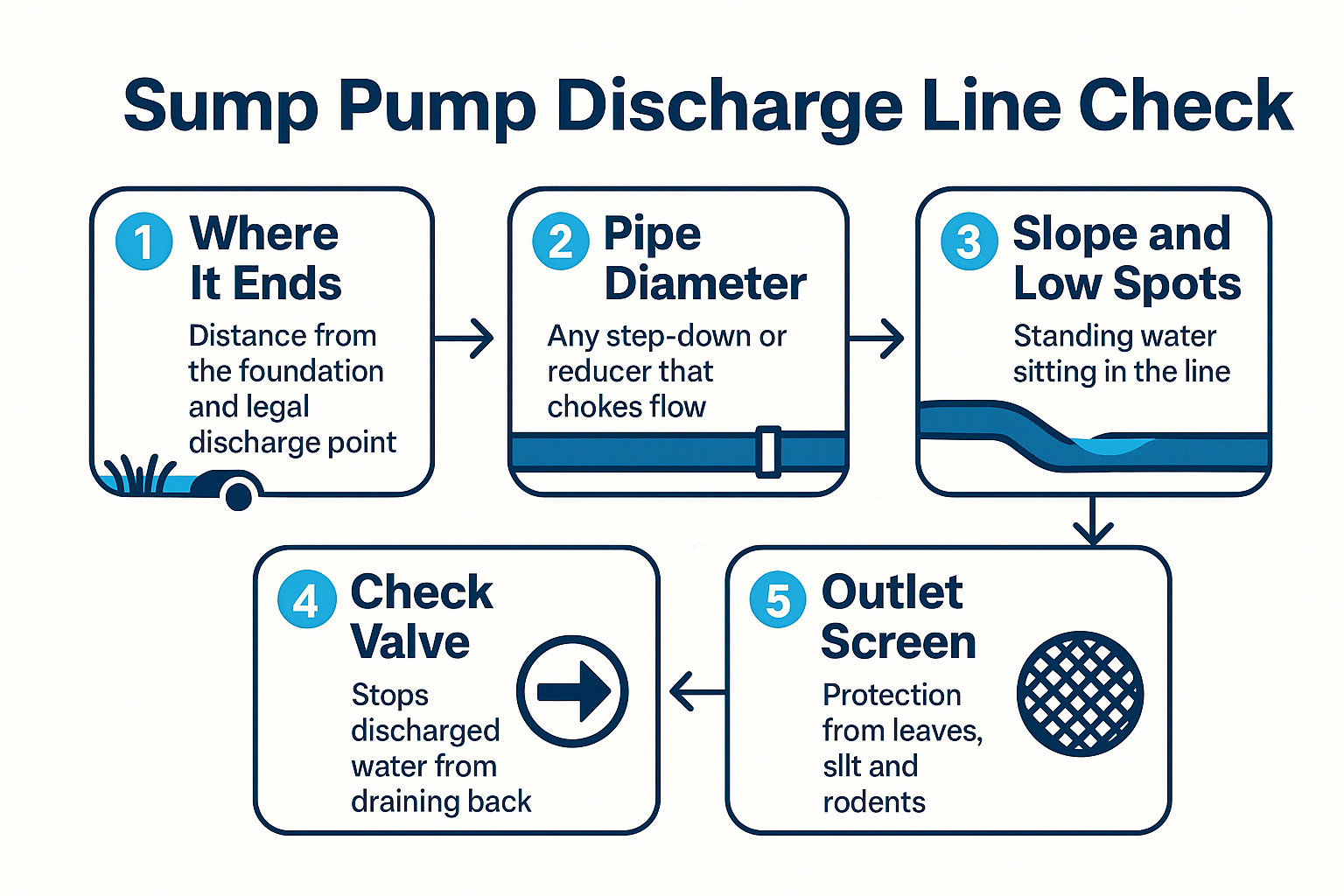
What I look at, and why I photograph it
People call and ask for a number before anyone has seen the property. I understand why, and I would rather explain what determines the scope than guess at it over the phone.
On the discharge side, here is what gets evaluated:
- Where the line terminates and how far that is from the foundation
- The pipe diameter and whether it steps down anywhere along the run
- The slope, and any low spots holding standing water
- Check valve condition, since a failed one lets discharged water drain straight back to the basin
- Whether the outlet is screened against debris and rodents
None of that is visible from the driveway. Most of it is underground, in a crawl space, or under a shrub, which is exactly why I document what I find with photos and send them over.
One customer put it this way in a review: “I appreciated that he sent pictures of the plumbing repairs and installation to me even when I didn’t specifically request them.” That is standard practice, not a favor. You should not have to take anybody’s word about something you cannot see yourself.
If part of your concern is what happens when PG&E goes down mid storm, that is a separate piece of the system and worth reading about battery backup options as well.
Check the route in September, not during the first atmospheric river
A discharge route can only be tested honestly while the ground is dry and there is still time to re-trench or re-route it. That window is roughly September and October on the Central Coast.
Most people do the opposite. Plumbing searches in this market bottom out in the fall and spike in January and February, which means homeowners go looking for help after the water is already under the house.
Santa Cruz County’s own El Nino preparedness information tells residents the same thing in different words: heavy rain and flooding are more likely in some seasons, the local effect is never certain, and the right move is to prepare now instead of waiting to find out.
One homeowner on the upper west side of Santa Cruz wrote in asking for a sump pump upgrade with a battery backup, saying they wanted something “reliable and efficient due to increasing heavy storms.” That is a person thinking in terms of long-term reliability before anything has failed, which is the right instinct.
Checking your discharge route in October costs you an afternoon. Checking it in January costs you the storm. If you want a broader pre-season walkthrough, our piece on rainy season readiness covers the rest of the system.
Frequently Asked Questions About Sump Pump Discharge Lines
How far from the house should a sump pump discharge line end?
Far enough that the water cannot work its way back to the basin, which depends on your soil, your slope, and your lot. On flat clay-heavy ground, a short run that satisfies a general rule of thumb often is not enough. The real answer comes from looking at where the water goes once it leaves the pipe.
Can I just run my discharge into the sewer cleanout or a floor drain?
Don’t. Routing clean groundwater into the sanitary sewer is the kind of shortcut that creates a bigger problem than the wet crawl space did, and local districts care about it. Confirm the allowed discharge point with your sanitation or public works district before any work starts.
My pump runs constantly. Is that the pump or the discharge line?
It can be either. A pump that is undersized for the water load will run nonstop, and so will a correctly sized pump returning the same water to the basin through a bad route or a failed check valve. Those are two different fixes, so it is worth having both checked rather than replacing the pump and hoping.
I can’t find where my discharge pipe comes out. What now?
That is common, especially on older Santa Cruz County homes where landscaping has grown over the outlet. The line can be traced from the basin end, and once the termination point is found, the slope and condition of the run can be assessed. An outlet nobody can find is also an outlet nobody has cleared in years.
What does a sump pump discharge assessment cost?
Scope depends entirely on what the route turns out to be, so I would rather talk it through than throw out a figure that does not apply to your property. Call (831) 515-9903 with the details and we can sort out what your situation actually involves.
Want someone to look at your discharge route before the rain?
We handle sump pump and drainage assessment across Santa Cruz County and Monterey County, and we treat it as pre-season work rather than only emergency rescue during active flooding. We are a licensed and insured plumbing contractor, CSLB #1102966, which is public and easy to look up, with 24/7 response if a storm does overwhelm a system. Questions about your specific property can be answered at (831) 515-9903 or through maverickplumbingtechnicians.com.
