

Direct Answer: Watsonville utility rates went up July 1, 2026, with more increases planned through 2030. If your bill jumped unexpectedly, a hidden leak is worth ruling out before assuming it’s just the rate increase.
If your water bill looked different this summer, you are not imagining it. Watsonville’s City Council approved utility rate increases that took effect July 1, 2026, with planned annual adjustments continuing through 2030. The sewer fee increases alone are tied to replacing aging wastewater infrastructure that could run upward of $57 million, according to Santa Cruz Local’s April 2026 reporting. Every gallon you run through your pipes now costs more than it did last year, and that gap will keep widening.
But here’s the part that concerns me when I talk to homeowners in this area: a rate increase and a hidden leak can look exactly the same on your bill. Both show up as a number that’s higher than you expected, with no obvious explanation waiting for you at the faucet. The difference is that one of those causes is fixed and the other one is getting worse every day it goes undetected.
This article is about the practical side of that problem. Specifically: how to tell whether your bill reflects the new rates, a hidden leak, or both, and what to do when the meter points toward something you cannot see.
What the Rate Increase Actually Means for a Leak You Don’t Know About
The financial picture of Watsonville’s rate increases is covered elsewhere. What matters here is a simpler point: when the rate per unit of water goes up, every leak you already had becomes a bigger problem on paper.
The EPA estimates that roughly 10 percent of U.S. homes lose 90 gallons or more per day to household leaks. At old rates, that volume was already adding up on a monthly statement. At the new Watsonville rates, that same leak produces a larger bill for the same volume of loss. And because the increases are scheduled annually through 2030, a leak you ignore this year will cost progressively more each year you leave it.
I’ve heard from homeowners in the Watsonville area who noticed unexplained bill spikes and assumed it was just the rate adjustment. Sometimes that’s right. But a meaningful number of those calls turn out to involve a real leak that was already present and simply became more visible once the baseline cost went up. The rate change didn’t create the leak. It just made it harder to dismiss.
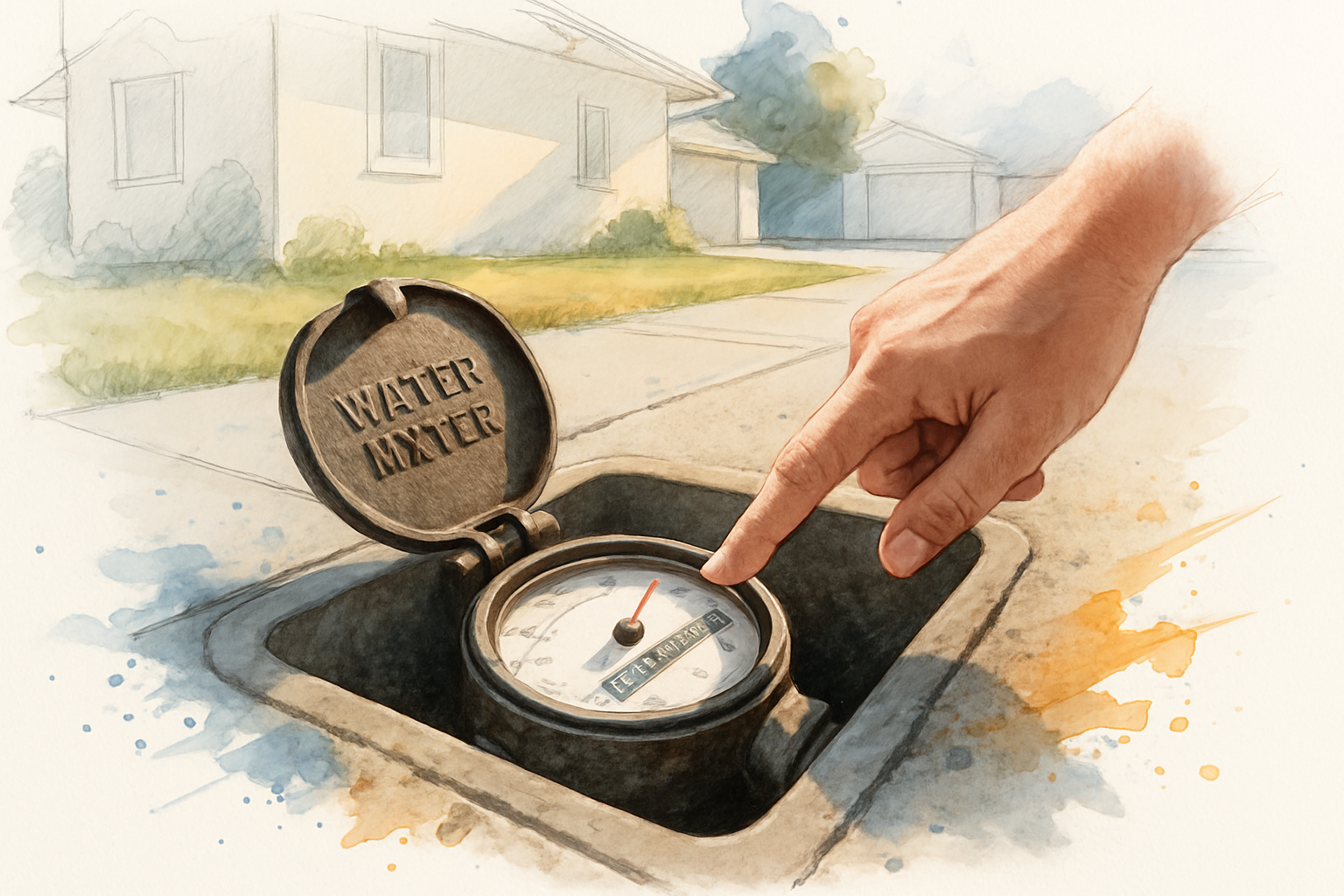
The Meter Test: Your First Real Answer
The water meter is the most honest diagnostic tool a homeowner has access to, and most people have never used it this way. If your bill went up and you don’t know why, this is the right place to start.
Here’s how to do it:
- Turn off every water fixture in the house. That includes the dishwasher, ice maker, washing machine, and any irrigation. Nothing should be drawing water.
- Find your meter. In most Watsonville homes it’s in a covered box near the street or at the edge of the property, set into the sidewalk or a patch of ground.
- Note the reading, then wait 15 to 30 minutes. Don’t run any water during that window.
- Check the reading again. If the dial or digital display has moved, water passed through the meter while no fixture was running.
That movement is the signal. It doesn’t tell you where the leak is, but it confirms that something is sending water somewhere it shouldn’t be going. You can also check for a small triangle or gear icon on the meter face, sometimes called the leak indicator. On many meters, it spins even when full consumption dials are still, which makes slow leaks easier to spot.
If the meter shows movement, the next step is a professional evaluation, not more self-diagnosis. You’ve done what you can from the outside. Your water meter can tell you quite a bit about what’s happening inside your plumbing system, but reading the result correctly and locating the source are two different things.
Three Common Sources of Invisible Water Loss in Older Homes
Slab leaks, supply line failures, and slow toilet leaks each have a different symptom pattern. This breakdown helps you describe what you’re seeing before you call.
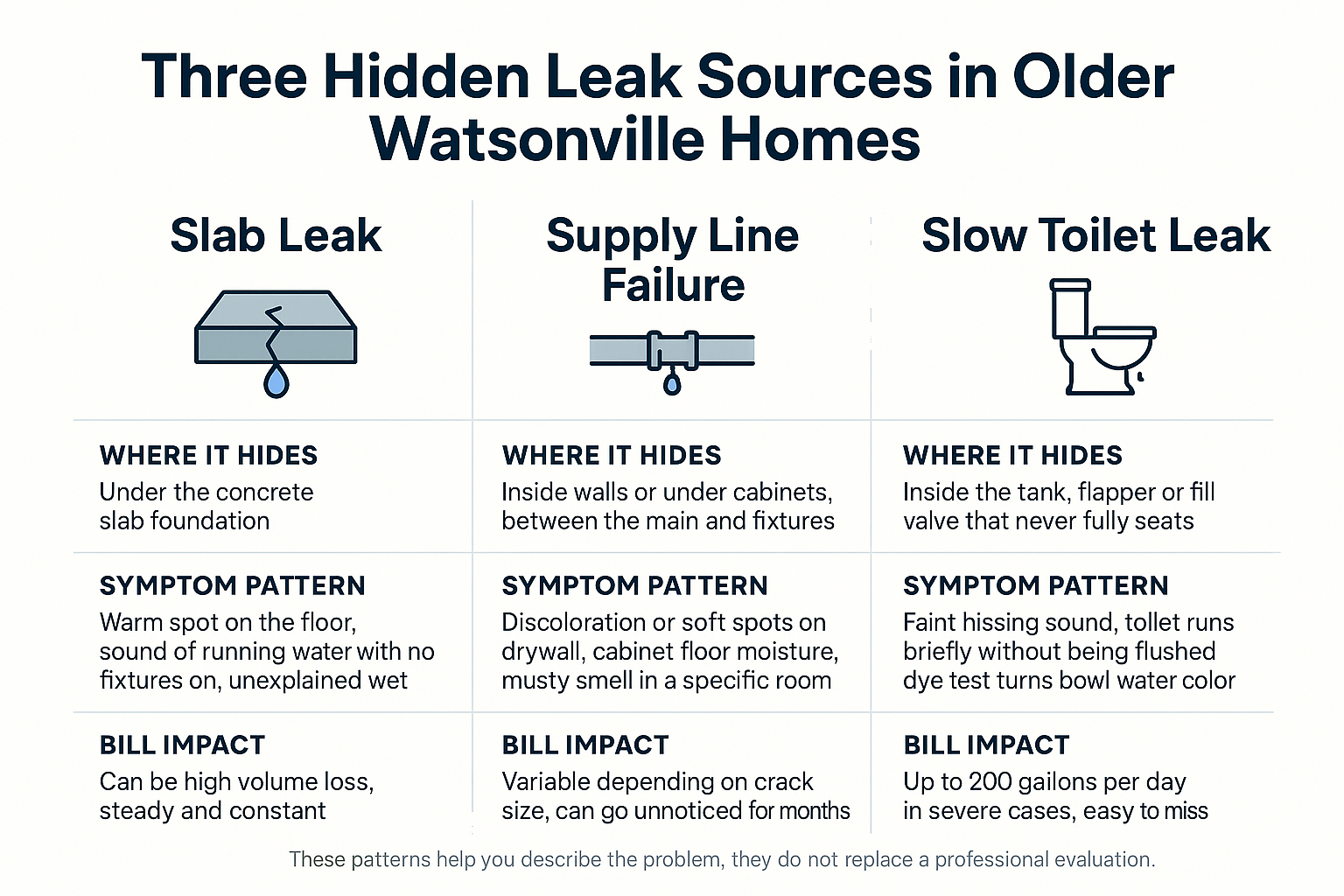
What Each Leak Type Looks Like Before You Call
I want to give you enough to describe the problem accurately when you call a plumber. Specificity matters because it cuts down on unnecessary diagnostic steps and helps the technician arrive with the right equipment.
Slab leaks are the ones that tend to surprise homeowners the most. The pipe is under your concrete foundation, so there’s nothing to see on the surface for a long time. What you might notice first is a warm or damp spot on a tile or hardwood floor, a faint sound of running water that you can’t locate, or an unexplained wet area near a baseboard. Older homes in Watsonville and Santa Cruz County with copper plumbing are particularly vulnerable, especially where that pipe has been sitting in soil with shifting moisture levels for decades. If that description sounds familiar, read more about the warning signs of a slab leak before your next step.
Supply line failures happen inside walls or under cabinet floors, and they usually make themselves known through secondary damage before the pipe failure itself. A soft spot in drywall, a musty smell localized to one room, or cabinet wood that feels swollen along the base are all signals. This is one reason I always remind homeowners that a water stain is rarely just cosmetic.
Slow toilet leaks are probably the most common source of invisible water loss I see, and the easiest to test at home. A flapper or fill valve that doesn’t fully seat will let water trickle from the tank into the bowl continuously. You can test it yourself by adding a few drops of food dye to the tank and waiting 15 minutes without flushing. If the bowl water changes color, the flapper isn’t sealing. A toilet in that condition can waste an enormous amount of water daily, and it will do it quietly for months if you don’t check.
None of this is meant to help you diagnose the problem yourself. It’s meant to help you describe it accurately, which makes the service call faster and more efficient for everyone involved.
Symptom to Leak Type: Quick Reference
If you noticed something specific before checking the meter, this table helps you connect the observation to the most likely source.
| What You’re Noticing | Most Likely Leak Type | Urgency Level |
|---|---|---|
| Warm or damp spot on the floor, no fixture above it | Slab leak | High, contact a plumber promptly |
| Soft drywall, musty smell in one room, cabinet floor moisture | Supply line failure behind wall | High, water damage accumulates |
| Toilet hissing, runs briefly without flushing, dye test positive | Slow toilet leak | Moderate, repair soon to limit loss |
| Meter moves with all fixtures off, no visible symptoms | Unknown location, professional detection needed | High, do not delay evaluation |
| Bill increase with no meter movement and no symptoms | Rate increase, not a leak | Low, monitor next billing cycle |
When the Meter Reading Warrants a Professional
If the meter moved during your test, don’t spend more time trying to pinpoint the source yourself. The value of the meter test is confirmation, not location. Finding a leak behind a wall or under a slab requires equipment and experience that go well beyond what’s practical for a homeowner to replicate.
What a professional evaluation looks like in practice is a combination of pressure testing, acoustic listening equipment, and sometimes a sewer camera inspection if drain lines are part of the picture. The goal before any access work begins is to locate the leak precisely, so that the repair is targeted rather than exploratory. That matters a lot when we’re talking about concrete slab access or opening up a finished wall.
For homes in Watsonville and Santa Cruz County with older pipe materials, a confirmed hidden leak sometimes opens a conversation about the broader pipe condition, not just the immediate repair. Understanding whether your home’s pipes are approaching end of life is a separate topic, but it’s worth having that conversation with a licensed plumber once you know what you’re dealing with.
Frequently Asked Questions About Hidden Leaks and Your Water Bill
My bill went up but I don’t see any leaks. Could it still be one?
Yes, and this is actually the more common scenario. Hidden leaks, by definition, don’t show visible signs right away. The meter test described above is the fastest way to find out if water is moving through your system when it shouldn’t be. If the meter moves with everything shut off, you have a leak somewhere, even if you can’t see it.
How much can a slow toilet leak actually add to my bill?
A flapper that doesn’t seat properly can lose anywhere from a few gallons a day to well over 100 gallons per day in worse cases. At Watsonville’s new utility rates, that adds up quickly across a full billing cycle. The dye test takes about 15 minutes and costs nothing.
Is a slab leak something I can repair myself?
No. Slab leak repair involves locating the pipe under concrete, deciding between targeted repair and rerouting, and completing the work to California plumbing code. It requires licensed contractor work. Attempting it without the right equipment risks expanding the damage significantly.
What if the meter test shows movement but I can’t find anything wrong?
That’s exactly when you call a plumber. A meter reading that shows water movement with no fixtures running is reliable evidence of a leak, even if you can’t locate it. A professional can use acoustic detection tools and pressure testing to find what you can’t see. Don’t wait, because the leak won’t stop on its own.
Will the rate increases affect how much a leak repair costs too?
The rate increases affect what you pay for water and sewer service on your utility bill, not what a plumber charges for labor and materials. For questions about what a specific repair might run, the right move is to contact Maverick Plumbing directly at (831) 515-9903 for an evaluation.
How do I know if it’s a leak or just the rate increase making my bill higher?
Do the meter test. If the meter is still with everything off, the increase is likely rate-driven. If the meter moves, you have a leak. Both can be true at the same time, which is why the meter reading is the clearest way to separate the two.
Ready to Find Out If a Leak Is Behind Your Higher Bill?
If your meter moved during the test, or if something you read here matched what you’ve been seeing at home, the next call should be to a licensed plumber. We serve Watsonville, Santa Cruz County, and surrounding parts of Monterey County, with 24/7 emergency service available when the situation can’t wait. Call Maverick Plumbing Technicians at (831) 515-9903 or request service at maverickplumbingtechnicians.com.
