

Direct Answer: Rain rarely creates a sewer problem. Rising groundwater pushes into cracks, root openings, and offset joints in an aging lateral, so the line is already partly full before anyone flushes.
Long range outlooks for the 2026-2027 winter point toward a strong El Nino. Forecasters including UCLA climate scientist Daniel Swain have pointed to European model guidance putting high odds on above average California precipitation from December through February, with more frequent atmospheric rivers.
That tilts the odds toward a wet winter. It does not guarantee one. But if you own property in Watsonville, the Pajaro Valley, or north Monterey County, the useful response is not watching model runs. It is checking the drainage and sewer side of your property in October, while I can still get a camera down the line on a dry day.
I get these calls every January, and they sound the same. The drain that was fine in September starts gurgling the week after the first real storm. Below I want to explain why that happens, how to tell a main line problem from a single slow fixture, and what a real diagnosis looks like.
Why Drains Start Backing Up When It Rains in Watsonville
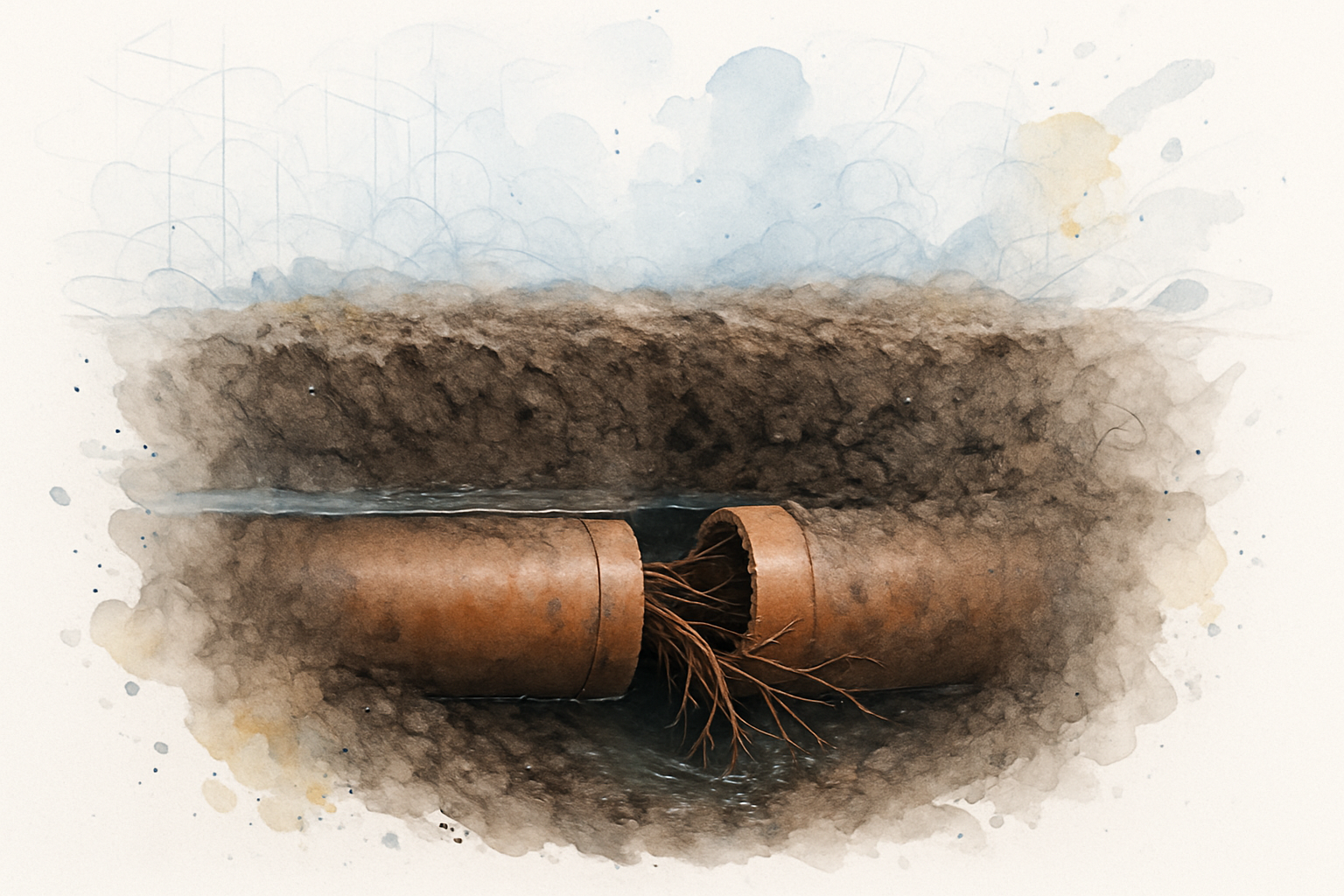
Rain does not create a sewer defect. It exposes one that was already sitting there.
As the rainy season raises groundwater across the Pajaro Valley floor, that water looks for the easiest path. On older properties, the easiest path is your sewer lateral. Clay pipe with mortared joints and old cast iron both open up over decades, and groundwater pushes in through:
- Cracked or separated joints between pipe sections
- Root openings where a tree or shrub found a moisture source years ago
- Offset sections where soil movement dropped one length of pipe below the next
- Hairline cracks along the pipe barrel that seep rather than gush
So the line that handled your household flow all summer is now running partly full of groundwater before anyone flushes anything. Add a shower, a load of laundry, and a dishwasher on the same evening and there is no capacity left.
That is the whole mechanism. It is also why the problem feels seasonal and random when it is actually physical and predictable. The same drain that keeps backing up is usually telling you something about the condition of the pipe, not about your habits.
Three Separate Systems, and Only One Is Yours
Most homeowners I talk to during a storm are mixing up three different systems. Sorting them out saves a lot of wasted worry.
1. The city storm drain system. Watsonville’s storm drains are not connected to the sanitary sewer. They carry street runoff to local sloughs, creeks, and the Pajaro River. The city also notes that areas outside the mapped Pajaro River and creek flood zones still see local flooding when intense rainfall overwhelms storm drain inlets and pipes, or when those inlets are blocked. You can read the city’s own explanation of where flooding happens in Watsonville.
2. Your private yard drainage. Area drains, driveway drains, and downspout tie-ins on your property. These are yours to maintain, and they clog with leaves and silt fast in this valley.
3. Your sewer lateral. The line running from the house to the city main. As the property owner, this one is your responsibility, and it is the one that produces sewage backups.
When the street ponds, that is stormwater. When your shower fills with dirty water, that is the lateral. Two very different phone calls.
What a Main Line Backup Actually Sounds and Looks Like
One caller described it as sewage backing up into the shower and tub. That is exactly how a mainline blockage announces itself, and it is a completely different situation from one sink draining slowly.
Here is the quick read. You are likely dealing with the main line if:
- More than one fixture is involved at the same time
- The lowest drains in the house go first, usually a ground floor shower, tub, or floor drain
- A toilet bubbles or gurgles when the washing machine drains
- Water rises in one fixture when you use another
If only the kitchen sink is slow and everything else drains fine, that is a local problem in a branch line. I wrote more about one slow drain versus every drain backing up because the difference changes what needs to happen next.
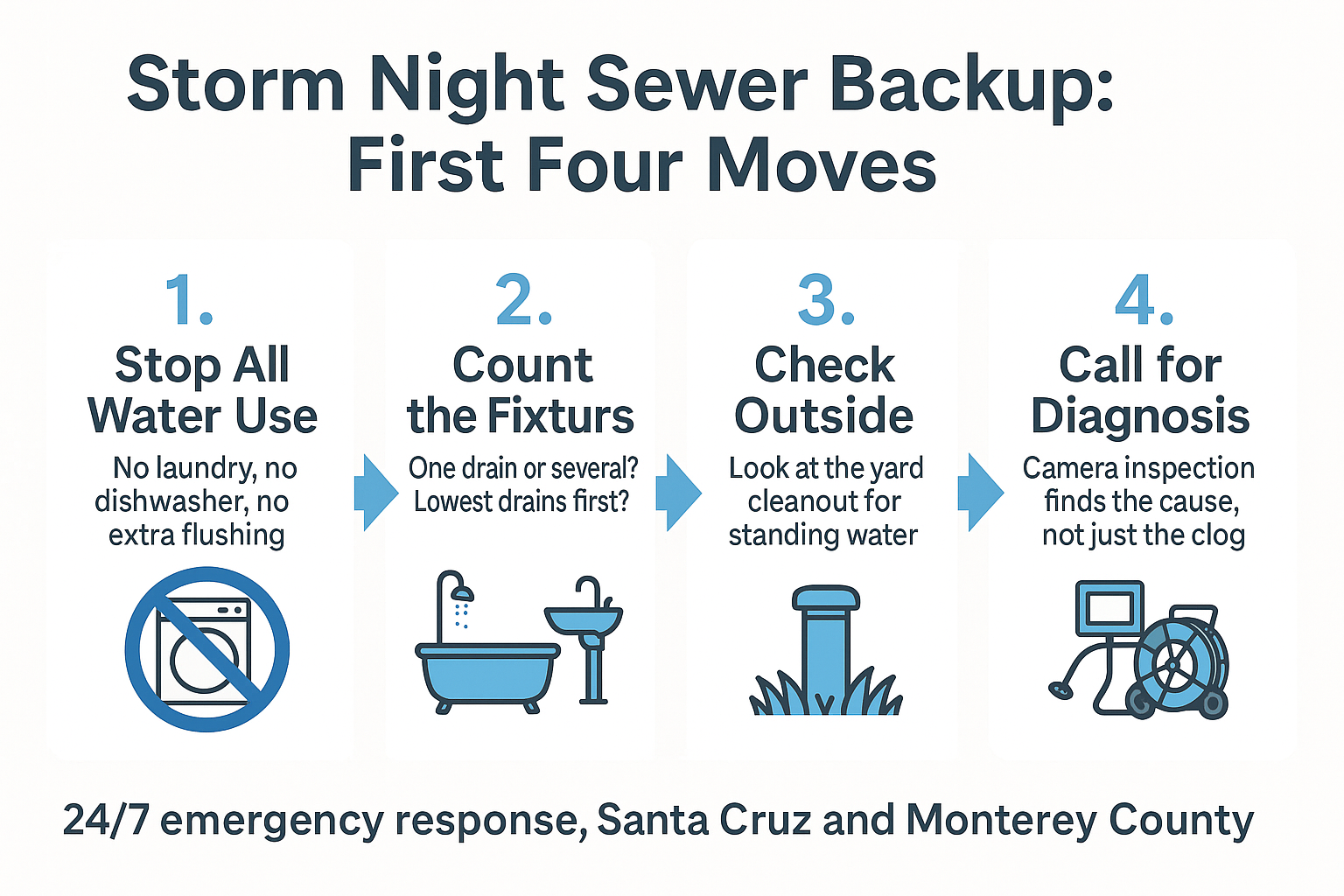
While you wait, stop adding water. No laundry, no dishwasher, no extra flushing. Every gallon you send down has to go somewhere, and right now it comes back up at the lowest opening in the house.
Reading Your Symptoms Before You Call
This is the same sorting I do on the phone before dispatching. It tells you how urgent your situation is.
| What You Are Seeing | Likely Location | What It Usually Points To |
|---|---|---|
| One sink slow, everything else fine | Branch line under that fixture | Local buildup or a venting issue |
| Shower and tub filling with dirty water | Main line or lateral | Mainline blockage, often roots or a failed section |
| Toilet gurgles when the washer drains | Main line | Partial blockage with restricted flow |
| Backups only after heavy rain | Lateral below the water table | Groundwater getting in through cracks or joints |
| Sewage odor outside near a cleanout | Lateral or cleanout | Overflowing or surcharged line |
| Street ponding, drains inside fine | City storm drain inlet | Stormwater, separate from your sewer |
Storm Night Backup: The First Four Moves
If a backup starts during a storm, the order of what you do matters more than how fast you do it.
Diagnose the Line Before You Clear It
Here is the pattern behind most repeat winter calls. A homeowner pays for snaking every January and never learns why the line closes up again.
A cable does one job well. It punches a hole through the blockage and gets flow moving, which is the right first move during an active backup. But if the pipe wall is coated with root hair and grease, a cable cuts a channel through it and leaves the rest in place. That is why it comes back.
Hydro jetting works differently. High pressure water scours the full inside diameter of the pipe, pulling grease and root mass off the wall rather than boring through the middle. On a grease-heavy kitchen line or a root-invaded lateral, that is the difference between a fix and a delay. I covered this more fully in recurring drain clogs and when snaking isn’t enough.
A camera inspection is how the cause gets identified instead of guessed at. On the footage I am looking for:
- Standing water at a low spot, which means a belly or sag holding waste
- Joint separation where two sections no longer line up
- Root intrusion points that keep refilling after every clearing
- Cracks or a collapsed section that no cleaning method will solve
What the camera finds is what decides the repair scope. A root intrusion at one joint is a different job from forty feet of failed clay. For specifics on your own line, call (831) 515-9903 and we can talk through what the evaluation looks at.
If You Manage Units, a Restaurant, or a Motel
The stakes are different for commercial callers, and so is the timing.
When a main line backs up during a storm week, multi unit owners lose tenant goodwill, motel operators lose rooms, and restaurant managers lose service hours. One local motel owner with two Santa Cruz properties reached out asking about hydro jetting the mainlines at both ahead of a busy stretch, which is exactly the right instinct.
The argument for preventive work is scheduling. A slow week in October or November beats an emergency call at 9pm in January, when you are triaging tenants instead of running your business.
For commercial properties, there is a second reason to do it on a calendar rather than on a crisis. Work is documented, so you have something to show an owner, an insurer, or a health inspector. If you run a kitchen, summer restaurant drain backups follow the same logic on a different season.
And if your property has a below-grade space, the rainy season adds groundwater pressure on top of everything else. What a wet winter does to below-grade plumbing goes deeper on sump pumps and drainage.
Frequently Asked Questions About Rain Related Sewer Backups
Why do my drains only back up when it rains?
Because groundwater is getting into your sewer lateral through cracks, open joints, or root openings. The line is already carrying water before your household adds any, so it runs out of capacity. Rain exposes the defect, it does not cause it.
Can rainwater get into my sewer line if the storm drains are separate?
Yes. The city storm drain system and the sanitary sewer are separate systems, but that is about where the pipes go, not about whether soil water can seep into a damaged pipe. Groundwater infiltration happens through the pipe itself, underground on your property.
Is a camera inspection worth doing before winter or only after a backup?
Before, if you can. A dry day in October gives a much clearer picture of the pipe than a surcharged line during a storm, and it means you find out about roots or a sagging section before it turns into a 10pm problem. If you have already had one backup, that is a reason to look, not a reason to wait.
What should I not do while I wait for a plumber?
Do not run laundry, the dishwasher, or extra flushes, and skip the store-bought drain chemicals. Those products mask symptoms and can damage pipe, and they do nothing about roots or a broken section.
How much does clearing a rain related sewer backup cost?
Scope drives everything here, and no honest answer exists before somebody looks at the line. What the camera finds, whether the blockage is roots, grease, or a failed pipe section, and how the lateral is laid out all change the work involved. Call (831) 515-9903 to talk through your specific situation.
Getting a Look at the Line Before the Storms Arrive
Maverick Plumbing is a licensed and insured plumbing contractor, CSLB #1102966, with 24/7 response for active backups across Santa Cruz County, Watsonville, and Monterey County. The theme that keeps showing up in our reviews is a clear explanation and a quick answer, like this one: “Communicative, quick, and helpful. Immediately knew what the problem was and fixed it.” – Ruby W.
We are available for pre season camera inspections on a dry fall day, and for storm night calls when a line is already backing up. Either way, the number is (831) 515-9903.
