

Direct Answer: Many no hot water calls get fixed on the first visit. But if the tank itself has failed, expect a diagnosis visit, correct sizing, ordering the unit, then installation, usually across a few days.
You turned on the shower this morning and got nothing but cold. Now you are standing in the garage staring at a tank you have never really looked at before, wondering if someone can be here in the next hour and whether this is a small fix or a big one.
I take these calls constantly. Roughly a quarter of our inbound calls in a given month open with some version of “can you come out today?” That urgency makes sense. What most homeowners do not know is whether they are looking at a one visit problem or a multi day one.
So here is the honest version of how a no hot water call plays out across Santa Cruz County and Monterey County. I will cover which failures usually get corrected on the spot, why a full replacement takes a few days, and what you can do in the meantime so the waiting stops feeling like nothing is happening.
The Real Sequence Behind a No Hot Water Repair in Santa Cruz
Most people picture one truck, one visit, one new heater. That does happen. But when a unit is genuinely finished, the work splits into stages, and each stage exists for a reason.
One local homeowner wrote out the whole timeline in a review, and it is a good example of the normal path:
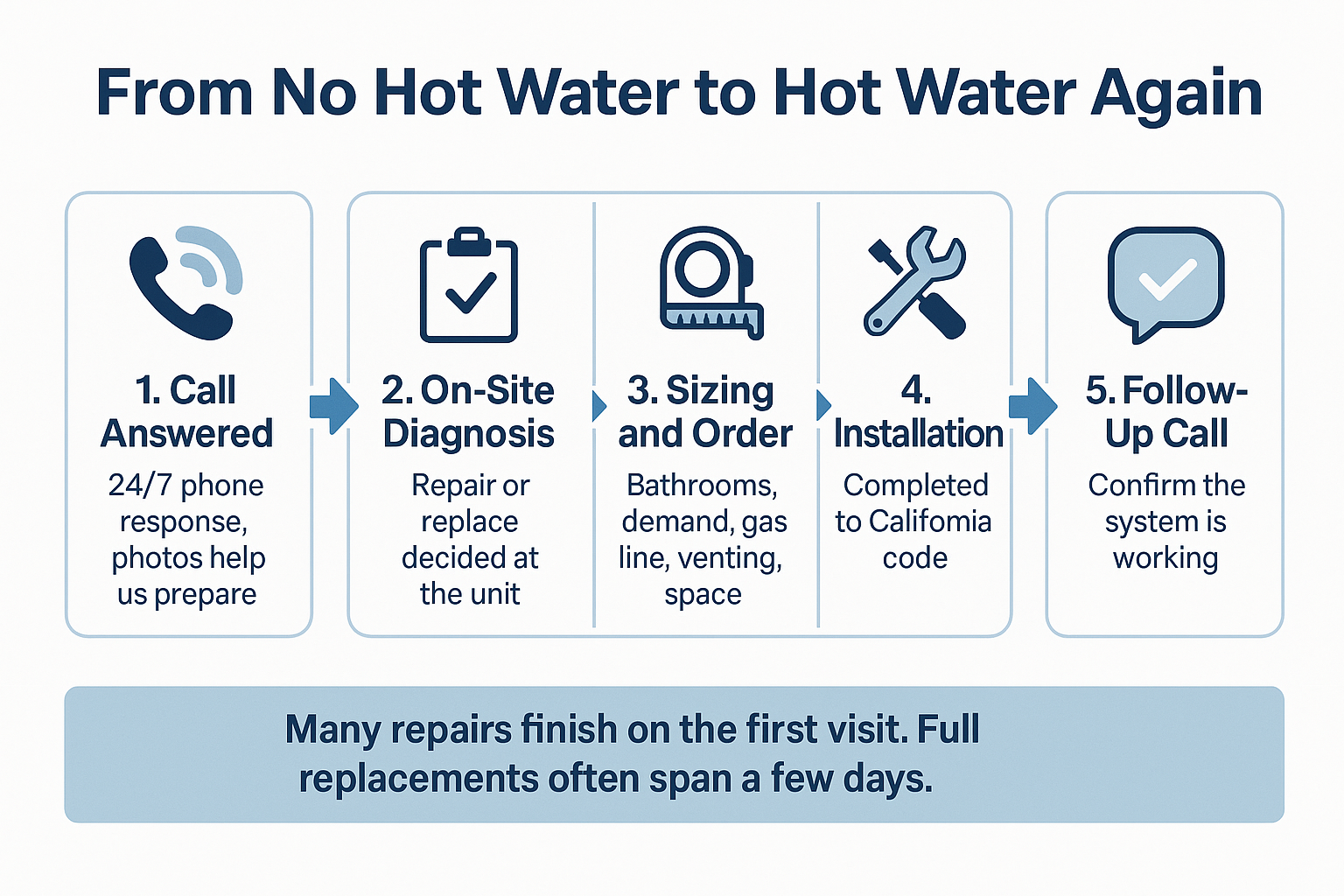
- Friday night: the tankless unit failed
- Saturday: the call was answered live
- Monday: a consult confirmed the unit had to be replaced
- Same day: size and capacity were assessed, and the correct unit was ordered
- Wednesday: the new heater was installed
- Thursday: a follow up call to confirm everything was working
In his own words, we “showed up exactly when they said they would, and even gave a courtesy call a half hour before they showed up.”
That gap between the consult and the install is not idle time. It is ordering the right unit instead of grabbing whatever is on a shelf. Rushing that step is how people end up living with the wrong heater for the next ten years.
Sometimes replacement does happen the same day. It depends on the unit type, the fuel source, the venting, and what is actually available. I will tell you which one you are looking at after I see it, not before.
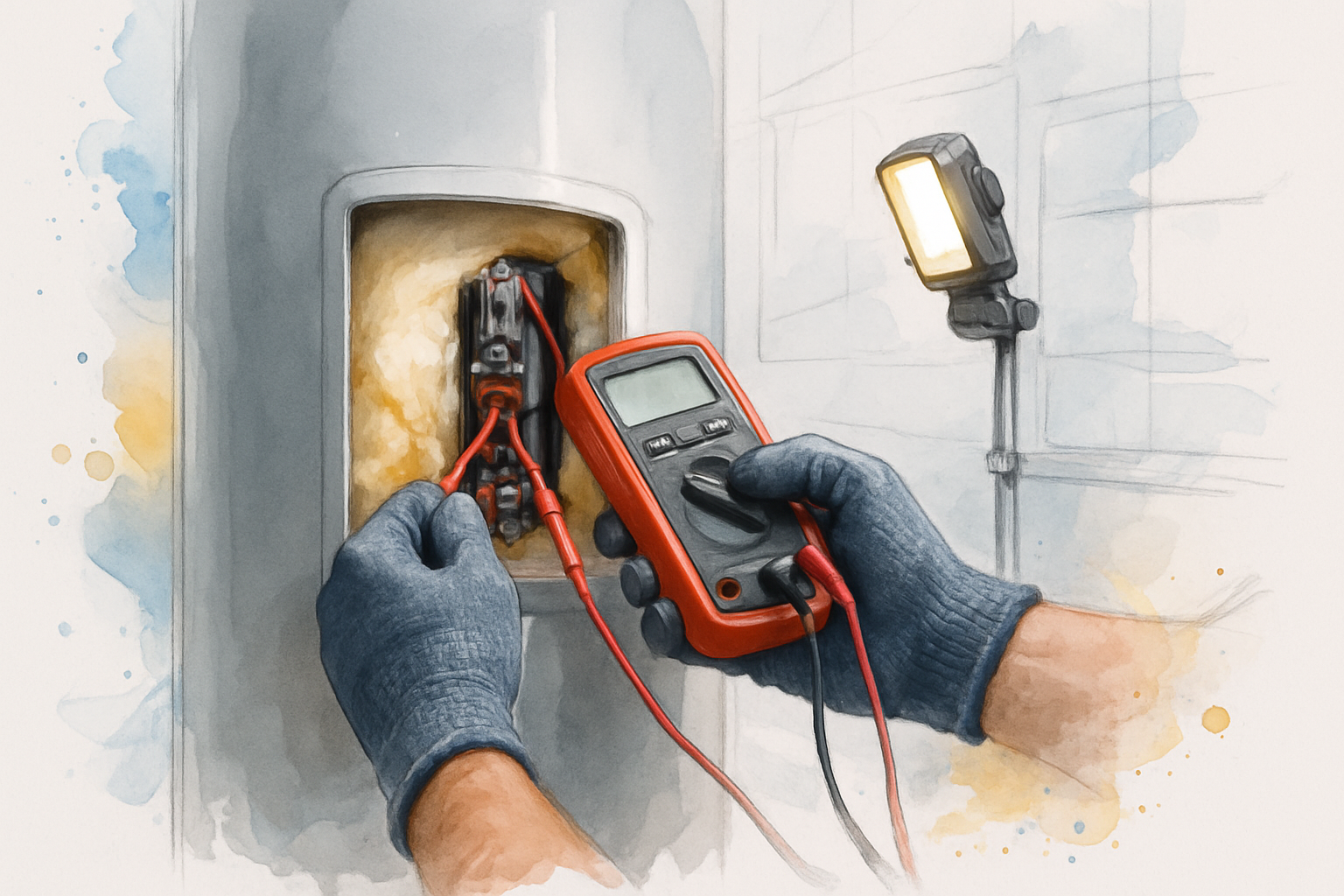
Failures I Can Often Fix on the First Visit vs. Failures That End the Tank
This is the distinction that decides your week. Two very different categories of problem produce the same cold shower.
Often correctable on the first visit:
- A failed thermostat on an electric unit
- A burned out heating element
- A faulty gas control valve
- Pilot or ignition faults, including a bad thermocouple
- A tripped breaker or a blown high limit switch
- Sediment noise and slow recovery that responds to service
Usually points to the end of the tank:
- Water pooling underneath the unit with no plumbing connection leaking above it
- Rust colored water on the hot side only
- Visible corrosion seeping at a seam or the base of the tank
- A tank well past its expected service life that is failing repeatedly
When the steel tank itself has gone, there is no repair for that. The water is already on your garage floor and the only real answer is replacement.
Our position on water heaters has always been assessment first. Repair is possible in plenty of cases, and the recommendation comes from the condition of the unit in front of me, not from a script. If you want the longer version of that judgment call, I wrote about the signs that say repair, not replace, and about how long a water heater should actually last.
What Your Symptom Usually Points To
This is a general guide, not a diagnosis. Two homes with the same symptom can have different causes, which is why the visit happens before the recommendation.
| What you are seeing | What it often points to | Likely path |
|---|---|---|
| No hot water at all, gas unit | Pilot, thermocouple, or gas control valve | Often one visit |
| No hot water at all, electric unit | Breaker, high limit switch, thermostat, or element | Often one visit |
| Lukewarm water only | One failed element or a thermostat out of calibration | Often one visit |
| Hot water runs out in minutes | Sediment buildup or a failed lower element | Service visit, sometimes more |
| Rust colored hot water | Tank corrosion, spent anode rod | Assessment, often replacement |
| Water pooling under the tank | Tank failure | Replacement |
| Tankless throwing an error code | Ignition, flow sensor, venting, or scale buildup | Diagnostic visit first |
Why Sizing Matters More Than Matching What Was Already There
When the answer is replacement, the next question is not “what was in here before.” It is what your household actually needs now.
That homeowner’s review specifically credited the consult for assessing what size and capacity were necessary before anything was ordered. That step is the difference between a heater you never think about and one that frustrates you every winter morning.
Here is what feeds into the recommendation:
- Number of bathrooms and how often they run at the same time
- Peak simultaneous demand, like a shower plus a dishwasher
- Gas line capacity and meter sizing on gas units
- Venting type and what the existing chase or flue can support
- Available space, clearances, and platform height
- Whether you are staying with a tank or moving to tankless
The federal guidance on sizing a new water heater walks through first hour rating and flow rate demand if you want to see the math behind it.
There is a local wrinkle too. Hard water is common throughout Santa Cruz County and much of the Central Coast, and it drives sediment buildup, slower recovery, and shorter equipment life. You notice it most in December and January when demand peaks and recovery time lags. If mineral content is already chewing through your fixtures, that is worth factoring into the conversation, and I covered it in detail in hard water in Santa Cruz County and what it does to your plumbing.
A same size swap is sometimes exactly right. Sometimes it is not. That is why I ask about your household before I order anything.
What Happens Between the Call and Hot Water
A typical replacement timeline, laid out so you know what each stage is for.
What to Do in the Hours Before Anyone Arrives
The stretch between hanging up the phone and hearing the truck is when people feel most helpless. There are a few useful things you can do right now.
- Shut the cold water supply to the unit. There is a valve on the cold inlet line at the top of the tank.
- On a gas unit, turn the gas control knob to off. On an electric unit, shut the breaker at the panel.
- If water is pooling, move stored items away and keep the area clear so nobody is stepping through it.
- Photograph the data plate on the side of the unit, the top connections, the venting, and the space around it.
That last one is not busywork. Callers already do this on their own, and one homeowner put it plainly when they asked us to text so they could send pictures. Clear photos let me see the fuel type, the capacity, the venting configuration, and the clearances before I load the truck.
One important exception. If you smell gas, do not touch switches or breakers. Leave the building, avoid open flames, and call from outside the property. Gas leak response is available 24/7, and that call takes priority over everything else.
If you are still trying to figure out whether this is a water heater issue at all, this walkthrough on finding out why there is no hot water is a good place to start. For tankless units specifically, the problems that aren’t what they look like covers the error codes people misread.
A Replacement Is More Than the Heater Itself
The fear I hear most often from planners is scope creep. They agree to a replacement and then worry about hearing “there’s more going on here” once the old unit is already out.
So let me say up front what gets examined during a replacement. Not because I am looking for add-ons, but because the installation has to meet California code:
- Water connections and flex lines
- Shutoff valves on the cold supply
- Venting condition, slope, and clearance
- Drain pan and drain line routing
- Thermal expansion control where required
- Seismic strapping, which matters in this region
- Combustion air and clearance to combustibles on gas units
Some of these are fine as they sit and get reused. Others are out of date because the original install predates current requirements. I go over what I find before the work starts, not halfway through it.
On cost, I am not going to put numbers in an article. Too much depends on the unit, the fuel type, the venting, and the condition of what is already there. A conversation and a look at the unit gets you a real answer instead of a guess.
Frequently Asked Questions About No Hot Water Repair
Can you come out today?
Sometimes yes. We offer 24/7 emergency service across Santa Cruz County and Monterey County, and no hot water is one of the situations we respond to. Availability depends on the day and what is already on the schedule, so the fastest way to find out is to call and ask directly.
Is it worth repairing an older water heater or should I just replace it?
It depends on what failed and how old the unit is. A thermostat, element, or gas control valve on a unit with years left is usually worth fixing. A corroded tank that is already leaking is not repairable at all, no matter how much you want it to be.
How long will I be without hot water?
If it is a component failure, often just the length of the visit. If the tank has to be replaced and the right unit needs to be ordered, plan on a few days from diagnosis to installation. The consult tells you which one you are in.
Should I just buy a heater myself and have someone install it?
I would hold off until someone has looked at your setup. Fuel type, venting, gas line capacity, and clearances all limit what will actually work in your space, and the wrong unit sitting in your garage helps nobody.
Can I send photos before the visit?
Yes, and it genuinely helps. Pictures of the data plate, the top connections, the venting, and the surrounding space let us plan for what we are walking into.
Still Without Hot Water?
We are a licensed and insured plumbing contractor, CSLB #1102966, with 24/7 availability for no hot water situations throughout Santa Cruz County and Monterey County. Customers tend to mention the same things in their reviews: arrival windows kept, a courtesy call before we show up, and a follow up call after the install to confirm everything is working. If you want to talk through what you are seeing, the number is (831) 515-9903.
