
Direct Answer: Only a backflow assembly tester certified by a certification organization recognized in California can test and sign your annual report. Ask which organization certified the tester before scheduling.
A notice shows up from the water department with a due date printed on it, and the first question I get is almost always the same. Who is actually allowed to run this test and sign the report?
Fair question, and the answer in California is not the same one it was last year. The test procedure did not change. The credential behind the signature did.
I work with property owners and managers across Santa Cruz County and Monterey County who are juggling several buildings at once. Below is what changed, what a complete record for one assembly looks like, and how to figure out how many devices you are responsible for before a notice forces the issue.
What Changed About Backflow Tester Certification Requirements in California
The State Water Resources Control Board’s Cross-Connection Control Policy Handbook sets the rules that public water systems have to follow. Two pieces of it matter directly to you.
First, backflow prevention assemblies have to be field tested annually. That part is familiar to anyone who has owned an irrigation meter for a few years.
Second, and this is the newer piece, the people doing that testing have to hold the right credential. Per the State Water Resources Control Board, from July 1, 2026 through June 30, 2027, backflow assembly testers and cross-connection control specialists used by public water systems must be certified by a certification organization that is recognized in California.
So a tester whose paperwork sailed through in 2025 is not automatically acceptable to your water purveyor today. Nothing about the gauges or the procedure on your property looks different. The report just has to come from someone the water system will accept.
That is where the rejected reports come from. Not a failed device, a signature the program will not take.

The Two Minute Question That Prevents a Rejected Report
Before anyone opens a test cock on your property, ask this: which organization certified you, and is that organization recognized in California?
It takes about two minutes on the phone. It prevents a rejected report showing up months later, usually at the exact moment you are trying to tell an owner or a board that the item is closed.
While you have them on the line, I would also ask for:
- The tester’s certification number and the expiration date on it
- The name of the certifying organization, written out, not an acronym you have to go look up
- When the test gauge was last calibrated, since many programs want that on file
- Whether they submit the report to the water purveyor directly or hand it to you to submit
That last one trips people up more than it should. Some programs want the report from the tester, some will take it from the property owner, and assuming the wrong one means the deadline passes with a completed test sitting in somebody’s truck.
If a tester gets cagey about any of it, that is your answer. The credential is not a secret, and anyone who holds it can rattle it off.
A Passing Test Was Never the Whole Compliance File
Here is the part most owners have not been told. The passing test result is one line in a record that is supposed to be a lot broader.
The Handbook requires that compliance be documented through a hazard assessment and an inventory of field testable assemblies. For each device, the record is supposed to cover the hazard or application, the location, the owner, the type, manufacturer, model, size, installation date, and serial number.
On top of that, field test results are retained for three years, along with any repairs, replacements, and relocations.
The water system maintains the official record. I still tell every property manager I work with to keep a property side copy, because the official file is not sitting in your inbox when someone asks you a question on a Tuesday afternoon.
That is the difference between having a test done and being able to prove it was done. One is a service call. The other is a file you can hand over without a three day scramble.
What a Complete Record Looks Like for a Single Assembly
Here is how one device breaks down on paper. If you can fill in every row for every assembly on your property, you are in good shape.
| Record item | What it should show | Where it comes from |
|---|---|---|
| Hazard or application | What the device is protecting against, such as an irrigation line or process connection | Hazard assessment done by the water system |
| Location | Specific spot on the property, not just the address | Your own inventory or the tester’s report |
| Owner | The responsible party for the assembly | Property records |
| Type, manufacturer, model, size | Printed on the tag or body of the assembly | Photograph of the device tag |
| Serial number | The unique number on the assembly tag | Photograph of the device tag |
| Installation date | When the assembly was put in service | Permit records or prior test reports |
| Annual field test results | Pass or fail, date, and the certified tester’s information | Test report, retained three years |
| Repairs, replacements, relocations | Any work done on the assembly and when | Service invoices and follow-up test reports |
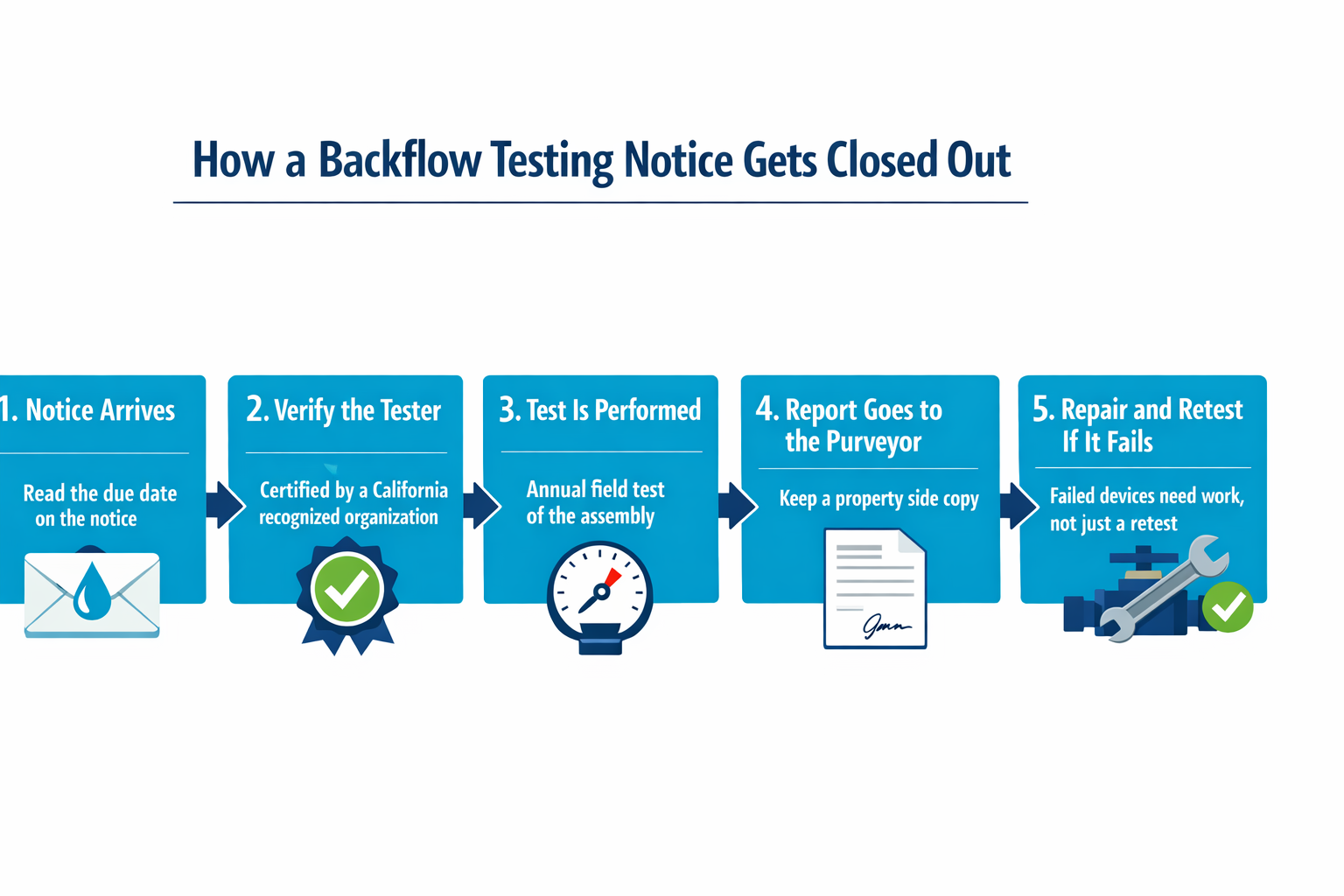
How a Testing Notice Gets Opened and Closed
The sequence is the same whether you own one building or six. Knowing the order keeps you from guessing at what comes next.
Build Your Assembly Inventory Before the Notice Shows Up
A lot of owners honestly do not know how many backflow assemblies they are responsible for. I get versions of that question regularly, and it comes up most with people running more than one property.
A motel owner with two buildings on different streets, or a contractor finishing a restaurant build out in Watsonville, can easily be carrying several assemblies without a single list anywhere.
Walk the property once and look in the usual spots:
- The irrigation connection at or near the water meter, which is the most common one on both homes and commercial lots
- A dedicated landscape service, common on Santa Cruz County commercial parcels with separate irrigation meters
- Process or equipment connections inside a restaurant kitchen, a motel laundry, or a mechanical room
- Boiler feed or chemical feed lines where non-potable water could be pulled back toward the clean supply
- Any connection a previous owner added that nobody wrote down
Photograph the tag on each one. The serial number, model, and size are all right there, and having that photo on file turns a ten minute phone call into a thirty second answer later.
If you want a plainer walk-through of the residential side of this, here is how to tell whether your irrigation backflow preventer still works.
What You Control and What the Water Department Controls
This boundary is where most of the confusion lives, so let me lay it out plainly.
The public water system owns the cross-connection control program. They do the hazard assessments, they send the notices, they keep the official records, and they decide which testers they will accept.
The assembly on your property belongs to you. You pay for the testing, the repairs, and the replacement, and you have to use a tester the water system will accept.
Fall is a good time to sort this out on the Central Coast. Irrigation gets dialed back once the rain starts, and a failed assembly on an idle line can sit unnoticed until spring startup, which is a rough time to discover the device needs replacing.
Also worth knowing: purveyors across Santa Cruz County and Monterey County each run their own program with their own due dates. Two properties a few miles apart can be on completely different schedules, so read the date on the notice rather than assuming a calendar year deadline.
And if a device fails, it usually needs repair or replacement before a retest will pass. A retest alone does not fix a worn check valve or a leaking relief valve.
One more honest note. I do not have reliable information on how each individual water department here handles a late report, and I would rather tell you that than guess. Call the water department named on your notice and ask them directly.
Frequently Asked Questions About Backflow Tester Certification in California
Does a licensed plumber automatically qualify to test my backflow assembly?
No. A plumbing license and a backflow assembly tester certification are two different things. The person performing and signing the annual test has to be certified by a certification organization recognized in California, which is separate from any contractor license they hold.
How often does my backflow assembly need to be tested?
The Cross-Connection Control Policy Handbook calls for annual field testing of backflow prevention assemblies. Your specific due date comes from the water purveyor that serves your property, which is why neighbors on different systems can be on different schedules.
What happens if my assembly fails the test?
A failed assembly needs repair or replacement, not just another test. Depending on the device, that can mean rebuilding internal check valves and the relief valve, or replacing the assembly outright if it is old or the parts are no longer available. Once the work is done, a follow-up test closes out the notice.
I manage several properties. Where do I start?
Start with an inventory, not a notice. Walk each property, find every field testable assembly, photograph the tag so the model and serial number are on file, and note the location. That one afternoon makes every future notice a scheduling task instead of a scavenger hunt.
Is backflow testing something I can do myself?
Not if you want the report accepted. The test requires calibrated gauges and a certified tester, and the water system will only take a report from someone certified by an organization it recognizes. Backflow is one of those areas where code decides the answer before preference does, similar to whether a heat pump water heater will even fit where your old tank sits.
My water use is high but the irrigation is off. Is the backflow device leaking?
It might be, especially if the relief valve is discharging. But steady water use with everything shut off can also point underground. Warm floors, a running water sound, and a spiking bill are classic slab leak signs worth ruling out.
Questions About Your Backflow Testing Notice?
We handle backflow preventer installation, replacement, and annual testing along with the documentation that answers a water authority notice, for properties throughout Santa Cruz County and Monterey County. The record keeping habit is the same one customers describe on everyday jobs, like this one from Karen M: “Jorge responded very quickly to my requests and provided clear details in the estimates. I appreciated that he sent pictures of the plumbing repairs and installation to me even when I didn’t specifically request them.” If you want to talk through what is on your notice, Maverick Plumbing can be reached at (831) 515-9903.
